Key Takeaways
- Common custom Tritan bottle FOB China pricing runs about USD 1.20-3.80 per unit at 3,000-10,000 pcs, depending on size, lid, print, and packaging
- Typical MOQ is 1,000 pcs for existing molds and 3,000-5,000 pcs for color-customized or fully customized canteen programs
- New mold development usually adds USD 2,500-8,000 and 20-35 days before mass production starts
- A realistic first-order timeline is 35-60 days from sample approval to vessel departure from Zhejiang, China
You can pull ten tritan bottle quotes in one afternoon and still not know which one is usable. One factory says USD 1.48, another says USD 2.35, and both stamp the same line: “food-grade, BPA-free, fast delivery.” The number only starts to make sense when you break it down: resin grade, mold cavities, lid structure, print method, carton spec, and whether the price is FOB Ningbo or ex-works Zhejiang. We have seen buyers sign on the lowest quote, then find the lid tooling added USD 0.18 a unit after the PO typo was caught at order review. That is where the margin gets hit.
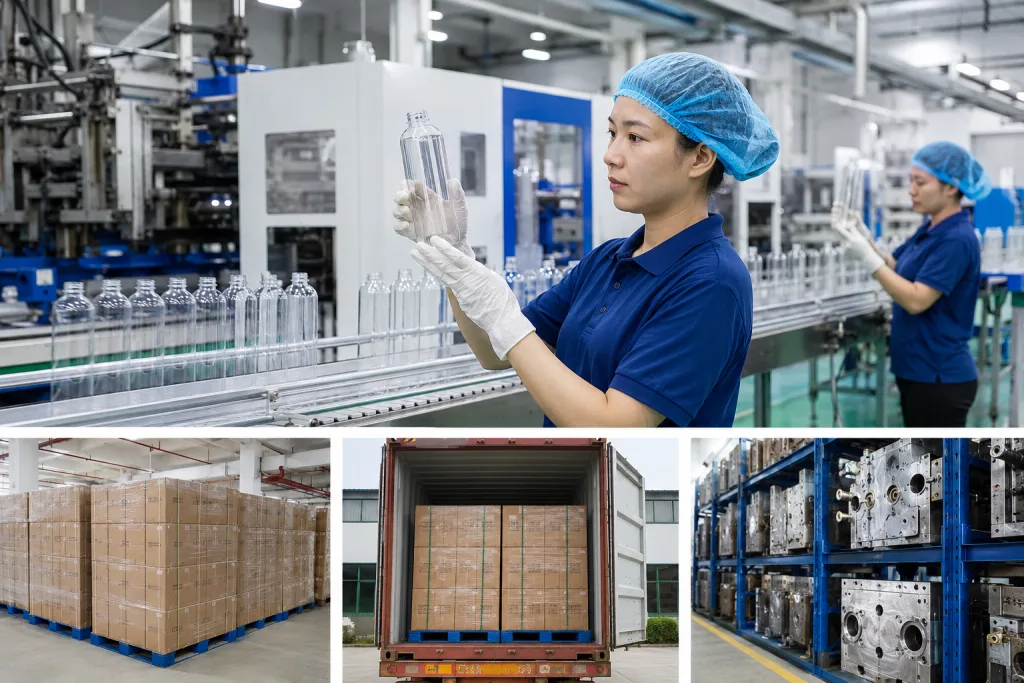
For buyers in Europe and North America, the real questions are plain: what does a manufacturers tritan bottle project cost, what MOQ works, and how many days before cargo leaves China? BottleForge Industrial in Hangzhou, Zhejiang runs about 600,000 units a month, and the same pattern shows up again and again on the line. If you know the cost stack and the lead time, you can compare a canteen factory, canteen supplier, or distributor drinkware partner without guessing. QC pulled the sample at 24 hours, and the cap torque was off by 0.6 N·m on the first run. That kind of detail matters more than the headline quote.
Where Tritan bottle pricing really moves
The biggest mistake buyers make with manufacturers tritan bottle sourcing is treating all 700 ml bottles as equal. They are not. A plain single-wall Tritan body with a PP screw lid and one-color silkscreen can land at USD 1.20-1.65 FOB Ningbo at 5,000 pcs. Swap in a leakproof flip-top with lock ring, silicone seal, carry handle, and tea strainer, and the same body can move to USD 1.95-2.80. Add retail box packaging and you may be at USD 2.20-3.10 before freight. We ran that comparison on the line last month; the buyer flagged the lid, not the bottle.
The body cost is mostly driven by resin weight. For a typical 700 ml bottle, you are looking at roughly 140-190 g Tritan depending on wall thickness, usually around 2.0-2.8 mm. A lighter gym bottle may save USD 0.08-0.15 per unit, but if the base flexes or the sidewall panels oil-can during dishwashing tests, the savings do not hold. QC pulled the sample after a 65°C wash cycle because the bottom ring moved. Good canteen manufacturers in China will tell you the exact bottle weight, lid weight, and resin family up front.
Decoration is the next swing factor. One-color silkscreen might add USD 0.05-0.12. Two-color print often reaches USD 0.10-0.18. Heat transfer can add USD 0.18-0.35. Wrap printing, soft-touch coating, or metallic effect can push higher and extend lead time. A PO typo on a 5,000 pc order once changed the print area from 180 mm to 280 mm, and the math did not work anymore. If you need a canteen promotional run for events, keep decoration simple and use an existing mold. If you need shelf appeal for retail, pay more attention to cap feel, clarity, and print adhesion than chasing the lowest opening quote.
- Body resin and weight: usually 35-45% of ex-factory cost
- Lid assembly: often 20-30% of cost on feature-heavy designs
- Decoration: 3-15% depending on process
- Packaging: from USD 0.06 for polybag to USD 0.45+ for printed gift box
If you are also comparing a custom growler or customizable growler project, remember Tritan bottles compete on weight and impact resistance, not insulation. We see buyers ask the wrong question here. A 304 stainless growler and a Tritan bottle do not share the same cost stack, and the spec sheet should not pretend they do.
MOQ tiers that change your unit economics
MOQ is not a random hurdle. It is the point where a Tritan bottle line can batch resin, hit a stable color, run cap assembly, and fill cartons without wasting labor. On our line, the 500 pcs request often dies at the packing table. For existing molds, Zhejiang factories can start at 1,000 pcs per style, and stock colors or blank goods sometimes go down to 500 pcs. Once you add custom lid color, logo print, barcode label, and export carton mark, the real MOQ usually lands at 1,000-3,000 pcs.
For a custom Tritan bottle program with a unique Pantone body and lid, these are the tiers we actually quote:
- 1,000 pcs: workable on an existing mold, one or two colors, basic print, fewer packaging choices
- 3,000 pcs: better resin batching, less scrap risk, unit price often drops by USD 0.10-0.25
- 5,000 pcs: the common sweet spot for retail-ready drinkware with inner box and master carton
- 10,000 pcs+: where mold amortization and decoration setup start to make sense
If you are a Tritan bottle distributor building a private-label line, do not try to force a 500-piece launch on a design that needs 3,000 pcs. The math does not work. We have seen buyers push for it, then the carton mix, color changeover, and hand packing eat the margin. If you are testing a market, a stock-body and custom-logo setup is the cleaner move. Many Chinese suppliers can give you 2 or 3 cap options on the same bottle body, so you can build a line without opening multiple molds.
Ask every manufacturer the same MOQ questions: MOQ for blank units, MOQ by color, MOQ by logo, MOQ by inner box, and MOQ for barcode or FNSKU application if Amazon FBA is in play. One PO typo on carton marks can turn into a rework order. For distributor programs, MOQ discipline matters more than the headline price, because slow stock costs more than a 6-cent unit saving.
Tooling, samples, and one-time charges
Not every manufacturers tritan bottle order needs fresh tooling. If your shape can run on an existing mold, you pay for samples and decoration setup only. That is the faster path for custom canteen or customized canteen jobs. On our line, an existing-mold pre-production sample usually lands at USD 30-100 a piece, and we often credit it back after the order. A printed pre-production sample with exact Pantone matching can run USD 50-150 and usually takes 5-10 days.
New mold jobs are a different math problem. A Tritan bottle body mold often lands around USD 2,500-5,500, depending on size and cavity count. A lid with moving parts, lock features, or an integrated straw system can add another USD 1,500-3,000. We have seen buyers push for one lid across two bottle sizes; that works if the neck finish stays consistent, because it cuts duplicate tooling and keeps the line simpler.
Typical one-time cost ranges
- Body mold: USD 2,500-5,500
- Lid mold: USD 1,500-3,000
- Silkscreen screen charge: USD 20-50 per color/art position
- Heat transfer set-up: USD 80-200
- Color matching / material trial: sometimes USD 50-150
- Drop test or special compliance test: USD 150-500 if outsourced
Good canteen vendors will tell you who owns the mold, whether it is exclusive, where it sits, and what maintenance terms apply. Put that in writing. QC pulled a sample last week with a 0.3 mm parting-line flash, and that is the kind of detail that tells you whether the factory is honest about tooling. If you are sourcing from China for Europe, ask for REACH and food-contact paperwork on the Tritan grade and colorants. For North America, ask what testing they can support against FDA contact requirements and whether ASTM-related physical test protocols are already in use. The wrong question is, "Can you make it cheap?" The right one is, "Who carries the tooling risk when the PO says one thing and the mold says another?"
Cheap tooling usually shows up later as flash lines, lid mismatch, leakage variation, or unstable dimensions between production lots.
Lead times from inquiry to vessel booking
Lead time only makes sense when you split it into stages. A “25 days” quote usually covers mass production only. It does not cover artwork sign-off, sample making, lab tests, or the vessel slot. For a first custom drinkware order out of Zhejiang, China, build the full calendar.
Stage 1: Quotation and technical confirmation. Usually 2-5 days when the brief is clean. Send capacity, target market, printing method, packaging standard, and compliance needs. If the buyer writes “need custom bottle ASAP,” we can only give a soft quote. That is the wrong question to ask.
Stage 2: Sampling. Existing mold samples take 5-10 days. New mold prototype and T1/T2 samples can take 20-35 days. On the line, QC pulled a 550 ml Tritan sample and found the cap torque off by 0.3 N·m, so the handoff went back one round. If color approval needs physical chips by courier, add 3-5 days each way.
Stage 3: Material prep and mass production. Standard existing-mold orders run about 20-30 days after sample approval and deposit. More complex customized growler or customized drinkware packs with gift boxes can reach 30-40 days because the print shop and carton supplier run on their own schedule. BottleForge typically quotes 25-35 days for a 3,000-10,000 piece Tritan run, depending on cap type and finish. The math does not work any other way.
Stage 4: Inspection and shipping release. Plan 2-4 days for final random inspection under AQL, rework if needed, and booking release. If you use AQL 2.5/4.0 for major/minor defects, tell the factory before production starts, not the day before inspection. We have seen that go sideways on a PO with a typo in the carton count.
Stage 5: Port and transit. Trucking from Hangzhou to Ningbo is usually 1-2 days. Ocean transit to Western Europe commonly runs 30-40 days; to East Coast North America 25-35 days; to West Coast 15-25 days, port congestion aside. A container booking can slip on a Friday cut-off by a full week. That one hurts.
If you are a canteen distributor, distributor growler buyer, or canteen vendor planning seasonal launches, work backward at least 90 days from the in-warehouse date. That is not conservative. It is normal.
Quality checks that protect landed cost
The cheapest bottle turns into the most expensive shipment once leakage claims, Amazon returns, or retail penalties hit the file. For manufacturers tritan bottle orders, ask for a control plan before deposit. We want to see what gets checked at IQC, on the line, and at final inspection. A serious canteen manufacturer in China should already track dimensions, lid torque, leakage, print adhesion, and carton drop performance. We pulled one sample last month with a 0.6 mm neck variation, and that kind of miss will bite you later.
At final inspection, practical checkpoints include:
- Leak test: 100% or sampling with inverted hold, usually 30 minutes to 2 hours depending on spec
- Print adhesion: cross-hatch or tape test after curing
- Dishwasher or heat resistance: if claimed, define cycle count and temperature
- Odor and contamination: especially for colored lids and silicone seals
- Carton integrity: burst strength, drop test, and pallet pattern if required
For large runs, put the AQL standard in the PO. We see buyers use AQL 2.5 for major defects and 4.0 for minor ones. This is the wrong question to ask if the brief is vague. If your sales channel is premium retail, tighten cosmetic standards around black specks, flow marks, gate blush, and logo registration. If your channel is canteen promotional, you can allow more minor appearance variation in exchange for lower cost and faster turnaround. QC pulled the sample on a 24-hour water hold, and the lid passed only after the gasket was swapped.
Ask the factory what management systems are in place. ISO-based process control, BSCI social compliance, and lot traceability are not magic, but they cut the odds of a bad surprise. We have seen buyers save USD 0.07 per unit by moving to an unknown canteen factory in China, then lose USD 0.40 per unit in relabeling, repacking, and replacement stock. The math does not work. Landed cost is what matters. If you are a canteen distributor or working with canteen distributors, quality discipline protects both your margin and your reputation. One PO typo on a carton mark can turn a clean run into a slow, expensive mess.
How to quote apples to apples
If you want clean comparisons across canteen suppliers, send one RFQ sheet and make every canteen factory answer in the same format. Put the same numbers on the page: bottle capacity, net weight, material spec, seal material, decoration method, packaging, carton quantity, carton size, FOB port, tooling cost, sample lead time, production lead time, and compliance documents available. We see this go sideways all the time. One supplier quotes a bare bottle in a polybag, another quotes a customized canteen in a printed box with a spare gasket, and the buyer flags the cheaper line item without seeing the real landed cost.
A useful RFQ for customizable canteen or custom growler sourcing should include these minimum details:
- Capacity: 500 ml, 700 ml, or 1,000 ml
- Body material: Eastman Tritan or equivalent approved spec
- Lid construction: PP, ABS, Tritan, silicone gasket, straw if any
- Color standard: Pantone code or stock color
- Logo method: 1-color silkscreen, UV print, heat transfer, laser on metal part
- Packaging: egg-crate, white box, color box, PDQ, or master carton only
- Incoterm: EXW, FOB Ningbo, or DDP target warehouse
Then ask one hard question: what drops out if I simplify this spec? Good canteen vendors will answer fast. The math does not work any other way. On our line, a metal carry loop can add USD 0.18 and 5 days; a window box and inside card can add USD 0.22 and 7 days; moving from two print positions to one may save only USD 0.03, which is not worth the weaker shelf read.
That is how experienced distributor drinkware buyers work with a canteen supplier in Zhejiang or elsewhere in China. They do not chase the first low quote. They isolate each cost driver, check the PO for packaging typos, and lock a spec the factory can repeat over 3,000 or 30,000 pieces without drama. That is the only workable route to scalable customized growler, custom canteen, and custom drinkware programs.
Get a concrete Tritan bottle quote, not a vague range
Send your target capacity, lid style, logo method, MOQ, and delivery date. We will break down tooling, unit cost, and lead time line by line.
Frequently asked questions
What is a realistic FOB price for a custom Tritan bottle from China?
For an existing mold, single-wall Tritan bottle with basic PP lid and one-color logo, a realistic FOB China range is about USD 1.20-1.65 at 5,000 pcs. Add a more complex lid with lock, strap, or straw, and the range often moves to USD 1.90-2.80. Printed retail box packaging can add another USD 0.18-0.45. At 1,000 pcs, expect pricing to be roughly 8-20% higher than a 5,000-piece run. If a quote is far below market, check whether it excludes packaging, leakage testing, or uses lighter bottle weight than your target spec.
How long does a first custom order usually take?
If you use an existing mold, allow about 5-10 days for samples, 20-30 days for production after approval, and 2-4 days for inspection and release. That gives a practical 30-45 day factory timeline before ocean transit. If new tooling is required, add around 20-35 days for mold making and T1/T2 sample approval. For buyers in Europe or North America, total project timing from first payment to arrival can easily be 60-95 days depending on port congestion and your packaging complexity. Buyers sourcing from Zhejiang, China should always build in a buffer for artwork approval and final carton confirmation.
What MOQ should I expect for a customized Tritan bottle?
For stock colors and no decoration, some factories can accept 500-1,000 pcs. For a proper customized drinkware order with Pantone body color, logo print, and export packaging, 1,000-3,000 pcs is the usual starting point on existing molds. If you need exact retail packaging, multiple print positions, or special cap colors, 3,000-5,000 pcs is more realistic. New mold projects are usually more economical at 5,000 pcs and above, even if the factory says it can start lower. MOQ should be confirmed separately for bottle color, lid color, logo, barcode label, and gift box because each has its own set-up logic.
Do I need to open a new mold for my brand’s shape?
Only if your design cannot be achieved with an existing bottle and lid platform. Many buyers can save USD 2,500-8,000 in tooling by choosing an existing body and customizing color, lid, strap, and decoration. If you want a distinctive profile for retail or IP protection, new tooling may be worth it. A new bottle body mold often costs USD 2,500-5,500, while a complex lid may add USD 1,500-3,000. Before approving tooling, ask for 2D/3D drawings, cavity plan, ownership terms, expected mold life, and sample timeline. A shared lid platform across two bottle sizes usually improves long-term economics.
What compliance and quality documents should I ask for?
For Europe, ask for REACH-related material declarations and food-contact support documents relevant to the product configuration. For North America, request food-contact compliance support for the materials used, plus any test reports the factory already holds for similar items. On quality, ask for your inspection standard, often AQL 2.5/4.0, leakage test method, print adhesion test, and carton drop test records. If the supplier has BSCI or ISO-based process controls, that helps but should not replace product-level checks. For Amazon or distributor channels, also confirm FNSKU labeling capability, master carton dimensions, and lot traceability in case claims occur.