Key Takeaways
- For a 20 oz stainless tumbler, define 18/8 inner wall, 0.4 mm outer wall, and vacuum retention target like 6+ hours hot at 60°C minimum
- Leak issues often come from lid and silicone tolerance drift; require 100% vacuum test and AQL 2.5 final inspection on sealing parts
- Decoration cost can swing by USD 0.12-0.65 per unit depending on silk screen, powder coat, laser engraving, or wrap printing
- Realistic MOQ for custom travel tumbler projects is often 1,000-3,000 pcs per color, with 25-35 day lead time from Zhejiang, China
You usually spot a bad travel tumbler after the first carton arrives wet, after a distributor sample shows a logo scuffed at the lip, or after a buyer measures the base and finds it misses a car cup holder by 3 mm. The issue is not picking a nice-looking cup from a catalog. When you source from manufacturers travel tumbler suppliers, the failure usually starts in the spec sheet, not on the line.
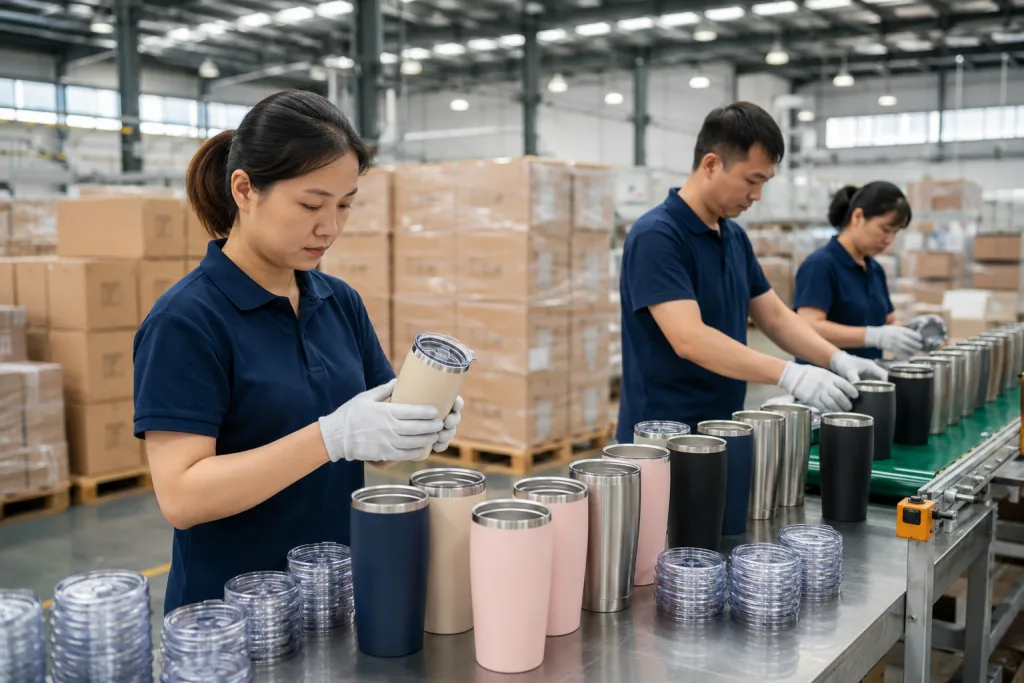
If you buy for a coffee brand or a corporate-gift program, the tumbler has to survive shipping, daily use, and compliance review without noise. At BottleForge Industrial in Hangzhou, Zhejiang, we run drinkware production in China at up to 450,000 units per month, and the same faults keep coming back. QC pulled a sample last week with a PO typo on the artwork position, and that kind of miss turns into scrap fast. Write the PO around failure modes: where it leaks, dents, rusts, prints badly, or blows the target cost by USD 0.40 per unit. That is the right question to ask.
Where most tumbler projects fail
Buyers often start with the wrong question: What is your best price? Price matters, but it is not the first control point. For a bulk travel tumbler or bulk coffee mug program, the real question is what can fail between sampling and final delivery. We have seen a 12-day sample turn into an 18-day rework cycle because the lid thread pitch was never locked. If you do not define those points, the factory fills in the blanks with its standard practice, and standard practice may not match your market.
For coffee brands, the common failure is the gap between brand promise and actual product feel. A matte coated body that looks premium online can chip when it rubs against carton partitions; we tested one lot with a steel wool rub and the coating opened up at the shoulder in 30 seconds. A slider lid may feel fine on a desk but leak in a commuter bag. For corporate-gift buyers, the usual problem is consistency: 5,000 units land, but the logo placement varies by 3-5 mm, gift boxes crush in transit, and one colorway arrives glossier than the approved sample.
When dealing with a coffee mug manufacturer or coffee mug factory in China, split the project into six technical risks:
- body material and thickness
- vacuum insulation performance
- lid fit and leak control
- decoration adhesion and color control
- packaging compression strength
- compliance and inspection standards
At the RFQ stage, ask for a controlled specification instead of a picture quote. You want material grade, dimensions, net weight tolerance, finish process, print method, test standard, carton drop standard, and inspection AQL. One PO typo can break the whole run; we once saw a buyer write 304 as 201 on the order, and QC pulled the sample before the line started. If a coffee mug supplier directory or coffee mug supplier list gives you ten possible factories, this is how you narrow them down fast. The suppliers that answer clearly are usually the ones that can mass-produce clearly.
Thin walls, dents, and false economy
The fastest way to make a tumbler quote look good is to pull steel out of it. On a 20 oz double-wall vacuum tumbler, the normal spec is 304 stainless steel, also called 18/8, for the inner wall. We run 0.4 mm inner wall and 0.4 mm outer wall for standard production, and 0.5/0.5 mm when the buyer wants a heavier retail feel. That is the real comparison.
Drop the outer wall to 0.3 mm and you save a few cents. The math does not work for sea freight. Cartons get stacked, bands bite in, and dent claims start showing up on arrival. QC pulled the sample on one line last month and the buyer flagged it at once: the hand feel was thin, and the shell rang too light. If the inner wall slips from 304 to a lower grade without disclosure, tea staining, odor retention, and corrosion risk show up fast in daily use.
What to specify
- Material: 304 inner, 201 or 304 outer only if disclosed
- Thickness: state inner and outer wall separately
- Weight tolerance: for example 285 g ± 10 g
- Base diameter and height tolerance: for cup-holder fit and retail packaging
- Powder coat thickness if used: commonly 60-80 μm
For coffee mug custom made projects, ask the factory to cut open one approved golden sample and record the build. We have seen this go sideways when the buyer approved one 0.4 mm sample, then mass production came out of another line with lighter gauge steel. A PO typo on the approved BOM can cause the same mess. In Zhejiang, that is easy to avoid if the golden sample, wall thickness, and drawing are tied together in writing.
Factory-direct pricing means little if 3% of units arrive dented and you have to rework or discount them.
If you are comparing a coffee mug factory direct quote with a trading company offer, check whether both include the same steel grade and wall thickness. A USD 2.85 FOB quote and a USD 3.18 FOB quote are not the same product if one cuts the shell by 0.1 mm. We ship enough of these to know where the false economy starts.
Vacuum loss and poor heat retention
If a travel tumbler cannot hold coffee hot, it fails the job. Vacuum loss usually starts at two spots: an unstable weld at the bottom seal, or handling after evacuation that cracks the vacuum. We see the lot split fast. One unit still holds heat after 6 hours; the next feels warm on the outside in 30 minutes.
For a coffee mug oem manufacturer, the control point is process testing, not a clean outer shell. Ask how vacuum is checked. A factory with discipline will run a 100% vacuum check on the line, then do model-based thermal retention tests. For a 20 oz tumbler, a working target is 95°C hot water, then at least 60°C after 6 hours at room temperature around 20-25°C. For cold retention, some buyers ask for ice hold or anti-sweat performance, but the hot test is easier to keep consistent. QC pulled the sample, and that is where the truth shows up.
Do not over-spec the product if your market does not need it. A corporate gift program may not need 12-hour hot retention if the budget ceiling is fixed. The math does not work. Set a clear minimum anyway. Without that line, you have no objective basis to reject weak goods when the buyer flags it later.
Questions worth asking
- Is vacuum tested 100% or by sampling only?
- What is the stated hot retention standard and test condition?
- Is the bottom plug laser welded or only covered with glue for appearance?
- Will the factory share vacuum defect rate from the last three runs?
If you buy coffee mug in bulk for Amazon FBA or for a coffee mug distributor channel, thermal consistency drives returns faster than print defects do. A unit can pass carton checks and still fail in use. We have seen this go sideways on a 2,000-piece order because the PO typo said 18 oz while the buyer expected 20 oz. A serious quality plan checks function before shipment, not just carton count and logo placement.
Lids leak long before steel fails
The body gets most of the attention, but the lid is where the complaints start. We have seen a tumbler pass drop tests and finish checks, then fail because the slider will not seat, the thread starts crooked, or the silicone ring shrinks after two dishwasher cycles. On a bulk travel mug order, lid tolerance is where a cheap substitution does real damage.
Specify the lid by structure, not by photo. Is it press-fit, screw-on, or flip-top? Is the slider splash-resistant or leak-resistant? A lot of promotional tumblers ship with lids that are fine on a desk and useless in a bag. If your sales team says leakproof and the lid is only splash-resistant, the buyer flagged it, and the complaint lands on you. That is the wrong question to ask.
For silicone parts, call out food-contact grade silicone and ask for REACH and LFGB testing where they apply. Hardness matters too. We run better seals around 50-60 Shore A than with parts that are too soft or too hard, though the groove design still decides the final result. If the program is above 10,000 units, state whether spare gaskets are packed in the carton.
Minimum lid controls
- Leak test orientation and duration, such as upside down for 30 minutes
- Torque or insertion standard for assembly
- Color matching if the lid is tinted or custom molded
- Dishwasher warning or care mark if print cannot tolerate heat
For coffee mug customized or coffee mug customizable programs, a custom lid color can add 7-12 days if the mold insert changes or the color chip misses the target. The line has seen this drag a launch from 12 days to 18 days. If the order has a fixed event date, keep the existing lid platform and put the custom work on the body finish instead. The math works better that way.
At final inspection, use AQL 2.5 for major defects and AQL 4.0 for minor defects as a baseline. Leakage is a major defect at minimum. On retail programs, it is close to critical, and QC pulled the sample fast when we saw one lid weep after an inverted hold test.
Decoration fails under real use
Most buyers underestimate how fast decoration quality separates a tumbler that ships clean from one that comes back with claims. We run silk screen, heat transfer, laser engraving, UV print, and powder coat with logo application on the line, and each method has its own cost and wear profile. On a standard 20 oz model, a one-color silk screen print may add around USD 0.12-0.18 per unit. Laser engraving may add USD 0.20-0.35. Full wrap or complex multicolor decoration can push the increase to USD 0.45-0.65. That is the math, and it does not care about brand mood boards.
The wrong method fails fast. QC pulled the sample last month and found silk screen over a low-energy powder surface could chip after a short rub, while fine lines under 0.25 mm started to close up on curved walls. Metallic colors also drift when the varnish stack changes. For coffee mug custom or coffee mug private labeling programs, ask for a cross-hatch tape test and a rub test with alcohol if the artwork has small text or thin strokes.
Color control matters more than many new buyers expect. If the brand color has to match, specify the Pantone reference and set the acceptable delta against the approved pre-production sample. You will not get offset-print precision on every curved metal body, but you can control deviation. We had a buyer flag a PO typo once because the logo placement was drawn 3 mm off-center instead of the approved ±2 mm window. That is the kind of miss that shows up on the first carton.
For a coffee mug promotional order, the temptation is to save money by moving from powder coat to plain spray paint. That is the wrong question to ask. Powder coat gives better abrasion resistance and a cleaner hand feel, especially for North America and Europe gift channels. If cost is the issue, simplify the decoration area before you downgrade the finish. On one run, a 150 ml paint cup showed edge wear after carton rub testing in under 12 minutes, and the buyer did not accept the trade.
Buyers looking through a coffee mug supplier list often compare decoration prices only. Compare rework risk too. The cheapest print line is expensive if 8% of units need manual sorting because the logo drifts, and we have seen that go sideways on a 5,000-unit run. Ask for the scrap rate, the inspection method, and the actual MOQ for a redo before you treat the quote as final.
Packaging that collapses in transit
You can build a solid tumbler and still lose margin through bad packaging. We see the same failures on the line: white boxes crushed at the corners, inserts that leave 3-5 mm of play, and export cartons with weak burst strength that fold in a stack. For coffee mug bulk and bulk coffee travel mug orders, transit damage is one of the easiest costs to avoid.
Start from the channel spec. For e-commerce, a nice gift box is not enough; the pack has to survive parcel drops and belt transfers. For a coffee mug distributor or coffee mug distributors supplying retail stores, pallet stability and master carton labels often matter more than the retail sleeve. For FBA-type shipments, carton dimensions, FNSKU labeling, and barcode scan quality need to be locked before production starts, not after the PO is signed.
Practical specs usually mean an individual polybag or tissue wrap, a molded pulp or EPE insert, and a 5-layer export carton. On 30 oz tumblers, we often see buyers move to 6-layer cartons or cut the pack-out count per carton to keep burst and corner crush under control. A common outer carton drop test request is 76 cm on one corner, three edges, and six faces. The test is simple. The result tells you if the pack will survive the truck.
Ask for carton gross weight under 15 kg if manual handling is frequent. Set the carton marks, pallet pattern, and whether corner boards and stretch wrap are required. We had one buyer flag a PO typo on the pallet count, and the warehouse loaded it wrong for a week. Details like that matter when you buy coffee mug in bulk from China, because ocean transit and destination warehousing are rougher than sample shipping suggests.
At BottleForge in Zhejiang, we usually push new buyers to spend USD 0.08-0.15 more per unit on protective packaging if the item is matte black or has a soft-touch finish. The math works. We checked one 30-day sea shipment last season and the scuff rate on soft-touch cups was enough to wipe out the carton savings. Spend the cents before you spend the dollars.
Compliance gaps and weak inspection plans
The last failure mode is administrative, but it drives the worst disputes: the goods pass a visual check, then stall at retailer review or your own compliance gate. For Europe and North America, travel tumblers need a clean material declaration and food-contact support that matches the market. In practice, that can mean REACH screening, LFGB or FDA-related food-contact testing, and CPSIA or ASTM review if the item is sold for children. If the program is not for kids, do not load the file with random tests. Ask for the ones the buyer will actually review.
Social and quality-system checks matter too. We see buyers ask for BSCI, Sedex, or ISO 9001 from the cup factory before they even talk pricing. Those papers do not guarantee a clean shipment, but they do cut out weak suppliers when you are comparing a coffee mug supplier or coffee mug manufacturer in China. QC pulled one sample last month with no traceable batch card, and that file died on the spot.
Your purchase order should connect paperwork to inspection. For a first run, the sequence that works is: pre-production sample approval, inline inspection at 20-30% completion, final random inspection to ANSI/ASQ Z1.4 with the agreed AQL, then document review before balance payment. On custom logo jobs, keep one sealed golden sample with signed artwork and packaging standard. We have seen this go sideways when the buyer flagged a PO typo on the carton mark and the line printed 5,000 wrong boxes.
- AQL 2.5 major / 4.0 minor is common for standard drinkware
- Critical defects should be zero tolerance
- Vacuum loss, sharp burrs, and missing compliance marks should be treated seriously
If you are new to a coffee mug supplier directory and trying to shortlist factories, ask one direct question: What defects do you classify as critical, major, and minor for this model? That is the wrong question to avoid. A polished website tells you nothing. A serious coffee mug private label partner will already have that list, and they will answer without bluffing because they have dealt with the same 3 defect buckets on the line before.
Send your tumbler spec for a blunt feasibility check
Share capacity, target price, logo method, and market. We will flag likely failure points, MOQ, and lead time before you commit to tooling or a PO.
Frequently asked questions
What MOQ should I expect for a custom travel tumbler order?
For a standard 20 oz stainless travel tumbler with custom logo, realistic MOQ is usually 1,000 pcs per colorway and 3,000 pcs if you want a new body mold or custom lid tooling. Some stock models can start at 500 pcs with one-color print, but unit cost rises fast. In Zhejiang, China, most factories quote lower prices only when you hit carton-efficient volumes such as 2,000-5,000 pcs. If you need coffee mug custom made packaging, add MOQ for boxes as well, often 1,000 pcs per design. Always ask whether MOQ applies per SKU, per color, or per artwork. That detail changes the landed cost a lot.
What is a normal lead time from sample approval to shipment?
For a repeat model with existing lid and body, allow 25-35 days after deposit and artwork approval. If you add a custom mold, new pantone-matched lid, or complex coffee mug customized print, 35-50 days is more realistic. Pre-production sample time is often 5-10 days for standard decoration and 10-15 days if packaging is also custom. During peak season from August to November, some China factories need an extra 7-10 days. Do not book vessel space based only on the sales quote. Confirm whether lead time includes lab testing, carton approval, and final inspection buffer. Those three items are where schedules usually slip.
How do I compare quotes from different coffee mug manufacturers fairly?
Put every supplier on the same technical sheet. Ask for steel grade, wall thickness, capacity, net weight, finish, lid type, print method, packing, FOB port, and testing included. A quote of USD 2.90 FOB Ningbo and another at USD 3.25 FOB Shanghai may actually become the same once you align 304 inner steel, 0.4/0.4 mm walls, powder coat, and a leak-resistant lid. Also check whether the quote includes spare parts, barcode labels, and drop-tested export cartons. Many coffee mug factory direct offers look cheap because they exclude packaging upgrades or use lighter steel. Without a normalized RFQ, you are not comparing suppliers; you are comparing assumptions.
Which print method is best for corporate gifts versus retail coffee brands?
For corporate-gift orders under tight budgets, one-color silk screen on powder coat is usually the most cost-effective choice at roughly USD 0.12-0.18 extra per unit. For retail coffee brands, laser engraving or more durable decoration is often worth the added USD 0.20-0.35 because the logo stays sharp through heavier use and looks more premium. If you need full-color wraps for coffee mug promotional products, expect higher reject risk and a decoration uplift around USD 0.45 or more. The right choice depends on use cycle. A conference giveaway used for three months needs a different print strategy from a private-label tumbler meant to sit on shelf for a year and in daily use after that.
What quality documents should I ask from a coffee mug supplier before placing a PO?
Ask for business license, factory audit status such as BSCI or Sedex if required, ISO 9001 if available, and product-specific test reports relevant to your market. For Europe, that often means food-contact support and REACH-related declarations. For North America, ask for material safety support aligned with your retailer or program needs. Also request a written QC flow: incoming inspection, inline checks, vacuum test method, leak test standard, and final AQL plan. If the supplier cannot provide a defect classification table for your tumbler model, that is a warning sign. Good documentation will not replace inspection, but it tells you the coffee mug supplier has a repeatable system instead of improvising every order.