Key Takeaways
- For a 20 oz double-wall 18/8 tumbler, FOB China pricing often lands at USD 2.80-4.60 at 3,000 pcs, depending on lid type and decoration
- A realistic MOQ for custom travel tumblers is 1,000 pcs per color, while private label packaging usually adds 7-12 days
- 304 stainless inner wall at 0.4 mm with copper coating and vacuum insulation typically gives 6-12 hours hot retention in normal use
- Use AQL 2.5 for major defects, require REACH and LFGB or FDA declarations, and define leak testing before mass production
You usually do not get burned buying a custom tumbler because the render was off. The trouble starts when one line on the spec sheet is loose: body material, lid leak standard, print method, carton drop test, or the capacity tolerance. That is where a program slips, costs move, and complaints land on the buyer’s desk. For a coffee brand or a corporate gift launch, the spec sheet beats the sales pitch every time.
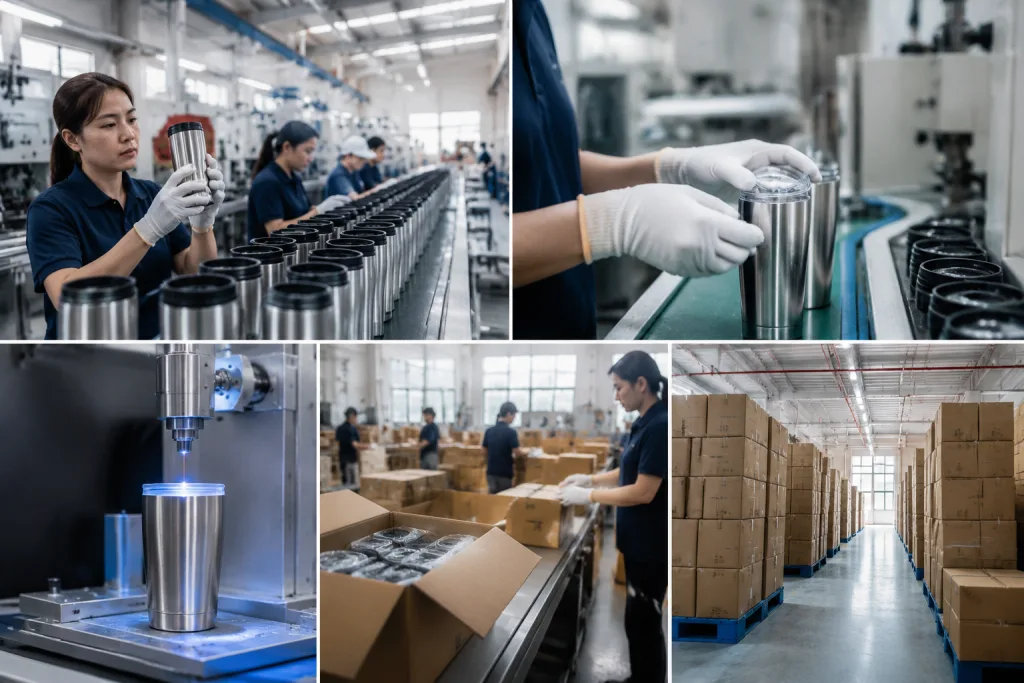
At BottleForge Industrial in Zhejiang, China, we run travel tumblers for buyers who need the same result on every batch, not one nice sample from the showroom shelf. Our line ships about 450,000 units a month, with MOQ from 1,000 pieces per color and lead times of 25 to 35 days. QC pulled the sample on a 2 mm lid gap before packing, and that is the kind of check that saves a PO with the wrong print code from getting expensive. If you are new to China sourcing, read the tumbler spec line by line. That is the right question to ask.
Start With The Core Build
The first lines on a tumbler spec sheet decide the cost and the complaint rate. For a manufacturers travel mug project, start with body construction before color or logo size. Lock capacity, steel grade, wall thickness, vacuum structure, and bottom diameter. If those five points are loose, the quote is a rough guess. On the line, we have seen a 2 mm bottom change turn a stable carton into a wobble problem.
Most custom travel tumbler programs in Europe and North America sit at 12 oz, 16 oz, and 20 oz. The 20 oz size sells best for coffee brands and office gifting because it works as a bulk coffee travel mug and a bulk coffee tumbler without forcing the buyer to change habits. Typical build is 18/8 stainless steel, also called 304 stainless. For a serious coffee mug manufacturer, inner wall thickness is usually 0.4 mm and outer wall 0.4-0.5 mm. Go thinner and you save a few cents. Dent resistance drops fast in transit. QC pulled a sample last month at 0.32 mm and the buyer flagged it after one carton test.
If you are buying a coffee mug custom made for resale, ask one direct question: is the inner wall 304, or only the outer wall? Some low-cost offers in a coffee mug supplier directory look clean on paper but use mixed grades. That is the wrong question to dodge. A photo check can pass and the brand still gets burned later. In Zhejiang, a decent factory will put the steel grade on the approved drawing and match it to incoming material records. We run that check against the mill cert before production starts.
- Entry spec: 20 oz, 304/201 mixed steel, PP slider lid, single-color print
- Balanced spec: 20 oz, 304/304, vacuum insulated, AS lid, powder coat
- Premium spec: 20 oz, 304/304, copper-plated vacuum layer, leak-resistant threaded lid, laser mark plus gift box
For a coffee mug factory direct buy, the gap between entry and balanced spec is often USD 0.35-0.70 per unit at 3,000 pieces. That math works. It is usually cheaper than handling returns after launch. We have seen a PO typo on lid color cost more than that in rework alone.
Insulation Numbers Need Context
Buyers always ask how many hours a tumbler keeps coffee hot. Fair question. The number gets abused fast. A factory can quote 8, 10, or 12 hours, but if the test setup is not fixed, you cannot compare suppliers. For a coffee mug customized program, get the test method in writing. We have seen PO notes say “hot for workday” and that tells QC nothing.
A usable standard for a bulk travel tumbler is simple: fill with 95 degrees C water, hold ambient temperature at 20 to 25 degrees C, keep the lid closed, then record temperature at 6 and 12 hours. A solid 20 oz vacuum tumbler with 304 inner wall and copper coating can still stay above 60 degrees C after 6 hours. Without copper coating, we usually see a 2 to 4 degrees C drop in the same period. For cold retention, 0 to 4 degrees C water with ice should stay chilled for 12 to 24 hours, depending on fill ratio and how often the lid opens. The line test rack does not lie.
Do not overbuy insulation for a short-commute gift program. A corporate order for coffee mug promotional products for office staff may not need the most expensive vacuum stack. A retail coffee brand selling direct online usually does. End users paying retail notice heat loss fast. The math does not work if the mug sits in a desk drawer most of the day.
You are not buying a laboratory number. You are buying repeatable consumer experience across 5,000 or 50,000 pieces.
If you compare coffee mug manufacturers, ask whether the hot or cold claim is verified per production lot or only from a development sample. Good practice is random heat-retention checks during final inspection. We run AQL 2.5 for major and 4.0 for minor, plus 100% vacuum spot-check by machine where possible. That beats a broad promise from a coffee mug supplier list. QC pulled the sample once and found a lid typo on the carton, and that same job also exposed a weak vacuum read on 37 pieces.
Lid Design Drives Complaint Rate
Most tumbler returns come from the lid, not the steel body. That is where the complaints start. A lid can be splash-resistant, leak-resistant, or leakproof, and buyers mix those terms up all the time. On a 5,000 pcs order, one wrong label can turn into 200 support emails. If you are sourcing a bulk coffee mug or bulk coffee travel mug, lock the lid function before artwork approval.
Slider lids are the cheapest and most common for coffee mug bulk orders. They work for desk use and short carry, but they are rarely leakproof. Press-in lids with silicone rings seal better, though we still do not sell them as upside-down safe unless QC pulled the sample and passed the test. Threaded lids with gasket systems suit commuting and e-commerce better because they cut spill claims. They cost more too, usually adding USD 0.25-0.60 per unit depending on tool complexity and resin type. The buyer flagged a loose slider, and the math stopped there.
What to put on your purchase order
- Lid material: PP, AS, Tritan, or SAN
- Gasket material: food-grade silicone, color specified
- Leak standard: no leakage after 30 minutes upside down, or splash-resistant only
- Dishwasher recommendation: hand wash only, or top-rack lid only
- Spare parts: request 1% extra lids for orders above 5,000 pcs
For coffee mug private label and coffee mug private labeling projects, lid interchangeability matters. If one body SKU uses three lid colors, ask for dimensional tolerance on the mouth diameter and snap fit force. A coffee mug oem manufacturer in China should be able to show tooling control records from the line. If they cannot, you get one lid that is too loose in August and another that is too tight in December after shrink changes. We have seen that go sideways. The PO typo is usually small, then the claim is not.
For corporate-gift buyers, wide-mouth tumblers look premium, but they can feel less secure in transit. That is the wrong question to ask if the program rides in boxes, vans, and check-in bags. A safer lid beats a trendy silhouette when the route is rough. We ship a lot of gift sets, and the lid decides the complaint rate.
Surface Finish, Logo, And Durability
Decoration is where branding people get excited and operations people get nervous. We have seen a tumbler pass pre-production, then fail after 200 dishwasher cycles, or after two weeks of carton rub in a warehouse. If you need a coffee mug custom, coffee mug customizable, or coffee mug customized program, lock finish and test standards in the same PO. That is the right question to ask.
The body finishes we run most often are spray paint, powder coating, electroplating, and bare stainless with varnish. Powder coating is usually the safest commercial choice for a bulk coffee tumbler because it gives better scratch resistance and grip. Typical powder coat thickness sits around 60-90 microns. At 120 microns, edge chips show up faster; at 40 microns, steel flashes through after abrasion. QC pulled the sample and checked edge wear under a caliper, not by eye.
For logos, the main options are silkscreen, heat transfer, laser engraving, water transfer, and full-wrap digital process on selected models. Silkscreen is cost-efficient for simple spot colors and usually adds around USD 0.05-0.12 per color position at volume. Laser engraving is cleaner and more permanent, but the base coating and logo size set the limit. Heat transfer handles multi-color artwork, and the line needs tighter temperature control on that run. We once caught a PO typo on the logo width, 28 mm turned into 38 mm, and the buyer flagged it before tooling.
If you are a coffee mug distributor or one of several coffee mug distributors serving promotional channels, ask for these checks:
- Cross-hatch adhesion test for painted areas
- Logo rub test: 50 to 100 cycles dry cloth minimum
- Salt spray requirement if electroplated finish is used
- Color tolerance against Pantone reference under D65 light
For coffee mug promotional campaigns, branding often matters more than thermal performance. Fine. Put the use case in the brief. A matte black tumbler with white silkscreen for an indoor conference is not the same job as a premium coffee mug custom made SKU sold online at USD 24.99 retail. The first can run on faster lead time. The second needs a tougher coating, better pack-out, and a carton test that holds up after 12 days in transit instead of 18.
Packaging Is Part Of The Product
Buyers often treat packaging as a late-stage add-on. That is the wrong question to ask. Packaging hits freight cost, Amazon compliance, damage rate, and the unboxing result. For a coffee mug in bulk order, carton details belong on the same spec sheet as the tumbler body.
Standard export packing for a 20 oz travel tumbler is one polybag, one white box, then 24 or 36 units per outer carton, depending on box size and drop performance. A typical outer carton for 24 pieces may target a gross weight under 12 kg to reduce handling damage. We have seen this go sideways when a buyer pushed for 36 pieces in a box that was already too tight, and the corner crush showed up at QC. If you sell online, ask for single-unit drop testing. If you supply retail chains, check whether the buyer requires ISTA-style transit testing or specific carton edge crush values.
For FBA programs, every detail matters: FNSKU placement, suffocation warning language, carton labels, pallet height, and master carton dimensions. A coffee mug factory that also handles e-commerce prep can save you one warehouse touch. At BottleForge in Zhejiang, China, custom logo plus FNSKU and gift-box assembly usually adds 3 to 5 days, not 2 weeks, if artwork is approved before production starts. The line can do it, but only if the PO and label file match on the first pass.
Private packaging can change your effective MOQ. You may buy 1,000 tumblers but need 3,000 gift boxes because of the paper mill order quantity. Ask this early, especially if you are a coffee mug supplier working for multiple end clients. White-box programs stay flexible. Fully printed rigid boxes look good but add cost fast, often USD 0.45-1.20 each depending on board weight, foam insert, and print coverage. We once had a buyer flag a PO typo on the insert size, and the reprint bill wiped out the margin on the whole carton.
If a quote says coffee mug factory direct and looks cheap, check whether unit price excludes inner box, barcode application, and export carton upgrade. Those missing cents often come back later as chargebacks or freight inefficiency. The math does not work if the packing line is priced like an afterthought.
Compliance, Inspection, And Paperwork
If you buy for Europe or North America, compliance is not decoration. It is the entry ticket. A serious manufacturers travel mug supplier should know the basic rules, but the buyer still has to spell out which tests and papers belong to this order.
For EU sales, buyers usually ask for REACH compliance and food-contact declarations tied to the actual materials. For Germany and wider DACH distribution, importers often ask for LFGB testing even when the law does not force it in every case. For the US market, FDA food-contact expectations matter, and child-oriented designs may bring in ASTM or CPSIA checks depending on how the mug is sold. If the tumbler is an adult commuter mug, do not spend on child-product testing you do not need. We had a buyer flag a 400 ml promo mug for CPSIA once; the math did not work.
Factory social and quality systems matter to larger buyers. BSCI audits are common on corporate-gift and retail jobs. ISO 9001 still helps because it shows process discipline, though it does not make a tumbler good by itself. Ask for the latest audit date, scope, and factory name. In China, trading firms sometimes pass off a real factory certificate as their own. Check the bank account name against the document trail. One PO typo on the beneficiary name has delayed a shipment by 12 days before.
Minimum paperwork you should request
- Material declaration for stainless steel, plastic, and silicone parts
- Test reports that match the current SKU where possible
- Final approved artwork and dimension drawing
- AQL inspection standard with defect definitions
- Packing specification with carton marks and barcode details
For repeat orders from Zhejiang or elsewhere in China, keep a golden sample signed by both sides. QC pulled the sample on a 24-hour line check, and that piece settled a finish dispute six months later. It beats a long email thread every time.
Cost Structure And Order Strategy
The wrong way to buy is to ask ten factories for the lowest price on a vague tumbler. Freeze the body spec, lid type, print method, and carton count first, then compare real offers. For a coffee mug supplier or coffee mug distributor building a long-term assortment, cost stability beats saving USD 0.08 on the first order. We run this every week. The buyer flags the same trap.
A practical FOB China range for a 20 oz vacuum tumbler is:
- USD 2.80-3.20: basic powder coat, standard slider lid, one-color print, 1,000-3,000 pcs
- USD 3.30-3.90: improved lid, better coating, laser logo or multi-color print, 3,000-5,000 pcs
- USD 4.00-4.60: premium threaded lid, copper layer, gift box, stronger packaging, lower complaint risk
Tooling is where buyers get spun around. Pick an existing body and lid from a coffee mug factory, and there may be no mold charge. Change the lid mechanism, base shape, or handle geometry, and new tooling can run USD 2,000 to 8,000, depending on complexity. On the line, we treat custom color and standard branding as decoration, not OEM engineering. True OEM starts when the structure changes. QC pulled the sample at 1.2 mm wall check and the math did not lie.
Lead time usually breaks down like this: 3 to 7 days for sample revision, 25 to 35 days for mass production after deposit and artwork approval, plus shipping. During peak Q4 gifting season, add 7 to 10 days. MOQ is commonly 1,000 pieces per color for standard models, and mixed-color orders can work if the total reaches 3,000 pieces. We ship to that pattern all the time. A PO typo on lid color once cost two days.
If you are sourcing coffee mug promotional products for an event date, build backward from the in-market deadline, not the ex-factory date. That is the wrong question to ask. And if a supplier shows up on every coffee mug supplier list with impossible pricing, ask what got cut: steel grade, lid resin, QC labor, or carton strength. There is always a reason, and we have seen it go sideways.
Send your tumbler spec sheet for a real quote
Share capacity, lid type, logo method, packaging target, and order quantity. We will review the spec gaps and quote what your project actually needs.
Frequently asked questions
What is a normal MOQ for a custom travel tumbler order?
For a standard 20 oz vacuum tumbler using existing tooling, a normal MOQ is 1,000 pieces per color and around 3,000 pieces total for the best pricing. Some coffee mug factory direct programs in China will accept 500 pieces for plain stock colors, but once you add custom Pantone coating, logo printing, and retail packaging, 1,000 is the more realistic floor. If you need custom gift boxes, the packaging supplier may require 2,000 to 3,000 boxes even when the tumbler MOQ is lower. Ask whether MOQ applies to body color, lid color, logo position, and carton assortment separately, because many new buyers only check the tumbler count and miss the packaging minimums.
How much should I budget for a private label travel mug?
For a practical coffee mug private label order, budget FOB China around USD 2.80 to 4.60 per unit for a 20 oz vacuum tumbler. At the low end you get standard 304 inner steel, powder coat, slider lid, and one-position logo. Around USD 3.50 to 4.00 usually buys a better lid fit, upgraded finish, and stronger packaging. Add roughly USD 0.45 to 1.20 for a custom gift box depending on board thickness and print coverage. Sampling can cost USD 50 to 150 per version, often refundable after bulk order. Sea freight, duty, and local fulfillment are separate, so landed cost can be 25% to 60% above FOB depending on destination and shipping mode.
Which tests matter most before I place the bulk order?
For most Europe and North America programs, focus on food-contact compliance, leak testing, coating durability, and packaging drop performance. At minimum, ask for REACH-related declarations for EU sales and appropriate food-contact documentation for your market, plus lid leak tests defined in writing. For painted tumblers, require adhesion and rub tests. For e-commerce, request single-pack drop tests from at least 76 cm to 100 cm depending on your channel. During production, use AQL inspection, commonly 2.5 for major defects and 4.0 for minor defects. If the tumbler is going to retail, confirm barcode readability and carton label accuracy too. Those are boring details, but they prevent warehouse and returns problems.
Is 304 stainless enough, or do I need a higher grade?
For most travel tumbler applications, 304 stainless steel is the correct commercial choice. It gives good corrosion resistance, food-contact suitability, and stable pricing. In a well-built vacuum tumbler with 0.4 mm inner wall and proper welding, 304 performs well for coffee, tea, and cold drinks. Higher grades can make sense for very aggressive contents or specialty positioning, but many buyers pay extra without getting a meaningful consumer benefit. The bigger risk is not that 304 is too low. The bigger risk is that the supplier quotes 304 and uses mixed materials on inner and outer walls without documenting it. Ask for material declarations and make sure the approved drawing states which parts are 304.
How long does production take for a custom logo tumbler from China?
If you use an existing model, expect 3 to 7 days for pre-production samples and 25 to 35 days for mass production after deposit, artwork approval, and sample sign-off. Add 3 to 5 days for barcode labeling, FNSKU, or custom gift-box assembly. In peak season from September to November, many Zhejiang factories need an extra 7 to 10 days, especially for powder-coated colors and printed packaging. New tooling adds much more time: typically 20 to 40 days for mold work and validation before production starts. The safest way to buy from China is to freeze artwork, packaging, and compliance requirements early. Last-minute changes to lid color or box size can delay the whole shipment.