Key Takeaways
- A 500 ml promotional thermos can start around 3,000 pcs MOQ, while full custom tooling usually needs 10,000 pcs or more.
- For outdoor retail, 0.5 mm outer wall and 0.4 mm inner wall is safer than ultra-light promotional builds.
- Powder coating normally adds USD 0.25-0.55 per unit versus plain stainless, depending on color and bottle size.
- AQL 2.5/4.0 inspection should include vacuum retention, coating adhesion, leak testing, and carton drop checks.
If you sell outdoor gear or promotional drinkware, finding a manufacturers thermos listing is the easy part. The hard part is choosing a stainless thermos spec that still looks clean after a 90-day winter retail season, survives 5,000 pcs for a corporate gifting order, and arrives with carton marks printed on two sides, barcode labels that scan at 30 cm, and compliance files your warehouse team can match to the PO. We’ve seen this go sideways over one digit: QC pulled a carton sample last month and the buyer flagged a barcode ending in 68 instead of 86.
We manufacture stainless vacuum bottles in Zhejiang, China, and we see the same buying mistake on the line about twice a week: buyers compare only capacity and unit price. That is the wrong question to ask. A 500 ml promotional thermos and a 1,000 ml retail flask may both be called a custom thermos, but a 0.4 mm body, a push-button lid, and a powder coating test at 3M tape pull do not belong in every project. MOQ and test standard matter too. The math does not work if a cheap lid saves USD 0.18 and then 3% of pieces leak in the carton drop test.
The spec fight buyers actually face
Search “thermos manufacturer” or “thermos supplier in China” and the same 60 product photos show up: matte black bottle, stainless cup cap, handle lid, maybe a mountain trail behind it. Photos are cheap. The fight starts in the spec sheet. Last month a buyer sent us a 17-line RFQ where the photo showed one lid, the drawing showed another, and the PO even misspelled “powder coating” as “power coating.” QC caught it before sample build.
For outdoor retailers, the thermos is a paid SKU sitting beside jackets, packs, stoves, and boots. The customer expects it to take drops, winter use, and dishwasher complaints without killing the review score. For promotional brands, the same thermos may be a gift for a bank, software company, university, or event sponsor. The buyer cares about clean branding, stable delivery, and landed cost at 3,000 to 20,000 units. We’ve seen this go sideways when the marketing team asks for a mirror-polished bottle, then the warehouse rejects 8 cartons because fingerprints show through the clear window box.
That is why a head-to-head comparison beats a generic catalog. A factory thermos for outdoor retail usually needs thicker 304 stainless, a coating that passes a 3M tape test, conservative heat-retention claims, and packaging that survives a 1.2 m carton drop. A promotional thermos needs surface consistency and logo placement within 1.5 mm, then packaging that still fits the campaign budget. A distributor range sits in the middle: flexible SKUs, repeatable colors, and cartons sized for wholesale racking. This is the wrong question to ask: “Which model is cheapest?” Ask which model will pass your channel’s complaints.
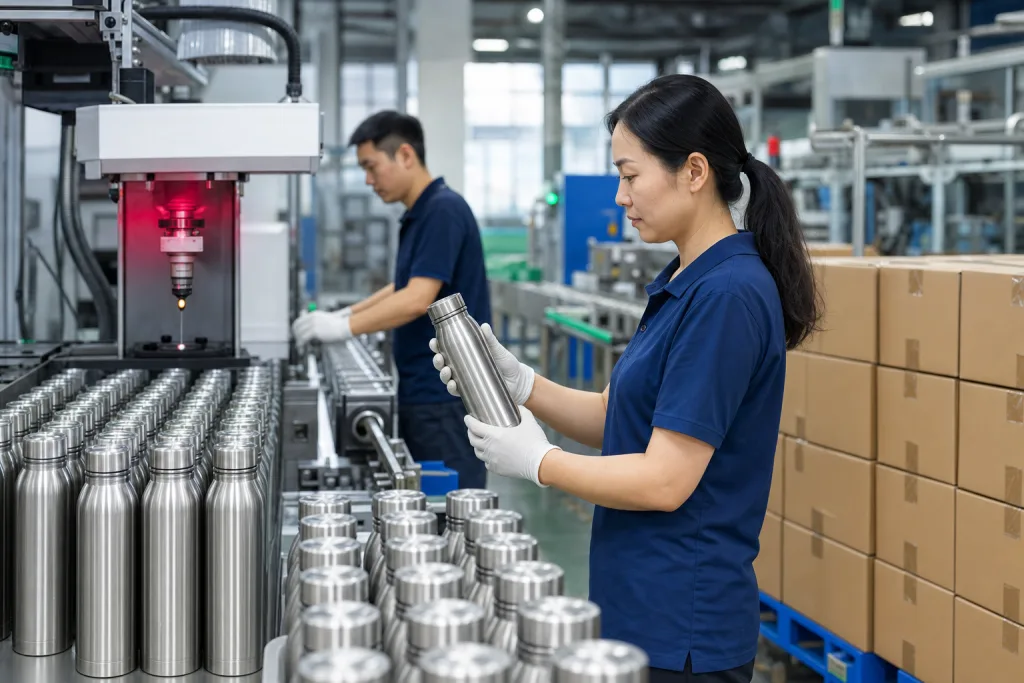
At BottleForge Industrial in Hangzhou, Zhejiang, our stainless thermos line runs about 450,000 units per month across vacuum bottles, travel tumblers, and food jars. Standard MOQ for existing molds is usually 3,000 pcs per color, with 25-35 days mass production after artwork and pre-production sample approval. If you need a fully customized thermos body, lid, or proprietary silhouette, plan for 10,000-30,000 pcs and 45-60 days after tooling confirmation. On the line, we run vacuum leak checks before final packing; QC pulled the sample from a 5,000 pcs order last week because the silicone ring sat 0.4 mm proud and the lid torque felt off.
Retail flask versus promotional bottle
Before we quote a manufacturer thermos project, we put this table in front of the buyer and mark it up with a caliper reading from the sample room. It stops the “same bottle, cheaper price” argument fast.
| Spec item | Outdoor retail thermos | Promotional thermos | Distributor thermos |
|---|---|---|---|
| Common capacity | 750 ml, 1,000 ml, 1,200 ml | 350 ml, 500 ml, 600 ml | 500 ml, 750 ml, 1,000 ml |
| Steel grade | 304 inner, 304 or 201 outer | 304 inner, 201 outer common | 304 inner, 304 outer for premium lines |
| Wall thickness | 0.5 mm outer, 0.4 mm inner | 0.4 mm outer, 0.35 mm inner | 0.45-0.5 mm outer |
| Finish | Powder coat for grip, hammer tone for outdoor shelves, brushed for lower scratch visibility | Spray paint for budget gifts, powder coat for repeat handling, polished for bright logo contrast | Powder coat for color SKUs, stainless for plain stock programs |
| Logo method | Laser, debossed plate, durable silkscreen | Silkscreen, pad print, laser, UV print | Laser and silkscreen mix |
| Typical MOQ | 3,000 pcs per color | 3,000-5,000 pcs per design | 5,000 pcs per SKU preferred |
| Use-case fit | Camping, hiking, fishing, van life | Corporate gifts, events, loyalty programs | Wholesale, regional retail, online bundles |
The lowest thermos bulk quote usually removes cost from one of 4 places: steel thickness, vacuum yield control, coating quality, or carton strength. Sometimes it works. For a one-day conference, we ship a light 500 ml customized thermos with a clean silkscreen logo and nobody complains if the gift sits on a desk. For an outdoor store promising two years of use, the math does not work if you build it like a campaign giveaway; QC pulled the sample last month after 18 out of 80 pcs showed rim paint chipping in the tape test.
Steel, vacuum, and heat claims
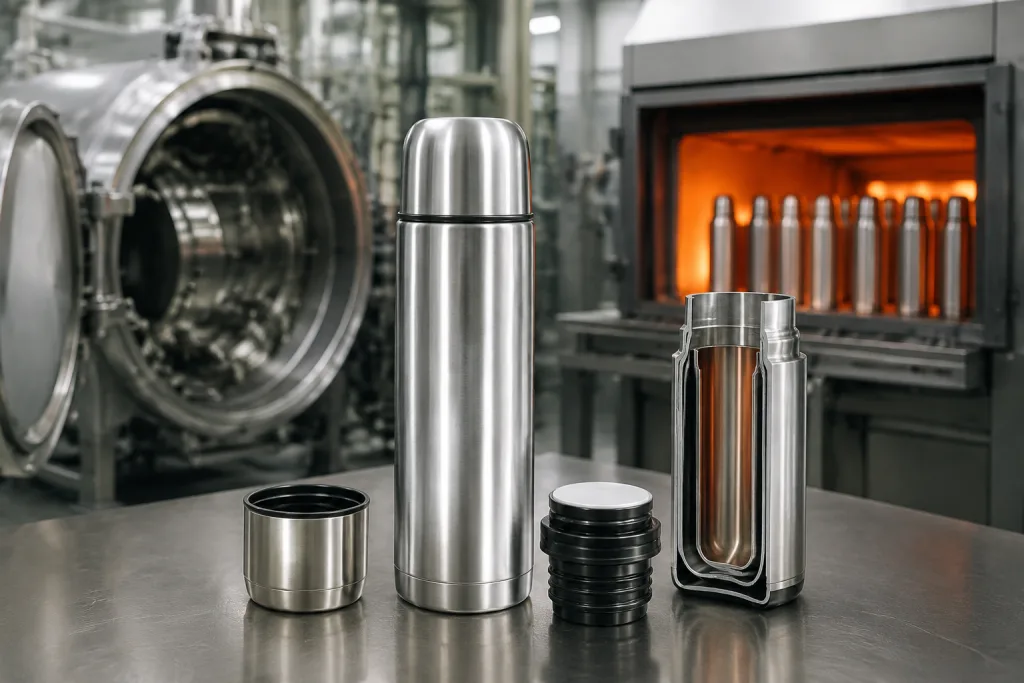
Most stainless thermos factories run double-wall vacuum construction. The real gap is not the words “vacuum insulated” on the quotation sheet; it is whether the line pulls the vacuum to a stable level, checks it before powder coating, and keeps the tail seal protected during handling. Looks can lie. QC has pulled bright, clean samples from a carton that passed appearance check, then failed the 12-hour heat test because the vacuum tail was bumped during polishing.
For the inner wall, 304 stainless steel is the normal baseline for food contact. It handles coffee, tea, and acidic drinks better than 201 stainless under normal consumer use. For the outer wall, 201 stainless can work on price-driven promotional thermos orders, especially when the buyer is fighting for USD 0.08 on a 3,000 pcs MOQ. For outdoor retail or premium distributor thermos programs, we push for 304 outer wall. Saving USD 0.15 and getting rust photos 45 days after delivery is the wrong math.
Thermal claims need discipline. A well-built 1,000 ml vacuum flask can often keep hot water above 60°C for 12-18 hours in room-temperature testing. A 500 ml bottle has less thermal mass, so the claim should be lower. Some sellers print “24 hours hot” on every size. We have seen this go sideways. The buyer flags returns, then everyone argues over the hangtag wording. We test with 95°C starting water, 20°C ambient temperature, and recorded readings at 6, 12, and 24 hours, using a calibrated probe instead of guessing from a hand touch.
For quality control, ask your thermos factory for vacuum thermal testing records by batch, not a generic report from last season. In our Zhejiang facility, vacuum inspection is done before coating, then random finished-goods testing is repeated under AQL sampling. AQL 2.5 for major defects and 4.0 for minor defects is common. Critical defects such as leakage, sharp edges, food-contact contamination, and wrong logo color should be treated at 0 acceptance. On one matte black order, QC pulled the sample after logo curing and found a 1.5 mm color shift against the approved Pantone chip; small miss, big shelf problem.
Logo methods under real use
Brand owners often ask for the “most premium” logo method. Wrong question. Ask where the bottle will live. A customizable thermos for ski shops, outdoor clubs, or fishing retailers gets scraped by gloves, carabiners, sand, and truck cup holders; we had one 750 ml black powder-coated sample come back with 14 visible rub marks after a buyer clipped it to a metal display hook. A hotel launch promotional thermos may sit on a desk for 300 days a year.
Laser engraving is the safe long-run choice on powder coating or stainless steel. It does not peel. It gives a clean retail look. The catch is color: laser usually cuts back to base metal or leaves a contrast mark, not a Pantone logo. Silkscreen printing works for 1-2 color logos on smooth powder coating, and the cost is hard to beat, but adhesion needs proof. We run cross-hatch tape testing with a 1 mm cutter and alcohol rub testing before mass production; QC pulled one sample last month because the white ink lifted after 35 rubs. UV printing handles multi-color artwork, but curved bodies and rough coatings make registration less forgiving.
For promotional thermos bulk orders, silkscreen still wins on price-performance. A one-color logo may add around USD 0.06-0.12 per unit depending on size and position. Laser engraving usually adds USD 0.10-0.25. Full wrap printing, gradient coating, or special rubberized finishes can add USD 0.40-1.20 and push up reject risk; on a 5,000 pcs run, even a 3% decoration reject means 150 bottles waiting for rework on the line.
If you are a thermos distributor building a repeatable line, keep one decoration zone across 500 ml, 750 ml, and 1,000 ml sizes. Sales moves faster. The warehouse also avoids five artwork templates for the same customer. If you are a promotional brand, lock logo size, Pantone number, and placement in the purchase order. “Same as sample” is not enough for a China production line when three shifts are running; we once saw a PO typo change 60 mm to 90 mm, and the buyer flagged it only after the pre-production sample was on DHL.
Lids, cups, handles, and leaks
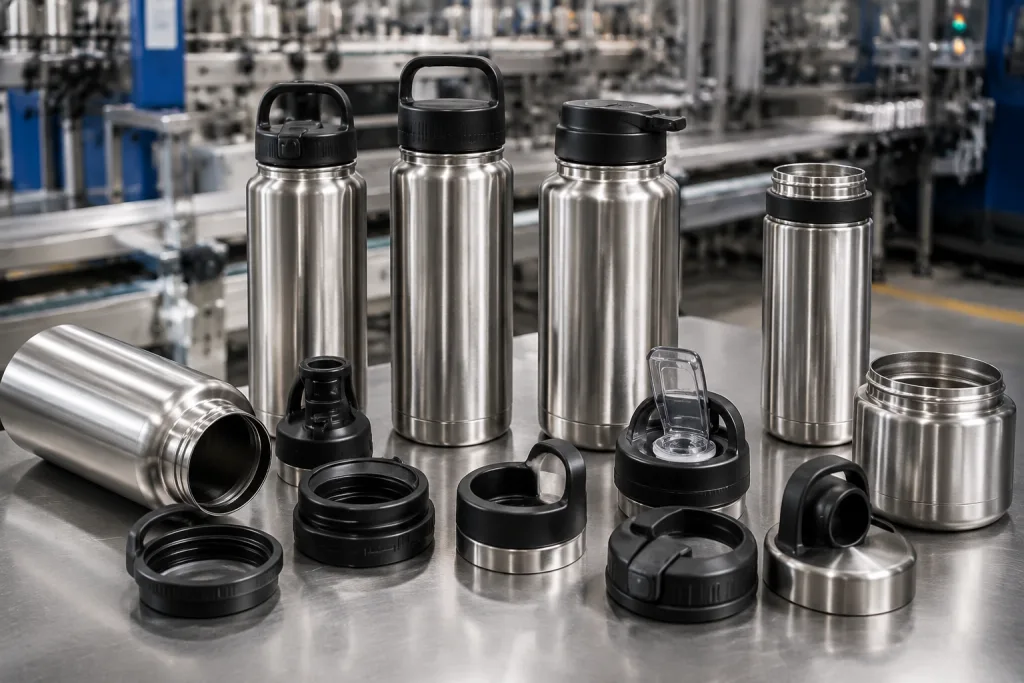
Lid design is where a lot of custom thermos jobs get expensive fast. The bottle body can stay standard, but the lid drives user feel, leak risk, and the tooling bill. For outdoor retail, a screw cap with an integrated drinking cup still sells well on 750 ml and 1,000 ml flasks. Simple. Tough. Easy to wash. For promo bottles, push-button lids, flip lids, and carry handles look better on a shelf, but every moving part gives us another place for trouble.
For a thermos customized with a handle lid, check the handle material and the pivot structure. PP plastic is common, but the grade matters. We had a buyer flag a soft handle on the first round, and the fix was a thicker pin, not a new mold. Silicone gaskets should be food grade, removable for cleaning, and tight enough to pass inversion testing. We run 100% leak testing on selected lid types and random leak testing on finished packed goods. Standard check: fill the bottle, close the lid, invert for 30 minutes, then shake it by hand or on a jig, depending on buyer spec.
Thread tolerance matters too. If the lid feels gritty or cross-threads easily, returns will follow. This is the wrong question to ask: “Can we make it fit?” The real question is whether it still fits after coating. Powder coat thickness can change neck feel if masking is sloppy, and we have seen that go sideways on a 0.35 mm buildup at the mouth. For wide-mouth flasks, confirm the opening takes ice cubes if your outdoor retail copy promises cold drinks. For kids or commuter use, check whether the lid has small parts that may trigger safety issues under ASTM or local market rules.
Do not pick a lid from a rendering. Ask for 5-10 physical samples and let your team abuse them for 7 days. Fill them, toss them into a bag, wash them, and open them with cold hands. QC pulled one sample with a slight burr on the drinking edge, and that tiny defect would have turned into complaints. A screen shot never shows that. A sample does.
Compliance and packaging side by side
For Europe and North America, compliance comes before final pricing. Food-contact stainless drinkware is straightforward on the line, but paperwork still matters. For EU buyers, REACH, LFGB, or food-contact migration tests may be asked for, depending on the channel. For the United States, FDA food-contact expectations and state rules may apply. If the thermos has a painted coating, silicone gasket, plastic lid, straw, or printed artwork, we check those parts too. A 0.5 mm coating issue can turn into a buyer rejection fast.
Factory audits are another buyer filter. We see BSCI, Sedex, and ISO 9001 requests all the time, especially from promo brands. Outdoor retailers usually ask for restricted substances, traceability, and corrective action records. A supplier saying “all certificates available” still needs to show current papers with the factory name, address, product scope, and valid dates. We had a PO once with the wrong company name on the test report. Useless.
Packaging has to fit the sales model. A retail thermos usually needs a color box, instruction sheet, barcode, warning text, and sometimes a hang tag. A promo thermos can run in a white box, kraft box, or polybag with a master carton. For e-commerce, we add carton drop testing, FNSKU or SKU labels, suffocation warnings for polybags, and stronger outer cartons. A 1,000 ml stainless flask is heavy, and a weak carton fails in the courier sort. QC pulled the sample after a 76 cm drop crack.
FOB Ningbo or FOB Shanghai are common for our Zhejiang production. For a 5,000 pcs 750 ml bulk thermos order, export cartons usually take around 12-18 CBM, depending on the box structure. If the margin is tight, carton size and loading efficiency matter as much as USD 0.10 on the unit price. Good thermos suppliers plan pallet pattern, carton marks, and spare parts before the deposit lands. The math does not work any other way.
Price bands and order planning
Price is not just capacity. A 500 ml thermos custom order can land below a 750 ml order, but coating, lid, logo, packaging, and testing can flip that fast. As a rough FOB China range, a plain 500 ml stainless promotional thermos sits around USD 3.20-4.80 at 5,000 pcs. A 750 ml outdoor flask with powder coating and cup cap sits around USD 5.20-7.50. A 1,000 ml premium 304/304 model with retail box, laser logo, and upgraded lid can move toward USD 8.00-11.50. On the line, we often see the lid add more cost than the bottle body.
Those ranges are planning numbers, not promises. Nickel price, exchange rate, coating yield, and carton spec all move the final quote. If a thermos vendors quote comes in 20% below the pack, ask what changed in the spec. We have seen the math fail on 0.35 mm steel, a lighter lid, no thermal test, or a cheaper coating line. QC pulled a sample once and found the wall thickness off by 0.05 mm.
For first orders, we usually tell outdoor retailers to start with 3 SKUs: 500 ml commuter, 750 ml trail bottle, and 1,000 ml camp flask. Promotional brands can stay tighter: one 500 ml or 600 ml model in two colors with one decoration method. Thermos distributors should plan around replenishment cycles. If sell-through is unclear, choose existing molds and colors close to stock standards. You can keep logo and packaging custom without paying for new tooling. The buyer flagged a PO typo on one case pack, and that alone would have burned a week.
A clean project timeline looks like this: 3-5 days for quote and artwork check, 7-10 days for sample production, 2-3 days for sample review, 25-35 days for mass production, and 3-7 days for inspection and export paperwork. Sea freight is separate. If your event date is fixed, work backward from delivery day, not from the day you want to place the order. We ship this way all the time, because a 12-day slip on sample approval can turn into an 18-day miss on the vessel cutoff.
Send your thermos spec sheet for a factory quote
Share capacity, lid, coating, logo, MOQ, and target market. We will return a practical FOB China quote with production timing.
Frequently asked questions
What MOQ should I expect for a custom stainless thermos order?
For existing BottleForge molds, the practical MOQ is usually 3,000 pcs per color for a standard custom thermos with logo. If you need a special coating color, carton, and accessories, 5,000 pcs is easier for cost control. For a fully customized thermos body or lid, expect 10,000-30,000 pcs because tooling, trial runs, and fixture setup must be amortized. Small test orders below 1,000 pcs are possible only when using ready components, but the unit price can be 25-60% higher. Outdoor retailers should use the first order to test 2-3 capacities, while promotional brands often focus on one bulk thermos model for cleaner pricing.
Is 304 stainless steel required for both inner and outer walls?
The inner wall should be 304 stainless steel for normal food-contact use. For the outer wall, 201 stainless is common on cost-sensitive promotional thermos programs, while 304 outer wall is better for outdoor retail, marine, winter, or premium distributor thermos lines. The price difference can be roughly USD 0.15-0.45 per unit depending on size and steel market movement. If your marketing copy says rugged, expedition, or long-life, we recommend 304/304 construction. If the product is a one-time corporate gift used mainly indoors, 304 inner and 201 outer may be acceptable. Always confirm material by specification sheet and, for larger orders, third-party testing.
Which logo method is best for outdoor retailers?
For outdoor retail, laser engraving is usually the safest choice because it does not peel and handles abrasion better than most printed logos. On powder-coated bottles, laser creates a clean contrast mark by removing or marking the coating layer. If you need exact Pantone color, silkscreen or UV print may be required, but you should request adhesion testing before production. A one-color silkscreen logo is often USD 0.06-0.12 per unit, while laser is commonly USD 0.10-0.25 depending on logo size. For high-abuse products, avoid very large print areas near the lower bottle body because that zone gets scratched in cup holders and racks.
How do I compare quotes from different thermos suppliers?
Put every quote into the same spec sheet before judging price. Compare capacity, steel grade, wall thickness, lid type, coating, logo method, packaging, MOQ, FOB port, lead time, and inspection standard. A USD 4.10 supplier thermos quote and a USD 4.80 quote may not be the same product. Ask whether thermal testing, leak testing, food-contact testing, and AQL inspection are included. Also check carton dimensions, because freight cost can change your landed price by more than USD 0.20 per unit. If a thermos vendor avoids specific numbers such as 0.5 mm wall thickness or 25-35 day lead time, treat the quote as incomplete.
Can you prepare thermos orders for retail or e-commerce warehouses?
Yes, but you need to define packaging early. For retail, we can produce color boxes, kraft boxes, instruction sheets, barcode labels, warning text, and master carton marks. For e-commerce or marketplace warehouses, we can apply SKU or FNSKU labels, use stronger export cartons, and follow carton drop-test requirements if provided. A 5,000 pcs thermos bulk order may occupy 12-18 CBM depending on capacity and packaging style, so carton engineering affects freight and damage rate. If you ship to multiple distributors thermos warehouses, provide the carton mark rules, pallet requirements, and delivery split before mass production starts.