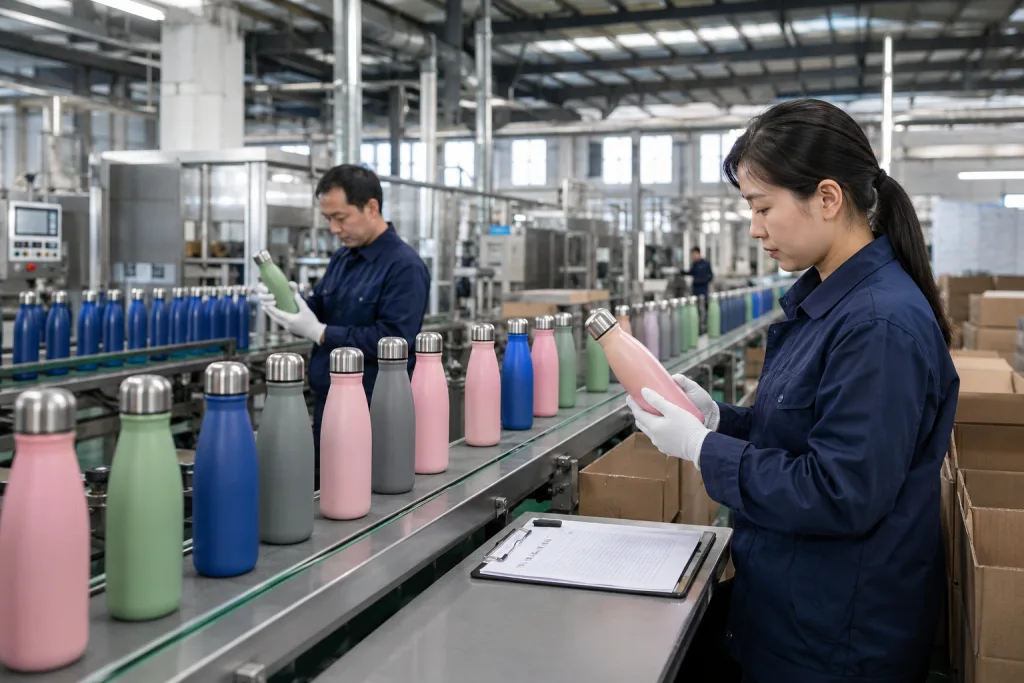
Key Takeaways
- A workable thermal bottle program usually starts at 1,000-3,000 units MOQ and 35-55 days lead time.
- 304 stainless steel is the common baseline; 316 costs more and is usually reserved for higher corrosion exposure.
- For custom drinkware, ask for AQL 2.5 or tighter on critical defects and written vacuum-retention targets.
- A Zhejiang canteen factory with 200,000+ units/month output can handle mixed SKUs better than a small trading setup.
You are not buying a bottle. You are buying a repeatable production process, and that is where most projects go wrong. A thermal bottle can look simple on a spec sheet, then the line starts rejecting caps because the lid torque is off by 0.3 N·m. We have seen buyers focus on the render and skip the hard parts: steel grade, vacuum retention, coating adhesion, drop test results, and whether the supplier can hold tolerance when the order goes from 500 to 50,000 pieces. In Zhejiang, the factories that stay busy are the ones that can answer those questions without guessing.
If you source custom drinkware for retail, corporate gifts, or channel distribution, the right manufacturers thermal bottle partner should give you numbers, not slogans. Think in units per month, not promises. Think in AQL, REACH, and ASTM-style test logic, not polished mockups. A serious canteen manufacturer in China will tell you the MOQ, the lead time, the decoration limits, and what fails in production before you put a PO on the table. QC pulled the sample, and the buyer flagged it because the laser logo wandered 1.2 mm; that is the kind of detail that saves a shipment.
What You Are Actually Buying
Most buyers say they need a bottle. They are buying a controlled stack of variables: material, vacuum structure, cap system, decoration method, carton packing, and compliance documents. Miss one, and the job slips. We have seen a 500 ml powder-coated bottle pass visual checks, then fail when the lid leaked at 80 degrees C, the thread stripped after 1,000 cycles, or the vacuum jacket dropped performance after a hot-cold shock test on the line.
Start with the end use. A distributor canteen for outdoor retail needs different specs than a canteen promotional item for events or a custom growler for beverage brands. For retail, we ask about finish wear, drop resistance, and carton strength. For corporate gifting, print sharpness and color match carry more weight. For a canteen distributor handling several regions, the factory should handle different packing labels, barcode formats, and mixed order planning without turning every change into a new project. That is the wrong question to ask: "Can you make it?" The better question is whether the spec survives your channel.
Checklist
- Confirm capacity: 350 ml, 500 ml, 750 ml, or 1 L
- Confirm steel: 304 as default, 316 if corrosion resistance is a real need
- Confirm insulation target: 6, 12, or 24 hours with test method stated
- Confirm lid type: screw lid, flip lid, straw lid, or handle lid
- Confirm packaging: single box, bulk pack, or retail-ready carton
How To Judge Factory Capability
Factories often say they can do custom canteen work, but capability shows up in numbers and repeatability. Ask how many units they ship per month, how many assembly lines they run, and how many SKUs they keep moving without delays. A real canteen factory in Zhejiang should tell you whether your order fits normal production or needs a dedicated line. We had a buyer flag a PO typo on a 30,000-piece order once; the plant that caught it on the line had already earned the next round of business. If they dodge the question, you are probably talking to a trading layer, not the factory.
For thermal bottle sourcing, production scale matters because vacuum welding, seam control, and lid assembly are tied together. A canteen manufacturer running 150,000 to 300,000 units per month can usually absorb the small swings that come with custom drinkware programs. Smaller canteen suppliers can still work for niche orders, but the schedule gets tight fast when you ask for two logos, a special Pantone color, or a new mold. We ship North America and Europe orders with 12-day artwork turns against 18-day packaging windows, and the math does not work if the shop is already stretched. One inspection finding from our QC team: a 0.3 mm lid gap can pass a quick glance and fail after five opening cycles.
Ask for these factory facts: in-house vacuum line or outsourced, coating line ownership, cap mold library, and whether they run BSCI or another social compliance audit. If a canteen vendor cannot state their in-process QC checkpoints, you will find the defect at the customer warehouse, and that is the expensive place to learn it. We ask where the torque wrench sits, who logs the 304 stainless lot, and how often QC pulled the sample last shift. This is the wrong question to ask if the answer stays vague.
Spec Details That Change Cost
Thermal bottle pricing usually moves on five levers: steel grade, wall structure, finish, lid tooling, and packing. A plain 500 ml 304 stainless bottle with a standard screw lid can sit around USD 2.10 to 3.20 FOB China at a few thousand pieces. Switch to 316 steel, double-color powder coat, laser logo, and a custom molded cap, and the quote can go past USD 4.50 fast. We see this every week on the line. The wrong question is “why is yours higher?” The real question is what got removed from the spec sheet.
If you want a canteen customizable program that still leaves margin, lock the spec before you ask for final pricing. Every add-on changes yield. A matte coating hides fingerprints better than gloss, but it needs tighter surface prep and a cleaner spray booth. Silicone base rings improve grip, yet they add assembly time and one more QC check. A custom canteen with a handle lid or integrated straw often needs a new mold, or at least a modified cap insert, and that is where the math starts to move. One buyer once sent a PO with the lid code wrong by one digit; QC pulled the sample, and the sample did not match the drawing.
For distributor drinkware, landed cost matters more than unit price. Add freight, duty, labeling, and defect allowance. A cheaper unit that fails in 3% of cartons is not cheaper. We ship enough cartons to know that. It is scrap with a spreadsheet attached.
QC Rules You Should Demand
Ask for the inspection plan before you talk about artwork. A serious canteen supplier should show incoming material checks, in-process vacuum tests, and final random inspection by AQL. For most consumer drinkware, AQL 2.5 for major defects and 4.0 for minor defects is a workable start, but critical defects such as leaking lids or vacuum failure need zero tolerance. If the factory cannot split those categories, they are not ready for export work. We saw a buyer reject a PO because the QC sheet mixed “scratch” and “leak” in one column. That is the wrong question to ask.
Testing should cover leak checks, thermal retention, lid cycle testing, coating adhesion, and carton drop tests. A good factory will name the method, not just the result. On our line, we run thermal checks with 95 degrees C fill water in a 20 degrees C room, then log the curve at 6 hours and 24 hours. The sample may pass at 12 hours and slip at 24. That is not a small detail. It tells you how the bottle behaves after the line speeds up and the vacuum seal gets a little less clean.
Practical rule: if the factory cannot describe how they reject defects, they are probably not controlling defects.
This is where Chinese manufacturing gets oversimplified. A Zhejiang plant with export habits can be tight on QC. A weak supplier can sit across the road. The split is not geography; it is whether they keep documented checks or just hope the line supervisor catches issues by eye. We once pulled a sample where the lid torque was 0.6 N·m on one shift and 1.1 N·m on the next. The buyer flagged it, and the math did not work.
Artwork And Branding Choices
Branding is where a lot of custom drinkware jobs go off script. A canteen promo item for a trade show does not need the same decoration as a premium retail bottle. Screen print is cheap at 1 or 2 colors. Laser engraving is cleaner and holds up better on stainless steel, but it fits a restrained, technical look. Heat transfer and UV print can carry full-color graphics, though we check curved walls and coated finishes before we quote them. QC pulled a curved 750 ml sample last week and the edge blur told the story.
If you are ordering a customized canteen for retail, ask how the logo behaves on powder coat and bare steel. If you are building a custom growler or customizable growler for beer, cold brew, or hospitality use, the decoration has to survive condensation and repeated washing. A distributor canteen program looks simple until the buyer asks for private label cartons, hanging tags, and region-specific barcodes. Then artwork control is part of the product, not a side note. We ship those files through the line in versioned sets, because one PO typo on a barcode can stall a whole carton run.
One practical move is to request 3 samples: a blank body, a decorated body, and a packed sample. That tells you more than a PDF ever will. It also shows whether the canteen vendor understands the real production sequence. A factory that skips that step is counting on the customer to find packaging problems after shipment, and that is the wrong stage to catch them. We’ve seen that go sideways on a 5,000-piece order when the hang tag hole was 2 mm off.
Your Ordering Checklist
Run the checklist before you release a PO. First, verify whether you are talking to a canteen factory or a trading company. Second, pin down the material, capacity, and lid system; a 500 ml bottle with a screw lid is not the same job as a 750 ml unit with a push-button cap. Third, name the target markets so the factory quotes the right compliance pack. Europe may need REACH-related declarations and packaging marks; North America often wants different carton labels, barcode formats, and retailer fields. Fourth, ask for sample approval logic. You need to know which sample is the production reference and who signs off on it.
Then get into the money and timing. Confirm MOQ, unit price at 1,000, 3,000, and 5,000 units, lead time from sample approval, and the spare-parts policy for lids or seals. For a custom canteen order, sample lead time is usually 7 to 12 days, and bulk production is often 35 to 55 days once artwork is frozen. QC pulled a sample with a loose gasket on a 28 mm cap last month; that is the kind of miss that turns into a claim. If a factory says 15 days for a full custom mold job, the math does not work. Ask what they left out.
- Factory type: manufacturer, not just vendor
- Compliance: BSCI, REACH, and documented testing
- QC: AQL, leak tests, drop tests, coating adhesion
- Commercials: MOQ, FOB price, sample fee, production lead time
- Execution: carton marks, barcode rules, spare gaskets, retest policy
That list is not bureaucracy. It is the line between a clean shipment and a PO typo that burns a week in rework.
Send your spec and get a factory quote
Share capacity, finish, logo method, and target market. We will quote the workable build, not a wish list.
Frequently asked questions
What MOQ should I expect from manufacturers thermal bottle suppliers?
For standard thermal bottles, MOQ is often 1,000 to 3,000 units per SKU. A canteen distributor order with one color and one lid is easier to place than a mixed custom drinkware program with multiple logos or packs. If you ask for a new mold, custom carton, and special finish, the MOQ can move higher because the factory has to absorb setup loss. In Zhejiang and other parts of China, a serious export factory should explain where the MOQ comes from, not just quote a number and hope you accept it.
Is 304 stainless steel enough for custom drinkware?
For most custom drinkware, yes. 304 stainless steel is the standard base material for a custom canteen or thermal bottle because it balances cost, corrosion resistance, and availability. If the bottle will face salt exposure, acidic liquids, or premium positioning, 316 stainless can be justified, but expect a higher unit price. Ask the canteen supplier for material certificates and let them state the wall thickness, usually around 0.4 to 0.7 mm depending on the design. That matters more than the marketing label.
How long should production take after sample approval?
A normal production window is 35 to 55 days after sample approval, assuming the artwork is final and the canteen factory already has the right tooling. Simple customized drinkware can move faster, but only if the order is close to standard. If you need a new cap mold, special coating, or packed retail cartons, add time. A sample usually takes 7 to 12 days. If a canteen manufacturer promises bulk shipment in under 20 days for a fully customized job, you should ask what step they skipped.
What QC documents should I request before paying?
Request the inspection plan, test reports, and a sample approval record. For thermal bottle programs, ask for AQL limits, leak-test method, heat-retention data, and carton drop-test results. If you are importing into Europe or North America, also ask for REACH-related material declarations, and if the supplier claims social compliance, ask for a recent BSCI audit summary. A disciplined canteen vendor will give you these without drama. A weak one will send photos of the product and hope that is enough.
How do I choose between laser engraving and printing?
Choose laser engraving when you want a permanent, low-maintenance logo on stainless steel and you do not need full color. Choose screen print when you have one or two brand colors and need cost control. UV print or heat transfer makes sense for complex graphics, but the factory must prove adhesion on the exact coating and body curvature. For a custom growler or customized canteen that gets washed often, durability matters more than visual impact. Ask for a rub test and a sample wash test before committing to volume.