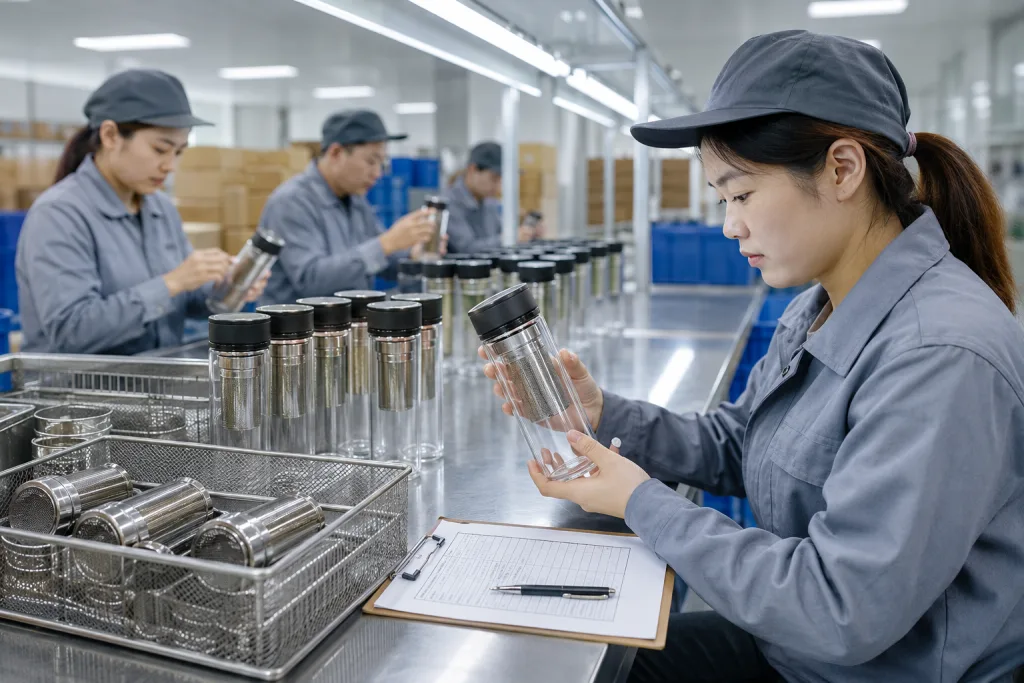
Key Takeaways
- MOQ for a custom tea infuser bottle usually starts at 3,000 to 5,000 units, with better pricing at 10,000+
- Typical factory direct infuser bottle lead time is 20 to 35 days after sample approval, plus 5 to 10 days for shipping
- A custom logo infuser bottle can add USD 0.08 to 0.45 per unit depending on print method and color count
- For bulk fruit infuser bottle orders, stainless steel filters and silicone seals often add 8% to 18% to base cost
When you source a manufacturers tea infuser bottle, the first question is not whether it can steep tea. The real question is whether unit cost, tooling, MOQ, and lead time line up with your launch window and margin. We have seen brands blow the budget by treating it like a plain plastic bottle. It is not. The filter basket, lid seal, bottle wall thickness, decoration method, and carton spec all change the price. On our line, a 0.4 mm wall and a 0.6 mm wall are not the same quote.
If you buy from China or a factory in Zhejiang, separate factory-direct numbers from trading-company quotes. A proper factory tea infuser bottle line can run 50,000 to 120,000 units a month, but your order can still sit on tooling sign-off, resin allocation, and print setup. That is how a 20-day plan turns into 45 days. QC pulled a sample last week with a loose mesh ring, and the buyer flagged it before shipment. That is the right question to ask: what is actually driving the number?
What you actually pay for
Buyers ask for unit price first. That is the wrong question to ask until you know what sits inside the quote. A proper custom infuser bottle price should cover the bottle body, lid, infuser basket or rod, seal ring, artwork, inner pack, and master carton loading. Leave out one line item and the quote looks cheap on paper, then the PO gets ugly later. We have seen that go sideways on a 3,000 pcs order when the buyer flagged a missing carton insert after sample approval.
For a standard 500 ml or 600 ml bulk tea infuser bottle, the cost moves with material and assembly. Tritan-style copolyester, PETG, and glass sit in different brackets. A plain plastic factory infuser bottle with one-color logo and a standard box may run about USD 1.20 to 2.10 FOB China at 3,000 units. Add a stainless infusion basket, tighter lid seal, and retail packaging, and the same item can move to USD 2.00 to 3.80. On the line, we check the lid torque at 18 to 22 kgf.cm; if it slips, that quote is not real.
The infuser insert is not free. A removable tea basket, especially with fine mesh or a threaded lock, adds parts, labor, and inspection time. Same story with a custom logo infuser bottle that needs matte spray or a special Pantone color. The buyer may push back on that line item, then QC pulled the sample and found the logo print offset by 1.5 mm. In Zhejiang, tooling and assembly sit close together, so lead time can be shorter, but process steps still cost money.
- Base bottle: USD 0.65 to 1.50 depending on material and wall thickness
- Infuser insert: USD 0.18 to 0.65 depending on mesh, plastic, or stainless steel
- Decoration: USD 0.08 to 0.45 for print, laser, or heat-transfer methods
- Packaging: USD 0.10 to 0.40 for simple box, more for retail-ready sets
MOQ tiers that make sense
MOQ is not a random figure a factory pulls out of thin air. It follows resin buying, masterbatch mixing, silk-screen setup, and how many cartons the line can run before the next changeover. For a custom tea infuser bottle, the working tiers are usually 3,000, 5,000, and 10,000 units. Under 3,000, we still quote it sometimes, but the math gets ugly fast because scrap and setup are spread too thin.
At 3,000 units, you can usually hold the order to one logo position, one body color, and standard packaging. QC pulled the sample on a 3,000-piece run and found the print shift was still within 1.5 mm, which is why that tier is workable. At 5,000 units, there is room to adjust lid color, mold color, or a tighter insert spec. At 10,000 units, the landed cost starts moving down in a way distributors notice, especially on bulk infuser bottle orders for replenishment. A distributor tea infuser bottle program needs that volume if the buyer wants the margin to survive freight swings.
For a customizable tea infuser bottle with a unique body color, the factory may ask for a 30% to 50% deposit plus proof approval before production starts. That is standard in China. On one Zhejiang line, a buyer flagged a PO typo on the carton count, and we held the run until the artwork was corrected; a bad carton spec burns a half day fast. If you want a customized fruit infuser bottle in two Pantone colors, expect a higher MOQ than one stock body color and one ink color. The wrong question is whether the MOQ is “fair”; the real question is whether the batch size matches the parts count and the changeover time.
Read MOQ as a factory process number, not a penalty. Add more custom parts, and the batch has to grow or the line pays for it in downtime.
Lead times by production stage
Lead time is where first-time buyers blow the launch window. A realistic factory direct infuser bottle schedule has five steps: sample sign-off, material booking, mass production, QC, and export loading. If a supplier promises 10 days for a fully custom order, the quote is missing something or the line is being sold too hard.
For a stock-style bulk fruit infuser bottle with logo print only, sample approval usually takes 3 to 7 days, production takes 15 to 20 days, and packing plus booking needs another 3 to 5 days. That lands at 21 to 32 days before the goods leave the port. We once had a buyer flag a PO typo on carton marks at this stage; the reprint cost 2 days and nobody was happy. A more customized order, such as a custom made infuser bottle with a special lid and bespoke carton, often needs 25 to 35 production days after artwork approval. Add sea freight, and the total is 35 to 55 days to a U.S. or European warehouse.
Zhejiang factories are fast on molded parts, but insert filtration and mixed-material lid builds stretch the clock. If the supplier is waiting on a food-contact certificate set, color masterbatch, or a new mold insert, budget another 5 to 12 days. We run into this on the shop floor all the time: QC pulled the sample, the 0.3 mm seal gap was fine, then the buyer asked for a different cap color and the schedule moved. For a custom fruit infuser bottle launch tied to a seasonal campaign, freeze artwork earlier than you think and approve samples before you book retail media. Waiting on the media plan first is the wrong question to ask.
- Simple logo order: 20 to 30 days factory time
- Mid-custom order: 25 to 35 days factory time
- New mold or new lid tooling: 35 to 45 days factory time
- Ocean freight: 18 to 35 days depending on destination and port
Material choices change margins
Material choice is where a customized infuser bottle keeps margin or gives it away. PETG and copolyester run cheaper and ship lighter, so a 500 ml bottle can save freight before you even touch carton design. Glass sells a cleaner premium story, but the line sees more breakage and you pay for thicker inserts, dividers, and corner protection. Stainless steel bodies are tough, though the body-lid stack gets expensive fast. A buyer asking for a customizable fruit infuser bottle should start with the use case. Looks come second.
For tea, the basket needs mesh tight enough to hold leaf fines and open enough to rinse in seconds. We run a lot of 304 mesh inserts, and they cost more than a basic plastic strainer, but QC pulled the sample and the difference in finish was obvious. If you are sourcing a distributor infuser bottle program, durability and pack count matter more than shaving a few cents off the insert. A 0.8 mm to 1.2 mm wall thickness in plastic bottles is common; glass units often sit around 2.5 mm to 3.5 mm, depending on shape. Go thinner and you win on material. Go thicker and freight climbs.
One factory-floor point from China sourcing: if you want a factory tea infuser bottle with FDA-style food-contact expectations for North America and REACH awareness for Europe, ask for declaration packs before sample approval. We ship from Zhejiang, and a factory that already exports should have those files ready. A buyer once flagged a PO typo on the carton code, and the paperwork delay was still less painful than rebuilding compliance from scratch. If the supplier cannot produce the docs, your lead time stretches while everyone waits on paperwork.
- PETG/copoyester: lower cost, lighter freight, moderate premium look
- Glass: higher packaging cost, better shelf appeal, fragile in transit
- Stainless steel accents: higher part cost, stronger perceived value
- Silicone seals: small unit cost, big impact on leak complaints
What export compliance affects
You do not want a low-cost bottle that gets held at customs or rejected in retailer onboarding. For Europe and North America, the supplier needs food-contact documents, traceability, and a basic factory audit record. Ask about REACH, LFGB where needed, FDA food-contact declarations, and the factory quality system before you place the order. A serious manufacturer tea infuser bottle supplier in Zhejiang should answer cleanly, with the file number ready, not with a guess from the sales desk.
Compliance changes the schedule. If you order a customized tea infuser bottle with a new colorant or print system, the factory may need to source compliant ink or resin and reissue declarations. We have seen that add 3 to 10 days before mass production starts. One buyer once sent a PO with the print spec in a separate email thread, and the line had already locked the material list. If your retailer wants carton labeling, barcode placement, or drop-test standards, put them in the purchase order before sample approval. The math does not work well after the sample is signed off.
For direct-to-consumer programs, outer carton strength matters more than a lot of brands expect. A 3-layer inner box may hold for local transport, but cross-border freight usually needs a stronger master carton and better dividers. If the product is a custom made infuser bottle for Amazon or a distributor network, ask the factory for carton loading data, net weight, gross weight, and carton count per pallet. We run those figures on every export job because a 0.5 kg mismatch can turn into a chargeback at the warehouse.
Good suppliers do not hide the paperwork. They send it early because they know the product will move through customs, warehouses, and retailer QA.
How to negotiate factory direct
The best price on a factory direct infuser bottle order comes from a clean brief, not pressure. Send one drawing, one target material, one decoration method, and one packaging spec. If you ask three factories for the same item in different wording, you get three quotes and none of them line up. We see this every week on the line. A buyer flagged a PO typo last month because “matte blue” turned into “metal blue,” and the sample team had to stop the run.
Use a simple comparison sheet. Ask for EXW and FOB China pricing, sample cost, mold charge if any, MOQ, production lead time, and test reports. Then compare landed cost, not FOB alone. A bulk tea infuser bottle quote that is USD 0.20 lower can turn more expensive after extra packaging, an 18-day slip, or a higher reject rate. If the supplier is in Zhejiang, ask how many units per month the line can actually support, not what the annual capacity slide says. Real numbers matter: 50,000 units per month, 20 to 35 days lead time, 1.2 mm wall thickness, and an AQL 2.5 check at packing.
For distributors tea infuser bottle programs, negotiate repeatability: the same lid fit, the same print position, and the same carton pack count across reorders. That beats shaving a few cents off the first shipment. We run that math all the time, and the math does not work any other way. If you are building a custom tea infuser bottle line for a wellness brand, lock the spec once, then let the factory buy components in larger batches. That is how you keep margin steady and avoid chasing a new sample every quarter.
Request a factory quote with your exact spec
Send your material, MOQ target, and artwork. We will price your custom infuser bottle against real lead time, not wishful numbers.
Frequently asked questions
What is the usual MOQ for a custom tea infuser bottle?
Most factories quote 3,000 to 5,000 units for a standard custom tea infuser bottle with logo print and stock components. If you want custom color, special lid, or packaging inserts, 5,000 to 10,000 units is more realistic. For a distributor tea infuser bottle program, 10,000 units usually gives better pricing and steadier component sourcing. Below 3,000 units, the per-unit cost often rises sharply because setup and scrap get spread over too few pieces.
How much does a custom logo infuser bottle cost FOB China?
A simple custom logo infuser bottle often starts around USD 1.20 to 2.10 FOB China at 3,000 units, depending on material and basket style. Add stainless steel parts, matte coating, or premium packaging, and the price can move to USD 2.00 to 3.80. If you want a customized infuser bottle with two-color print or a special lid, expect another USD 0.15 to 0.50 per unit. Exact pricing depends on wall thickness, decoration method, and carton spec.
How long does a factory direct infuser bottle order take?
A basic factory direct infuser bottle order usually takes 20 to 30 days after sample approval if the components are standard and the artwork is fixed. Mid-custom orders often need 25 to 35 days. If you need new tooling, a nonstandard lid, or a new color resin, plan for 35 to 45 days. Ocean freight then adds about 18 to 35 days depending on destination. In practice, a launch should be planned at least 8 to 12 weeks ahead.
Can I order a bulk fruit infuser bottle with my own packaging?
Yes, and you should if you are selling retail. A bulk fruit infuser bottle program usually allows custom cartons, inserts, barcode labels, and shipper marks. Packaging can add USD 0.10 to 0.40 per unit, sometimes more if you want a printed sleeve or premium gift box. The factory will usually need final artwork 7 to 10 days before production starts. For Amazon or distributor orders, give the factory carton specs early so they can match pallet and warehouse requirements.
What should I check before paying a deposit to a China factory?
Check whether the supplier can provide food-contact declarations, sample photos, carton specs, and a realistic lead time. For a manufacturers tea infuser bottle order, ask for the exact material, wall thickness, seal type, and print method. Confirm whether the quote is EXW or FOB China, because shipping, inland trucking, and export documents can change the landed price. If you are buying from Zhejiang, ask how many units per month the factory line can actually produce and whether they have handled Europe or North America shipments before.