Key Takeaways
- For tea bottles, 316 stainless with 0.4-0.6 mm wall thickness usually costs USD 2.40-4.90 FOB at 1,000 pcs.
- A practical MOQ from a Zhejiang canteen supplier is often 500-1,000 pcs per SKU, with 35-45 day lead time after sample approval.
- If you need a canteen customized for retail, prioritize leak test performance at 0.8-1.2 bar and dishwasher-safe print or laser marking.
- For distributor drinkware programs, one body size with 2 lid options lowers tooling risk and keeps freight predictable.
When you source manufacturers tea bottle programs, the mistake is not the lid color. It is buying a bottle built for plain water and trying to push it into tea retail, office gifting, or distributor resale. Tea bottles need tighter control on seal performance, infuser geometry, thermal retention, and cleaning access than a generic bottle. For Europe or North America, you still need REACH, food-contact compliance, and a carton that can take 1.2 m drop tests without turning into a claims file. We have seen that go sideways fast.
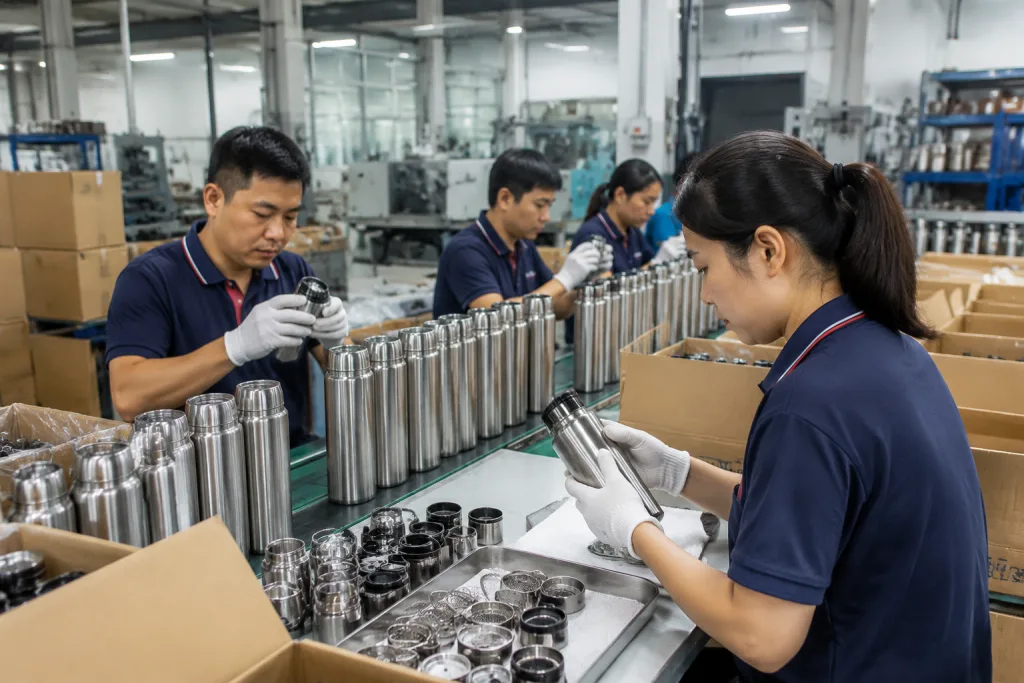
I work from the factory side in Zhejiang, China, and the pattern is consistent: buyers who compare spec first, use case second, and branding third usually land better margins. A capable canteen factory can run 30,000 to 80,000 units per month, but not every canteen manufacturer is good at tea filtration, coating durability, or low-MOQ customization. QC pulled the sample at 500 ml and found a 0.8 mm infuser gap that let leaf fines through. The right question is not who can make a bottle. It is which bottle fits your channel, your price point, and the chargeback risk you can live with.
Tea Bottle Specs That Matter
Buyers often compare tea bottles by capacity and miss the details that decide whether the product gets reordered. For custom drinkware, the specs that matter are the liner, the infuser, the lid seal, and the finish. A 500 ml tea bottle with a full-length stainless infuser looks clean on paper, but if the mesh is too coarse you get debris in the cup. If the basket is too small, the tea leaves cannot open up, extraction drops, and the buyer flags it after the first sample run. If the lid gasket is thin or the thread pitch is off, we see leaks in transit and returns in-market.
| Spec | Retail Tea Bottle | Promotional Canteen | Distributor-Focused Custom Growler |
|---|---|---|---|
| Capacity | 350-500 ml | 500-750 ml | 1,000-1,500 ml |
| Body material | 304 or 316 stainless | 304 stainless or PET-lined steel | 304 stainless, sometimes double-wall |
| Wall thickness | 0.4-0.6 mm | 0.35-0.5 mm | 0.5-0.7 mm |
| Infuser | Fine mesh, removable | Optional, usually basic | Large basket or no infuser |
| Leak test | 100% tested | Batch tested | 100% tested |
For a canteen customizable program, ask for hard numbers: thermal retention, lid torque, and the seal test standard. A solid office tea bottle should hold 60-70 degrees Celsius for 4-6 hours in a double-wall build; a single-wall version belongs in cold or room-temperature use. We run this on the line with a torque wrench and a 48-hour hot-fill test, because a nice shell print does not pay for leakage claims. The buyer once sent us a PO with the lid code typed as L1D instead of LID, and that kind of mistake is exactly why we check the sample, not the render. In Zhejiang, plenty of canteen factories can decorate well, but decoration is not performance.
Head-To-Head By Use Case
The fastest way to choose is to compare use case fit, not catalog language. Same body, different job. We see one 500 ml shell sold as a canteen promotional item, a premium retail tea bottle, or a distributor program, but the spec stack has to match the channel or the buyer will flag it on first sample.
Retail tea bottle versus promotional canteen
A retail tea bottle needs stronger perceived value. On the line, that means a cleaner seam line, tighter print registration within 0.3 mm, and a lid that closes with a solid feel. A canteen promotional order can run a simpler carton and a lower-cost powder coat, but it still needs a reliable seal. If the customer is gifting, shipping on e-commerce, or using FNSKU labeling for Amazon, a crushed corner in transit can kill the order faster than a small coating defect.
Distributor drinkware versus brand launch
A canteen distributor usually wants something broad enough to move across accounts. That points to a neutral shape, 1-2 colorways, and one decoration area that works for both silkscreen and laser engraving. For a branded launch, we can push a more custom canteen profile, but the math does not work without higher MOQ and slower tooling. A new cap adds 10-15 days to the schedule and raises initial tooling by USD 600-2,000, and we have seen a typo on a PO turn into a week of back-and-forth over cap color code and carton label.
Here is the rule we run by: if you need volume now, choose a proven shell and let branding carry the job. If you need differentiation, spend on lid geometry, coating, and surface finish first, not on a random shape that looks good in a rendering. A canteen vendor in China can make almost anything once. The real test is whether it still sells after the third reorder, and QC pulled the sample to prove that point when the lid gap drifted by 0.6 mm.
Materials, Compliance, And Cost
Materials set cost and complaint rate. We run 304 stainless as the default for custom drinkware, and it holds up for most tea bottle programs. Go to 316 when the buyer wants acidic infusions, a cleaner retail story, or less risk on corrosion. Tritan lids and Eastman-style copolyesters show up when clarity matters. For tea infusers, spec 304 or 316 mesh. Mystery alloy is where we see trouble. Thin walls feel cheap and dent in transit; too thick pushes weight and freight with no real return.
- 304 stainless: lowest mainstream cost, fits most canteen suppliers and private label runs.
- 316 stainless: better corrosion resistance, usually adds USD 0.25-0.60 per unit at common MOQs.
- Powder coat: 60-80 microns works well; too thin scuffs fast, too thick fills fine logo detail.
- Food-contact compliance: ask for REACH, LFGB where needed, and migration tests before mass production.
For Europe, buyers often ask for REACH and LFGB in the same file pack. For North America, FDA food-contact compliance is the baseline, but a verbal claim means nothing at the line. We ask for the report, then check it against the exact resin, steel lot, and dye lot. One batch had a typo on the PO and the paperwork still looked clean, so QC pulled the sample and caught the mismatch before shipment. A real canteen manufacturer should also have ISO 9001 or BSCI audit records if your vendor onboarding asks for them.
On pricing, a straight FOB tea bottle in a plain kraft box may start around USD 1.80-2.60 for basic promo work, then move to USD 3.00-5.50 once you add double-wall insulation, laser logo, and a better infuser. We ship a lot of those. If someone comes in far below that range, this is the wrong question to ask: what is the price, or what was removed? Usually it is steel grade, inspection time, or carton protection. We've seen the math fail on a 0.4 mm wall and an undersized insert that let bottles rub in transit.
Branding Choices That Hold Up
Branding is where a lot of canteen distributors get too confident. A logo that looks clean on a mockup can break on a 72 mm curved body or a brushed steel wall. We run into this on the line all the time. The decoration method has to match the surface, the sales channel, and the reorder cycle. For a custom canteen used in corporate gifting, pad print or silkscreen works if the artwork stays simple. For premium retail, laser engraving holds up better and does not wear the way ink does. For colorful canteen customized launches, water transfer or heat transfer can work, but only when curing and adhesion are locked down by QC.
Compare the methods like this:
| Method | Best For | Practical Notes |
|---|---|---|
| Silkscreen | Simple logos, canteen promotional orders | Low cost, 1-2 colors, watch registration on curves |
| Laser engraving | Premium retail and distributor drinkware | Durable, clean, no ink wear, limited color |
| Heat transfer | Full-color graphics | Good visual impact, needs strict curing control |
| Powder coat with logo reveal | Custom canteen launches | Useful for brand differentiation, but QC must be tight |
If you need a canteen customizable program for channel partners, keep the branding system tight. One body color, one logo area, one lid family. A distributor canteen line is easier to quote, easier to reorder, and easier to store when the spec stays fixed. The buyer flagged a PO typo once and asked for six logo positions on a 500-piece order; the math did not work. More variants just tie up cash in slow stock. We see that go sideways in inventory, not in the sample room, whether the source is a canteen supplier in Zhejiang or a bigger Chinese exporter.
MOQ, Lead Time, And Factory Reality
The factory numbers matter more than the marketing language. A canteen factory running 30,000 to 80,000 units per month can usually cover both stock and custom drinkware, but the line does not treat every SKU the same. We have seen a buyer ask for a new cap mold, metallic coating, and a premium box on one tea bottle order; the schedule moved the same day. For a standard tea bottle with existing tooling, we usually quote 7 days for sample confirmation, 30-35 days for production, and 5-12 days for sea freight, depending on destination and booking window.
For buyers comparing canteen manufacturers, the practical MOQs usually look like this:
- Standard shell with logo only: 500 pcs.
- Canteen customized color or lid: 1,000 pcs.
- New mold or special accessory: 3,000 pcs or more.
A canteen distributor should also ask about carton count, master carton dimensions, and drop-test standards. We checked one pack at 1.5 mm over the agreed carton height, and it cut loading efficiency enough to move landed cost by 3-6%. That is a small box mistake with a real bill attached. The buyer flagged it, and they were right. This is the wrong question to ask if you only chase unit price. In China, some suppliers quote only the bottle price and leave packaging freight math to the buyer. Do not let them. Ask for FOB, then build your own landed estimate with duty, inland freight, and last-mile handling.
Buy the sample like you will buy the container. If the sample survives heat, leak, and carton drop checks, the mass order has a better chance of arriving usable.
Picking The Right Supplier Type
Not every seller in this category works the same way. A canteen supplier that mainly trades can be fine when speed matters, but ask one blunt question first: do they own the line, or do they push your order to a subcontractor? A canteen vendor with factory access can turn samples faster and fix print issues on the spot; we’ve seen a 2-color logo drift 1.2 mm when the screen file was sloppy. A true canteen manufacturer in Zhejiang usually gives better control on material traceability, but they will expect cleaner artwork, tighter forecast numbers, and fewer last-minute PO changes.
Use the role that matches your buying pattern:
- Canteen suppliers: useful when you want fast quotes and broad sourcing across categories.
- Canteen manufacturers: better when you need process control, repeatability, and audit support.
- Canteen distributors: good for regional stock programs and mixed-SKU fulfillment.
- Canteen promotional partners: practical for campaigns, events, and short-run corporate gifts.
The same logic applies to distributor canteen and distributor growler programs. If you need a fast-moving assortment, keep the body fixed and vary the lid or finish; the math works, and the line stays simpler. If you need a custom growler, set the rules early: 1.5 liter means heavier cartons, higher freight, and a breakage rate that jumps once the master carton goes past 12 kg. The buyers who do best in China and Zhejiang are the ones who ask where margin disappears before they place the PO, because that is the real question.
Get a tea bottle spec sheet that sells
Send your target price, logo method, and market. We will map the right custom drinkware build, MOQ, and compliance path before sampling.
Frequently asked questions
What MOQ should I expect for a custom tea bottle?
For a standard tea bottle with logo only, 500 pcs is common. If you want a canteen customized color, lid change, or special box, expect 1,000 pcs. New tooling or a unique infuser shape often pushes MOQ to 3,000 pcs. A serious factory in Zhejiang should state this clearly before sampling.
Is 304 or 316 better for manufacturers tea bottle orders?
304 is the default for most custom drinkware because it balances cost and durability. 316 is better if you want higher corrosion resistance, premium positioning, or you are handling acidic tea blends. The cost premium is usually USD 0.25-0.60 per unit at common MOQs, which is worth it only when the margin supports it.
How long does production usually take?
For an existing mold and standard decoration, 30-35 days after sample approval is realistic. Add 7 days for sample confirmation and 5-12 days for sea freight depending on destination. If you change the lid structure or add a new mold, plan for 10-15 extra days. That is normal in China, especially for coated or insulated tea bottles.
What tests should I ask for before mass production?
Ask for leak tests, coating adhesion, dishwasher or abrasion testing if relevant, and food-contact compliance such as REACH, LFGB, or FDA depending on market. For insulated models, request temperature-retention data at 4 hours and 6 hours. If the factory says it tests everything, ask how many units are checked per lot and what AQL level they use.
Can one supplier handle canteen promotional and retail orders?
Yes, but only if they have both decoration control and packaging discipline. A canteen promotional order may tolerate simpler packaging, while retail needs stronger box protection, better print accuracy, and consistent barcode labeling. The best canteen suppliers in Zhejiang can do both, but you should separate the SKUs so retail stock does not get mixed with campaign cartons.