Key Takeaways
- Double-wall 18/8 stainless steel tumblers usually start at 0.5 mm inner wall and 0.4-0.5 mm outer wall for stable vacuum performance.
- A realistic factory MOQ for a custom tumbler is often 500-1,000 pcs per SKU; sampling adds 7-15 days before mass production.
- For EU and North America, ask for REACH, LFGB, food-contact declarations, and coating test reports before you approve artwork.
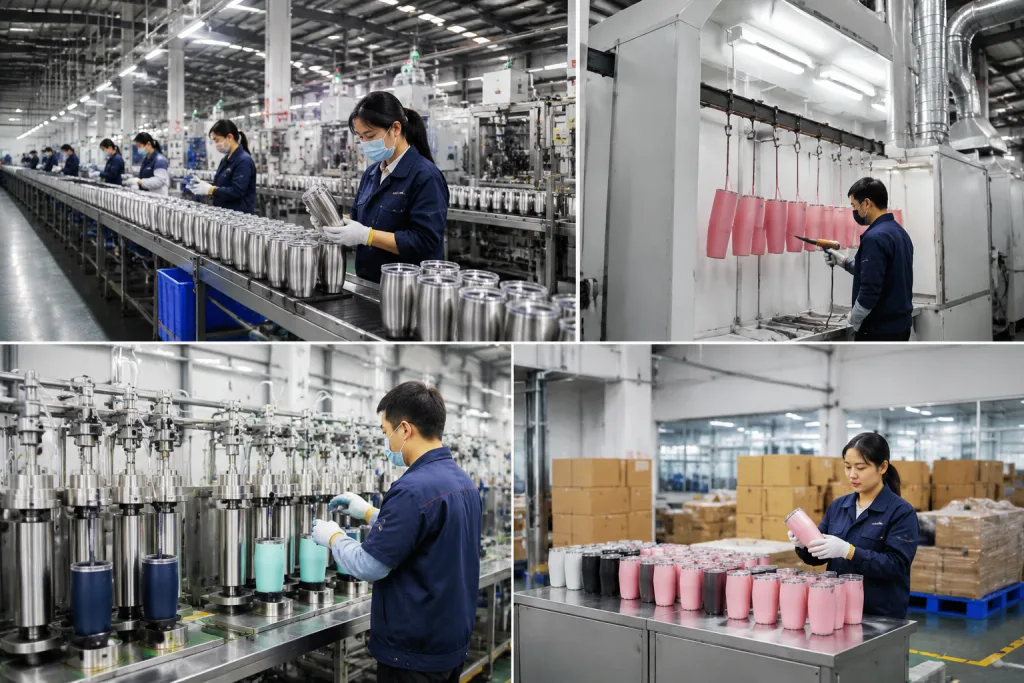
- A well-run canteen factory in Zhejiang should be able to produce 300,000-500,000 units per month across drinkware lines, not just quote them.
If you are sourcing manufacturers stainless steel tumbler products, finding a factory is the easy part. The real question is what to lock first: wall build, lid type, print method, compliance files, and whether the supplier can ship on the date on the PO without asking for a spec revision on day 3. We have seen a buyer accept a nice sample, then the mass order came in with a typo on the carton mark and the line had to stop.
In Zhejiang and across China, plenty of factories can send a quote in 24 hours. Fewer can hold a 500-unit MOQ, keep a 35-day lead time, and keep coating, vacuum performance, and packing stable across repeat orders. QC pulled the sample on a 0.35 mm wall spec and the numbers drifted after the second run; that is the sort of miss that costs money. You need a buyer checklist, not a product list. That is the right way to run a custom drinkware program without filling a container with rework.
Start With The Use Case
Before you ask for price, define the job. A 20 oz tumbler for office gifting is not the same piece as a 32 oz insulated cup for field crews or a powder-coated travel tumbler for retail shelves. We run these on different lines. The first call is whether you are buying for customized drinkware performance, brand value, or channel margin. That choice sets wall thickness, lid style, packing spec, and how much defect risk you can live with. On one order, a buyer flagged a 1.2 mm wall as too thin after QC pulled the sample and found dent marks at the seam.
If your customer is a distributor canteen buyer or a bulk corporate program, repeatability matters more than a fancy curve line. If you are a retail brand, finish quality and decoration area beat the lowest FOB quote. A canteen distributor usually wants the same lid torque and the same box count on every reorder. A canteen vendor serving promotions may accept simpler tooling if the order is spread across 8 SKUs and the MOQ is low. We have seen the math fail when someone asks for retail looks on a promo budget.
Use these four filters early:
- Capacity: 12 oz, 16 oz, 20 oz, 30 oz, or 40 oz changes box size and freight density.
- Channel: corporate gift, e-commerce, food service, or retail shelf.
- Decoration: screen print, laser engraving, heat transfer, or full-color wrap.
- Compliance: EU food contact, FDA expectations, and any retailer test protocol.
Once you know the use case, you stop comparing the wrong samples. A custom canteen for a B2B promo campaign can be built differently from a customized canteen for an outdoor brand, even if both start with the same stainless body. Last month, one PO came in with a 30 oz spec but a 20 oz carton code; the buyer caught it before the line ran, and that saved a week.
Judge The Body, Not The Brochure
The body structure decides whether the tumbler behaves like a real product or a cheap blank. Ask for the exact steel grade, wall gauge, seam method, and vacuum spec. On the line, we check the seam under a borescope before the shell goes into the press. Most reputable canteen manufacturers in China use 304 stainless for food-contact interiors. For lower-cost lines, 201 stainless may show up on the outer shell or in non-food-contact parts, but vague wording is where buyers get burned.
For a standard insulated tumbler, a workable spec is 18/8 stainless steel, 0.5 mm inner wall, 0.4-0.5 mm outer wall, and a vacuum layer of roughly 2-3 mm. That looks small on paper. The math still moves your reject rate. It affects heat retention, dent resistance, and how often QC pulls a sample that fails after shipping. Thin steel can hold the quote down, but then you eat coating failure, ovality, and dent claims from freight damage.
Ask the canteen factory for three things, not one:
- Cross-section photos of the body.
- Vacuum leak test method and pass rate.
- Thermal test data, usually based on hot-fill and ambient conditions.
A canteen supplier that sends only a pretty render is selling marketing. A real canteen manufacturer should tell you how many minutes the product stays above 60 C or below 10 C under a defined test setup. We have seen buyers flag a PO typo on the wall thickness, then the sample and the production lot stop matching. If they cannot give you those numbers, the sheet is not a procurement sheet; it is a brochure.
Price Depends On Decoration And Tools
FOB is never one fixed number. Shape, lid, coating, and print method all move it. For a plain 20 oz double-wall tumbler, a China factory quote often lands around USD 2.10-3.40 FOB at 1,000 pcs. Add powder coating, laser logo, and a better lid, and the number can climb to USD 3.80-5.20. We run this every week. If the order is for a canteen promo campaign, the logo bill often matters more than the shell cost because the mark has to read from 3 to 5 meters away.
Decide early whether you want customizable canteen structure or only surface customization. That is the right question. A customizable drinkware program with interchangeable lids or sleeves helps distributors, but tooling adds cash and weeks. We had one buyer flag a PO typo on “wide mouth” and the correction changed the mold plan. A customized growler with handle and wide mouth may need separate mold work, while a custom growler blank from an existing mold cuts startup cost and gets samples out faster.
Price drivers to watch:
- Coating: solid powder coat, spray paint, or ombré finish; the line treats each one differently.
- Logo method: one-color silk screen is cheaper than wrap print or laser on two or three positions.
- Lid: PP, Tritan, sliding lid, flip lid, or straw lid.
- Packing: bulk tray, retail box, barcode label, or FNSKU application.
For B2B buyers, low unit price only works when landed cost works. A canteen distributor ordering 20,000 pcs should ask for carton optimization, pallet count, and whether the factory can cut air space by changing the carton layout. QC pulled the sample last month and found 18% void space in one export carton. In China, that freight waste is where the margin disappears.
Compliance Is Not Optional
If you sell into Europe or North America, compliance is not paperwork on the side. It is part of supplier qualification. Ask for material declarations, food-contact statements, and test reports tied to the exact SKU, not a similar tumbler with the same lid. For stainless drinkware, we run REACH, LFGB, FDA-related food-contact checks, and migration testing through an accredited lab. If the tumbler has paint or coating, ask for heavy metal and adhesion results too.
Generic files from a canteen vendor do not pass a buyer review. They are weak files, full stop. The supplier should show batch traceability, resin or coating lot numbers where relevant, and the same model code across sample, packing list, and report. We have seen this go sideways when the PO said 500 ml but the test report covered a 450 ml cup. If your customer asks for customized drinkware for retail, they may also want carton drop-test standards, barcode verification, and packaging artwork approval.
Use a simple approval stack:
- Pre-production sample: confirm dimensions, lid fit, logo placement.
- Golden sample: lock color, finish, and print standard.
- Mass inspection: AQL 2.5 for major defects, 4.0 for minor defects is common in drinkware programs.
A canteen manufacturer in Zhejiang that knows the line will say what is tested in-house and what goes to an outside lab. That is the right answer. QC pulled the sample, checked the 2 mm logo offset, and found the spec sheet had the wrong coating code once already. That kind of discipline matters more than a lower quote from a factory with messy document control.
Lead Time And Capacity Decide Reliability
Procurement teams often stare at the sample and skip the production line. That is the wrong question. Ask how many units the factory ships each month, how many polishing lines run, and how many vacuum welding stations are live. A Zhejiang plant that cannot answer monthly output by product family is guessing, not quoting. For a mid-size stainless tumbler program, 300,000-500,000 units per month across all lines is a workable scale check.
Lead time needs a breakdown. Sampling usually takes 7-15 days. Tooling, if needed, takes 20-35 days. Mass production for a repeat order often lands at 25-35 days after sample approval and deposit. We had a buyer flag a PO typo once, the box count changed from 5,000 to 50,000, and the schedule slipped two days while we fixed the carton plan. If a supplier claims 10 days for a fully customized canteen with new artwork, new lid color, and new box print, the math does not work. Stock goods are a different case.
Pressure-test the schedule with these questions:
- How many days from artwork approval to pre-production sample?
- What is the backup if coating curing on the line is delayed?
- What happens if carton printing or label files change late?
Reliable canteen suppliers plan around bottlenecks. Unreliable ones wait and hope. You want the first type, especially if the order depends on seasonal sell-in or a fixed event date.
Choose The Right Supplier Type
Not every source fits the job. A canteen supplier, a canteen manufacturer, and a canteen distributor may all sell the same-looking item, but the economics are different. A canteen manufacturer gives you control on tooling, 0.8 mm wall thickness, and line scheduling. A distributor handles low-volume sourcing and mixed-SKU buying faster. A canteen vendor works when you need stock on the shelf and a 7-day refill cycle.
For repeat business, go straight to the factory when the SKU matters. For a promotion with 3,000 pieces across five variants, a distributor can save time because they can consolidate the load in one PO. For private label retail, a factory is usually the better base because you need ownership of your artwork, molds, and packaging specs. We saw this go sideways on a 2,400-piece order when the buyer flagged a lid typo after print approval. That is the wrong question to ask if you are chasing the lowest unit price; the real issue is who owns the mold and who answers when QC pulls the sample.
A practical sourcing matrix looks like this:
- Factory direct: best for margin, control, and custom molds.
- Distributor channel: best for mixed orders and faster small-batch buying.
- Vendor stock model: best for urgent campaigns with limited changes.
In Zhejiang, we run into factories with export trading teams every week, and that does make communication easier for overseas buyers. Still, the quote sheet is not proof. Ask for plant photos, production process videos, and recent audit records. One factory can show a polished office and still outsource the line. If the answer stays vague, treat the source as a broker until proven otherwise.
Build For Reorders, Not Just First Orders
The buyers who know the game do not optimize for the first carton. They optimize for the second PO, the third PO, and the fifth. Same artwork file. Same Pantone reference. Same lid code. Same carton master. On the line, that is what keeps a 12-day repeat run from turning into an 18-day cleanup job. If you are running a customized drinkware program, make the factory record the critical dimensions and print positions in the order file, down to the 0.5 mm callouts.
For distributor drinkware programs, reorder stability is the money. A canteen distributor buyer or a distributor canteen buyer usually loses a week when every replenishment opens the same old argument. We have seen a PO typo on a lid code cost a full sampling round, and that is the wrong question to ask at reorder stage. Lock these items:
- Logo file: vector format, one approved color reference.
- Packaging: one carton spec with confirmed drop test.
- Inspection: agreed defect list and photo standards.
- Spare parts: lid seals, straws, and replacement caps where relevant.
Do the same for larger format products. A custom growler, customized growler, or customizable canteen should not be treated like one-off novelty stock if you expect annual reorders. QC pulled the sample on a 64 mm mouth opening once and found the lid fit was off by 1.2 mm; the buyer flagged it before we shipped. The better canteen manufacturers archive your production settings and keep a repeat order from turning into a new project. That is the difference between a supplier and a long-term manufacturing partner in China.
Send Your Spec, Get A Real Quote
Share capacity, lid type, logo method, and target market. We will quote from China with clear MOQ, lead time, and compliance details.
Frequently asked questions
What MOQ should I expect from manufacturers stainless steel tumbler suppliers?
For a normal custom tumbler, expect 500-1,000 pcs per SKU as a realistic MOQ. Some canteen manufacturers will quote 300 pcs for stock bodies with simple logo print, but once you add a custom lid color, box print, or new coating, the MOQ rises quickly. Tooling-heavy items can need 3,000 pcs or more to make the price work. If a factory in Zhejiang offers 100 pcs with full customization, check whether they are reselling stock rather than producing it. A serious project should also allow 7-15 days for samples and 25-35 days for mass production after approval.
How do I compare FOB prices across Chinese suppliers?
Do not compare the quote line only. Ask each canteen supplier to break out body, lid, logo, packaging, and testing. A 20 oz insulated tumbler may look like USD 2.20 FOB from one canteen vendor and USD 3.10 from another, but the cheaper quote may exclude packing, carton print, or compliance documents. For North America and Europe, the landed cost also changes with carton efficiency and pallet count. If you are buying 10,000 pcs or more, ask for a proforma invoice with exact packaging dimensions and a test report list. That is where the real comparison starts.
What compliance documents should I request for Europe and North America?
At minimum, request food-contact declarations, REACH-related material statements, and a test report that matches the exact SKU. If the item has coatings or print, ask for migration, adhesion, and heavy metal results where applicable. For EU retail programs, LFGB-style expectations are common, and for U.S. buyers, the factory should understand FDA food-contact expectations even if the final testing path is different. Also ask for batch traceability and the date code system. If the canteen manufacturer cannot link the report to the exact artwork, lid, and coating, the document is not useful.
Should I buy from a factory or a distributor?
Buy from a factory when the product is strategic, repeatable, or tooling-sensitive. Buy from a distributor when you need mixed quantities, faster market testing, or a low-risk reorder on a stock item. A canteen distributor can help with a distributor drinkware bundle across multiple SKUs, but the margin is usually thinner and control is lower. A canteen factory in China gives you better access to mold changes, surface finish control, and packaging ownership. For private label programs, factory direct is usually the better path unless your order is too small to justify the setup.
Can I source canteen custom and growler items from the same factory?
Yes, if the plant has multiple forming lines and matching decoration capability. Many stainless drinkware factories in Zhejiang can handle canteen custom work, custom growler orders, and standard tumblers in one export program. The issue is not whether they can list the products; it is whether they can maintain consistent vacuum quality, lid fit, and coating across different body shapes. Ask for monthly output by line, not a generic total. A factory making 300,000-500,000 units per month across drinkware can usually support mixed programs, but only if the scheduling discipline is real.