Key Takeaways
- MOQ for a standard custom thermos usually starts at 1,000-3,000 pcs, while fully customized lids or molds often need 5,000+ pcs.
- Typical FOB pricing for a 500 ml stainless thermos runs about USD 2.80-6.80 depending on steel, finish, and accessory complexity.
- A realistic factory lead time is 25-35 days for standard decorated orders and 45-60 days when tooling, new molds, or special packaging are involved.
- For promotional thermos programs, decoration can add 0.12-0.45 USD per unit, while premium retail packing can add 0.20-0.70 USD per unit.
If you are sourcing from manufacturers stainless steel bottle factories, the first question is not whether the sample looks good. It is what the landed cost will be at 500, 3,000, or 10,000 units, and how long the order will sit before it ships. We run this math every week in Zhejiang. A 500-piece trial and a 10,000-piece repeat are different jobs, and the line will price them that way because steel grade, wall thickness, lid tooling, coating, decoration, and test load all move the number.
That is the part buyers miss. A clean spec sheet does not save margin. We have seen a PO typo turn a matte black bottle into gloss black, and the buyer flagged it only after QC pulled the sample against the 25 mm neck drawing. A custom thermos can work as a tight-margin item or a solid program, but the math does not work if MOQ, logo method, and freight timing are left vague. A factory thermos at USD 3.20 for 5,000 units can land at USD 4.60 once you add a vacuum leak test report, matte powder coat, laser logo, and an upgraded flip lid.
What Actually Moves the Price
Buyers usually ask for unit price first. That is the wrong question to ask. A quote for a custom thermos hangs on five levers: steel grade, vacuum structure, lid parts, surface finish, and decoration. We run samples on the line every week, and a plain 304 stainless body with one-color screen print does not sit in the same cost bucket as a double-wall vacuum bottle with 18/8 steel inside and outside, powder coating, and a locking lid.
Material choice is the first split. 304 stainless is the baseline for a manufacturer thermos, while 316 adds cost and only makes sense when the buyer wants better corrosion resistance or a premium spec. Wall thickness changes the math too. A body at 0.35 mm is cheaper than 0.45 mm, but the thicker tube feels better in hand and takes dents better in carton drop tests. We had a buyer flag a PO once because they wrote 0.4 mm on the drawing and 0.35 mm on the order, and QC pulled the sample before we packed it. A three-part lid with silicone, spring, and release button can add USD 0.40-1.20 per unit out of Zhejiang, and that number is not guesswork.
Decoration is where margin gets away from people. One-color silk screen stays cheap for thermos bulk orders. Laser engraving costs more, but it gives a clean mark that does not wear off after 200 washes. Full-color heat transfer, UV print, or wrapped artwork adds setup and handwork, and the math stops looking friendly fast. We saw this go sideways on a 5,000-piece promotion order: the buyer wanted full-wrap art, then pushed back on the unit price after proofing. If the bottle is for giveaways, keep the decoration simple and spend the money on carton quality or a better-shaped body.
- Basic factory thermos: 304 steel, screw lid, one-color print.
- Mid-tier custom thermos: powder coat, laser logo, upgraded lid.
- Premium customized thermos: 316 insert, special finish, custom packaging, extra testing.
Typical FOB Price Bands
For outdoor retailers and promotional brands, price bands work better than chasing a single “best” quote. A standard 500 ml thermos bulk order from China or Zhejiang usually lands in a few usable ranges. For low spec, we see FOB China at USD 2.80-3.60 per piece for 1,000-3,000 units. Mid-market custom thermos orders usually sit at USD 3.60-5.20. Premium retail-grade bottles, with special lids or dual packaging, often reach USD 5.20-6.80 or more.
That spread is normal. One thermos supplier quoting USD 3.10 and another quoting USD 4.40 are not automatically out of line. The cheaper offer may use thinner steel, a simpler stopper, fewer tests, or a smaller carton spec. We had one PO where the buyer flagged a lid code typo, and QC pulled the sample back because the vacuum retention note was missing. The higher quote may include a better coating process, tighter vacuum retention, and a finish that holds up better on the line. This is the wrong question to ask if you only stare at unit price.
If you are comparing thermos manufacturers, send the same baseline to each factory: capacity, steel grade, inner and outer wall thickness, lid type, logo method, carton count, and test standard. We run this check on the shop floor with a 0.1 mm gauge and the result is usually obvious fast. Without that, you are not comparing thermos offers. You are comparing assumptions.
A useful buying rule: if the quote does not define steel grade, lid type, and carton spec, the price is incomplete.
For a promotional thermos, the cheapest option is not always the smartest. A unit cost that looks low on paper can turn into leakage claims, print wear, or a retail complaint rate that eats the margin later. We have seen this go sideways on a 12-day rush order where the carton spec saved 0.08 USD and cost far more in returns.
MOQ Tiers That Make Sense
MOQ is where a lot of buyers first meet the factory side of the deal. A thermos factory in China may quote 500 pcs for a stock shape, then move that number fast once you ask for custom color, a new print, or a different lid. We see it on the line all the time. For planning, use three tiers. At 500-1,000 pcs, you are usually buying a low-complexity promotional thermos with tight options. At 1,000-3,000 pcs, you can usually build a stable custom thermos program with your logo, custom color, and retail carton. At 5,000 pcs and above, the factory is more open to new tooling, special packaging, and mixed-color production.
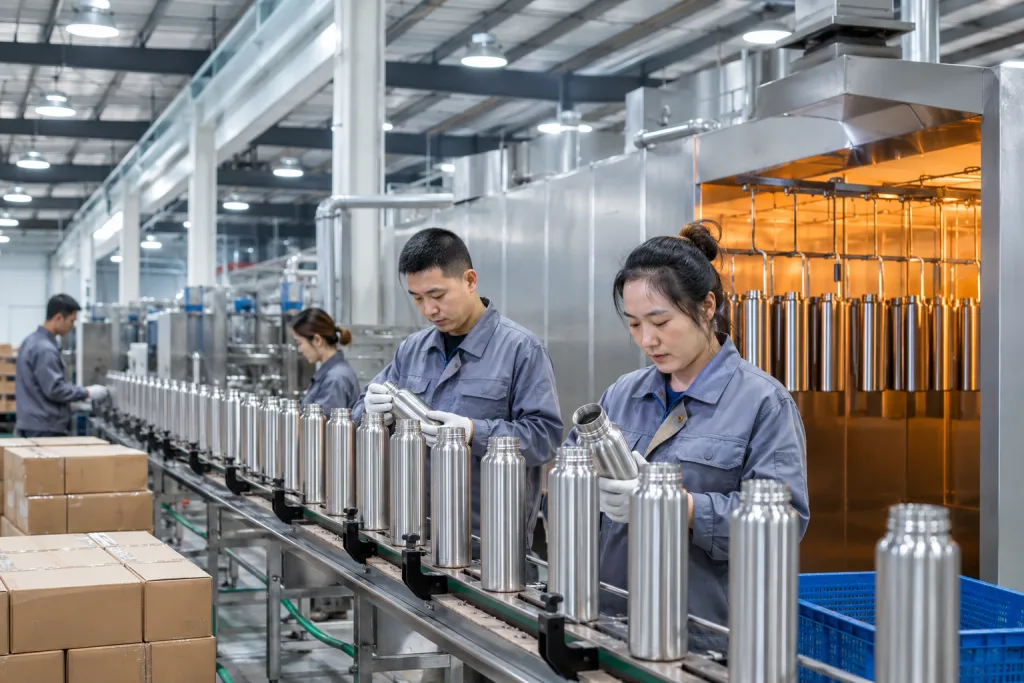
The MOQ climbs for a simple reason: setup time costs money. Printing screens need prep, coating changeovers need cleaning, carton sourcing needs confirmation, and line balancing still has to be reset. A manufacturer stainless steel bottle line can run high volume, but a small order still takes the same setup work. We have seen a buyer push back on a 700 pcs order, then the QC pull showed the carton insert alone needed a separate 2-hour changeover. In a Zhejiang thermos factory producing 300,000-500,000 units per month across several SKUs, the production team wants a run length that pays for the line change.
For distributors thermos programs, ask whether MOQ applies per color, per logo version, or per carton style. A “1,000 pcs MOQ” may actually mean 1,000 pcs per color and 1,000 pcs per artwork version. That is the wrong question to skip. Check the PO carefully; one buyer once sent “navy blue” while the sample record said “deep blue,” and the line had to stop until the paint card was matched. If you sell to retail chains, keep the SKU tree simple: one body color, one lid color, one logo method. That keeps your thermos customized order clean and your inventory manageable.
- 500-1,000 pcs: stock shape, simple print, limited color choices.
- 1,000-3,000 pcs: common MOQ for bulk thermos programs.
- 5,000+ pcs: better for mold changes, special lids, and retailer-specific packaging.
Lead Time by Order Type
Lead time is not one number. It changes with the order route: stock pull, overprint on existing inventory, or a fresh run from raw tube to finished carton. For a standard custom thermos with an existing mold, we usually quote 25-35 days after sample approval and deposit. If the buyer wants a new lid, a new coating color, or retail packaging with inserts, 35-45 days is the safer call. New mold work, new accessory tooling, or a stricter compliance file pushes that to 45-60 days. The math does not move because the PO is urgent.
That timing is normal for a thermos supplier in Zhejiang or elsewhere in China because the line runs in sequence. Tube forming, welding, vacuum sealing, leak testing, surface finishing, logo application, packing, and carton drop testing each take their slot. On a 304 stainless run, QC pulled the sample at 8:40 a.m. and still found a 0.3 mm lid gap before packing. Peak season bites too, especially before summer outdoor promotions or Q4 retail pushes, when capacity gets tight. We have seen buyers lose 7-10 days just because final artwork landed after the order was already half ready.
Sample lead time and mass production lead time are different. A sample for a thermos manufacturer may take 7-12 days if it uses existing parts, but 15-20 days if it needs exact color matching or custom tooling. The buyer flagged it once on a PO typo: "matte sliver" instead of "matte silver," and that small error cost two extra days on the proof. If launch timing matters, lock the artwork and carton dieline early. Do not treat the sample as a side task. It sits on the production clock.
For importers handling bulk thermos replenishment, freight belongs in the schedule from day one. Sea transit from China to North America or Europe can add 20-40 days depending on lane and season. A carton spec that looks fine on paper can fail a 1.2 m drop test and force a re-pack, which is another day lost. If your custom thermos must hit a shelf by a fixed date, back-plan from store delivery, not factory finish. That is the right question to ask.
Compliance, Testing, and Claims
Compliance is the unglamorous part of sourcing, and it is where serious thermos distributors separate from casual importers. If a bottle touches food and drink in the US or EU, ask for material declarations and the test report numbers, not a sales PDF. For Europe, REACH and food-contact declarations matter. For the US, buyers often ask for FDA food-contact suitability, and sometimes ASTM references when the claim is about performance. We saw a PO once with “FDA approved” typed in red; the buyer flagged it, because that phrasing is wrong and the math on liability does not work.
Do not assume every thermos factory in China is equal here. A working thermos line should show vacuum retention data, lid leak testing, coating adhesion results, and carton drop test records. If the supplier cannot say whether they hold 12 hours or 18 hours on the same test setup, the claim is soft. QC pulled the sample, checked a 1.5 mm lid seal gap, and the reading told us more than the brochure did. That is the wrong question to ask of a promo bottle: not whether the copy sounds strong, but whether the test method is repeatable.
For buyer-side control, ask for AQL inspection terms before production starts. Common export programs use AQL 2.5 for major defects and 4.0 for minor defects, but the right level depends on your risk and price point. If you are buying thermos bulk for a retail chain, write the inspection standard into the purchase order, down to the carton count and defect list. We ship a lot of 3,000 pcs MOQ orders this way, and it keeps both sides honest when the line is moving fast.
What to request
- Material declaration for 304 or 316 stainless
- Food-contact and REACH-related documentation where applicable
- Leak test and vacuum retention data
- Carton drop test or transit test summary
- AQL inspection agreement before mass production
How to Brief a Factory Cleanly
Good quotes come from a good brief. If you want accurate pricing from a thermos supplier, send the same package every time: capacity, body material, inner and outer wall thickness, lid style, finish, logo method, color code, carton spec, test requirement, and target delivery date. That is the gap between a usable offer and a rough guess. On our side, QC pulled the sample and checked the lid fit at 0.2 mm before the quote went out. A serious thermos team can turn a complete brief into a usable quote within 24-72 hours. A vague brief can burn a week.
For a custom thermos program, the fastest way to get control is to narrow the choices. Pick one capacity first, usually 350 ml, 500 ml, or 750 ml. Pick one decoration method. Pick one carton format. Then ask the thermos manufacturer to quote a standard option and an upgraded option. That gives you a clean price ladder. Your distributor thermos margin becomes easier to calculate because you can see where the extra USD 0.30, USD 0.80, or USD 1.50 comes from. We ship this way all the time. The math works.
When you are sourcing from China, especially Zhejiang, avoid endless revisions before you have a baseline. Every change resets part of the line. The factory can do it, but the lead time and pricing move. We saw a buyer flag a PO typo once, and one missing lid code turned into a full rework request. A focused brief also helps you compare thermos customizable options across different factories without drowning in incomplete data.
The practical buyer’s question is simple: what do I need to sell this at retail or in a promotion and still make money? If the answer is not visible in the brief, the sourcing work is not finished. This is the wrong question to ask only at the end. Put it in the first RFQ, and the factory can quote against the real target, not a wish.
Get a real thermos quote, not a guess
Send your capacity, lid type, artwork, and target MOQ. We can price a custom thermos program with clear factory terms from Zhejiang, China.
Frequently asked questions
What is a realistic MOQ for a custom stainless thermos?
For most export programs, expect 1,000-3,000 pcs for a standard custom thermos with logo and one color, and 5,000 pcs or more if you want new tooling, special lids, or custom packaging. Some thermos factory lines will accept 500 pcs on a stock body, but the unit price usually rises 10%-25% because setup cost is spread across fewer pieces. If you are buying for retail, a tighter SKU plan usually matters more than chasing a low MOQ on paper.
How much should I budget for FOB China pricing?
A 500 ml stainless steel bottle or thermos commonly lands around USD 2.80-6.80 FOB China depending on steel grade, wall thickness, lid type, finish, and decoration. Simple promotional thermos orders sit near the bottom of that range. Better retail-grade custom thermos models with powder coating, laser logo, and upgraded lids sit in the middle or high end. Ask for a quote that separates product price, decoration, packaging, and testing so you can see the true cost driver.
How long does production take after I approve the sample?
Standard mass production usually takes 25-35 days after sample approval and deposit. If you add a new lid, special coating, or custom packaging, plan for 35-45 days. If the project needs tooling changes, it can stretch to 45-60 days. That is for the factory side only. Sea freight from China to Europe or North America can add another 20-40 days depending on lane and season, so build the calendar backwards from your delivery date.
What quality checks should I ask for?
Ask for leak testing, vacuum retention data, coating adhesion results, and carton drop test records. For export programs, many buyers specify AQL 2.5 for major defects and 4.0 for minor defects, though your risk level may justify tighter control. If the thermos manufacturer is serious, they should also be able to provide food-contact declarations, REACH-related documents for Europe, and factory audit records such as BSCI or ISO where applicable.
Is laser engraving better than silk screen for branding?
For long-term durability, laser engraving is usually better because it does not peel or wear like surface print. It also looks cleaner on brushed or matte stainless surfaces. Silk screen is cheaper, often by USD 0.05-0.20 per piece on simple runs, and it works well for promotional thermos orders where cost is the priority. If your brand sells through retail, laser tends to age better. If the bottle is a giveaway, silk screen is often the smarter spend.