Key Takeaways
- Typical MOQ for a custom sports water bottle is 3,000-5,000 pcs, with sample lead time around 7-10 days
- Factory pricing for a bulk fitness water bottle can start around USD 0.85-2.40 depending on material, lid, and print
- A serious Zhejiang supplier should state monthly capacity, often 300,000-800,000 units, plus AQL 2.5 inspection terms
- REACH, FDA food-contact, LFGB, and ISO 9001 matter more than a glossy catalog when you buy bulk sports water bottle programs
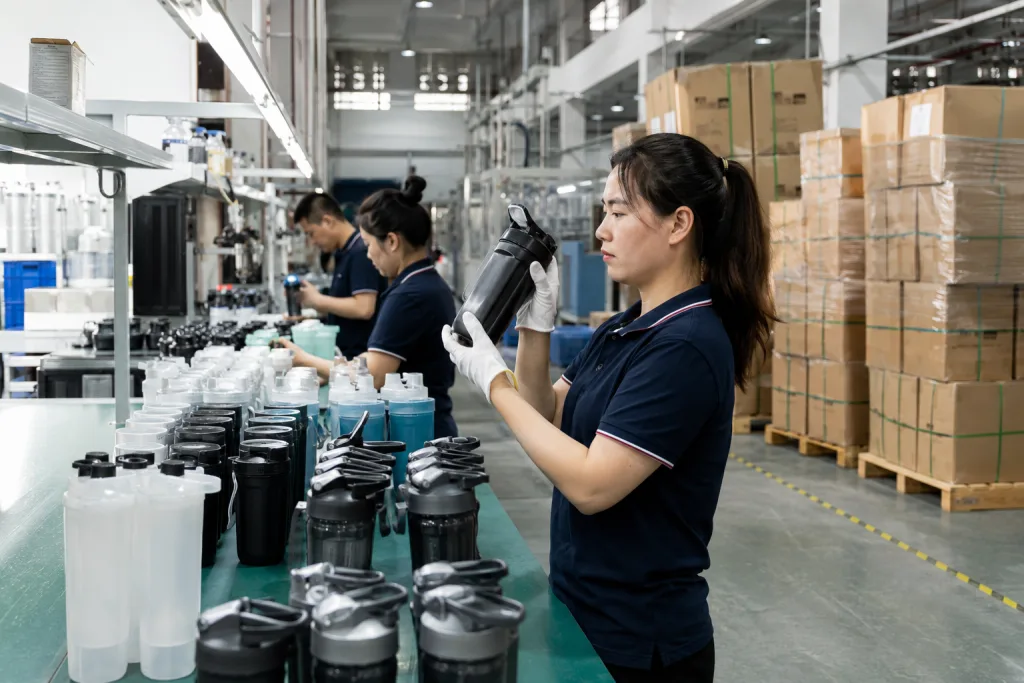
If you are buying a manufacturers sports water bottle program for a fitness brand or gym chain, the real problem is not finding a supplier. It is sorting a workable factory from a polished sales deck. We run this line in Zhejiang, China, and the first thing buyers ask us is usually the thing that saves the job: fill volume, cap torque, print wear, and a price that still works at 3,000 or 30,000 units. QC pulled the sample, shook it for 30 seconds, and the lid still wept at the hinge. That is the kind of miss that shows up after the sample stage, when the mass order lands with soft lids, off-color logos, or PP and Tritan parts that do not match the approved board.
The buyers who do best bring a clean spec and a hard MOQ check early. The math does not work any other way. For custom sports water bottle orders, we want mold ownership clear, food-contact compliance on file, AQL targets written down, and freight terms settled before artwork starts. A PO typo on one job moved the neck size from 28 mm to 30 mm, and the buyer flagged it before we cut steel. The bottle is simple. The order is not.
What you should ask first
Start with the use case, not the color. A 5,000-piece gym giveaway bottle and a retail custom fitness bottle are not the same job. Locker room use means drop resistance, one-hand opening, and dishwasher tolerance. Retail means cleaner decoration, tighter cosmetic control, and barcoded packs that pass receiving without a fight.
Ask for six numbers before artwork: capacity, MOQ, sample lead time, bulk lead time, monthly output, and carton size. A Zhejiang factory that runs this line can answer fast. On a standard 750 ml customizable sports water bottle in PP or Tritan, we often see a 3,000 pcs MOQ, 7-10 days for samples, and 25-35 days for bulk after approval. If the seller gets fuzzy here, the math does not work.
- Confirm whether the bottle is single-wall, double-wall, or insulated.
- Ask for the closure type: flip-top, screw cap, flip straw, or shaker lid.
- Request the material declaration with resin grade and color masterbatch.
- Get the quote on FOB Ningbo or FOB Shanghai, not only ex-factory.
Checklist: if the supplier cannot state cap torque, wall thickness, or carton count, they are selling the look, not process control. QC pulled the sample on this one. The buyer flagged it for a 0.3 mm wall variance, and that is the sort of miss that turns into returns.
How pricing really breaks down
Price comes down to resin, tooling, decoration, and labor. A basic bulk sports water bottle in PP with one-color silkscreen usually lands around USD 0.85-1.20 at 5,000 pcs. Move to Tritan, a leak-resistant cap, and a two-color print, and the quote often moves into the USD 1.40-2.40 range. Add a custom logo shaker bottle with a mixing ball, inner grid, and premium packaging, and the number climbs again. We ran a batch last month where the PO had the cap code typed wrong, and that single typo changed the tooling check. The real job is not hunting the cheapest quote. It is seeing what drives it.
For a custom gym water bottle program, ask the supplier to split the quote line by line: bottle body, lid, gasket, printing, packaging, carton. Then you can compare offers from different China factories on the same basis. In Zhejiang, we run the same injection line across multiple orders to cut idle time, but that only helps when your spec fits the existing mold and does not call for a special insert. The buyer flagged a 28 mm cap drawing on one job because the seal groove looked standard, yet the insert pushed the unit cost up by USD 0.18. That is the wrong question to ask if you only want a single number.
Buyers who only ask for a unit price usually pay for uncertainty later. Buyers who ask for a component breakdown can negotiate with facts.
For distributor sports water bottle orders, freight matters too. A 20-foot container from China can move landed cost by 8-18% depending on season and route, so compare FOB and landed pricing before you sign off. We shipped one route through Ningbo that looked cheap on paper, then port space tightened and the math did not work once the ocean bill hit. Ask for the carton count, pallet size, and cube per case before you compare quotes. That is where the hidden cost sits.
What materials make sense
Material choice should match the sales channel and the price point. PP is light, cheap, and works for a bulk fitness water bottle used in promotions or member gifts. Tritan fits when the buyer wants a clearer bottle with a retail look and better impact resistance. Stainless steel suits premium programs, but it pushes cost up and changes the production schedule by 7 to 14 days. PET shows up in low-cost clear bottles, but it is weak on durability and hot-fill tolerance.
For a customizable gym water bottle, wall thickness is not a side note. A PP sports bottle usually runs 1.0-1.5 mm on the body, while Tritan sits around 2.0-2.5 mm depending on the shape. If the factory cannot give you the thickness range, the line is probably not stable from cavity to cavity. We have seen that go sideways. For a customizable shaker bottle, check whether the mixing insert is PP or stainless steel and whether the lid still seals after repeated compression. QC pulled one sample at 500 open-close cycles; it looked fine on day one and started weeping at the cap by week two.
- PP: lowest cost, practical for promotions, usually the first choice for MOQ 3,000.
- Tritan: clearer, tougher, better for retail shelves and repeat-use programs.
- Stainless steel: premium, heavier, slower to run, and shipping usually needs stronger packing.
- PET: budget clear bottle, limited durability, better for short campaigns than long use.
For custom made shaker bottle programs, ask for migration data and odor test results if your market cares about taste transfer. The buyer flagged one PO typo on the resin grade before, and that kind of mistake is exactly how a clean sample turns into a claim later.
Compliance is not optional
If you are shipping into Europe or North America, compliance sits in the purchase order, not in an attachment nobody reads. A serious factory should know REACH, LFGB, FDA food-contact requirements, and basic ISO 9001 process control. For gym chains and fitness brands, we still ask for BSCI when the channel goes through retail or hospitality. I have seen the buyer flag it on a 5,000-piece order, and the deal stalled on paperwork, not price.
Do not treat one lab report as proof. A 2023 report tells you little if the resin lot changed or the print ink switched on line 2. Ask for the current material declaration, the test scope, and whether the report covers the exact build. If you buy a custom shaker bottle with a metal ball and flip lid, the report should cover that full assembly. A PO typo on the lid code can create a mess later, and we have seen that go sideways in Zhejiang plants that ship every week.
What to verify:
- Food-contact declaration for body, lid, and gasket.
- REACH or LFGB coverage for your market.
- Lead, phthalates, and BPA-free statements where applicable.
- Traceable lot coding for recalls or field issues.
If your buyer team handles private label, this is where customizable fitness water bottle sourcing becomes either a clean repeat order or a costly correction.
How to judge a real factory
A real factory answers production questions without stalling. Ask how many units per month they run, how many lines are on the floor, and who pays if your bottle needs a new mold. On a mid-size Zhejiang shop floor, 300,000-800,000 units per month is a believable band for mixed sports bottle output, but only if the decoration mix stays steady. We have seen traders dodge that number when they are borrowing capacity.
Check the details people skip. Are three samples matched piece for piece? Does the cap lock with a clean stop? Is the logo centered within 1 mm? Did the carton pass a drop test at 76 cm? For a distributor shaker bottle order, we ask for a pre-production checklist and a photo report before the first box ships. If the buyer flags a typo on the PO and the supplier gets defensive, that tells you enough.
Factory checklist:
- ISO 9001 or equivalent process system.
- In-house injection, assembly, and print control.
- Tooling ownership clarified in writing.
- AQL 2.5 general inspection for critical defects.
- Sample approval signed before bulk starts.
When you compare manufacturers sports water bottle offers, the lowest quote is often the wrong question to ask. The real test is whether the factory can explain variation control in plain terms, down to the 0.3 mm print shift and the 24-hour cap fit check. That is what separates a dependable bulk gym water bottle partner from a one-off seller.
Decoration changes the whole job
Decoration is where a lot of jobs go off the rails. A one-color silkscreen on a custom sports water bottle is cheap and holds up, but it has a hard ceiling on detail and color count. Laser engraving runs clean on stainless steel and some coated bodies, but it does not read well on every material. Heat transfer and full wrap printing give better coverage, yet they add setup steps and more chances for the artwork to drift 1 to 2 mm on the line.
If your brand wants a custom logo shaker bottle for retail or club merchandising, ask for decoration samples on the exact substrate. We have seen a logo look crisp on white PP and then vanish on translucent Tritan. Soft-touch coating feels premium in the hand, and the buyer flagged it as a cleaning problem after one gym trial. For a custom fitness water bottle that gets reordered every quarter, repeatability beats a one-off visual stunt.
Decide on the decoration method before you lock the mold. Change the logo position after tooling is built, and you burn time and money fast. We had one PO where the buyer changed the art file after the mold was cut, and the rework pushed delivery by 11 days. A solid China supplier should show print tolerance, Pantone matching range, and maximum decoration area in millimeters, not vague “large logo” talk.
For a bulk shaker bottle program, ask whether the measuring marks are molded-in or printed. Molded-in marks stay readable through use. Printed marks cost less, but QC pulled the sample and the ink started rubbing off after a few wash cycles.
Ordering without surprises
The cleanest procurement process is simple: sample, spec sheet, approval, deposit, production, inspection, shipment. The trouble starts when someone skips the spec sheet. For a customized sports water bottle order, your file should include capacity, material, lid type, color codes, logo file format, packaging instruction, and test requirements. We had a buyer send “blue” on a PO once; the line ran Pantone 293C, and the mismatch ate two days. If you sell as a distributor sports water bottle line, add carton labeling, barcode format, and pallet stack limits.
Payment terms in China usually begin with 30% deposit and 70% balance before shipment, though established buyers may negotiate better terms after repeat orders. Lead time from approval to shipment for a standard custom gym water bottle is often 25-35 days. If the supplier promises 10 days on a fully customized program, ask what they are skipping. QC pulled the sample on a 500 ml run last month and found lid color drift after the second heat-transfer pass; that is where the schedule went sideways. Good factories in Zhejiang are fast, but they are not magic.
Use a final inspection before the balance payment. Keep the AQL standard explicit: critical defects at zero, major defects at 2.5, minor defects at 4.0 is a common setup. That gives both sides a working standard. On one 20,000-piece shipment, the buyer flagged three cartons with crushed outer boxes, and the pallet pattern was the real problem, not the bottle. When the order is for distributors fitness water bottle channels, consistent cartons, clean labels, and correct count per master carton are just as important as the bottle itself.
The better you write the order, the less you will spend explaining it later.
Source your next sports bottle with hard numbers
Send your spec, target price, and market. We will quote the right material, MOQ, and lead time from our Zhejiang production line.
Frequently asked questions
What MOQ should I expect for a custom sports water bottle order?
For a standard custom sports water bottle, MOQ is often 3,000-5,000 pcs per design and color. If you need a new mold, complex lid, or multiple Pantone colors, expect the minimum to move higher. For a simple stock mold with custom print, some Zhejiang factories can quote 1,000-2,000 pcs, but unit price usually rises 15-30%. Always separate MOQ for bottle body, lid, and packaging if you are comparing suppliers. That keeps the quote honest.
How much should a bulk gym water bottle cost?
A basic bulk gym water bottle in PP may land around USD 0.85-1.20 at 5,000 pcs. Tritan versions with better lids and print usually run USD 1.40-2.40. A bulk shaker bottle with mixer insert can be higher depending on seal quality and packaging. Shipping, testing, and carton labeling are extra. Ask for FOB Ningbo or FOB Shanghai pricing so you can calculate landed cost properly instead of guessing from ex-factory numbers.
What is a normal lead time from sample to shipment?
For a straightforward custom gym water bottle, sample lead time is usually 7-10 days and bulk production is 25-35 days after approval and deposit. If the order needs a new mold, add 15-25 days for tooling and first trial. Decoration complexity also matters: one-color silkscreen is faster than wrap printing or multi-position logos. A factory in China that promises a complex custom shaker bottle in under 15 days is usually compressing critical steps.
Which compliance documents should I request?
At minimum, ask for food-contact declarations for all wet-contact parts, and current test coverage for REACH, LFGB, or FDA food-contact requirements depending on your market. If you sell in Europe, LFGB and REACH matter more than a generic “passed test” note. For North America, ask how the bottle aligns with FDA food-contact expectations. Also request ISO 9001 if you want process discipline, and BSCI if your customer asks for social compliance on a distributor fitness water bottle program.
How do I know if the supplier is a factory or a trader?
Ask for monthly capacity, machine count, and tooling ownership. A real manufacturers sports water bottle factory can usually tell you how many injection machines, assembly lines, and printing setups they run, plus a believable output range like 300,000-800,000 units per month. Ask for workshop photos with dated production, not just showroom images. If they cannot explain wall thickness, cap material, or AQL inspection terms, they are not managing production directly. They may still quote well, but you need to price in the risk.