Key Takeaways
- Most shaker orders start at 3,000-5,000 pcs; full custom molds usually need 8,000-10,000 pcs and 35-45 days lead time.
- For cold-chain supplement channels, Tritan or copolyester bodies usually price 18%-35% above PP, but they hold graphics and odor control better.
- A leak rate target below 1.0% at AQL 2.5 is realistic for a decent canteen factory or shaker line if lids and seals are tested properly.
- The right spec depends on channel: distributor drinkware wants broad color flexibility, while retail and DTC want stronger branding and lower return risk.
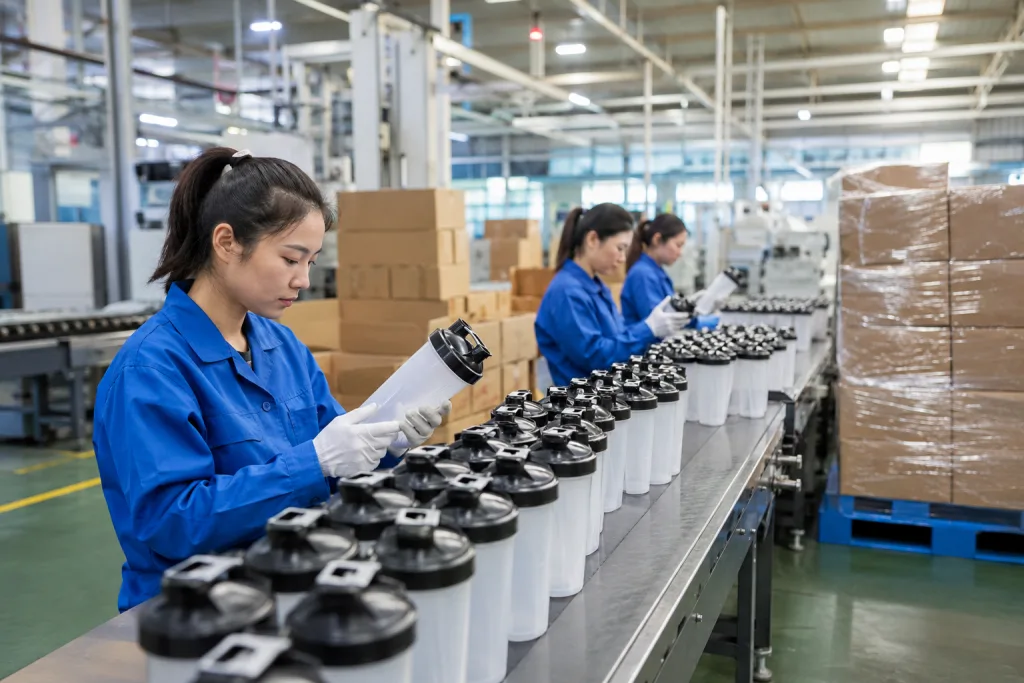
If you are buying manufacturers protein shaker programs for retail, gym chains, Amazon, or promotion, the hard part is not finding a supplier. The hard part is matching the spec to the channel without paying for the wrong details. We have seen a 600 ml shaker pass photo approval and still come back with leakage at the lid after 200 shakes on the line, which is the wrong place to learn that lesson.
In Zhejiang and across China, the better factories do not sell “a shaker.” They sell a stack of decisions: PP or Tritan, 600 ml or 800 ml, wire whisk or blending ball, screw cap or flip top, single-wall or insulated. A 3,000-unit MOQ at FOB USD 1.35 and a 10,000-unit MOQ at USD 0.92 are usually the result of tooling, decoration method, and how much custom work you really need; one buyer even sent a PO with “600ml” typed as “60ml,” and QC pulled the sample before the carton labels went out.
What buyers compare first
When you compare manufacturers protein shaker offers, skip the color chart. Start with the parts that drive failure risk and landed cost. We run this like a procurement sheet on the line: body material, lid architecture, sealing method, decoration, and packout. Those five points decide whether you are buying a commodity shaker or a program that survives retail pressure.
Spec table
| Spec | Budget shaker | Mid-tier retail shaker | Premium branded shaker |
|---|---|---|---|
| Body material | PP | Tritan / copolyester | Tritan with matte or frosted finish |
| Capacity | 500-600 ml | 600-750 ml | 750-1000 ml |
| Closure | Flip cap | Screw cap + flip cap | Threaded lid with gasket and locking spout |
| MOQ | 3,000 pcs | 5,000 pcs | 8,000-10,000 pcs |
| FOB price | USD 0.78-1.20 | USD 1.35-2.40 | USD 2.60-4.80 |
That spread is normal. QC pulled the sample on a 2 mm lid gasket and the cheap build already showed why: the price drops fast when the structure is standard and the print is simple, but a custom shell, silicone grip, or two-color lid pushes the quote up. The buyer flagged it on one PO with a typo on the cap code, then asked for retail-grade leak control at promo pricing. The math does not work.
If you are buying for a canteen distributor or a distributor drinkware program, the useful question is not “What is the cheapest shaker?” It is “Which spec gives me the lowest claim rate at my target margin?” We have seen this go sideways: a buyer saves USD 0.18 a piece, then spends more on returns, relabeling, and phone calls about odor or lid play. A slightly higher unit price usually buys less rework and fewer complaints.
PP versus Tritan builds
Body material is the first real decision. PP is low cost, light, and good enough for a 5,000-piece canteen promo run. Tritan costs more, but it gives cleaner clarity, a tighter retail look, and a stronger story for customizable drinkware. For supermarket shelves, supplement stores, or DTC, the buyer usually pushes for Tritan because it photographs well and the first hand feel is better.
Here is the practical split. On standard shaker molds, PP bodies usually run 0.8-1.1 mm wall thickness. Tritan bodies often sit at 1.0-1.3 mm, depending on the cavity shape and gate position. That extra thickness is not just about strength. It helps with stiffness, mold release, and surface finish, and it changes the weight in hand. We’ve seen buyers reject a sample at 168 g because it felt too light next to a 304 stainless bottle.
- Choose PP when price is the main constraint and the order is for canteen giveaways or entry-level gym packs.
- Choose Tritan when the buyer expects repeat use, clearer walls, and a lower return rate.
- Choose copolyester when you want a middle ground on cost and performance.
A canteen supplier in Zhejiang can usually run both options on the same line, but the decoration and QC plan should change. PP is more forgiving on tooling marks; Tritan needs better polish control on the mold insert, especially around the shoulder. One PO typo we see all the time is the buyer asking for "clear" and approving opaque PP by mistake. If the logo has to look sharp under retail lighting, Tritan is the better call. If the order is for event kits and the math does not work for premium resin, PP is the right answer.
Lid design and leakage risk
Most complaints start at the lid, not the cup. For manufacturers protein shaker sourcing, the lid is the product. A 0.5 mm gasket change or a thread profile that closes the same way every time on the line can decide whether a program runs clean or turns into refunds.
We see three lid setups in the shop. The first is a flip cap over a drinking spout. It is cheap, and the mold is simple, but seal quality lives or dies on hinge fit and gasket compression. The second is a screw cap with a secondary flip top; it holds up better for distributor canteen orders because the carton gets handled, stacked, and reopened in transit. The third uses a threaded closure with a silicone seal ring and a locked spout. It adds cost, and that is the point: buyers choose it when a leak claim costs more than the extra 8-12 cents per set. QC pulled a sample last week with a 0.3 mm mismatch at the hinge, and the buyer flagged it immediately.
Leak testing should not be a vague promise. Ask for a 30-minute inversion test, 1-meter drop test, and an AQL inspection plan at 2.5 for critical defects.
On lead time, the numbers need to be real. A standard shaker structure usually runs 25-35 days; custom lids or color matching push that to 35-45 days. If a factory says it can open a new mold, print the logo, and ship packed cartons in 15 days, the math does not work. We have seen that go sideways because the tooling slot was never booked or the QC team was only checking appearance, not seal failure. For Europe and North America, that shortcut usually lands as a claim on the next container.
Use cases by channel
The same shaker spec does not work across channels. We see it on the line all the time. A distributor buyer wants repeat orders and a clean margin stack. A brand owner pushes for packaging, print impact, and social-ready presentation. A gym chain or supplement label cares about drop resistance and leak control, and the buyer usually flags the lid first. Match the bottle to the channel. Do not force one spec into every program.
| Channel | Best fit | Why it works |
|---|---|---|
| Retail | Tritan 700-900 ml, premium lid, printed scale | Better shelf appeal and lower complaint risk |
| Promotional | PP 500-600 ml, one-color print | Lowest FOB cost and fast turnaround |
| Distributor | Mid-tier copolyester, flexible color batch | Easy to reorder with private-label variation |
| Fitness subscription | Tritan with gasket upgrade | Repeat-use performance and fewer leaks |
If you also sell related items like custom growler, customizable growler, or customized growler programs, the math shifts. Growlers are heavier, more gift-led, and they usually need extra decoration work. We shipped one 64 oz run where the PO typo changed the print position by 8 mm, and QC pulled the sample before packout. A canteen distributor who also runs custom drinkware lines normally keeps shaker SKUs separate from growlers because the carton spec and pallet count are different. Bundling everything into one “sports bottle” quote is the wrong question to ask.
For a canteen manufacturer in Zhejiang, the clean orders are the ones where the buyer names the channel before samples. If you are building canteen customized bundles for retail, the carton art, insert card, and barcode placement matter as much as the body. We run a lot of 500 ml and 750 ml sets, and the buyer usually asks for lid torque data after the first test. If it is a custom canteen program for internal company use, cut the packout down and put the money into print clarity and lid reliability. That is where the margin stays.
Decoration and branding choices
Decoration changes unit cost and the way the shaker sells on shelf. One-color silk screen is fast and cheap. Laser engraving looks clean on metal or coated parts, but it is a poor fit for translucent shaker bodies. UV printing carries finer detail and handles short runs, yet the price sits above basic screen print. If the artwork is a simple logo, paying for a fancier process is the wrong question.
For customizable canteen and customized canteen projects, the same rule holds: match the decoration method to the surface. On a shaker body, a wrap print with a clear registration mark can work, but the line has to hold alignment within 1.5 mm. On a matte bottle, a tone-on-tone logo often looks more expensive than a bright full-color print. We have seen buyers push back on this, then come back after the sample passes, because the math works better for canteen promo orders with tight margin.
- Silk screen: best for 1-2 colors, low unit cost, and MOQ orders starting around 3,000 pcs.
- UV print: best for logos with gradients or multiple colors.
- Heat transfer: useful for full-wrap artwork and seasonal campaigns.
- Laser: better for metal parts than clear plastic shakers.
Do not load extra decoration onto a product that gets replaced every few months. We ship shakers that need to survive washing, sweat, and carton abrasion, not just look good on a mockup. One PO typo on a logo size can turn into a reprint, so we ask for a 50-cycle handwash rub test and a dry abrasion check before artwork approval.
MOQ, pricing, and factory terms
Price only matters after you know the commercial structure. A standard shaker program from a canteen factory in China usually sits at 3,000 pcs MOQ for stock tooling, 5,000 pcs for custom color, and 8,000 pcs or more for custom mold changes. Those numbers are normal for Zhejiang production when we already have the line set for drinkware. Ask for a special cap, insert strainer, or molded measurement marks, and the MOQ moves up. We saw one buyer push a 2,000 pcs target on a 28 mm cap change; the math did not work.
FOB pricing comes down to three things: resin cost, decoration method, and packout complexity. A plain PP unit with one-color print might land at USD 0.78-1.20. A Tritan shaker with a premium gasket and better carton pack can move to USD 2.00-3.50 fast. Buyers sometimes compare that with a canteen promotional quote and think the factory is padding margin. That is the wrong question to ask. The resin bill, the extra print pass, and the inspection time are what you are paying for. On one run, QC pulled the sample after the logo shifted 1.5 mm off center.
Payment terms from a reliable canteen supplier are typically 30% deposit and 70% before shipment, though large canteen distributors may negotiate better after one or two successful cycles. Put the inspection standard in writing. AQL 2.5 for major defects and AQL 4.0 for minor defects is common. For export to Europe and North America, confirm REACH, food contact compliance, and carton labeling. If the factory claims broad compliance but cannot show test reports, treat that as a quote problem, not a paperwork problem. We have seen a PO lose a digit in the carton count and it held the truck for a day.
How to choose the right factory
Do not pick the factory that replies fastest. Pick the one that can explain the tradeoff between structure, decoration, and QC without hand-waving. A good canteen manufacturer will tell you exactly when the price moves because of material grade, when lead time shifts because of tooling, and when the design is too costly for your channel. We had a buyer flag a PO typo on a 28 mm cap spec once; the line caught it before molding, and that saved a week. That is the standard you want, whether you are buying a shaker or building a broader custom drinkware program.
Ask five questions. How many units per month can the line actually produce? What is the real lead time for a sample and for mass production? Which defect level is accepted at final inspection? Which test reports are current for Europe and North America? What happens if the first shipment fails leak testing? A serious factory should answer without drama. QC pulled the sample on one run and found a 0.3 mm flash at the thread; that is the kind of thing you want reported early, not hidden. In Zhejiang, stronger plants usually run 200,000-500,000 units per month across drinkware categories, which is enough capacity for a retailer or distributor canteen program if scheduling is honest.
If you also source canteen suppliers, canteen manufacturers, or canteen distributor stock, consolidate only when the specifications are close. A custom growler and a protein shaker may both be drinkware, but they should not be managed as if they were the same product family. The math does not work. One needs a different mold, a different seal, and often a different carton drop test. The more precise your spec sheet, the easier it is for a China factory to quote correctly and the easier it is for you to compare samples on facts, not presentation.
Send your shaker spec for a factory quote
We can price PP, Tritan, and custom lid options fast, with MOQ, lead time, and compliance details that make sense for export.
Frequently asked questions
What MOQ should I expect for manufacturers protein shaker orders?
For a standard shaker with stock tooling, 3,000 pcs is normal, and 5,000 pcs is common once you request custom color or decoration. If you want a new mold, custom cap, or unique body shape, expect 8,000-10,000 pcs. In China, especially Zhejiang, a factory with a stable drinkware line can usually sample in 7-10 days and ship mass production in 25-45 days depending on customization. For canteen promotional runs, lower MOQ is possible, but the unit price usually rises 12%-25%.
Which material is better, PP or Tritan?
PP is the cheaper answer and works for giveaway or entry-level gym programs. Tritan is the better retail material because it is clearer, more premium-looking, and usually more resistant to odor retention. Expect Tritan pricing to run about 18%-35% above PP depending on wall thickness, lid system, and finish. If your product needs to sit next to custom drinkware or a custom growler on shelf, Tritan usually wins on perceived value. If the buyer only wants a functional canteen customized for an event, PP is enough.
How do I reduce leak complaints?
Start with the lid, not the body. Use a silicone gasket, verify thread engagement, and demand a 30-minute inversion test plus a 1-meter drop test before shipment. At final inspection, ask for AQL 2.5 on critical defects. On a competent canteen factory line, leak complaints can be kept under 1% if the seal design is right and the packout does not deform the lid. Also check carton compression, because many leaks start after shipping, not during molding.
Can I combine shaker and canteen orders with one supplier?
Yes, but only if the factory actually runs both lines well. A canteen supplier in China can often handle custom canteen, customizable canteen, and protein shaker programs together if the tooling and QC teams are separate. That helps with color matching and freight consolidation. The risk is mixing a low-cost promotional item with a premium retail item and expecting one inspection standard to fit both. Use one supplier for coordination, but keep separate specs, packing rules, and defect limits.
What should I verify before approving artwork and packaging?
Confirm logo size, Pantone references, print position, carton label format, and whether you need FNSKU, barcodes, or export marks. For North American retail, carton strength and inner packing matter as much as print. For Europe, ask for current food-contact and REACH paperwork. If the order includes distributor drinkware or canteen distributors stock, make sure the factory can keep repeat color consistency within a reasonable tolerance, usually Delta E under 2.0 for branded programs.