Key Takeaways
- Most polypropylene bottle programs start at 3,000 to 5,000 pcs MOQ, with 25 to 35 days lead time after sample approval.
- For direct food-contact use, ask for PP resin grade, BPA-free declaration, REACH support, and migration test references before tooling starts.
- A workable QC plan uses AQL 2.5 for major defects and AQL 4.0 for minor defects, plus leak and drop testing on every production lot.
- For custom canteen and custom drinkware orders, packaging detail matters as much as decoration: carton size, FNSKU label placement, and pallet height can change landed cost by 8% to 15%.
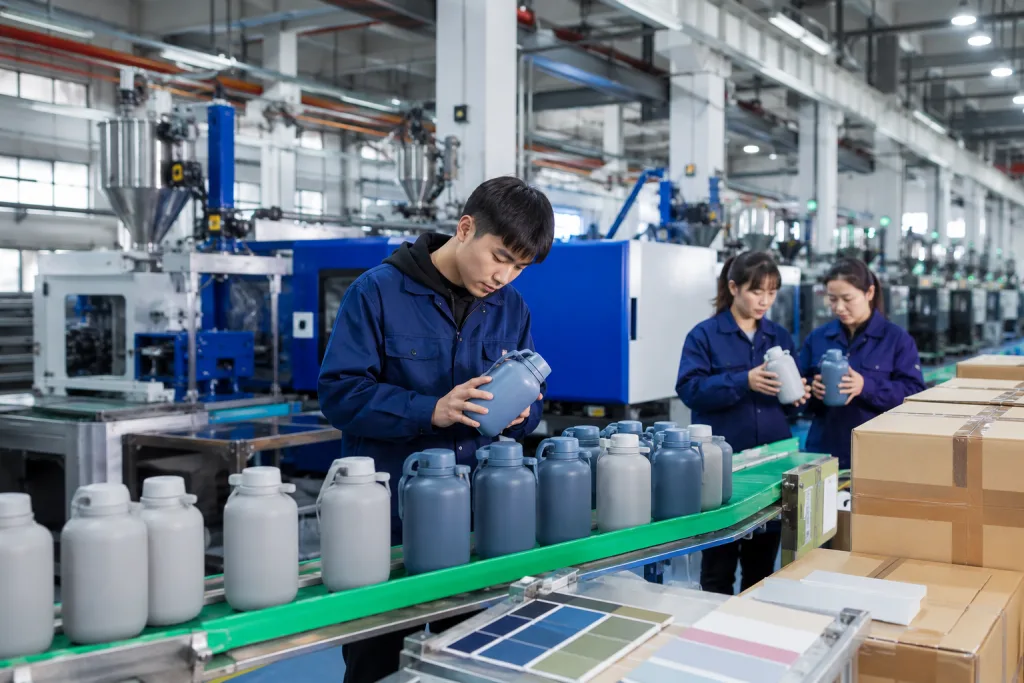
You are not buying a bottle. You are buying a repeatable supply line that has to survive decoration, filling, carton drop tests, customs, and the first complaint from a distributor. That is the real job. Buyers searching for manufacturers polypropylene bottle usually need more than a catalog; they need to know how a canteen factory handles resin grade, mold finish, leak testing, and whether the numbers on paper still hold up on the line in Zhejiang or anywhere else in China.
The practical way to buy custom drinkware is to work the order from end to end. Start with the use case, push the supplier on material and tooling, approve a sample with measurable checkpoints, then lock packaging and inspection terms before you place the PO. We see POs with the wrong capacity code all the time, and that kind of typo wastes a week. A good canteen manufacturer in China should quote MOQ, lead time, and monthly output straight. If they cannot say 20,000 units/month, 30-day production, or AQL 2.5 and stand behind it, keep moving.
Start With The Actual Use Case
The cleanest way to buy a polypropylene bottle is to start with who uses it and how. A canteen distributor selling to gyms needs a different mouth size, lid torque, and outer finish than a canteen promotional program for a trade show. If you source for retail, you are buying shelf behavior: translucent color, scratch resistance, and how the bottle reads under store lighting. If the bottles go into field kits, grip, seal reliability, and dishwasher tolerance matter more. We run that split every week on the line.
Write the brief around the failure you cannot accept. A school order might reject sharp edges, a travel account may reject odors, and a branded outdoor line may reject weak hinge life. That sounds basic, but most mistakes come from vague briefs. QC pulled a sample last month with a 0.8 mm flash line at the cap seat, and the buyer flagged it before packing. A canteen supplier can quote properly only when you specify volume, cap style, decoration area, and whether the bottle is a custom canteen, customizable canteen, or customized canteen with packaging already tied to a retail channel.
In Zhejiang, the better factories ask about end use before they ask about artwork. That is the right sequence. A factory that jumps straight to logo placement without talking about wall thickness, expected temperature range, or cleaning method is selling a drawing, not a stable product. For a polypropylene program, that is a problem because PP behaves differently from PET or Tritan under heat, pressure, and repeated hinge cycles. We had one PO with a typo on the mouth diameter, 38 mm written as 36 mm, and the buyer wanted the old quote honored. The math does not work. Buyers looking for customizable drinkware should treat the application as the first spec, not the last one.
Check Resin, Mold, And Wall Thickness
Once the use case is clear, lock the material and structure. For a polypropylene bottle, the first question is plain: which PP grade is on the line, and is it virgin food-contact resin or a blend? Don’t take a vague answer. Ask for the resin brand, melt flow index, and the supplier’s food-contact papers for Europe and North America. We’ve seen a buyer accept “food grade” on a PO typo, then QC pulled the sample and the batch failed the paperwork check. The real problem is not plastic in general; it is lot-to-lot consistency.
Wall thickness matters more than most first-time buyers expect. A lightweight PP canteen often runs 1.2 mm to 1.8 mm on the body and 2.0 mm to 2.5 mm at the neck and thread area, depending on capacity. Too thin and you get sink marks, panel wobble, or a bottle that feels cheap in hand. Too thick and cycle time climbs, which pushes cost up and can make lid fit less forgiving. This is the wrong question to ask if you only look at a render. A competent canteen factory will send a section drawing, and you should ask for it before you talk logo colors.
Tooling is where long-term savings live. A mold with clean venting and stable parting lines cuts flash and trimming labor. That matters if you are a canteen manufacturer or a distributor drinkware buyer planning repeat runs. Ask whether the mold is single-cavity or multi-cavity, what the cycle time is, and whether the factory is quoting 20,000 or 60,000 units/month on that tool. We run into this every season: the buyer flags the low unit price, then the line spends an extra 8 seconds per shot cleaning flash and the math falls apart. In Zhejiang, a serious supplier will put the numbers on the table.
Do not approve a sample until you have checked body weight, wall thickness, thread engagement, and seal compression. A nice logo on a bad neck finish is still a bad bottle.
Sample Like A Buyer Who Counts Returns
The sample stage should read like a small production audit. Order two decorated samples and one plain engineering sample. The plain piece tells you whether the body, neck, and lid seat are right; the decorated pieces show whether the print or laser holds on PP. We run it that way on the line. If you are comparing silkscreen with laser, send the exact production method, because PP behaves differently from metal or glass, and a logo that looks clean at 1 meter can still lift after washing. That is the real test for custom drinkware.
Measure the bottle. Do not eyeball it. Check capacity with a calibrated fill line, weigh it, confirm lid torque, and run an inverted leak test for at least 30 minutes. For a travel account, add a 1-meter drop test on the filled sample: six faces, one edge, one corner. QC pulled one sample at 52 g against the spec sheet at 49 g, and that 3 g gap changed the feel in hand. A good canteen supplier accepts that process. A weak one says the sample is “reference only.” That is usually code for “the production lot will drift.”
If your channel includes Amazon or other marketplace sales, plan barcode and carton rules before the tool is signed off. A custom canteen for FBA needs the FNSKU label position, carton count, and polybag warning plan locked before mass production. We have seen a buyer flag a PO typo on carton qty and spend two extra days fixing labels on 800 units. That is the wrong question to ask at the end. Ask it here. The sample stage is where you decide whether the product is a custom canteen for a short campaign or a full customized drinkware line that has to reorder cleanly every quarter without drama.
Tie Decoration To The Container
Decoration is not a side decision. On polypropylene, the bottle shape, surface texture, and curvature decide whether the mark stays crisp after 200 abrasion cycles or turns soft at the edge. We run screen printing on simple cylindrical bodies; once the shoulder gets busy, pad printing or laser marking usually wins, depending on the target finish. A buyer once pushed back with a mockup that looked fine on screen, then QC pulled the sample after a 1.5 mm logo drift on the curved panel. If you want a retail-grade result, ask the canteen vendor for adhesion and rub-test data, not just renderings. PP behaves. Until it doesn't.
For an outdoor account, a custom growler body or a larger-format customizable growler with a wide mouth changes the whole setup. The imprint area shifts, the cap height moves, and carton count changes by 6 or 12 units per case, so the math has to be checked early. If the logo sits near the shoulder radius, print tolerance matters more than color matching. We saw one order go sideways because the buyer wanted a matte shell with a glossy logo, but the mold grain blocked ink wetting on the line. Ask for the tool texture code and the exact flat area in mm, not a vague "premium look."
Use a decoration approval sheet with Pantone target, logo size in millimeters, print location from the base, and allowed shift. That saves rework, and it saves arguments on the PO. A canteen distributor or distributor canteen buyer should also ask about reorders: can the factory keep the same mold and print fixture on file for 12 months, and can they match the same ink batch on the next run? We ship repeat jobs this way all the time, and the stable plants in Zhejiang usually keep a real export schedule, not just domestic turnover.
When buyers ask for a canteen customizable line or a canteen customized promo item, standardize the bottle and vary only one or two variables. Any more, and the line slows, waste climbs, and MOQ goes up for no good reason. Keep the base model fixed. Let the branding carry the change.
Write QC Into The PO
The purchase order should read like an inspection plan, not a wish list. Put AQL levels, defect categories, and test order in writing before the line starts. For a mid-volume polypropylene bottle order, we usually see AQL 2.5 for major defects and AQL 4.0 for minor defects, with critical defects at zero tolerance. Critical items are leakage, contamination, cracked lids, and sharp edges. Major defects cover off-center logos, color drift, or weak seal compression. Minor defects are cosmetic, but retail buyers still flag them.
Spell out the functional checks. Ask for cap torque testing, hot-water deformation checks if the bottle will hold warm liquids, and carton compression checks. If the bottle is for food contact in Europe or North America, request REACH support and any FDA food-contact paperwork the factory can issue. You do not need a compliance essay. You need traceable records. A good canteen manufacturers partner should be able to send batch records, incoming resin checks, and photo evidence from the in-line inspection. We once saw a PO typo on the cap spec, 28 mm written as 82 mm. QC pulled the sample, caught it before packing, and the buyer kept the order on schedule.
Insist on pre-shipment inspection by a third party when the order is over 5,000 pcs or the buyer is new to the factory. In China, a solid canteen manufacturer knows that this protects both sides. It keeps the talk concrete: if the defect rate is 1.8% on visual issues or 0.4% on function, you can choose sort, rework, or ship. That is the right question to ask. We have seen this go sideways when the PO stayed vague and the buyer assumed the line would self-correct. It won’t.
Packaging And Freight Decide Your Margin
Packaging is part of the margin math. A 500 ml polypropylene bottle can still land profitably in a master carton if the retail pack is tight and the carton sits well on a pallet. If the pack-out is sloppy, freight burns cash faster than decoration. We ran this with one buyer last month: the carton was 58 x 42 x 36 cm, and the first sample came in 0.8 kg heavier than the PO said. Ask the factory for carton dimensions, gross weight, and cubic meter calculation before you approve the PO. Then you can see whether the order fits standard sea freight or turns into an air freight problem.
If you sell through distribution, spell out whether the bottles ship bulk packed, window boxed, or retail boxed. A canteen supplier handling distributor drinkware orders needs the pack plan for mixed-SKU cartons and case labels from day one. For marketplace or fulfillment buyers, push for barcode placement, carton markings, and pallet stacking limits. We had a buyer flag a PO typo on the carton mark line; one missing digit sent the line back to check the artwork. For a customized growler or a larger custom growler format, the carton spec can move by 15% or more because the neck and lid change the pack geometry.
China freight quotes care about volume first, weight second. A Zhejiang factory that knows export packaging will send the packing list before shipment, with units per carton, cartons per pallet, and pallet height under 1.8 meters if that is what your warehouse wants. We ship that way when the buyer asks for 1,200 cartons and the dock only takes 1.75 meters. That is the difference between a clean receiving day and a pileup at the dock.
Choose The Right Factory Relationship
At the end of the day, you are choosing a manufacturing relationship, not a single SKU. The right canteen manufacturer gives the same answer on sample one and reorder six. The wrong one changes the story every time. We had a buyer flag a lid crack after the third run; QC pulled the golden sample, checked the mold record, and the gap showed up fast. If you are working with canteen suppliers, ask who owns mold maintenance, where spare lids sit, and whether the factory keeps a golden sample for repeat production. Those details matter more than a polished sales deck.
A solid factory in Zhejiang should support orders from 3,000 pcs up to 100,000 pcs without changing the quality language. They should quote lead time in days, not “as soon as possible.” They should be clear on what they are, and are not, willing to custom-build. We run some lines with a 24-cavity mold and one body style; that setup works until someone asks for three cap systems and a 12-day ship date. Some can handle a customizable drinkware line with multiple cap options; others are a focused canteen vendor for one body style and one print process. Both can work, but you need to know the lane before you sign.
If your channel needs a distributor canteen or distributor growler program, prioritize consistency over novelty. If your channel needs a branded premium item, spend the money on mold quality and surface finish. Either way, the order gets easier when the factory is honest about monthly capacity, tooling life, and shipping discipline. The math does not work when a buyer wants 50,000 pcs, AQL 2.5, and a new color master in the same week. That is the part buyers miss when they focus only on unit price.
Send the spec sheet and get a real quote
If you need a polypropylene bottle program built for retail, promotion, or distribution, we can quote MOQ, tooling, QC, and packaging without guessing.
Frequently asked questions
What MOQ should I expect for a polypropylene bottle order?
For a standard PP bottle with one logo color, many factories quote 3,000 to 5,000 pcs MOQ. If you need custom tooling, a special lid, or multi-color decoration, 5,000 to 10,000 pcs is more realistic. A capable canteen factory in Zhejiang should also state whether MOQ changes by color or packaging. If they refuse to separate tooling cost from unit price, your comparison will be distorted.
How do I check whether the bottle material is really food grade?
Ask for the resin specification, food-contact declaration, and any migration test support tied to the exact PP grade. For Europe, you want REACH-related support; for the U.S., ask what food-contact basis they use. The factory should also confirm whether the lid gasket or seal is the same material family. A bottle body can be fine while the closure fails compliance.
What QC checks should I require before shipment?
Use a written inspection plan with AQL 2.5 for major defects and AQL 4.0 for minor defects, plus zero tolerance for leakage, cracks, contamination, and sharp edges. Add cap torque, inverted leak test, carton drop test, and label placement check. For new suppliers, a third-party pre-shipment inspection on a 5,000 pcs lot is money well spent.
Can I order a custom canteen with multiple logo or color options?
Yes, but every variable affects cost and lead time. One body color plus one logo color is the simplest. Adding multiple print positions, special lids, or color-matched parts can raise MOQ and add 7 to 14 days. A good canteen manufacturer will tell you which changes are cosmetic and which ones require new tooling.
How do I avoid freight surprises on custom drinkware?
Get the packing spec before production: units per carton, carton size, gross weight, and pallet height. A bottle that looks small in a sample can become expensive if the carton is oversized. For FBA or distributor programs, request FNSKU placement, master carton labels, and pallet configuration in writing. That usually saves 8% to 15% in avoidable logistics waste.