Key Takeaways
- A serious canteen factory should quote MOQ from 500 to 3,000 units and standard lead time around 25 to 35 days.
- For military use, aluminum often runs 0.6-0.8 mm and stainless models usually need 0.4-0.5 mm wall thickness plus leak testing.
- Ask for REACH, LFGB, FDA, and drop-test documentation before you approve a custom canteen or customized canteen program.
- A distributor canteen order fails fast if logo method, carton strength, and spare-cap policy are not fixed before mass production.
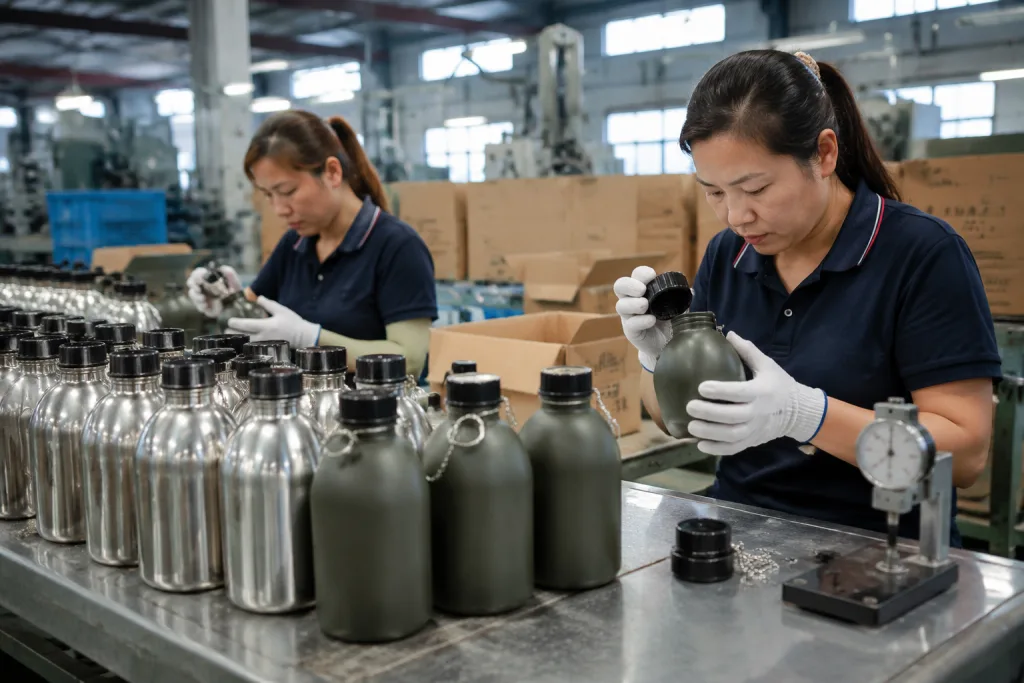
When you source manufacturers military canteen programs, the sample is not the decision point. The real test is whether the canteen holds up after 200 field cycles, clears the right compliance checks, and still leaves room for a workable FOB price. A procurement manager needs more than a catalog photo. We check wall thickness, seal performance, coating wear, and whether the canteen factory can hold color and logo matching across 5,000 or 50,000 units.
That is where a lot of programs go sideways. The buyer treats a custom canteen like generic custom drinkware, then the first batch comes back with leaks, weak straps, or a reorder that drifts by 18 days. If you are comparing canteen manufacturers in China or Zhejiang, or screening canteen suppliers for a distributor program, the list is plain: material, test standard, MOQ, lead time, packaging, and who owns the after-sales fix. The right canteen manufacturer answers those points before you have to press twice.
What buyers mean by military canteen
When buyers say manufacturers military canteen, they usually mean a rough-use bottle set for field issue, outdoor retail, or promo supply. It is not just a container. It is a system: body, cap, retention loop, coating, and carton pack that has to survive transit and field use. A decent canteen supplier should spell out how it differs from a standard sports bottle or custom growler, because the drop test and the end use are not the same. We run a 1.2 m drop on the line before QC pulls the sample.
For procurement, the first filter is material. Aluminum canteen bodies are still common for low weight and fast forming. Stainless steel gives better dent resistance and a higher perceived value, especially if you want a customized drinkware line for retail. HDPE and Tritan fit a lighter, lower-cost customizable canteen or canteen promotional item, but they are not our first pick for high heat or hard abrasion. In Zhejiang and across China, plenty of factories offer all three, yet the math does not work if the mold, coating, and assembly are handled by different teams and the bulk order has to stay consistent. MOQ is often 3,000 pcs, and that number matters.
Ask direct questions: Is the coating powder coat, spray paint, or anodized? Is the cap PP, aluminum, or stainless? Is the gasket silicone or TPE? What is the tested leak rate after 24 hours at room temperature and after a hot-fill cycle? A real canteen manufacturer will give you numbers, sample photos, and test reports, not a sales line. We have seen this go sideways when the buyer flagged a PO typo on the cap spec and the whole lot matched the wrong gasket.
Specs that decide the order
This is where procurement gets practical. Specs decide whether the PO moves or dies in QC. If you want a customized canteen program that survives approval, the sheet needs no gaps. Body thickness comes first. For aluminum military canteens, 0.6 mm is a workable baseline. Go to 0.8 mm and you get better dent resistance, but the weight and cost both climb. For stainless versions, 0.4 mm is common for light-duty retail. At 0.5 mm or more, the canteen holds up better when the buyer expects field handling, not just shelf display.
Cap performance matters just as much. A leaking cap kills re-order fast, even when the body looks fine. We had one buyer flag a sample because the gasket compressed unevenly after 200 cycles on the torque tester. Ask for torque test values, gasket hardness, and cycle testing on the actual closure. If the canteen is meant for outdoor or defense-adjacent channels, ask for a 1.2 meter drop test onto concrete and vibration checks in outer cartons. On a good line, QC already has these steps in the control plan. The weak factories say they can test later. That usually means they cannot test now.
- Body thickness: 0.6-0.8 mm aluminum, 0.4-0.5 mm stainless
- MOQ: often 500-3,000 pcs depending on logo, mold, and finish
- Lead time: 25-35 days after sample approval is realistic
- Carton test: 5-layer export carton, 10-15 kg per carton target
If you are comparing canteen distributors and canteen suppliers, ask who owns the tooling. A factory with its own dies can turn a repeat order faster. Outsourced tooling slows the second run when the buyer wants a new color or a custom logo. We have seen a PO typo on the finish code turn into a 12-day delay because the outside mold shop had to reopen setup. That is the wrong question to ask at quote stage if you only look at unit price. The math does not work when the line sits idle.
How to source from China properly
China is still the practical place to source a custom drinkware program when you need scale, speed, and sane unit economics. Zhejiang has the deepest manufacturing cluster for this work, and that matters on the floor: stamping, coating, printing, and carton packing sit close enough to cut dead time. A solid canteen factory in Zhejiang can usually turn samples in 7 to 10 days, then run production in 25 to 35 days once artwork and structure are locked. We run that schedule only when the drawing is clean. A typo on the PO can push the line by a week.
Do not mix up a trading desk with a real canteen factory. A vendor can answer fast and still miss coating thickness or gasket fit by a mile. Ask where forming happens, where coating happens, and whether final assembly stays in-house. If the answer is fuzzy, the math does not work. A direct canteen manufacturer should also speak clearly on compliance. For Europe, ask for REACH and often LFGB when the product touches food-contact surfaces. For North America, buyers often want FDA-related declarations, and some retail programs ask for ASTM-style drop or coating references depending on channel rules. QC pulled the sample on one job because the coating hit 18 microns on one side and 26 on the other. That sort of gap is why we push for the real factory, not the front desk.
Use a sampling ladder. Start with a white sample or natural sample to check fit and finish, then a logo sample, then a pre-production sample. If the canteen customized version has multiple colors, check each Pantone under daylight and under factory light. We have seen this go sideways on 5,000-piece orders when one shade drifts 5-8 percent and the buyer flags it at packing. The right question is not "Can you match it?" It is "How do you hold it on order two?" Ask for the spray gun model, the control card, and the carton drop standard. Those details tell you more than a sales pitch.
One good rule: if the supplier cannot explain how they will hold color, seal, and carton quality on order two, they are not ready for a reorder business.
Checklist before you approve samples
Use a checklist, not optimism. We see buyers fixate on logo placement and miss the failure points that show up on the line or at first field use. The sample can look clean and still fail. This is where you protect margin before the PO goes out.
Procurement checklist
- Confirm material grade and wall thickness in writing, with mm called out on the drawing.
- Request leak test results for 24 hours and after thermal cycling.
- Verify finish: powder coat, anodized, brushed, or painted.
- Approve logo method: silkscreen, laser, emboss, or pad print.
- Check cap fit, gasket compression, and strap stitching.
- Confirm carton drop-test standard and pack count.
- Ask for a sample of the production carton, not only the product.
For a canteen promotional campaign, packaging is often the weak link. We have seen a 1.5 mm carton spec pass on paper and fail in transit because the insert tore after one opening. If you sell through a canteen distributor network, that turns into a margin leak fast. Make the factory show you the finished retail pack and the export carton together. We ship a lot of programs through wholesale, e-commerce, and institutional channels, and the buyer flagged it when only one pack format was checked.
Ask about spare parts too. Caps, straps, and gaskets are not optional. For a customized growler or customizable growler program, buyers already push on this. Military canteen buyers should ask the same way. A spare-cap policy can save a full reorder when one part is damaged in transit or when an institutional customer needs replacements.
Pricing and MOQ without surprises
Pricing is easy to read once you split tooling from unit cost. For a simple custom canteen with a one-color logo and standard packaging, we usually see USD 1.20 to 2.80 FOB China on higher-volume runs, depending on material and finish. Stainless or multi-process models move up to USD 3.20 to 6.50 FOB. Tooling can add USD 150 to 800 per item, and the mold insert price changes fast once you ask for a new cap profile or strap slot.
MOQ is where deals get stuck. A stock body with a logo change can land at 500 units. A fully canteen customized mold, a unique cap, or a special strap usually pushes MOQ to 1,500 or 3,000 units. That is normal. The real issue is whether the canteen manufacturer gives the number upfront. We have seen buyers get a revised quote after PO draft because the drawing still had a typo on the strap length, and that kind of back-and-forth wastes a week. Good canteen manufacturers will also tell you where the break at 1,000, 3,000, or 5,000 units sits, because landed cost often drops by 8-15 percent there.
For distributor drinkware programs, ask for a tiered quote. You want one price for the first purchase, one for reorder, and one for mixed SKU loading. A distributor canteen order often needs that because buyers do not commit to one color or one decoration method. QC pulled the sample on one run because the logo placement shifted 3 mm after pad-print setup, and that is the sort of detail that tells you whether the line is controlled. The supplier that answers with real numbers and no drama is usually the one worth keeping.
What to ask before signing off
Before you sign a PO, ask the questions that tell you whether the factory can handle export work. A plant that only serves China domestic orders often misses the basics for Europe or North America. We see it in the paper trail, traceability, and reply speed. Ask for the business license, factory photos, and a third-party audit report if your market needs it. BSCI is common here, and a lot of buyers still want ISO 9001 discipline, certificate or not.
Then ask how they handle deviations. What if the logo shifts 2 mm? What if 1 percent of cartons get crushed in transit? What is the replacement policy if a batch leaks? A serious canteen vendor gives you a corrective action flow, not a vague promise to be careful. QC pulled the sample on our line for a 0.3 mm print drift last week, and that is the level of answer you want for customized canteen or customized drinkware runs at scale.
One more check: the item name has to match across the quote, sample tag, and invoice. If one paper says canteen, another says custom drinkware, and a third says custom growler, customs and logistics teams start asking for explanations. We have seen a PO typo turn into a 3-day delay at handoff. Clean naming cuts avoidable friction, especially once your shipment leaves Zhejiang and moves through more than one warehouse or forwarder.
Send your spec, get a factory quote
If you need a custom canteen or custom drinkware program, we can quote MOQ, FOB price, lead time, and compliance in one pass.
Frequently asked questions
What MOQ should I expect from manufacturers military canteen orders?
For a standard canteen with existing tooling, expect MOQ around 500 to 1,000 units. If you need a new mold, special cap, or full canteen customized finish, 1,500 to 3,000 units is more realistic. The key is to separate tooling from unit cost. A good canteen manufacturer in China will show both clearly, and a Zhejiang factory with stable production can usually hold repeat order MOQs lower once the program is established.
What materials work best for a military-style custom canteen?
Aluminum is still the lightest practical option, often at 0.6 to 0.8 mm wall thickness for field use. Stainless steel at 0.4 to 0.5 mm gives better dent resistance and a more premium feel. HDPE and Tritan can work for lighter customizable canteen programs, but they are less suited to harsh abrasion. Choose material based on use, not just price. If the buyer expects real wear, stainless usually outlasts a cheaper custom drinkware body.
How do I check if a canteen supplier is export-ready?
Ask for REACH or LFGB where relevant, plus FDA-related declarations for North America if the product is food-contact. Then request factory audit proof, leak test results, carton drop-test data, and a sample QC report. A real canteen supplier will also explain the production line, not just show nice product photos. If they are in Zhejiang or another export cluster in China, they should be able to provide these documents without delay.
What is a realistic lead time for a canteen customized order?
For first production, 25 to 35 days after sample approval is normal if the spec is stable and packaging is simple. New tooling, multi-color decoration, or special packaging can push it to 40 to 50 days. A mature canteen factory should tell you where the delay sits: tooling, coating, printing, or carton sourcing. Fast answers matter because procurement schedules are usually tighter than production schedules.
Can I combine canteen promotional and distributor drinkware in one order?
Yes, and that is often the most efficient way to buy. Many canteen distributors use one body with multiple logo versions or packaging SKUs. Just keep the structure consistent and change only the decoration or carton insert. That reduces setup loss and lowers the chance of defects. A good canteen vendor can manage a mixed run if the artwork is locked and you agree on packaging rules before the PO is issued.