Key Takeaways
- For custom kids water bottle programs, a 0.2 mm change in silicone seal groove depth can decide whether leak rate stays below 1.0% at AQL 2.5
- Most bulk school water bottle orders under USD 2.80 FOB use single-wall PP or Tritan bodies; vacuum stainless usually starts around USD 3.80-5.50 FOB at 3,000 pcs
- Ask for migration, REACH, LFGB or ASTM/CPSIA testing before mass production, not after packing; lab cycles can add 7-12 days
- For children water bottle custom decoration, dishwasher-safe laser or debossed marks outlast standard silk screen by 3x to 5x on high-use school programs
Most kids bottle problems do not start in the warehouse. They start on the spec sheet. A school district buyer asks for a 400 ml straw bottle, BPA-free, custom logo, under USD 3.20 landed. An importer sends a Zhejiang factory a sample and asks for the same shape, cheaper freight, and a tighter ship date. Three weeks later, the first pre-production samples leak, the lid smells, and the print rubs off after 20 dishwasher cycles.
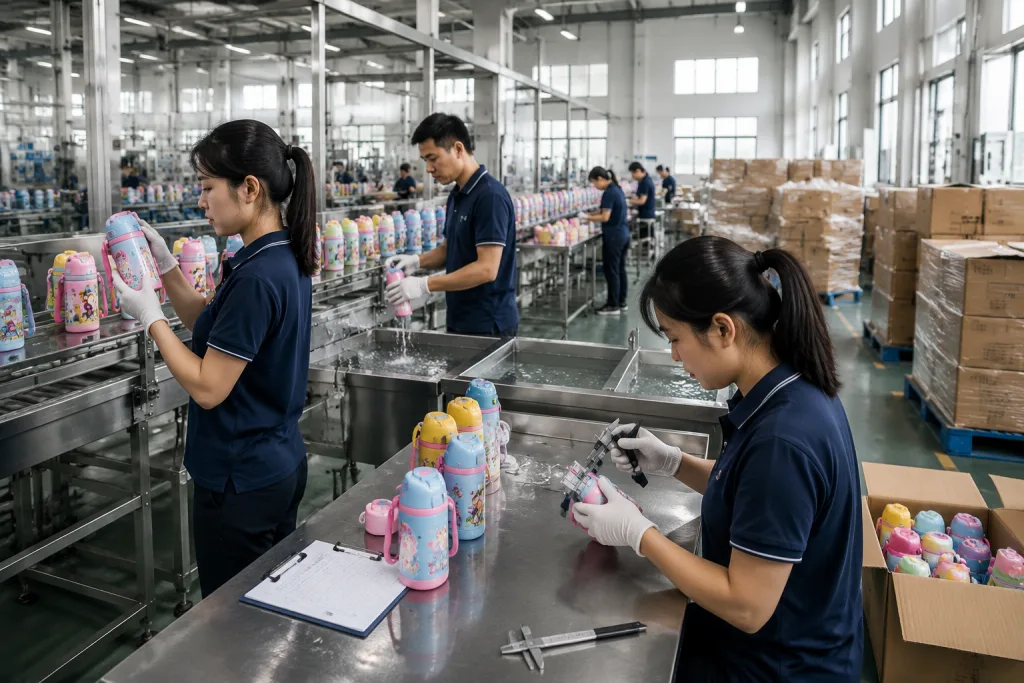
If you buy from manufacturers kids water bottle suppliers, catalog photos are the wrong place to start. You need to know what fails in production, what fails in use, and what to lock down before tooling, color matching, and compliance testing begin. At BottleForge Industrial in Zhejiang, China, we run about 600,000 units a month, with MOQ from 3,000 pieces per SKU and typical lead times of 25 to 35 days. The buyers with fewer claims spec the failure modes early. QC pulled the sample on a 0.8 mm lid gap last week, and that kind of miss is exactly where the math breaks.
Where leak complaints really begin
Leak complaints are the expensive ones. They drive returns, soak cartons, and wipe out trust with schools and parents in one shot. Buyers like to blame the cap. That is usually the wrong question to ask. We see leaks start in a stack-up problem: thread tolerance, seal hardness, hinge alignment, straw fit, and vent hole location all have to work together. A children water bottle manufacturer can pass a simple upside-down test on the line and still fail after transit, because shipping pressure shifts the lid or hot filling and dishwasher heat warps the closure.
For a bulk kids water bottle program, write the closure spec in engineering terms. Ask for thread pitch, seal material, seal Shore A hardness, and whether the bottle is meant for carbonated drinks, hot liquids, or cold water only. Most school programs are cold-water only, so the design can stay simpler and cheaper. For PP and Tritan lids, we usually run silicone seals in the 50-60 Shore A range and a 24-hour inverted leak test at 0.65 AQL critical defects. If the product uses a flip straw, require 500 open-close hinge cycles and a negative pressure leak test after cycling. QC pulled the sample last month and found one lid that only failed after the 300th cycle. That is the kind of miss that turns into claims.
- Common leak points: missing gasket, twisted straw, short-shot cap molding, flash on thread starts, warped lid after decoration curing
- Spec to add: 1 meter drop test, full water fill, 6 faces, then leak recheck
- Inspection point: 100% on-line vacuum or inverted test for assembled lids on children water bottle wholesale orders
If you are buying children water bottle bulk from China, do not approve a golden sample on hand feel alone. Ask the supplier to send a sectioned sample showing seal groove depth and wall thickness. A bottle body at 1.2-1.5 mm and a lid at 2.0-2.5 mm usually holds up better than a lighter build. The math does not work on extreme resin cutting. We have seen that go sideways after a PO typo changed the lid color callout, the buyer flagged it only at pre-shipment, and the line had to rework 8,000 pieces.
Odor, taste, and material surprises
Parents usually catch odor first. The bottle sits on the kitchen table for one day, then the smell shows up. The usual causes are plain: recycled content used where it should not be, resin not dried to spec before molding, too much masterbatch, or a soft gasket that holds smell after one wash. For custom children water bottle jobs, buyers spend time on Pantone matching and miss the resin grade. That is the wrong question to ask.
If you are sourcing from children water bottle suppliers in Zhejiang or elsewhere in China, ask for the exact body and lid materials by trade family, not just “food-safe plastic.” Tritan, PP, and 18/8 stainless steel are common. Tritan gives better clarity and impact resistance for premium custom kids bottle lines. PP keeps the unit price down on bulk school water bottle tenders. Stainless fits insulated builds, but it adds weight, more tooling steps, and a higher MOQ on some lines. On one 550 ml school bottle project, the buyer flagged a PO typo on the material line and we had to reissue the spec sheet before the line could start. For any material touching liquid, require declarations tied to your market: REACH for Europe, LFGB if an EU buyer asks for it, and CPSIA/ASTM support where applicable for North America. If the item is sold to children under the relevant rules, the file matters as much as the bottle itself.
When a factory says “same material as before,” ask for a resin code, supplier name, and test report date. We have seen this go sideways in low-margin children water bottle distributor programs.
Another failure mode is stress cracking after repeated dishwashing or sanitizer exposure. We ran a 60°C wash cycle on a clear Tritan sample and QC pulled the sample after the third cycle because the cap thread started to haze. Tritan handles this better than some lower-cost clear plastics, but only if molding temperature and drying are controlled. Ask the children water bottle vendor for dishwasher guidance backed by testing, not guesses from the sales desk. If you need top-rack dishwasher performance, make it part of the approval criteria. For lower-budget children water bottle promotional orders, hand wash only is often the honest call.
Print that disappears too fast
Decoration failures start fights because the artwork was approved, but the use case was not. That is the wrong question to skip. A custom logo kids bottle for a one-time event can run with standard silk screen. A custom school water bottle used 5 days a week by children needs a print spec for abrasion, detergent, and rough handling. Different job. Different cost. On our line, the same logo that passed on an event bottle failed after 60 dry rubs on a school sample because the buyer never defined daily use.
Most children water bottle customizable programs run on four print methods: silk screen, heat transfer, pad print, or laser on coated stainless. Silk screen is the low-cost option, usually adding around USD 0.05-0.18 per color depending on size and quantity. It works for plenty of bulk kids bottle orders, but it will not last like engraved branding or molded-in branding. If the bottle body is stainless with powder coating, laser marking holds up better over time, and QC pulled a sample last month where the laser depth stayed clean while the printed mark wore at the corner. For plastic, in-mold labeling or a debossed logo panel usually beats surface print. Tooling costs more, and the math doesn't work for small MOQ projects.
What to lock into the print spec
- Color standard: Pantone code with tolerance or approved drawdown
- Adhesion: cross-hatch tape test after curing
- Abrasion: 50 to 100 dry rubs minimum, plus detergent rub if school use
- Dishwasher cycles: if claimed, define the exact number and rack position
- Artwork placement tolerance: usually plus or minus 1.5 mm for screen print
For children water bottle customized orders sold through retail or school channels, approve the print on the final production material, not on a flat panel. Curved bodies distort logos. Edges get thin. We see this go sideways when a children water bottle supplier rushes sample approval and the buyer signs off on a flat plate from the screen room. We had one PO with the logo shifted 1.8 mm on the shoulder radius, and the buyer flagged it at carton audit. Spend three extra days on a real pre-production sample in China. That is cheaper than discounting 20,000 units later.
When the bottle survives, but the lid does not
Lids fail before bodies do. Hinges crack, buttons stick, carry loops tear, bite valves split, and spouts turn into hygiene complaints. We see this on the line all the time. This is where a lot of children water bottle manufacturers trim cost, because buyers look at volume and shape first. For kids products, the lid is the product.
Start with use-case segmentation. A nursery or elementary program usually needs fewer detachable parts and larger radii for easier cleaning. A sports-style custom kids water bottle can take a more complex straw lid, but then you need cycle and pull-force testing. We run 500 hinge cycles, 200 carry-loop pulls at rated load, and bite-valve fit retention after thermal aging. For a 350-500 ml bottle going into school bags, the loop should hold at least 10 kg static load for 1 minute without tearing or permanent deformation. The math does not work any other way.
Watch small-part risk closely. If the nozzle cap, straw connector, or decorative charm can detach, your compliance team will ask hard questions. We had a buyer flag a 2.8 mm charm loop once, and QC pulled the sample before it reached packing. Buyers working with children water bottle distributors in Europe and North America should confirm whether the design falls under extra child-related testing beyond food-contact compliance. That talk needs to happen before tooling is approved.
From a QC angle, ask the children water bottle factory for a control plan that lists the high-risk lid dimensions. Typical ones are hinge pin diameter, latch engagement depth, and button spring seat diameter. Those are not glamorous details, but they drive field failure rates. A bulk children water bottle project with a cheap latch can create more after-sales cost than the FOB savings ever justify. We have seen that go sideways after the first 3,000 units ship.
Compliance delays nobody priced in
One costly failure mode has nothing to do with the bottle breaking. The shipment sits because the compliance file is messy, points to the wrong SKU, or misses one material change. We see this on custom kids water bottle runs when a buyer swaps the lid, adds a straw, or changes print after the first report is already out.
For school district buyers and importers, the clean move is to lock every test request to the final bill of materials. Body resin, lid resin, seal material, color masterbatch, ink or coating, straw, and each accessory need to be listed. If one item changes, ask for a retest. REACH is common for EU chemical limits, LFGB shows up on food-contact requests in parts of Europe, and ASTM/CPSIA paperwork is standard for North America depending on category and age grade. A good children water bottle supplier is not your lawyer, but they should give accurate material declarations and book the lab work. We had a buyer flag a PO that called for TPR seals while the sample report still said silicone. That kind of typo burns days.
Timing is where the math turns ugly. Standard chemical and migration testing usually adds 7-12 working days. If QC pulled the sample again because the cap torque changed, add more. Our mass production lead time in Zhejiang, China is usually 25-35 days after deposit and sample approval, but late compliance work pushes that back fast. For repeat children water bottle wholesale SKUs with no material changes, the turnaround is shorter. We ship those on a tighter line.
- Buyer mistake: testing a showroom sample instead of the final production BOM
- Factory mistake: changing a gasket or colorant without updating the compliance file
- Fix: approve a signed BOM and keep it attached to PO, artwork, and lab request
If you are building a children water bottle distributor network, this paperwork discipline is not optional. One mismatch between the report and the carton can stop customs clearance or get the retailer to reject the lot. We have seen that go sideways over a 3 mm lid change.
Cartons, barcodes, and school-channel headaches
Good bottles still miss the PO when the pack-out is sloppy. School buyers and importers care more about pack count, barcode accuracy, carton strength, and on-time delivery than glossy retail sleeves. A children water bottle vendor can get the mold right and still trigger chargebacks if packing control is loose. We have seen that on the line.
For bulk school water bottle and children water bottle promotional orders, lock the packaging spec early: individual polybags, white boxes, PDQ trays, or retail gift boxes. Each one changes carton size, drop test results, and freight math. A 500 ml kids bottle in a simple polybag may fit 48 units per export carton, while the same bottle in a color box may drop to 24 or 36 units. That can push ocean freight cost per unit up 8-15% depending on destination. This is the wrong question to ask at the end.
Barcode mistakes keep coming back. If you sell through distribution, state whether you need UPC, EAN, carton labels, or FNSKU-style labeling for marketplace fulfillment. Ask for a barcode scan check in final inspection. QC pulled the sample once and found an inner box printed with one SKU revision while the master carton carried another. Basic problem. It still ships that way if nobody checks.
For carton quality, ask for burst strength or edge crush specs matched to the load pattern. If the bottles are stainless and heavy, double-wall corrugate may be the right call. If they are lightweight PP, you may be paying for board grade you do not need. Good children water bottle suppliers in China should give carton specs and pallet loading plans before mass production. That saves space calculations, booking surprises, and broken corners at the school warehouse. One typo on a PO can change the whole pallet plan.
How to write a spec that prevents claims
If you want fewer claims, stop buying from photos and target price alone. Write a purchase spec a children water bottle factory can run without guessing. The best custom kids bottle RFQs we see are short. They still pin down material, dimensions, closure, logo method, compliance scope, packaging, inspection, and acceptance criteria. On the line, a 0.5 mm gap can turn into a leak claim fast.
A practical RFQ for manufacturers kids water bottle sourcing should state body capacity, target weight tolerance, the material for each component, seal type, wall thickness target, logo size, color standard, packaging format, and test requirements. Put the AQL in writing. Many importers use AQL 2.5 for major and 4.0 for minor defects, with critical defects at 0. For children and school use, spell out what counts as critical: leakage, sharp edges, detached small parts, or wrong compliance labeling. We had one buyer flag a PO typo on the carton count, and that sort of miss does not stay small.
Minimum spec checklist
- Capacity: for example 400 ml plus or minus 3%
- Body material: Tritan or PP; stainless grade if insulated
- Seal material: food-grade silicone, hardness range
- Closure test: inverted 24 hours, no leakage
- Drop test: 1 meter, 6 faces, no functional failure
- Decoration: method, Pantone, adhesion requirement
- Compliance: REACH, LFGB on request, ASTM/CPSIA support as applicable
- Packing: units per carton, carton size, barcode placement
For custom children water bottle and children water bottle wholesale projects, this level of detail keeps the sample room, production line, and inspection team on the same page. It also makes supplier quotes comparable. Two children water bottle manufacturers can land miles apart on price because one includes thicker walls, better seals, and extra testing while the other leaves them out. That is the wrong question to ask. Write the spec around failure modes, and you compare real output, not brochure promises.
Send your kids bottle spec for a failure-risk review
We will check your drawing, BOM, decoration, packaging, and QC points against real production risks in Zhejiang before you place the PO.
Frequently asked questions
What MOQ should I expect for a custom kids water bottle order?
For most China factory programs, MOQ is 3,000 pieces per SKU for an existing bottle mold with one logo layout and standard packaging. If you need a custom color body plus custom color lid, some children water bottle manufacturers will ask for 5,000 pieces because of material setup and color loss. Fully new tooling usually starts higher, often 5,000-10,000 pieces depending on complexity. For stainless insulated kids bottles, MOQ can also rise if the coating or laser setup is unique. If you are testing a school district design, ask whether the supplier can split 3,000 pieces into 2-3 lid colors using one body color. That is often easier than asking for multiple body colors on a first run.
What price range is realistic for bulk children water bottle sourcing?
A realistic FOB China range depends mostly on material and lid complexity. A simple single-wall PP or clear plastic kids bottle for bulk school water bottle use often lands around USD 1.20-2.40 FOB at 3,000-10,000 pieces. A better Tritan body with a more robust straw lid usually falls around USD 2.10-3.40 FOB. Vacuum stainless kids bottles generally start near USD 3.80 and can reach USD 5.50 or more with powder coating and premium decoration. Add roughly USD 0.05-0.30 for standard custom logo work, plus packaging upgrades if you need retail boxes. If a quote is far below market, ask what changed in wall thickness, seal quality, testing, or pack-out.
Which tests matter most for school and children's bottle programs?
For school and kids-product programs, focus on leakage, drop resistance, closure durability, and food-contact compliance first. A solid baseline is a 24-hour inverted leak test, 1 meter drop test on six faces, and hinge or button cycle testing where relevant. On the compliance side, many buyers ask for REACH-related documentation for Europe and ASTM/CPSIA support for North America, with LFGB requested by some EU importers. If the bottle includes print or coating, add adhesion and abrasion testing. For straw lids, ask for retention checks after cycling and cleaning. Testing should be done on the final bill of materials, not a showroom sample. That one detail prevents a lot of delays.
Is Tritan better than PP for a custom children water bottle?
It depends on your price target and use case. Tritan is clearer, usually more premium in appearance, and generally stronger against cracking in repeated use. It is a good fit for retail-grade custom kids water bottle programs or importer lines where appearance matters. PP is lower cost, lighter, and practical for large children water bottle promotional or school distribution orders where budget discipline matters more than crystal clarity. For many school tenders, PP performs well if the lid and seal system are properly engineered. The wrong answer is choosing based only on appearance. Ask your children water bottle supplier to quote both materials with exact weights, wall thickness, and test standards so you can compare real value.
How long does production take after sample approval?
For existing molds, normal lead time is usually 25-35 days after deposit, artwork confirmation, and pre-production sample approval. If you need third-party lab testing on the final materials, add about 7-12 working days depending on the test package and season. New molds or major lid changes can add 20-35 days for tooling and sample correction before mass production begins. During peak export months in Zhejiang, China, booking and packaging material timing can also affect schedule. If your delivery window is tied to school opening dates, build in at least a 2-week buffer. The buyers with the fewest rush problems freeze artwork, BOM, and barcode details before the factory starts molding.