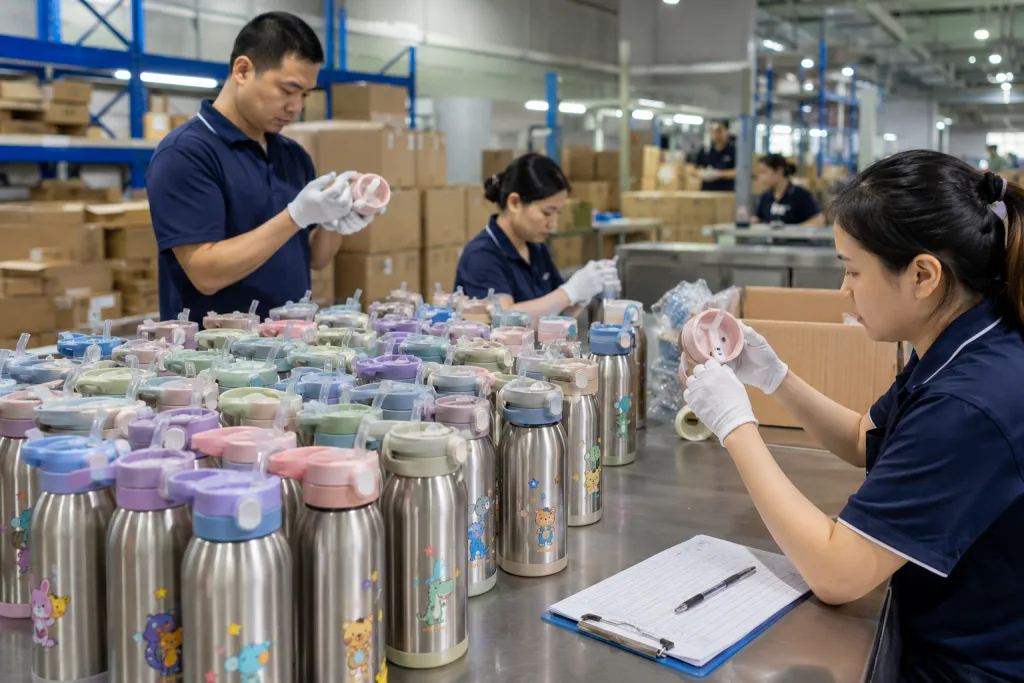
Key Takeaways
- Decide material first: Tritan, PP, or 18/8 stainless changes FOB cost by 25% to 70% and affects drop performance, weight, and compliance testing.
- For most private-label kids bottles, realistic MOQ is 3,000 to 5,000 units per color, with 30 to 45 days production after sample approval.
- Leak complaints usually come from lid and straw tolerances, not bottle bodies; ask for 1.2 meter drop tests and 8 hour inverted leak tests.
- AQL 2.5/4.0 inspections, REACH screening, and ASTM or LFGB file checks should be built into the quote before you compare suppliers.
You are not buying a kids bottle. You are buying a complaint rate, a return risk, a freight profile, and a compliance file that has to survive retailer review. That is why the search for manufacturers kids drink bottle suppliers gets messy fast. One factory is cheap but weak on testing. Another looks polished but pushes you into a mold you do not need. A third promised 45 days and missed the ship date by 18 days. We have seen that go sideways.
The clean way to buy is to lock four points first: material, lid system, decoration method, and compliance scope. Then you can compare MOQ, tooling, FOB pricing, and lead time without getting dragged around. On our line, the wrong lid spec has killed more than one order after QC pulled the sample at 10 mm and the buyer flagged it. In Zhejiang, China, factories that look the same on paper can run very differently once the line starts.
Start with four buying decisions
If you are sourcing from manufacturers kids drink bottle factories, do not start with logo placement or color cards. Start with four buying decisions. They drive almost everything after sample approval.
- Material: single-wall stainless, vacuum stainless, Tritan, or PP. This sets weight, drop behavior, and the compliance route. We run different checks on each one.
- Lid system: flip straw, screw cap, push-button, or sipper. This controls leak rate, kid handling, and complaint risk. QC pulled a sample with a weak hinge last week, and the buyer flagged it.
- Decoration: silk screen, heat transfer, UV print, laser, or powder coat. This changes MOQ, wear resistance, and unit price. A 0.3 mm misalignment on print can sink the whole batch.
- Market standard: EU, UK, US, Canada, or mixed distribution. This decides which test reports must be ready before shipment. One PO typo on the destination market can force a fresh test file.
For a normal 350ml to 500ml kids bottle program, changing one of these items late can add 7 to 15 days. Move from a standard PP lid to a new push-button lid, and tooling can add USD 1,500 to 4,000, depending on cavity count and whether the canteen factory already has a similar mold on the shelf.
Many buyers ask broad questions about custom canteen, customizable drinkware, or customized drinkware, but kids bottles are less forgiving than adult sports bottles. That is the wrong question to ask. A 500ml bottle for a school distributor drinkware account needs to clean fast, stay closed in a backpack, and survive rough handling. We have seen this go sideways when a buyer chased a fancy latch and ignored the seal geometry.
At BottleForge Industrial in Zhejiang, China, we see buyers save the most time when they lock these four points before RFQ. Then the math works. A standard 400ml Tritan body with PP flip-straw lid might land at USD 1.65 to 2.40 FOB Ningbo at 5,000 units, while a 350ml double-wall stainless version may run USD 3.20 to 5.10 FOB, depending on coating and print process. The line knows the difference before the first sample goes out.
Choose the right body material
Body material is not a branding call. It decides how many complaints you deal with after shipment.
Tritan and PP for lower landed cost
Tritan stays common on kids bottles that need a clear or translucent body. It takes color well, drops less often crack it, and the shipping weight is easier on the math. PP usually stays on lids, though we also run full-PP budget bottles for school programs. If your target is canteen promo, school fundraising, or mass retail under USD 3 FOB, Tritan or PP is usually the better fit than steel. A 400ml Tritan bottle may weigh 120 to 180g; stainless of the same size often weighs 220 to 320g. On our line, the buyer usually pushes back on scratch marks near the gate, so QC checks that area first after injection.
18/8 stainless for durability and perceived value
If you sell into specialty retail, museum shops, or premium private label, 18/8 stainless gives better shelf appeal and cleaner odor performance. Single-wall stainless is enough for daily use. Vacuum adds cost and weight. It keeps temperature longer, but this is the wrong question to ask for a kids bottle. Adults like the heft; kids do not. We have seen 260g bottles get rejected after sample review because the child could not hold them one-handed during a school trial.
A lot of buyers ask for vacuum by default. For kids under 8, single-wall often performs better commercially because it cuts weight by 30% to 40% and reduces freight cost.
Ask your canteen manufacturer or canteen supplier for actual wall thickness, not just “good quality steel.” Common ranges are 0.4mm to 0.5mm for bottle bodies and 0.35mm to 0.45mm for liners on vacuum models. The caliper tells the truth fast. Thin steel saves cents, then dents show up after transit drop tests and the buyer flagged it at receiving. If your channel is a canteen distributor or canteen distributors serving schools, dent tolerance matters less on plastic and more on steel.
Ask one more thing: are all contact parts virgin material only? For children’s drinkware, recycled-content claims sound good on paper, but the paperwork has to be clean if the bottle touches drinking water. We have had POs with “food grade recycled inside” typed in by mistake, and that goes sideways fast once compliance reviews start. In China and Zhejiang, serious custom drinkware exporters will tell you directly what can be certified for your market and what cannot.
Lids decide returns and reviews
Most buyer problems do not come from the bottle shell. They come from lids, seals, straws, and assembly tolerance. On one kids bottle run, QC pulled the sample at 0.8 mm thread mismatch and the body was still fine. If you are checking a canteen customizable program, spend more time on the cap than the body.
There are four lid structures we see all the time in this segment:
- Simple screw cap: lowest risk, easiest to wash, usually lowest cost.
- Flip-straw lid: popular for kids, but it needs tighter sealing control and a cleaner hinge line.
- Push-button lid: one-hand use works well, but tooling cost and failure risk go up.
- Sipper lid: moderate complexity, and usually easier to clean than straw systems.
For leak testing, ask for a protocol with numbers, not a promise. We run 8 hours inverted with a water fill, then a 1.2 meter drop test on 6 faces for filled samples. For stainless models, add torque checks on thread engagement and weld visual checks around handle points if the lid has a carry loop. For straws, ask for repeated open-close cycle testing, 2,000 cycles minimum. A buyer once flagged a PO typo on the cycle spec, and the line built the wrong test, so spell it out.
If your buyer channel includes a canteen vendor, canteen vendors, or distributor canteen network, complaint rates matter more than saving USD 0.08 on a more complex lid. This is the wrong question to ask. A push-button cap may look stronger on a sell sheet, but if the spring or lock tab fails at 1.5% of orders, the margin disappears fast. We have seen that math go sideways on a 20,000-piece order.
Ask each canteen factory whether lids are produced in-house or sourced. Sourced lids are not automatically bad, but supply consistency becomes the real issue. If the bottle maker assembles parts from multiple canteen suppliers, your PPAP-style approval needs to cover all contact components, silicone hardness, straw material, and color migration risk. That matters on customized canteen projects with three lid colors in one PO, because one wrong pigment lot can hold the shipment.
Compliance is part of the unit price
A low quote without the right paperwork is not a low quote. We have seen a 5,000-piece kids bottle order turn into a 12-day delay because the buyer flagged missing LFGB pages before the PO hit the line. For Europe and North America, set the compliance scope before you approve samples.
Common asks include REACH screening for EU distribution, LFGB for German buyers and some broader EU accounts, and US food-contact expectations. If the bottle is sold for children, buyers often ask for CPSIA-related checks, plus phthalates, lead, and cadmium limits in coatings or prints. For lids, straws, clips, and carry loops, ASTM review can matter depending on the age grade and the claim on the carton.
Good canteen manufacturers in Zhejiang, China should hand over a test plan, not a folder of old reports. We run the same question on every new SKU: what is tested on the exact bottle body, cap, gasket, and decoration process. A 2022 blank-body report does not cover a new heat-transfer wrap or a soft-touch coating with a 0.3 mm film layer.
There is a factory-system layer too. BSCI, ISO 9001, and social audit acceptance matter when you supply chain stores or larger importers. A buyer once sent a PO with "ISO9001" typed as one word and then asked why the audit team rejected the file. If you are new to custom drinkware, put those costs into your sourcing model early.
Practical rule: ask the quote to separate product cost, tooling, testing, and inspection. Third-party lab screening may add USD 300 to 1,200 per SKU depending on scope. Pre-shipment inspection at AQL 2.5/4.0 can add a few hundred dollars per lot, and QC pulled the sample from a 2,000-piece batch to prove it. The math does not work any other way, and the cheapest canteen custom order often stops being cheap after the paperwork lands.
MOQ, tooling, and true lead time
This is where a lot of RFQs go off the rails. Buyers send 1,000 units, five colors, a custom lid, gift box, and three print positions. The line says yes. The real quote lands with add-ons on every line, and the buyer flags it fast.
For manufacturers kids drink bottle programs in China, MOQ tracks with how standard the item is. If we run an existing body and existing lid with one-color logo, MOQ can sit at 3,000 units total. Add a custom color body, custom lid insert, and retail box, and 5,000 units is the cleaner target. A fully new mold usually pushes MOQ to 10,000 units or more, because the tooling has to be paid back. We have seen this go sideways when a buyer tries to keep OEM pricing on a semi-custom build.
Typical numbers for planning:
- Stock mold with custom color/logo: MOQ 3,000 to 5,000 units
- New lid color parts across several Pantones: often 1,000 units per color
- New mold tooling: USD 2,000 to 12,000 depending on complexity
- Sample lead time: 7 to 12 days for pre-production samples
- Mass production: 30 to 45 days after approval and deposit
Do not just ask lead time. Ask lead time under peak season. In Zhejiang, we ship smoothly from March to June, then the line gets tight from August to November before holiday cutoffs. A factory saying 25 days may mean 25 days only when components are in stock and decoration is simple. QC pulled the sample, and the print was fine; the delay came from caps, not bottles.
Factory scale matters too. A canteen supplier with 80,000 units/month capacity may fit a trial order, but it can get shaky on a 120,000-unit rollout. A larger canteen manufacturer running 500,000 units/month can plan better, but may push back on smaller canteen custom jobs unless they sit on existing tooling. Match your PO size to the supplier’s normal rhythm, not the brochure. We had one buyer send a PO with a lid typo, and the whole schedule slipped two days while packing rework got sorted.
Decoration that survives real use
Buyers often miss how hard kids are on decoration. Bottles go in backpacks, lunch bags, and dish racks. A sample can look clean on day one and still fail after two weeks of school use.
For plastic bottles, silk screen is the low-cost option for simple logos and one- or two-color art. Heat transfer handles more complex graphics, but we have seen it scratch if the ink stack is wrong. UV print looks sharp on the shelf, yet it is not the first pick for heavy rubbing. On stainless, powder coating plus silk screen is common; laser gives a permanent mark, but the look is different, and the buyer flagged it on a 350ml sample because the logo felt too industrial.
If you are quoting a customizable canteen or customized growler line alongside kids bottles, do not force one decoration method across both. That is the wrong question to ask. A customized growler usually wants a more premium finish, while kids products need better rub resistance and cleaner compliance files for inks and coatings. We run the line that way for a reason.
Ask for abrasion tests and dishwasher position guidance if the product claims it. Ask whether the factory masks print zones the same way on curved bodies; a 2 mm shift on a wrap print is enough to create a reject. QC pulled the sample on one job because the logo sat too close to the shoulder, and the touch point was right where kids grip the bottle. It is normal to see 2% to 5% spoilage on decorated runs, especially with multi-color wraps.
Packaging needs the same discipline. White box, color box, egg crate, and export carton all change the damage rate. If you sell into Amazon FBA or e-commerce, ask your canteen vendor about drop-tested inner packing and barcode placement, including FNSKU if required. For a distributor growler or distributor drinkware order going into retail stores, we ship to a 12kg to 15kg master carton target because the math does not work once handlers start throwing cartons around.
The plain truth: the nicest sample from a canteen factory is not always the best production choice. The better choice is the one that still looks acceptable after 90 days of use and keeps reject rates inside the 2% to 5% band.
How to compare suppliers without guessing
If you are choosing between several canteen manufacturers or canteen suppliers, put them on one sheet and make them answer the same line items. Otherwise you are comparing sales talk, not factories.
Use a shortlist with these points:
- Exact material spec for body, lid, straw, and seal
- Wall thickness or weight tolerance per bottle
- MOQ by color and by SKU
- Tooling ownership and maintenance responsibility
- Quoted Incoterm, usually FOB Ningbo or FOB Shanghai
- Lead time for sample and mass production
- Inspection standard, ideally AQL 2.5 major / 4.0 minor
- Testing scope included and excluded
- Carton dimensions, CBM, and gross weight
- Monthly capacity on this specific bottle type
Then ask one hard question: what usually goes wrong on this product? Good export teams in China answer fast. On the line, we have seen TPE mouthpieces drift by a shade, and we have seen a buyer flag a powder coat because the Pantone was checked against a screen, not a signed sample. That answer matters more than a low opening price.
Take a simple case. One canteen manufacturer quotes USD 1.92 FOB at 5,000 units, another quotes USD 2.08, and the math still fails if the cheaper offer cuts testing, uses a thinner silicone seal, and slips to a 50-day lead time in peak season. We run that comparison against landed risk, not unit price. A PO typo on carton count can wipe out the gap fast.
That is why a lot of B2B buyers keep a mixed sourcing base: one canteen supplier for value plastic programs, one for premium stainless, and another for adjacent lines such as custom growler or customizable growler projects. This is the wrong question to ask: who is cheapest. Ask which factory can hold spec, ship on time, and live with the inspection standard you write into the order.
Get a quote built around your real risk points
Send your target market, bottle size, lid type, and MOQ. We will map material, testing, decoration, and lead time before pricing.
Frequently asked questions
What MOQ should I expect for a custom kids drink bottle order?
For a standard existing model with your logo and one or two stock colors, 3,000 units is a normal starting point in China. If you need custom Pantone body color, custom lid parts, or retail packaging, expect 5,000 units or more. New mold projects usually need 10,000 units to make the tooling economics work. If a canteen manufacturer offers 1,000 units on a fully customized bottle, check what is really customized. Often it means stock color, stock lid, and just a simple print. Ask for MOQ by SKU, by color, and by decoration method, because those numbers are rarely the same.
Is Tritan or stainless better for children’s bottles?
It depends on channel and target price. Tritan is lighter, usually 120 to 180g for a 400ml bottle, and often costs 25% to 45% less than stainless FOB. It works well for school, promotional, and value retail programs. Stainless gives stronger shelf appeal and better long-term odor resistance, but a 350ml to 400ml bottle may weigh 220 to 320g. For younger children, lighter is often better. If your landed cost target is tight or you expect high parcel shipping volume, Tritan is usually the more practical choice. If your brand positioning is premium or outdoor-focused, single-wall 18/8 stainless is often the safer commercial decision.
What tests should I ask a factory to run before shipment?
For B2B kids bottle orders, ask for three layers of control. First, product performance: 8-hour inverted leak test, lid cycle test of at least 2,000 opens, and 1.2 meter drop test on filled samples. Second, material and chemical compliance: REACH screening for EU, food-contact checks relevant to your market, and coating or ink review on the final decorated SKU. Third, shipment quality: third-party inspection to AQL 2.5 major and 4.0 minor. If the bottle is sold specifically for children, many importers also ask for extra checks on lead, cadmium, and phthalates in accessible components. Get the test scope listed on the PI, not promised verbally.
How long does production usually take from sample approval?
For an existing bottle mold with standard components, 30 to 45 days after sample approval and deposit is a realistic planning range. Pre-production samples usually take 7 to 12 days. If you add a new mold, unusual coatings, or mixed-pack assortments, add 10 to 20 days. Peak season in Zhejiang and broader China can stretch lead times, especially from August through November. Also ask whether lead time starts after all packaging artwork is approved or only after the bottle sample is approved. That detail causes delays more often than buyers expect. For larger POs above 50,000 units, request a staged output plan by week, not just one final ship date.
How do I compare two suppliers when one price is much lower?
Break each quote into the same cost buckets: bottle, lid, decoration, packaging, tooling, testing, and inspection. Then compare material specs, wall thickness, seal hardness, MOQ per color, and confirmed lead time. A quote that is USD 0.12 cheaper can become more expensive if it excludes REACH testing, uses thinner silicone gaskets, or needs a higher reject allowance on printing. Also compare commercial terms: FOB port, payment schedule, tooling ownership, and defect handling. Ask both factories for a sample QC checklist and standard carton spec. The lower number only matters if the canteen supplier can deliver the same compliance file and the same complaint rate.