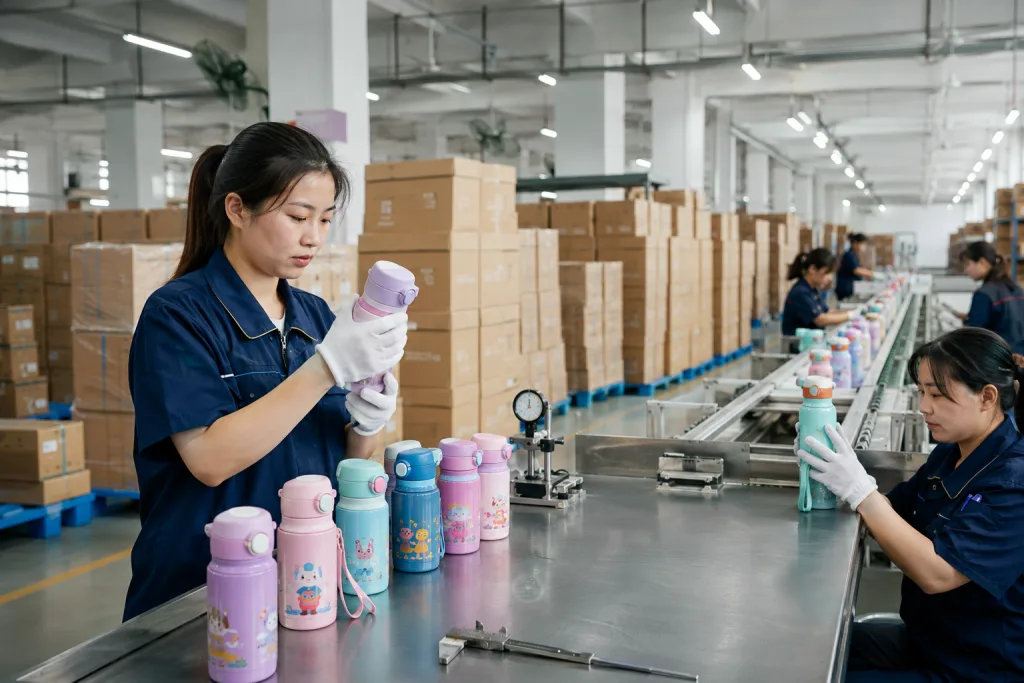
Key Takeaways
- A 500 ml custom kids water bottle in PP/Tritan with straw lid usually lands at FOB USD 1.35-3.80 depending on mold status, decoration, and packing
- Typical MOQ is 3,000 pcs for existing bottle bodies, but 10,000-30,000 pcs if you need a fully custom made kids bottle mold
- Normal production lead time is 25-40 days after sample approval, with new mold development adding 20-35 days
- Third-party testing for CPSIA, LFGB, REACH, or ASTM can add USD 350-1,200 and 5-10 working days
You are not buying a generic bottle. A kids SKU for schools, museum shops, supermarkets, or promo programs can blow up on one small miss. We have seen spout leakage, straw bite-valve fit, color migration, drop test failure, and a missing lab report turn a clean PO into a 2-week slip.
At BottleForge Industrial in Hangzhou, Zhejiang, China, the same thing keeps coming up: the buyer asks for a unit price first, then finds MOQ, mold charges, test fees, and packaging changes buried later. That is the wrong question to ask. For a bulk kids water bottle program, you need the landed number on day one, because a quote that hides cost or timing does not help when QC pulled the sample and the line is waiting.
What the unit price really includes
When you ask a children water bottle manufacturer for a price, one number is not enough. A proper quote splits out bottle body, lid assembly, decoration, packaging, and test assumptions. If a supplier sends only “USD 1.55 FOB Ningbo” with no breakdown, you are being asked to fill in the blanks yourself.
For a typical 350-500 ml kids bottle made in Zhejiang, China, the cost stack often looks like this:
- Body material: recycled stainless steel 18/8, virgin stainless steel 18/8, Tritan, PP, or glass. Tritan and PP stay common for school programs and promo orders where the buyer is chasing a lower landed cost.
- Lid construction: simple flip lid, one-touch push button, integrated straw, silicone spout, carry handle. A 5-part lid takes more line time than a 2-part cap, and it gives QC more chances to catch a leak issue before we ship.
- Decoration: one-color silk screen may add USD 0.05-0.12 per piece; wrap printing or heat transfer can add USD 0.18-0.45; laser on stainless is usually USD 0.04-0.10. We had a buyer flag a PO typo once because the artwork code and color code were swapped, and that kind of mistake turns into a rework fee fast.
- Packaging: polybag and export carton is the low end. Printed window boxes can add USD 0.18-0.60 each depending on board grade and print coverage. A plain 3-ply carton is one thing; a retail box with a 0.35 mm window film is another.
- Testing and compliance: food-contact tests, phthalate screening, drop testing, dishwasher claims, and carton transit tests are separate decisions. This is the wrong question to ask if the buyer wants a true landed number, because the math does not work until the test list is fixed.
A stock bulk children water bottle using an existing mold may quote at USD 1.35-1.95 FOB for PP or Tritan. A vacuum-insulated stainless custom kids bottle can move to USD 2.60-3.80 FOB, sometimes higher if you want powder coating, soft-touch paint, or retail display packaging. If you are a children water bottle distributor supplying school districts, ask for both FOB and ex-works pricing so you can compare freight options properly; we see that request a lot, and the gap is often bigger than the buyer expects.
At our Hangzhou facility in Zhejiang, monthly output across drinkware lines reaches 600,000 units, but kids products still depend on component release. The unit price only means something after the lid spec, packing spec, and carton count are frozen. Until then, it is just a placeholder.
MOQ tiers that change your economics
MOQ is where first-time buyers lose the plot. A children water bottle factory may quote “low MOQ,” but that price usually covers one stock color, one print position, and plain export carton only. Ask for a custom school water bottle with a Pantone-matched lid and a printed box, and the real MOQ shows up on the PI. We see this every month. Last week a buyer’s PO even said “Pantong blue,” and the line had to stop to confirm the lid chip before injection.
For sourcing, break it into two practical tiers plus one expensive one:
Existing mold, light customization
If you use an existing body and lid set, MOQ is usually 1,000-3,000 pcs per model. For a custom logo kids bottle with one-color print and standard carton pack, this is the quickest route and the lowest-risk one. We run these on existing jigs, so artwork setup is simple and QC pulled the sample in one pass on a 0.5 mm logo position check. Some children water bottle suppliers in China will take 500 pcs, but unit cost can rise 12-25% because setup is spread over fewer units. Buyers push back on that number. The math doesn't work at 500 unless the factory already has stock parts sitting on the rack.
Existing mold, custom colors and retail pack
Add Pantone body color, mixed carton assortments, hang tags, barcodes, or window boxes, and MOQ often moves to 3,000-5,000 pcs. Printed boxes themselves may carry a separate MOQ of 2,000-3,000 pcs per artwork. This is where projects get messy. A lid color match might be fine, then the window box supplier wants one full run per design, and freight density changes because the carton grew by 18 mm. We’ve seen this go sideways when buyers split one order into 6 assortments for 2,400 pcs total.
New mold or proprietary structure
A children water bottle customized around a new lid, a unique handle, or a special anti-choke straw system usually requires 10,000-30,000 pcs depending on the tooling plan. New injection molds for lids and small components can range from USD 3,000-12,000. A full bottle system with multiple cavities and silicone tools can exceed that. Tooling sounds manageable on paper, but the first T1 sample often comes back with fit issues: straw bite force too high, handle gate mark too visible, or cap torque out by 0.3 N·m. This is the wrong question to ask: “Can you do a new mold at 3,000 pcs?” Better question: how many shots do we need before scrap rate settles.
You do not lower risk by forcing a factory into an MOQ below its efficient run size. You usually just create quality drift, delayed shipments, or hidden charges later.
For school district buyers, a bulk school water bottle order is usually easier if you split by print and keep one physical colorway. For importers chasing children water bottle wholesale economics, stay above 3,000 pcs per SKU unless the factory already holds ready stock components. We ship these smoother when the bottle body, lid, and straw are shared parts, and the only change on the line is the artwork screen.
Biggest cost drivers after the bottle
Most buyers start with body material. Fair enough. After the bottle itself, the bill usually moves on decoration, lid build, and packaging. That is where two kids bottle quotes that look close in photos can land 30% apart on the sheet.
Lid complexity is the first swing. A screw cap with a carry loop is simple to run. A push-button lid with spring, lock catch, straw, vent, and silicone mouthpiece can add USD 0.25-0.60 per unit over a basic cap, and the line picks up more checks: cycle testing, leak testing, and bite resistance on the spout. We have seen buyers push back on this and then send a PO with the wrong cap code anyway.
Material claims come next. If you want recycled content, dishwasher-safe claims, BPA-free declarations, or odor-free silicone, the factory needs traceable raw material sourcing. Good children water bottle manufacturers can do that, but not with the cheapest resin on the market. The math does not work. If QC pulled the sample and the silicone smell still showed up after a hot-water soak, that cost was missed somewhere upstream.
Packaging is the quiet margin killer. For children water bottle promotional programs, plain kraft boxes usually make sense. For retail, the opposite is true. A four-color box with PET window, insert card, and multilingual warning labels can add more than the logo print itself. If you ship to Amazon FBA or major retail DCs, add FNSKU labels, outer carton marks, drop-test-ready corrugate, and pallet requirements. We once caught a PO typo on the carton count, and that one line item changed the freight math by a full pallet.
- Standard export carton: baseline cost
- Individual kraft box: +USD 0.08-0.18
- Printed color box: +USD 0.18-0.45
- Window gift box: +USD 0.35-0.60
- Barcode/FNSKU labeling: +USD 0.02-0.05
Then there is testing. If you are selling a custom children water bottle in North America, you may need CPSIA-related checks for accessible components and food-contact documentation. In Europe, REACH and LFGB discussions often come up depending on material and market position. A children water bottle supplier that cannot name the test scope before sampling is not ready for kids-product business. We keep a 72-hour sample window for this reason, and that is the wrong question to ask if someone says testing can be added later.
Lead times from idea to shipment
Lead time needs to be broken into stages, not sold as one clean promise. On a children water bottle order, “35 days” usually means production time after the pre-production sample is approved. It does not cover artwork cleanup, Pantone sign-off, tooling, or lab test booking. We see buyers miss that part all the time.
Here is a working timeline for a custom kids water bottle built from an existing mold:
- Day 1-3: RFQ alignment, artwork check, packaging brief, compliance scope
- Day 4-7: formal quote, material confirmation, sales sample selection
- Day 7-12: logo mockup and pre-sample arrangement
- Day 12-18: sample build and courier transit
- Day 19-23: buyer approval or revisions
- Day 24-28: deposit, PI confirmation, material booking
- Day 29-58: mass production, printing, assembly, packing
- Day 59-63: final inspection, booking, export docs
QC pulled the sample on the line and found a 1.5 mm cap-gap issue before the buyer did, which saved a round trip. For most stock-mold programs, the real build is 25-40 production days after sample approval, or about 45-65 total days from a clean RFQ to cargo-ready status.
For a children water bottle customizable with a new lid or bottle shape, add:
- Tooling DFM and drawings: 3-7 days
- Mold making: 15-25 days for simpler tools, 25-35 days for more complex assemblies
- First trial and corrections: 5-10 days
That is why a truly custom made kids bottle job often lands in the 70-100 day range before shipment. The math does not work any other way.
Season matters. Orders placed from late October to January in China can sit longer in queue because we are handling year-end volume and pre-Lunar New Year bookings. If you need bulk kids water bottle supply for back-to-school in August, lock artwork and packaging by March or April. We have seen school buyers push into June and then ask for a custom lid in 20 days; that is the wrong question to ask.
Compliance, testing, and failure points
Kids drinkware is not the place to shave USD 0.03 and call it a strategy. One leak complaint on an adult tumbler is noise. A complaint on a child product can kill the program. We have seen a school order stall over one missing warning line on the carton. If you work with children water bottle distributors or import straight from a children water bottle factory, put compliance on the timeline from day one.
The usual checkpoints are food-contact material declarations, REACH screening for the EU, and test plans matched to the real use case. For North America, schools and mass merchants often ask for ASTM-oriented mechanical safety checks, migration reports, and packaging warnings, depending on the accessories in the box. If the bottle has a detachable bumper, straw valve, or charm accessory, small-part risk is the right question to ask. One 4 mm part can turn into a claim.
Factory process control matters as much as lab reports. We run the line with a fixed checklist:
- AQL inspection: usually AQL 2.5 for major defects and 4.0 for minor defects
- Leak testing: 100% inline vacuum or inverted leak check for straw lids
- Drop testing: filled bottle drop simulation from 80-100 cm depending on spec
- Cycle testing: 2,000-5,000 open/close cycles for push-button lids
- Coating adhesion: cross-hatch or tape test for printed or painted bodies
Third-party testing usually costs USD 350-1,200, depending on the scope and number of materials. Add 5-10 working days. That is cheap compared with a rejected shipment. QC pulled a sample once where the lid passed on day one and failed after 300 cycles because the spring seat was off by 0.2 mm. Good children water bottle vendors in China will tell you which parts match a prior tested SKU and which parts are new. The silicone mouthpiece can stay the same, but a new color masterbatch in the lid can still trigger fresh review.
If a children water bottle customized for schools will go through the dishwasher every day, ask the factory to define “dishwasher safe” in writing. Top rack only? Domestic dishwasher at what temperature? For how many cycles? The buyer flagged one PO because the spec said “dishwasher safe” but the carton never said whether that meant 60°C or 80°C. We ship fewer surprises when the definition is tight.
How to quote school and importer programs
The cleanest RFQs come from buyers who know their channel. A school bottle job is priced one way, a retail or promo order another. If you want a sharp number from children water bottle suppliers, tell them where the bottle ships, how it packs, and whether the buyer will reject mixed cartons.
For school district buyers, the job is durability, leak control, quick replenishment, and plain branding. We usually steer them to an existing mold custom school water bottle in 350-500 ml, one or two body colors, and a straw cap or screw cap that has already passed drop tests on the line. Keep cartons plain. Ask for carton quantities that match the distribution plan, and set a spare-parts ratio for straws or mouthpieces at 1-2%. The wrong question is asking for a fancy lid first.
For importers and distributors, margin lives or dies on SKU discipline. Do not ask a children water bottle vendor for six lid colors, four prints, and three gift box versions at 2,000 pcs total. That is prototype math, and it does not work. Push volume into fewer SKUs, then use decoration to create the range. QC pulled the sample once on a PO that listed the lid color two different ways, so yes, wording matters.
A strong RFQ should include:
- Target capacity: 350 ml, 450 ml, 500 ml, etc.
- Material preference: PP, Tritan, 18/8 stainless, silicone details
- Leak-proof requirement and lid style
- Age range and market: preschool, elementary, tween
- Logo method and print area
- Packaging standard: polybag, kraft box, retail color box
- Compliance target: CPSIA, REACH, LFGB, retailer protocol
- Incoterm: EXW, FOB Ningbo, FOB Shanghai, DDP if needed
At BottleForge, standard MOQ for existing kids bottle models is 3,000 pcs, with sample lead time around 7-12 days and repeat-order production often 20-30 days once materials are confirmed. That is the advantage of working with a factory in Zhejiang, China that already runs stable children water bottle custom programs instead of rebuilding every order from zero. We ship faster because the molds, caps, and carton spec are already locked.
Where buyers overspend without noticing
The expensive mistakes are usually small ones made late. We see it on the line all the time. You approve the bottle, then tweak the logo size, then add multilingual warnings, then switch from sea freight to an urgent partial air shipment. Each step looks harmless. The cost plan breaks anyway.
The first hidden overspend is too many revisions after sample approval. If you change lid color, strap texture, or print method after the pre-production sample is signed off, we may have to scrap packaging, rebook materials, or lose a booked line slot. A buyer once flagged a lid color change after the PO typo was already corrected, and the rework bill was bigger than the sample fee.
The second is underestimating carton volume. A custom logo kids bottle with a wide carry handle or bulky retail box can add 15-30% CBM versus a plain-packed unit. Sea freight may still work, but warehousing and domestic distribution in Europe or North America will feel the extra cubes fast. QC pulled the sample and the carton sat 8 mm taller than the spec sheet said; that sort of miss moves money.
The third is splitting volume too far. A children water bottle distributor may think more colorways mean a stronger offer. On the floor, it often means slower replenishment and dead stock. If annual demand is 24,000 pcs, four SKUs at 6,000 each usually price and run better than eight SKUs at 3,000 each. The math does not work the other way.
The fourth is ignoring replacement components. Kids products get hard use. If the straw, gasket, or mouthpiece is a wear part, ask for spare sets in the first order. A USD 0.03 spare gasket packed in bulk can save a return case later. We ship those with a simple 2 kg carton and the complaint rate drops.
The buyers who do best with a custom children water bottle program are the ones who choose the right spec at the start, leave time for testing, and place volume where the factory can run consistently. That is the real savings. Everything else is noise.
Get a clear kids bottle quote, not a guess
Send your target capacity, material, packaging, and compliance needs. We will reply with MOQ, tooling cost, and a realistic Zhejiang production timeline.
Frequently asked questions
What is a realistic MOQ for a custom kids water bottle order?
For an existing mold with standard components, 1,000-3,000 pcs per model is realistic, though 3,000 pcs usually gives the best FOB price. If you need Pantone-matched colors, printed retail boxes, or multiple decorations, expect 3,000-5,000 pcs. A fully custom made kids bottle with a new lid or bottle body generally starts around 10,000 pcs and can reach 30,000 pcs depending on tooling cavities. If a factory in China offers 300 pcs on a highly customized project, check what is actually custom. Often only the logo is custom, while color, packaging, and structure stay standard.
How long does a bulk kids water bottle project usually take?
If you use an existing mold, allow 7-12 days for sampling and 25-40 days for mass production after sample approval. From first RFQ to cargo-ready shipment, most clean projects take 45-65 days. If you require new molds, add 20-35 days for tooling and trial corrections. Testing can add another 5-10 working days, especially if the bottle has multiple materials such as Tritan, PP, silicone, and printed coatings. For back-to-school delivery in North America or Europe, many buyers place orders by March or April to protect vessel space and avoid summer compression.
What price should I expect for children water bottle wholesale orders?
For a simple 350-500 ml PP or Tritan children water bottle wholesale order on an existing mold, typical FOB China pricing is around USD 1.35-1.95 per piece at 3,000-10,000 pcs. A vacuum stainless version with straw lid is more often USD 2.60-3.80 FOB. Add USD 0.05-0.12 for one-color silk screen, USD 0.18-0.45 for wrap decoration, and USD 0.18-0.60 for retail gift-style packaging. New tooling is separate and can range from USD 3,000 to over USD 12,000 depending on lid complexity and cavity count. Always compare quotes on the same Incoterm, packaging standard, and test scope.
What compliance documents should a children water bottle supplier provide?
At minimum, you should ask for material declarations for all food-contact parts, plus any existing test reports relevant to your market. For Europe, REACH and often LFGB discussions are standard. For North America, buyers may request food-contact reports, CPSIA-related information for accessible components, and mechanical safety checks where applicable. If the bottle includes detachable accessories, review small-part risks carefully. On the factory side, ask about AQL level, 100% leak testing, and whether they can support third-party inspection before shipment. A typical lab program costs about USD 350-1,200 and usually takes 5-10 working days.
Is it better to source from a children water bottle factory or a trading company?
It depends on the project. If you need one focused kids line with stable specifications, a factory usually gives better control over lead time, component changes, and production follow-up. You can discuss mold status, cavity output, defect rates, and line scheduling directly. If you are building a mixed catalog across many product types, a trading company can simplify sourcing, but you should still know which children water bottle factory is making the SKU. Ask who owns the molds, where testing is managed, and who handles corrective actions. For repeat school or retail programs, direct factory communication usually reduces confusion and saves 3-7 days on approvals.