Key Takeaways
- A usable RFQ for a custom stainless thermos should lock 12-15 data points before sampling, including steel grade, capacity, coating, logo process, test standard, and carton spec.
- Typical MOQ for a factory thermos project is 1,000-3,000 pcs per color, with sample lead time 7-12 days and bulk lead time 25-40 days in Zhejiang, China.
- For 18/8 stainless vacuum bottles, a realistic FOB price band is about USD 2.80-6.50 depending on size, coating, lid structure, and packaging.
- Put AQL levels, drop test standard, vacuum retention target, and PO tolerance into the order before deposit, not after pre-production samples.
You do not lose money on a stainless bottle because the quote was $0.18 too high. You lose it when the lid leaks after 18 days on the ocean, the logo rubs off in retail handling, or the carton size breaks your pallet math. Buyers who source a manufacturers insulated water bottle usually start with style and price. That is the wrong question to ask. Start with the sourcing process, or the line will teach you the hard way.
For outdoor retailers and promotional brands, a custom thermos program lives or dies on a few numbers: steel grade, vacuum hold time, decoration method, packaging, and inspection standard. On our Zhejiang line, QC pulled the sample at AQL 2.5 last week and the carton height was off by 4 mm, which would have changed the load plan. The buyers who send a precise RFQ get faster sampling, cleaner mass production, and fewer claims after delivery. The ones who skip details end up renegotiating points that should have been fixed before the first sample.
Start with an RFQ that means something
If you send three reference photos and ask for your best price, you will get a number. It will not be a dependable one. A manufacturers thermos quote only works when every supplier thermos candidate prices the same build. For a stainless vacuum bottle, the RFQ should look like a short spec sheet, not a mood board. QC pulled a sample with a 0.6 mm neck ring last week, and the buyer flagged it because the drawing said 0.5 mm.
At minimum, include these PO line items in the RFQ stage:
- Body specification: capacity such as 500 ml or 750 ml, double-wall vacuum, 18/8 inner and outer or 18/8 inner with 18/0 outer, wall thickness like 0.4 mm inner / 0.5 mm outer.
- Opening and lid: mouth diameter, screw lid or flip lid, PP material grade, silicone seal count, tea filter if needed.
- Finish: powder coating, spray paint, electroplating, or raw stainless. State Pantone if color matters.
- Logo: silkscreen, laser engraving, heat transfer, or UV print. Logo size and position.
- Performance: target heat retention, for example 12 hours above 55°C from 95°C fill, and cold retention target.
- Compliance: REACH, LFGB, FDA contact compliance, ASTM where relevant for gift sets, and BSCI if your brand policy asks for social audit.
- Packaging: white box, color box, barcode label, FNSKU, carton drop standard, master carton dimensions.
- Commercial terms: MOQ, target FOB Ningbo or Shanghai, sample deadline, mass production deadline.
This is where many buyers confuse a thermos vendor with a development partner. That is the wrong question to ask. We run into it all the time: the buyer wants one unit price first, then adds a lid sketch, then changes the coating to matte black. The math does not work. A thermos manufacturer in China can help refine the structure, but you still need to define the commercial target. If you are buying bulk thermos units for outdoor retail, ask the factory thermos team to quote standard tooling and any new mold cost separately. A lid mold can add USD 2,500-8,000; a simple logo tool may be zero; a new base geometry can go much higher. With a clear RFQ, the manufacturer thermos quote becomes comparable across 3-5 factories instead of guesswork.
Read quotes like a cost engineer
Once the quotes land, do not chase the lowest FOB line. On custom thermos jobs, the expensive miss is usually buried in exclusions. One supplier’s quote may include laser logo, inner electropolish, and individual polybag. Another leaves out all three. That is not a cheaper bottle. It is a different build, and the PO will prove it later.
Ask each thermos supplier to split the offer into PO-friendly cost lines. We run this check on the line with a printed sample and a caliper in hand, because a 0.3 mm lid gap turns into a claim fast.
- Unit price FOB: by quantity tier, such as 1,000 / 3,000 / 5,000 pcs.
- Sample charge: plain sample, logo sample, and whether the fee is refundable after bulk order.
- Tooling: lid mold, logo screen, packaging die-line, insert tray if any.
- Test cost: third-party lab fee if you need REACH, LFGB, or specific migration tests.
- Packaging adders: color box, gift tube, hangtag, barcode sticker, instruction sheet.
For reference, a 500 ml manufacturer thermos in a standard shape with powder coating and one-color silkscreen often lands around USD 3.20-4.60 FOB China at 3,000 pcs. A 750 ml customizable thermos with textured coating and a carry handle may run USD 4.50-6.50. A plain thermos bulk order using an existing mold and a simple box can price lower, but we’ve seen that go sideways when the carton spec, testing, or decoration line was left off the quote. QC pulled the sample, the buyer flagged the missing insert, and the math stopped working.
What to challenge in the quote
Check whether the quote states vacuum rate, leak test method, and production tolerance. A clean line is 100% leak test + 100% vacuum inspection before packing. Ask the thermos distributor or the buyer on your side what return rate they can absorb. For promotional thermos orders, logo consistency often matters more than color depth. For retail, lid fit and carton compression matter more. This is the wrong question to ask if someone only compares unit price. A factory that will not spell out the numbers usually has a reason, and we ship enough to know that reason shows up on the inspection report.
Lock the sample before talking bulk
A sample is not a formality. It is your production standard. Treat it like one. We see buyer delays for one repeat reason: one sample is asked to approve shape, color, and performance at the same time, then nobody knows what was actually signed off. Split it. On the line, even a 0.8 mm logo shift can turn into a bulk dispute.
Use a staged sample process with these PO checkpoints:
- Stage 1: plain construction sample within 3-7 days if existing mold. Approve dimensions, capacity, lid thread feel, base stability, and packing fit.
- Stage 2: pre-production logo sample within 7-12 days. Approve Pantone match, logo placement within +/- 1.5 mm, coating texture, and barcode layout.
- Stage 3: validation sample if your program needs lab or field testing. Check thermal retention, dishwasher statement if claimed, salt spray for coated parts, and transit packaging.
For a customized thermos or thermos custom project, put the approved sample straight onto the PO: Produce according to approved sample dated DD/MM/YYYY and artwork version V3. Use that exact line. Without it, sample approval is only a conversation. We have seen POs with the artwork typo carried into bulk, and then QC pulled the sample but purchasing pointed to a different PDF. This is the wrong question to ask: “Did we approve a sample?” Ask which sample, which date, and which version.
The sample is the first contract. The purchase order is the second.
If you are sourcing a promotional thermos for event deadlines, do not skip the logo sample. We ship rush orders too, but this is where programs go sideways. Silkscreen on a curved body, especially on powder coating, behaves differently from flat artwork. Laser engraving can read grey on one coating and bright silver on another. A thermos customizable program should also call out decoration adhesion testing. We usually run a cross-hatch tape test for printed areas and a rub test after curing. At BottleForge Industrial in Zhejiang, our standard sample path for existing shapes is 7-10 days, while a new lid structure usually adds another 10-15 days. That cost is minor next to a 3,000-piece bulk claim, and the math doesn't work any other way.
Write a PO that prevents arguments
By the time you place the order, the product should be dull in the best way. No open questions on steel, coating, logo, or packaging. We see too many POs that say 5,000 pcs custom bottle black with logo. Then the buyer flags a scratch or a carton mark, and everybody starts arguing over a line that should have been clear on day one.
Your bulk PO should give the production planner, QC inspector, and freight forwarder the same instructions, with no follow-up email needed:
- Item code and description: 500 ml double-wall vacuum bottle, 18/8 stainless inner and outer, powder coating black Pantone Black 6C.
- Quantity split: total pcs, color split, logo split, and country label split if needed.
- Unit price and Incoterm: FOB Ningbo, EXW Zhejiang, or DDP if separately agreed.
- Packaging: 1 pc per white box, 24 pcs per master carton, carton gross weight under 14 kg, outer carton marks, FNSKU location.
- Quality standard: AQL 2.5 major / 4.0 minor, 100% leak test, vacuum test by sampling plan, carton drop test 76 cm on 1 corner, 3 edges, 6 faces.
- Performance: hot retention and cold retention target, no sharp edge, no visible weld defect above agreed visual standard.
- Compliance files: declaration of conformity, test reports, audit copy if required.
- Timeline: pre-production sample date, mass production completion date, inspection booking date, ex-factory date.
- Payment: common terms are 30% deposit and 70% before shipment, though established accounts may negotiate better.
For thermos bulk business with outdoor retailers, add carton dimensions and palletization. We ran a carton at 47 x 47 x 32 cm last month, and the buyer saved more on warehouse handling than the supplier gave up on price. The math does not work any other way. If you are a thermos distributor or work with distributors thermos networks in North America, put UPC and carton scan rules on the PO too; QC pulled the sample once and the barcode on the outer carton was 8 mm off-center, which was enough to delay receiving.
Control production with real checkpoints
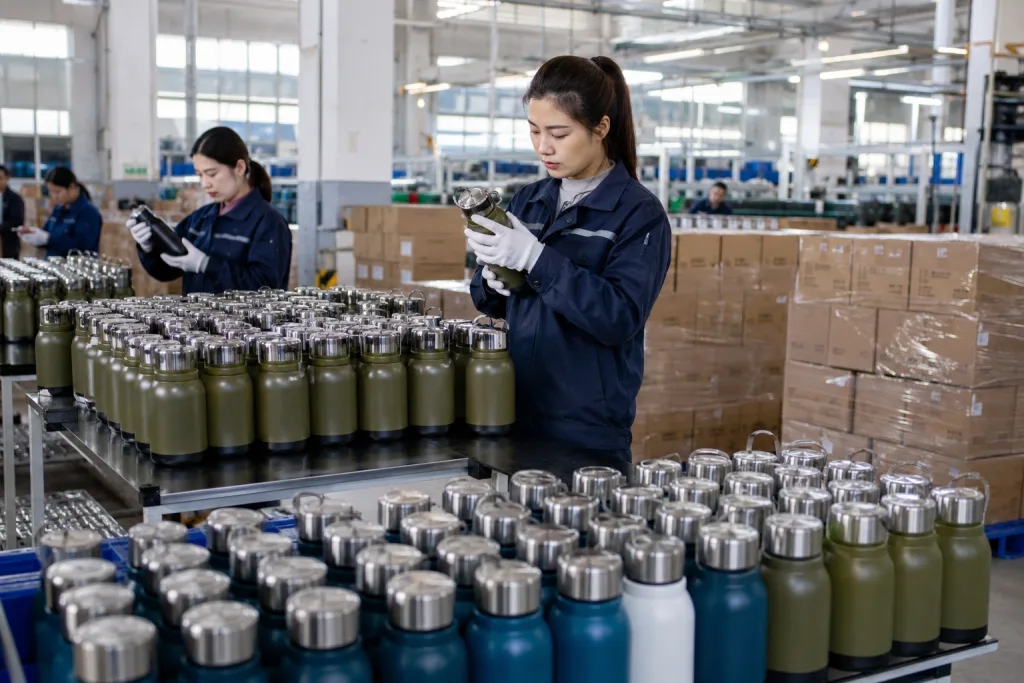
After deposit, the job moves from sourcing to control. A thermos supplier that goes quiet for 25 days and then drops container photos is a problem. Ask for milestone reporting. In our Zhejiang factory in China, we run about 300,000 units per month, and our standard MOQ starts at 1,000 pcs. The best checkpoints are simple, visual, and tied to one owner on the line.
Use this sequence:
- Pre-production meeting: lock artwork, approved sample, carton marks, test plan, and critical dimensions before the first tube hits the forming machine.
- First article photos: check body forming, welding seam, lid assembly, coating color, and logo placement from the first 20 pcs.
- Mid-line QC: pull leak test records, vacuum check records, coating adhesion spot checks, thread fit, and base flatness while the batch is still open.
- Packaging approval: verify folded box, insert fit, barcode scan, master carton weight, and carton dimensions before packing starts.
- Pre-shipment inspection: AQL based random inspection by your team or a third party, with sample count and defect limits written down.
Defects that matter most
On a manufacturer thermos order, watch lid cross-threading, silicone ring twist, coating orange peel, logo ghosting, and denting around the bottom seam. We have seen a 0.3% leak rate pass through mid-line checks and turn into a customer claim later, so that number needs a hard stop. Uneven vacuum retention between cavities from different shifts is the kind of thing QC pulled the sample for after lunch on a 2,000 pcs run.
Promotional buyers often ask whether 100% inspection is realistic. For leakage and vacuum, yes. For cosmetic defects, no factory can promise perfection on every square millimeter, and that is the wrong question to ask. AQL 2.5/4.0 is common. Some retail programs tighten visual standards on front-facing panels only. Write that into the spec with a viewing distance, usually 30-50 cm under normal light. We had one buyer flag a PO typo on “front panel” versus “front pannel,” and that kind of loose wording is exactly how cosmetic disputes start.
Plan freight, claims, and the next reorder
The bulk order is not finished when the goods leave China. If a custom thermos hits the port 9 days late for a Q4 launch, or the carton label format is wrong, the loss is commercial. We have seen buyers eat relabeling fees on a 3PL intake at 1,200 cartons because the PO typo changed the carton ID field.
Before shipment, confirm these final PO line items:
- Shipping marks: item code, color, quantity, carton number range, country of origin.
- Documents: invoice, packing list, test reports, origin files if required, booking information.
- Loading plan: container quantity, pallet or floor load, moisture protection if sea freight in humid months.
- Spare policy: agree whether 0.3%-0.5% spare units ship for claim support.
- Claim window: 15-30 days from receipt is common for visible defects; hidden defect rules should be separate.
For Amazon or 3PL channels, barcode placement and carton ID errors turn into paid relabeling fast. On one line we run, QC pulled the sample at 2 mm off-center from the FNSKU box, and the buyer flagged it before booking. For outdoor retail, a missing compliance file can sit stock at the warehouse for 12 days. This is the wrong question to ask after shipment; the supplier should already know the channel rules and raise the risk early.
The reorder talk should start before the first order lands. Ask the thermos manufacturer to keep the coating formula, logo screen file, and carton dieline under your item code so the next run matches the first one. If the first order was 2,000 pcs to test the market, set price breaks at 5,000 and 10,000 pcs before you sign. We ship with this kind of setup all the time, and the math works better when semi-finished bodies sit at 304 stainless spec during peak season. Lead time can drop from 35-40 days to 20-25 days. That is the difference between a one-off supplier thermos deal and a repeat manufacturer thermos program.
A good sourcing process does not promise a perfect bottle. It gives you a controlled bottle, from RFQ to sample to bulk, with fewer surprises and cleaner margins.
Send your thermos RFQ and get a workable quote
Share capacity, target price, logo method, and packaging. We will review the spec, flag risk points, and quote MOQ, sample timing, and FOB clearly.
Frequently asked questions
What MOQ should I expect for a custom stainless thermos order?
For an existing bottle shape, most China factories will quote 1,000-3,000 pcs per color, depending on decoration and lid type. A basic powder-coated 500 ml bottle with one-color logo may start at 1,000 pcs. A customized thermos with a new lid mold, special gift box, or multiple SKUs usually needs 3,000 pcs or more to keep cost sensible. If you need mixed colors, ask whether the MOQ applies per color or per item. Some manufacturers insulated water bottle suppliers in Zhejiang allow 500 pcs per color within a 3,000 pc total order if the body is standard. New tooling changes the equation, because mold amortization can add USD 0.20-1.20 per unit on small runs.
How long do samples and bulk production usually take?
For existing molds, a plain sample often takes 3-7 days, and a logo sample 7-12 days after artwork approval. If you are developing a new lid or base, add roughly 10-20 days for tooling and fit checks. Bulk production for 1,000-5,000 pcs is commonly 25-35 days after deposit and sample approval. During peak season in China, especially before summer outdoor and holiday gift programs, 35-45 days is safer. If your packaging is complex or requires third-party lab testing, add another 5-10 days. The fastest route is to lock artwork, compliance requirements, and carton spec before sampling. Most delays are buyer-side changes, not factory capacity.
What tests should I require for a stainless vacuum bottle?
At minimum, require 100% leak testing and a defined vacuum retention check. Many buyers specify hot retention using 95°C fill with a target such as above 55°C after 12 hours for a 500 ml bottle. If the product contacts food or drink, ask for material compliance suited to your market, such as REACH and LFGB for Europe or FDA-contact related documentation for North America. For coatings and logo, request adhesion and rub testing. For retail shipment, include a carton drop test, often 76 cm, plus barcode scan confirmation. If the bottle is for kids or sold as part of a set, check whether ASTM or other market-specific rules apply to accessories and packaging.
What is a realistic FOB price for bulk thermos orders?
A realistic FOB China price depends on size, steel grade, finish, lid complexity, and packaging. As a rough guide, a standard 500 ml double-wall stainless bottle with powder coating and one-color print is often USD 3.20-4.60 FOB at 3,000 pcs. Larger 750 ml or 1,000 ml styles, carry-handle lids, textured coatings, and premium gift packaging can push the price to USD 4.80-6.50 or higher. Very simple models with plain white box may price lower, but make sure the quote includes leak testing, vacuum control, and the exact decoration method. A quote that is USD 0.30 cheaper can become more expensive if it excludes packaging, testing, or proper QC.
How do I reduce quality claims on a custom thermos order?
Write the prevention into the PO. That means approved sample reference, steel specification, coating color code, logo placement tolerance, packaging detail, and an AQL standard such as 2.5 major / 4.0 minor. Require 100% leak test, define vacuum performance, and agree a carton drop standard before production starts. Ask for pre-production photos, mid-line QC updates, and a pre-shipment inspection. If you sell through distributors thermos channels or promotional campaigns, also define what counts as a cosmetic defect on the front-facing panel. A clear claim window helps too: for example, visible defects reported within 15 days of receipt. Most claim disputes happen because the buyer and factory never wrote down the acceptance standard.