Key Takeaways
- For a 20 oz double-wall 304 tumbler, normal MOQ is 1,000-3,000 pcs per color, with FOB China pricing often USD 2.80-5.80 depending on lid, coating, and print method
- A workable sample-to-shipment plan is 7-12 days for pre-production samples and 25-45 days for mass production after deposit and artwork approval
- Ask for AQL 2.5/4.0 inspection, 24-hour heat retention data, coating adhesion test results, and migration or REACH documentation before placing a repeat order
- Decoration, carton spec, and lid leakage cause more claims than the stainless body, so check logo tolerances, drop-test setup, and seal material early
Finding insulated tumblers is easy. Finding a factory that gives straight answers on steel grade, vacuum yield, decoration limits, carton drop risk, and what happens after the deposit clears is the hard part. That is where margin gets burned. A quote looks cheap on paper, then the buyer flags mold fees, logo rejects, late cartons, and lid rework. We have seen a 12-day slip turn into 18 days just from one bad proof.
If you buy from Zhejiang or any other part of China, you need a practical filter. Not a trend report. You need to know what a canteen manufacturer should lock down before sampling, what MOQ is realistic, how a canteen supplier compares with a tumbler line running 300,000 units per month, and which checks stop expensive surprises once production starts. QC pulled the sample on a 304 stainless run last month, and the lid thread was off by 0.3 mm. That is the wrong question to ask if you start with price alone.
What should you ask first?
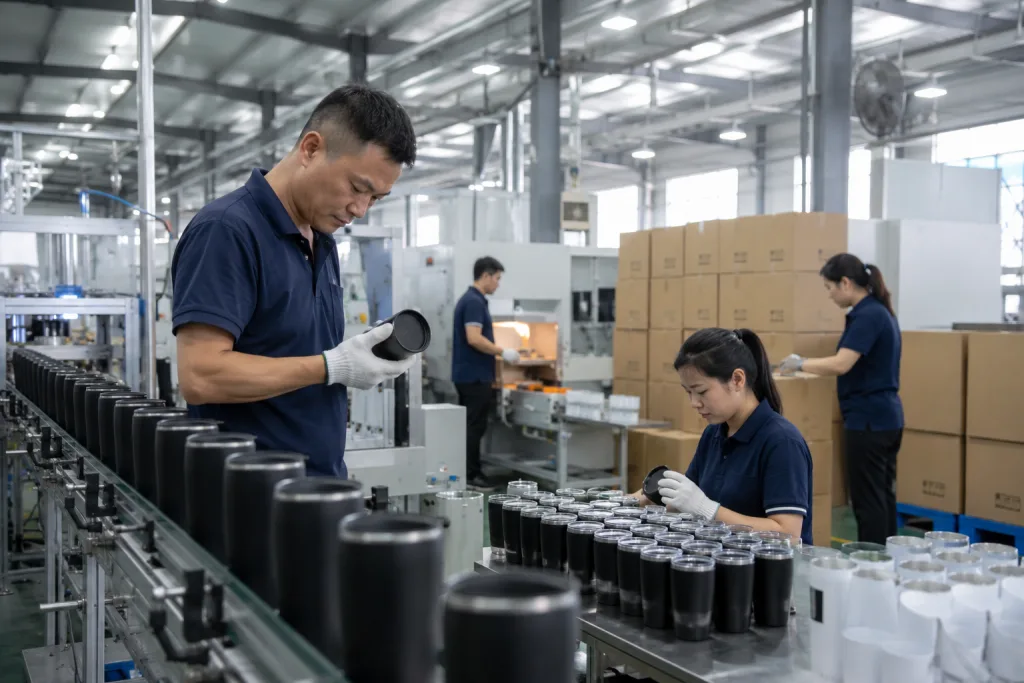
Start with questions that show whether you are talking to a real manufacturers insulated tumbler plant or a trading layer with little control. Ask what is made in-house, what is outsourced, and the monthly output for the exact body style you want. A real canteen factory or tumbler producer gives numbers, not slogans. At BottleForge Industrial in Zhejiang, the insulated line runs in the tens or hundreds of thousands of units per month. We check that against the line card, not a sales brochure.
Your first checklist should cover six points:
- Body material: 18/8 stainless steel or SUS304 for inner and outer wall; confirm if the base or handle uses a different grade. We have seen a PO typo swap SUS304 for 201 on a 20,000 pcs order, and the buyer flagged it before production.
- Wall thickness: common ranges are 0.4 mm inner and 0.45-0.5 mm outer. Thinner steel cuts cost, but it dents easier. Ask for the caliper reading from QC, not a verbal promise.
- Vacuum process: ask the vacuum rate and heat retention claim, such as 6 hours above 60°C or 12 hours below 10°C. If they cannot show a logged test, the math does not work.
- Lid structure: PP, Tritan, AS, or stainless cap; silicone seal grade; straw or slide closure leakage rating. We run leak checks at 1.2 meters, and a lid that passes at 0.8 meters still fails in transit.
- MOQ: stock shape with custom logo usually starts around 1,000 pcs; custom body tooling often starts at 3,000-5,000 pcs. For a new mold, 3,000 pcs is the number that matters, not a lower sales quote.
- Lead time: 7-10 days for sample, 30-35 days for repeat order is normal in China outside peak season. If a supplier says 15 days for both sample and mass order, we’ve seen that go sideways on the line.
If you also source custom canteen, customizable canteen, or customized drinkware lines, ask whether the same factory runs both bottle and tumbler tooling. Many canteen suppliers are strong on narrow-mouth flasks and weak on travel lids that leak under pressure. A canteen vendor can still work, but only if they can show export files for Europe and North America, including REACH, LFGB, FDA-contact compliance, and carton standards for retail or FBA. QC pulled the sample and checked the carton drop spec at 75 cm; that is the kind of detail that tells you whether they ship real programs or just quotes.
You are not buying steel only. You are buying process control on steel, coating, lid fit, and packaging.
How do you compare factory quotes?
Do not compare unit price alone. Check the quote line by line. For a 20 oz powder-coated insulated tumbler with a slide lid, FOB Ningbo or Shanghai pricing from Zhejiang or other China suppliers often lands between USD 2.80 and 5.80 at 3,000 pcs. A handle lid, electro-polished interior, gift box, or laser engraving can add USD 0.18 to 1.20 per piece. If one canteen supplier is 12% cheaper, there is usually a reason. We see it on the line: thinner 0.35 mm stainless, no spare lids packed, or the vacuum hold time tested on one sample instead of the full lot.
Quote comparison checklist
- Incoterm: FOB, EXW, or DDP. FOB is cleaner for comparing factories.
- Tooling: new lid mold can cost USD 2,000-8,000; full body mold more.
- Decoration: silkscreen, heat transfer, laser, 3D print, UV print, or embossed patch all price differently.
- Packaging: egg-crate divider, white box, color box, PDQ tray, barcode label, FNSKU, instruction card.
- Testing: whether routine leakage, salt spray, drop test, and dishwasher test are included.
- Spare allowance: 0.3%-1% extra units can save a reprint or retail shortage claim.
This matters more if you buy broad programs such as canteen custom, customized canteen, or customizable growler projects from the same source. A canteen distributor or distributor drinkware buyer should ask for a cost split by body, lid, decoration, and packaging. That is where cost engineering happens. This is the right question to ask. We have cut USD 0.11 by changing powder coat from fine texture to standard matte, and we have seen buyers drop a handle lid after QC pulled the sample and found the hinge force was overkill for a basic retail SKU.
Send every canteen manufacturer and canteen factory candidate the same spreadsheet. Same columns. Same assumptions. If one quote omits carton size, net weight, and CBM, your freight estimate is unreliable. We shipped one PO where the buyer flagged a 58 x 39 x 29 cm master carton mismatch against the booking sheet, and the freight budget was off before production even closed. If one quote states only “food safe,” push back. You want named standards or test reports, not marketing language.
What MOQ is actually realistic?
Buyers new to custom drinkware hear two promises: “We can do any quantity” and “Our MOQ is 10,000.” Both miss the point. MOQ changes with the mold, the number of colors, and the decoration method. I’ve seen a PO typo turn a 1,000 pcs sample run into a 10,000 pcs argument.
For stock-shape insulated tumblers, these are the working numbers from a canteen factory or tumbler plant in Zhejiang:
- Blank stock with no logo: 500-1,000 pcs if inventory is on the shelf.
- Custom logo on stock color: 1,000 pcs per model is standard.
- Custom body color: 1,000-3,000 pcs per color because the coating line needs a setup change.
- Retail gift box: usually 1,000 pcs, since box printing carries its own MOQ.
- New mold or customized growler body: 3,000-5,000 pcs minimum, sometimes more.
If you are a canteen distributor, canteen distributors, or distributor growler buyer building a mixed SKU program, ask whether the factory can combine models in one container booking while keeping the production lots separate. That is how you protect freight cost without forcing one slow color to sit for 90 days. The math works only when the line is scheduled cleanly.
Watch the “low MOQ custom” pitch from some canteen vendors. The body may be stock, the color may come from existing inventory, and the logo may be limited to one position. That can be the right call for a market test. It is not the same as fully canteen customized development. QC pulled the sample, and the buyer flagged it because the logo placement was fixed at 35 mm from the seam. Say clearly whether you want stock customization or exclusive product configuration.
The practical move is simple: start with one stock body, one lid, two colors, and one decoration process. Land the first order with stable quality. Then move into custom canteen, custom growler, or wider customizable drinkware lines when your forecast supports new tooling and the MOQ stops being the wrong question to ask.
How do you judge quality before mass production?
You cannot inspect quality into a bad design. We see this on the line all the time. The buyer locks the risk points before the purchase order goes out, not after. For insulated tumblers, the body is usually the easy part. Lids, coatings, logo adhesion, and pack-out are where the trouble starts.
Ask for a pre-production sample that matches the final spec: body color, logo process, lid version, straw if any, barcode label, and carton structure. We had a buyer flag a PO typo once, and the sample caught it before 5,000 pcs were packed. Then check it against a simple list:
- Vacuum performance: ask for the actual test setup, not a claim. 95°C hot water after 6 hours or ice retention after 12 hours is a usable reference.
- Leakage: run 45-degree and upside-down tests for 30 minutes. Many travel lids are splash-resistant, not leakproof.
- Coating adhesion: cross-hatch test and tape pull, especially on powder coat and metallic paint.
- Logo durability: rub test with alcohol and a dry cloth; check laser depth consistency on curved surfaces.
- Dimensional fit: check lid thread engagement, base diameter, cup-holder fit, and straw tolerance.
- Carton drop: 76 cm or 1 meter, depending on pack style and customer requirement.
For mass production, the normal export control plan is AQL 2.5 major / 4.0 minor final inspection. If your brand sits in premium retail, tighten the critical points like leakage and logo alignment. Ask for BSCI, ISO 9001, or social audit reports if your compliance team needs them. We run a 24-hour hold on first-off samples for this reason. A supplier should be able to say which tests are internal and which are third-party without hand-waving.
If you source both customized growler and tumbler ranges, ask whether they run the same polishing and welding standards. A growler with a swing cap and a tumbler with a threaded lid fail in different ways. One plant can be strong on one and weak on the other. This is the wrong question to ask: “Do you make both?” The better question is which process controls sit behind each SKU, down to the weld bead and the polish wheel.
Which compliance documents really matter?
Buyers in Europe and North America often ask for “all certificates.” That burns days for no gain. Ask for the papers that match the market, the material stack, and the channel. For insulated tumblers and related customizable drinkware, the baseline usually means food-contact safety for stainless steel, plastic lid parts, silicone seals, and any coating on the cup body. On the line, we usually check those parts separately; one missing lid declaration can stall a 3,000-piece order.
For the EU, ask for REACH SVHC status and, depending on your compliance route, LFGB or migration testing for food-contact parts. For the US and Canada, ask for FDA-related material declarations and any retailer chemical limits. If the tumbler is sold for children, then ASTM and CPSIA review can matter depending on age grading and accessory parts. The buyer flagged this on a 12 oz kids cup last month, and the math did not work without a separate cap report.
Also confirm the operational files:
- Material traceability: steel purchase records, plastic resin specs, silicone grade, heat number.
- Inspection records: in-line and final QC reports tied to PO or lot number, with AQL 2.5 if that is your standard.
- Carton labeling: shipping marks, FNSKU, suffocation warning, country of origin, carton count.
- Factory audits: BSCI or equivalent if your customer requires social compliance.
If you are buying from a canteen manufacturer or canteen manufacturers network in China, ask one blunt question: are the test reports product-specific, or generic? We have seen this go sideways. A supplier once sent an old report for a different lid gasket, and the PO had the wrong item code by one digit. That report did not protect anyone. The paper should match the current material set, or sit next to a clean material declaration from the same source.
For canteen promotional orders, timelines are usually short. That is when compliance shortcuts get expensive. Retailers in Europe do not care that a festival launch date was tight. If documents are incomplete, goods get held, rejected, or pushed into a price cut. Build document review into first sample approval, not two days before balance payment. QC pulled the sample on a 500 ml tumbler and found a missing coating declaration; that was enough to stop shipment for eight days.
How should you manage production and shipping?
Most delays do not come from welding the cup body. They come from artwork approval, the coating queue, outsourced lid parts, and packaging changes after the line has already started. We see this on the factory floor all the time. Good control is plain and strict.
Run a written timeline with clear gates: approved quotation, confirmed Pantone or color chip, approved artwork, signed sample, deposit received, in-line inspection date, final inspection date, booking window, and balance payment. For a normal 3,000-5,000 piece insulated tumbler order from Zhejiang, lead time is 30-45 days after sample approval. We quoted one 4,200-piece order where the buyer flagged a lid typo on the PO; that added 6 days before we could release molding. Peak season before Q4 gifting or summer hydration campaigns can push that to 45-60 days.
Your shipping checklist should include:
- Carton data: master carton size, GW/NW, cartons per pallet if applicable, and full container loading quantity.
- Barcode plan: UPC, EAN, FNSKU placement, scan verification.
- Spare parts: extra lids, straws, or seals at 1%-2% for after-sales support.
- Inspection timing: do final inspection when at least 80% packed, not when goods are still loose.
- Booking method: whether you ship LCL, FCL, or consolidated with other distributor canteen items.
If you work with a distributor canteen or distributor drinkware model, ask your canteen vendor whether they can palletize by SKU and provide outer carton photo records before loading. We had a pallet stack fail a tilt test at 45 mm deflection, so we changed the carton spec before booking. That saves warehouse labor on arrival. If you sell online, make sure carton strength and individual unit protection are tested for parcel handling, not only container transport.
The last practical point: do not keep changing details after production starts. A revised logo size or lid color one week late can cost more than the unit price saving you negotiated. The math does not work. Stable specifications are one of the cheapest forms of quality control.
When is a factory the right long-term fit?
The right factory is not the one that says yes to every request. It is the one that flags risk before you pay for it. If you plan a repeat insulated tumbler, custom canteen, and custom growler program, choose a supplier that can handle step-by-step growth. We run into this on the line all the time: a buyer starts with 3,000 pieces, then wants 30,000 in the next round, and the plant falls apart because nobody built for that path.
A useful long-term scorecard has five parts. First, repeat quality: does order two match the approved sample, down to coating shade and logo placement? Second, response speed: do technical questions come back in 24 hours with drawings or photos, not sales filler? Third, cost discipline: can the factory show year-over-year changes in steel, coating, carton, and labor cost? Fourth, development ability: can they move from stock customizable canteen projects into more customized canteen work without losing control? Fifth, problem handling: when a claim happens, do they issue a clear 8D-style corrective action, or just offer a small credit and close the file? QC pulled the sample twice on one 500 ml run because the print sat 2 mm high; that kind of miss tells you more than a smooth sales deck.
Some canteen vendors can ship one acceptable order. Fewer can scale a program across Europe and North America with stable compliance and packaging accuracy. That is the wrong question to ask if you only chase the lowest price. A Zhejiang-based partner with export docs and an engineering team that understands cup-holder dimensions, retail shelf limits, and Amazon FBA prep usually saves money later, because the buyer flagged it on the first PO when a carton typo turned into a warehouse rejection.
If your business depends on repeat launches, ask for evidence: monthly capacity, top three export markets, standard lead times, and defect history by category. Ask for the number, not the promise. A canteen supplier worth keeping will say where they are strong and where they want simpler specs. We’ve seen this go sideways when a buyer pushed for a matte white finish on a tight 18-day schedule; the math does not work, and a factory that admits it early is the one you can build with.
Get a straight answer on your tumbler project
Send your target size, lid type, quantity, and market. We will reply with realistic MOQ, FOB pricing, lead time, and compliance checkpoints.
Frequently asked questions
What is a normal MOQ for a custom insulated tumbler order?
For a stock-shape insulated tumbler with your logo, 1,000 pcs per model is a normal starting point in China. If you need a custom body color, expect 1,000-3,000 pcs per color because coating setup and curing runs drive the minimum. Full body or lid tooling usually pushes MOQ to 3,000-5,000 pcs, sometimes more if the structure is complex. If a canteen supplier offers 300 pcs, check what is really custom. Often it means stock inventory, one print position, and limited color choice. For B2B buyers, the best first order is usually one proven mold, one lid, two colors, and a simple print or laser decoration. That gives you realistic cost and quality data before you commit to a broader customized drinkware program.
How much should I budget per piece for a 20 oz insulated tumbler?
A workable FOB China budget for a 20 oz double-wall vacuum tumbler is USD 2.80-5.80 at 3,000 pcs, depending on steel thickness, lid type, coating, and decoration. A basic powder-coated body with a standard slide lid sits near the lower end. Add a handle lid, stainless straw, gift box, or full-wrap UV print, and the price climbs fast. Laser logo can add around USD 0.08-0.20, while premium retail packaging may add USD 0.35-0.90. New tooling is separate and can range from roughly USD 2,000 for a simple lid update to far higher for a full customized growler or tumbler body. Always ask for a price split by body, lid, decoration, and packaging so you know where to reduce cost without damaging function.
What quality checks matter most for insulated tumblers?
The critical checks are vacuum retention, leakage, coating adhesion, logo durability, and carton protection. Ask for a heat test with a stated method, such as water filled at 95°C and measured after 6 hours. For cold retention, many buyers ask for 12 hours under a defined room temperature. Leakage should be tested upright, at 45 degrees, and upside down for 30 minutes, especially for travel lids with sliding closures. Powder coat should pass a cross-hatch tape test, and printed logos should survive alcohol rub testing. For shipment safety, ask for carton drop testing at 76 cm or 1 meter depending on your pack style. Use AQL 2.5/4.0 for final inspection and make sure inspection happens when at least 80% of the order is packed.
Which compliance documents should I request from a Chinese canteen manufacturer?
Request documents that match your destination market and product structure. For Europe, start with REACH-related chemical compliance and, if your team requires it, food-contact testing such as migration or LFGB-related documentation for lid and seal components. For North America, ask for FDA-contact declarations for relevant materials and any retailer-restricted substance statements. If the item is aimed at children, additional review under ASTM or CPSIA-related rules may apply depending on the age grading. Beyond lab reports, ask for material declarations, steel grade confirmation, silicone and plastic specifications, and a clear match between the report and the actual lid or coating used on your order. Generic reports from another product are not enough for serious B2B procurement.
How long does production usually take after sample approval?
For a standard order of 3,000-5,000 insulated tumblers using an existing mold, 25-45 days after sample approval and deposit is a realistic range. Pre-production samples usually take 7-12 days, depending on whether you need a new coating color, custom packaging, or multiple logo methods to compare. Peak season can extend production to 45-60 days because powder coating lines, lid suppliers, and carton plants all get tight at the same time. If you add a new mold, allow several extra weeks for tooling, trial samples, and fit correction. The best way to protect your timeline is to approve artwork, packaging dielines, and Pantone references early. Late changes to lid color or logo size are a common reason China shipments miss vessel booking windows.