Key Takeaways
- A real manufacturers hydration flask buy starts with specs: 18/8 stainless, 0.5-0.8 mm wall, and cap compatibility matter more than artwork.
- For most B2B programs, MOQ ranges from 1,000 to 3,000 pcs per SKU, with 25-35 days lead time after sample approval.
- Ask for REACH, LFGB, and ASTM/FDA-relevant test documents; a serious canteen supplier in China should have them ready.
- The right choice depends on channel fit: custom growler for retail, customizable canteen for promotions, distributor drinkware for replenishment, and custom drinkware for e-commerce.
When you source a manufacturers hydration flask line, style is not the first filter. The real question is whether the bottle holds up in your channel, protects margin, and clears the compliance file. A canteen factory in Zhejiang can quote three products that look similar on a catalog page. One is built for heat retention, one for sports retail, one for distributor programs that need low defect rates and fast reorders. Pick by appearance and you usually pay later in returns, artwork failures, or a freight bill that wipes out the margin.
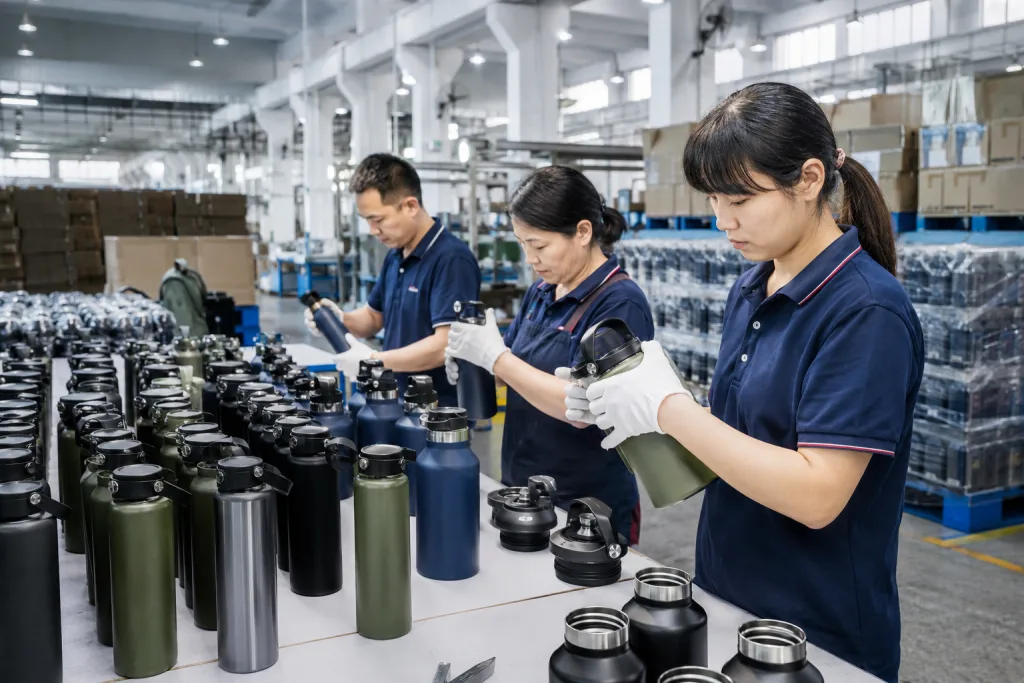
The cleaner approach is to compare specs head to head: material, wall thickness, cap system, MOQ, decoration method, and test standards. That is how a canteen manufacturer separates a true custom canteen from a canteen promotional item meant for a short campaign. We run in Hangzhou, Zhejiang, and the buyers who stay profitable ask for the numbers first. QC pulled a 1,000-piece sample last week and flagged a cap thread mismatch at 0.3 mm; that is the kind of detail that saves a PO from a bad reprint. A decent factory should ship 300,000 units per month, give clear lead times, and explain why one customized drinkware option fits your channel better than another.
Spec table first, marketing second
If you want a clean buying decision, start with a comparison table. QC pulled the sample sheet before lunch, and that is how buyers stop wasting time on bottles that were never going to pass. A manufacturers hydration flask program can cover several product families, but the spec line tells you what fits each channel.
| Format | Best use | Typical material | MOQ | Lead time | Risk |
|---|---|---|---|---|---|
| Standard hydration flask | Everyday retail | 304 stainless, PP cap | 1,000 pcs | 25-30 days | Moderate |
| Custom canteen | Promotions, clubs | 304/316 stainless or aluminum | 2,000 pcs | 30-35 days | Artwork mismatch |
| Custom growler | Beer, outdoor, premium resale | 304 stainless, thicker wall | 1,500 pcs | 30-40 days | Seal performance |
| Customized drinkware | Brand programs, DTC | Mix by channel | 500-3,000 pcs | 20-35 days | SKU sprawl |
That table is the right way to price canteen custom sourcing. A canteen vendor may pitch “one bottle for everything,” but the math does not work. We had a buyer flag a PO typo on a 316 stainless spec last month, and the line still had to stop to recheck the cap drawing. If you need a customizable canteen for a school program, unit cost and weight beat double-wall insulation. If you need a premium distributor growler, people inspect the thread finish, coating adhesion, and lid seal before they even look at the logo. A serious canteen factory in Zhejiang should quote those options cleanly, no guessing.
One practical rule: if the product will travel through retail shelves, ask for a 1.2 meter drop test and a coating adhesion standard tied to ASTM D3359 or an equivalent internal method. We run that check on the line with a caliper and a simple tape pull, because this is where cheap claims fall apart. For heat retention, ask for 6-12 hour performance data with the test conditions written down. Without written conditions, “performance” is just sales talk.
Material choice changes the channel
Most buyers say they want a canteen customizable enough for their brand, but the first call is still material. Material sets weight, landed cost, corrosion resistance, and what the bottle can take in printing or laser work. We run the same silhouette in stainless steel, aluminum, Tritan, or glass, and the channel result changes every time. On the line, a 0.5 mm shell and a 0.8 mm shell do not feel like the same product.
Stainless steel
For most manufacturers hydration flask orders, 304 stainless is the default that does the job. It handles acidic drinks better than cheap metal, clears compliance work more smoothly, and stays stable when the buyer comes back for a second PO. For food-contact-heavy markets, 316 stainless gives more corrosion resistance, but the price usually climbs by 8-15 percent. Wall thickness matters too: 0.5 mm shows up on entry products, while 0.6-0.8 mm feels firmer and cuts dent complaints. QC pulled the sample, tapped the side, and the thinner spec rang hollow.
Aluminum and light-duty bodies
Aluminum works for canteen promotional campaigns because it holds down unit price and takes color coating well. The tradeoff is dent resistance and lining requirements. If you are selling through a canteen distributor network, get the interior finish and seal data on paper before the first shipment. We have seen that go sideways on a 5,000-piece order when the buyer flagged a missing lining note in the PO.
For a canteen supplier in China, material selection is not a branding call; it is a margin call. A custom canteen for outdoor retail may justify thicker steel and silicone base pads. A distributor drinkware order for a supermarket chain may need lower weight and faster packing. The wrong question is, which material looks best in a catalog render. The better question is, which one cuts claims and keeps the reorder clean. One typo on a PO can still blow up a batch if the finish code is wrong.
Cap systems decide the real user experience
If the lid fails, the bottle is dead on arrival. Buyers sourcing customized canteen products often spend their time on logo size and box art, then get burned by the cap assembly. That is where the returns start: leaks, sticky threads, broken hinges, weak seals.
For a canteen custom program, ask the factory to run three closures side by side: screw cap, flip-top, and straw lid. We do this on the line because the buyer flagged a “same lid” claim once, and the samples behaved differently after 48 hours at 70°C. A screw cap is simpler and usually holds up better, so broad-market drinkware buyers keep coming back to it. Flip-top lids are easier for one-hand drinking, but they bring extra parts and more failure points. Straw lids sell in sports channels, yet they need tighter QC on silicone valves and assembly torque.
- Leak test: invert for 24 hours at room temperature and again after thermal cycling.
- Torque consistency: define a target range, not a vague “tight fit.”
- Spare parts: confirm whether seals are replaceable or molded in.
For customized drinkware sold through e-commerce, cap consistency matters more than almost any other feature because returns hit fast and in public. QC pulled the sample, checked the torque wrench log, and found a 0.8 N·m spread on one batch; that kind of spread turns into complaints. A canteen vendor in Zhejiang that knows export work should hand over torque specs, seal materials, and cycle-test data before you chase them twice. If they cannot, the math does not work for serious distributor canteen business.
Decoration methods are not equal
Your artwork budget can vanish fast if you pick the wrong decoration method. A canteen promo order with a one-color logo is a different job from a premium custom growler with wraparound graphics and a matte powder coat. On the line, the bottle body, ink system, and curing profile all have to match.
Silkscreen still wins on cost for large flat areas and simple logos. Laser engraving holds up on stainless when you want a durable, premium finish with no ink wear. Heat transfer and UV printing handle more complex branding on customizable drinkware, but the factory needs tight control of surface treatment and curing. Ask for abrasion test results, not just product photos; we have seen that go sideways. One rub test on a 300 mm sample tells you more than a polished sales shot.
For canteen customized projects sold in North America or Europe, ask whether the ink and coating system has been checked against REACH and food-contact expectations where relevant. The safe export workflow is plain: confirm substrate, confirm finish, confirm print method, then approve a pre-production sample with real color tolerance. If your brand lives or dies on Pantone accuracy, state a Delta E target. A Delta E under 2.0 is realistic on controlled runs; under 1.5 is tighter and costs more. QC pulled the sample, and the buyer flagged a 0.8 mm shift on the logo position before we shipped.
Custom drinkware buyers often miss packaging too. A canteen distributor program may need individual box barcodes, FNSKU labels for Amazon channels, and carton marks matched to warehouse intake. Decoration and packout should be reviewed together, because a PO typo on the label spec can stop the whole shipment at 20 cartons. The math does not work if you treat them as separate jobs.
Compliance and QA are where China matters
Buying from China is not the same as buying from a factory in China that ships export orders every week. Zhejiang has strong drinkware capacity, but the factory that matters can show real process control, not just a polished sample on a desk. We run BSCI checks when the buyer needs social compliance. We ask for LFGB, REACH, or the market report tied to the sales channel, and for the U.S. side we want food-contact declarations plus any ASTM-aligned test the buyer’s customer will ask for. For EU orders, the material chain needs to be clear all the way back to the resin or steel mill.
On the line, the numbers tell you more than the pitch. A proper canteen factory should talk about AQL 2.5 for major defects, AQL 4.0 for minor defects, batch-linked photo records, and the actual sample size behind “full inspection.” We had a buyer flag a PO typo on the carton code once, and QC pulled the sample because that is where export mistakes show up first. If a supplier cannot say whether it uses inline leak checks, vacuum checks, or destructive testing on a set percentage, that is a warning sign. The math does not work.
“The buyer who asks for the test method usually saves more money than the buyer who asks for the cheapest unit price.”
That is true for distributor drinkware. One bad lot can turn into returns, chargebacks, and a shelf-space problem fast. We have seen it go sideways on a 12,000-piece order where the unit price looked good and the cap torque spec was never written down. The cheapest custom canteen is the one that clears the first shipment and does not come back.
Fit the product to the sales channel
Not every bottle fits every channel. Shelf retail, distributor stock, and online carton work all punish different weak spots. We see it on the line: one SKU looks fine in a photo, then the cap scuffs in a store display or the carton crushes in transit. A buyer who wants one bottle for every channel is asking the wrong question.
For outdoor retail, a custom growler usually carries the sale because the larger body gives you room for premium pricing and repeat use. For schools, gyms, and corporate campaigns, a customizable canteen is the cleaner fit; at 1,000 pcs MOQ, the unit math stays under control and the print setup is faster. For brand stores or Amazon, customized drinkware needs tight carton dimensions and steady packaging, or FNSKU labeling turns into a delay on the dock.
- Retail: prioritize finish, cap feel, and shelf appeal.
- Distributor programs: prioritize stock stability, carton efficiency, and reorder speed.
- Promotional work: prioritize unit cost, print speed, and logo visibility.
- Premium resale: prioritize leak proofing, weight balance, and surface durability.
A canteen distributor who asks for one sample and one price is not building a program. QC pulled the sample at 72 hours and the buyer flagged the seal, so we now ask for packaging spec, spare seals, and reorder MOQ before we quote. That is the difference between a factory that gets repeat orders and one that only sends a single PDF.
What a clean factory quote includes
A usable quote is more than FOB Ningbo or FOB Shanghai. A clean canteen supplier quote from China breaks out mold cost, unit price, print charge, packing charge, and test cost. The headline number can look fine while setup work sits off to the side. We see that on the line all the time. If you compare canteen suppliers, normalize the quote first, then decide.
Ask for these items in writing: material grade, wall thickness, finish type, cap material, logo method, carton quantity, sample lead time, mass production lead time, and inspection standard. A good canteen factory in Zhejiang should also say whether the quoted price assumes stock colors or a custom Pantone run. We had a buyer flag a PO once because the color code was typed as “PMS” instead of the actual Pantone number, and the mismatch cost a week. Custom color usually adds 5-12 days and can raise scrap when the line is busy.
For custom drinkware and customized growler programs, the quote should also explain tooling ownership. If a mold is opened for your design, know whether it stays with you, how long it is retained, and what the re-order cost is after the first run. We keep a 3.2 mm cavity drawing on file for this reason. This is the part that protects margin on repeat orders, and the math does not work if the tooling terms stay fuzzy.
When the quote is clear, the sourcing decision gets easier. When it is vague, the factory is asking you to carry their uncertainty.
Request a spec-matched quote today
Send your target market, MOQ, and artwork. We will match the right hydration flask, canteen custom option, and packaging for your channel.
Frequently asked questions
What MOQ should I expect for a manufacturers hydration flask order?
For standard export programs, expect 1,000 to 3,000 pcs per SKU. A simple canteen promotional run may start at 500 pcs if the factory has stock bodies or stock caps, but custom colors, special lids, or new molds usually push MOQ up. If you are buying as a canteen distributor, ask for reorder MOQ separately from first-run MOQ. Those two numbers are rarely the same. A practical factory in Zhejiang should state the MOQ by decoration method, not just by product family.
Is 304 stainless enough for custom drinkware in Europe and North America?
Yes, 304 stainless is the standard choice for most custom drinkware and custom canteen programs. It is usually sufficient for water, tea, coffee, and general retail use. If your product will face more aggressive liquids, salty environments, or premium positioning, 316 stainless can be worth the extra cost, typically 8-15 percent higher on material-heavy designs. For EU and North America, the key is not only grade, but also traceable material documentation and test reports aligned to your market requirements.
What lead time should I plan for a canteen customized order?
A normal production window is 25-35 days after sample approval, depending on decoration, packaging, and order size. If you need a custom growler with special coating or new tooling, 30-40 days is more realistic. Add 5-12 days if the project needs custom Pantone color matching or extra compliance testing. If a canteen supplier promises a very short lead time without clarifying whether stock parts are available, ask for the production schedule in writing.
Which decoration method is best for a canteen promotional project?
For simple logos and large quantities, silkscreen is usually the lowest-cost option and performs well on flat or lightly curved bodies. Laser engraving is better when you want a durable premium look on stainless steel, but it usually costs more per unit. UV printing is useful for complex artwork and canteen custom graphics, though it needs stricter surface control. The right method depends on volume, color count, and how much wear the bottle will see in the field. Ask the factory for abrasion data before you approve artwork.
How do I judge whether a canteen factory is export-ready?
Look for three things: written quality standards, market compliance documents, and stable output. A real export-ready canteen factory should be able to talk about AQL levels, leak testing, packaging spec, and documents such as REACH, LFGB, or BSCI where relevant. Capacity matters too; a serious plant in Zhejiang may run 300,000 units per month across multiple lines. If they cannot explain inspection sampling or give batch-level traceability, they are probably not ready for distributor drinkware business at scale.