Key Takeaways
- A serious manufacturers hydration bottle order starts with a spec sheet, not a logo file.
- A practical MOQ is often 500-3,000 pcs, with 25-35 day lead times after sample approval.
- For coated stainless models, ask for 304 steel, 0.4-0.5 mm wall thickness, and REACH-compliant finishes.
- Use AQL 2.5 for major defects and 4.0 for minor defects, then verify cartons, drop tests, and leak checks.
You are not buying a “water bottle.” You are buying a repeatable SKU that has to survive freight, branding, compliance checks, and real end-user handling. Start with the build, not the artwork: material, capacity, lid, coating, test standard, and carton packout. Skip that, and the sample looks fine while the production lot lands on the rework table.
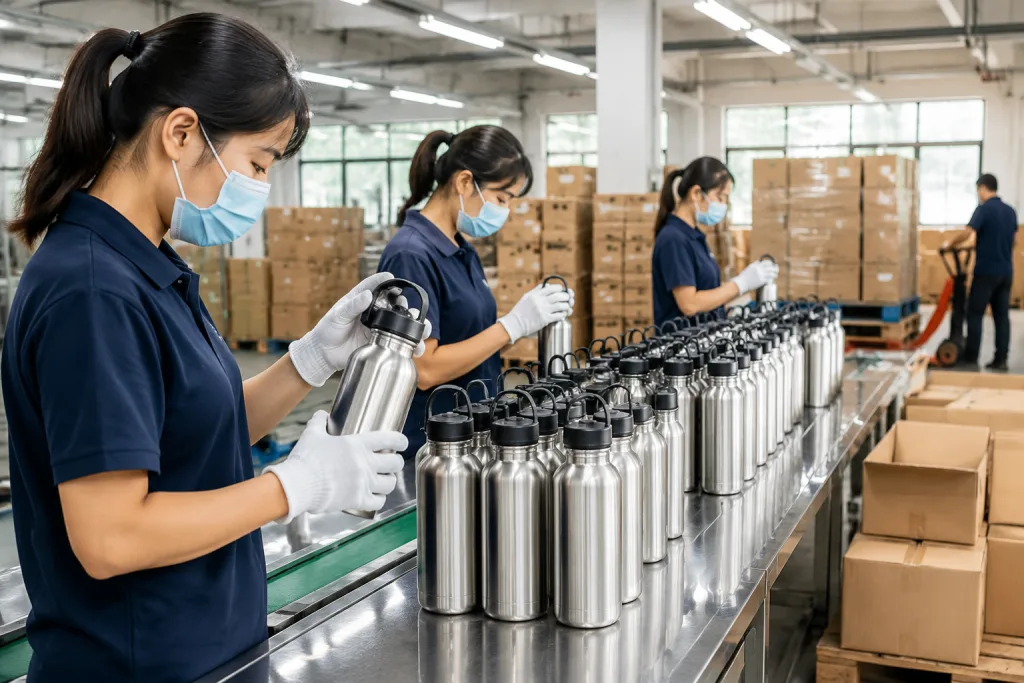
For a manufacturers hydration bottle program, the clean way to buy is to run one order from brief to QC. That is how we ship custom drinkware in Zhejiang and across China: lock the spec sheet, confirm decoration limits, sample against the same tooling, then inspect to AQL before booking freight. On the line, a 3 mm lid lip or a typo on the PO can change the whole job, and we've seen that go sideways fast. If you are working with a canteen manufacturer, a canteen supplier, or multiple canteen distributors, the flow should stay the same.
Start With the Use Case
The cleanest buyer case is plain. You have a distributor program for gyms, outdoor retail, or corporate resale, and you need one hydration bottle that protects margin without driving complaint rates. Write the use case in simple terms: who uses it, where it travels, how often it gets washed, and whether it must hold both hot and cold drinks. That choice tells you whether the right buy is a single-wall canteen custom item, a vacuum bottle, or a lightweight custom growler for beverage service.
For a canteen customized order, I would lock four items first: capacity, material, closure, and decoration. A 500 ml bottle for retail shelves behaves differently from a 1,000 ml promotional item. We have seen the buyer flag a 2 mm cap mismatch on the first PO, and that small typo cost a week. A powder-coated stainless body prices differently from an Eastman Tritan plastic body. If you need to compare canteen customizable options, ask the canteen factory for a costed matrix before packaging talks start. You want a vendor who can show the delta between laser logo, silk screen, and wrap print in USD, not a sales line that sounds neat.
In Zhejiang and the rest of China, the factories that handle repeat export work usually run from 30,000 to 80,000 units per month on standard SKUs. That matters because lead time is a capacity question, not a calendar slogan. QC pulled the sample on line 3 last month and found a closure torque drift at 0.4 N·m, which is the kind of thing that slips a weak supplier. If your canteen manufacturer says 15 days for molded parts and 20 days for assembly, you still need to know whether your order sits inside the real production window. A canteen vendor that cannot name the bottleneck is not ready for your PO.
Write a Spec That Can Be Quoted
Most bad orders start in email, not in CAD. We have seen that on the line: a buyer sends six notes, the PO has one typo, and the quote comes back useless. A spec sheet that can be quoted should list the material grade, wall thickness, finish, lid type, tolerance, packaging, and the compliance target. For stainless steel, call out 304 inside and outside unless you have a clear reason to step down. For an insulated bottle, state the 18/8 stainless grade, the vacuum layer, and whether the base weld stays visible. If the item is a canteen promotional item, put the decoration area on the same drawing as the bottle body.
Put numbers on the sheet. That is the point. A 750 ml custom drinkware bottle may need a 0.45 mm body wall, a 316L straw tube if the market asks for it, and a 100 percent leakage test before carton sealing. We ran this with one buyer who asked for "standard strength"; QC pulled the sample and the base dented at 80 cm. If the bottle is a custom canteen for retail, define the drop test: 1 meter on concrete, 3 faces, no leakage after impact. For a customized growler, specify the crown or twist cap torque range and the headspace allowance. Without that, the quote is a guess.
For B2B buyers, the quote should split tooling, sample fee, unit price, and carton cost. A canteen supplier in China may quote FOB Ningbo or FOB Shanghai, but that does not tell you whether inner boxes, test reports, and label insertion are included. We ship these jobs every week, and the math fails fast when one side assumes cartons are free. If you are comparing canteen suppliers or canteen manufacturers, use the same incoterm and the same packout. A lower unit price with a weak carton is not cheaper once breakage starts.
Sample the Real Build
Do not sign off on a sales sample if the build differs from production. That is the first trap on custom canteen jobs. We run into it when a factory swaps a thinner wall, a different lid mold, or a hand-polished finish just to make the sample look clean on the desk. That sample is dead wrong. If the line will use 0.8 mm 304 stainless, the sample needs the same 0.8 mm sheet, the same gasket spec, and the same coating line. Otherwise, reject it and ask for a new one.
Check the sample like a buyer who has to answer for returns. Thread engagement, fill line, weight, lid alignment, and decoration placement all need a hard look. On one PO, the buyer flagged a 2 mm logo shift that looked small in photos and turned into a customer complaint at retail. If it is laser engraved, ask for a dishwasher test tied to the market claim, not a hand wave. If it is silk screen, do a rub test. If it is a printed custom growler or customized drinkware item, flex the body after heat and cold cycling and see whether the graphics crack. Pressure test it too. Visual approval is not enough.
Keep a sample record with photos and measured values. We log actual mass, brim capacity, body diameter, and vacuum hold time when the item uses insulation. One job failed because the sample note said 18 hours, but the tested unit held 12 days was not the issue and the claim had to be rewritten before mass production; the math did not work. For distributor canteen or distributor growler programs, that record becomes the control point when later lots drift. QC pulled the sample, checked it against the signed sheet, and the buyer had a clean baseline. Good Zhejiang factories know this drill. Sample signoff should tie to a production record, not a loose email okay.
Check Compliance Before PO
Compliance is where buyers lose time because they leave it until the end. We see this on the line all the time. For Europe and North America, ask early for REACH, LFGB if food contact is involved, FDA food-contact declarations where relevant, and any state-specific labeling needs. If the product is stainless steel, ask for the material certs plus the migration declaration before you confirm the PO. If it is a plastic canteen customizable item, confirm the resin code and whether the lid gasket is silicone or TPE. For marketplace shipments, barcode and carton label rules are not optional.
For private label drinkware, the factory should support traceability from day one. Ask how they mark lot numbers, which panel of the carton carries the production code, and where they file inspection records. We had a buyer flag a PO typo on the lot code once, and the whole shipment had to be rechecked. If you are using a canteen distributor network, one lot should map to one shipment. That is the only clean way to isolate claims. A canteen supplier that treats lot traceability as optional is not export-ready.
When the item moves from custom drinkware into food-contact finished goods, the document pack needs to move with it: test report, declaration of conformity, commercial invoice, packing list, and photos of finished cartons. Our QC pulled a sample at 10:20 and the carton photo on file did not match the actual print, so the file went back for correction. A proper canteen manufacturer in Zhejiang or elsewhere in China should know this is not admin noise. It cuts border friction and keeps customs from opening a simple shipment into a 3-day problem.
Lock Production and AQL
Once the sample is approved, production control matters more than sales talk. Ask the factory for a pre-production meeting with the final BOM, artwork placement, carton spec, and inspection plan. We run that meeting before the line starts. Confirm line speed, curing time, and where the first article sits. For a 5,000-piece order, 25-35 days after sample approval is a normal lead time, depending on coating, tooling, and carton stock. In Zhejiang, the real risk is often raw material delay, not labor. We have seen buyers blame capacity when the shortage was on film or caps.
Inspect to a standard you can defend. AQL 2.5 for major defects and 4.0 for minor defects is a practical start for hydration bottle programs. Major defects are leaks, missing parts, wrong logo, and coating peel. Minor defects are small print shift, slight color variation, and carton scuffing that does not affect use. Build the inspection sheet around the failures you actually reject. QC pulled the sample, and the buyer flagged a lid mark; that is the kind of issue the sheet should catch. If your vendor is serious, they will sign off without drama.
Before release, test a random sample for lid torque, leak performance, drop resistance, and carton compression. We use a torque meter on the lid and a 1.2 m drop test on three faces. If you ship to Amazon or a distribution center, check the outer carton dimensions against pallet limits and FNSKU placement. A PO typo on carton size can break receiving even when the bottle is fine. That is the wrong question to ask if you only check the cup. The whole order needs QC.
Ship the Order Like a Program
The last step gets mishandled because people think export means booking freight. It does not. It is the handoff from factory to importer. We run this stage like a checklist on the packing table: carton count, net and gross weight, master carton photos, pallet plan, and a spare-parts policy when the lid ships as a separate component. On one 5,000-piece hydration bottle order, QC pulled the sample and found a 1.8 kg carton overweight by 0.3 kg. If the order has multiple SKUs, keep them split by carton code. The warehouse should not spend a day sorting mixed boxes.
For a canteen promotional run, we ship one master document set with the goods and one digital packet before vessel departure. The packet should show final photos, test results, and a confirmed packing list. Buyer flagged it once when a PO typo changed the lid color code from BLK to BKL; that took one hour to fix, not one week, because the carton labels were still clean. If the order goes to a canteen distributor or a regional reseller, write the issue rule down: what counts as replacement, what counts as credit, and which defects trigger full rework. That is the right question to ask. It keeps a small packing issue from turning into a commercial fight.
Do not ignore after-sales data. The first 60 days of sell-through tell you whether the design is commercially sound. If you see cap loss, sweat complaints, or logo wear, feed that back into the next buying cycle. We have seen this go sideways when a 24 oz bottle passed dispatch but failed in retail because the flip top opened too loose after 800 cycles on the line. Good canteen manufacturers in China treat that feedback as part of the order, not a favor. Experienced buyers keep one factory relationship warm in Zhejiang and one backup in another region of China, so they can compare performance, not guess.
Send your spec sheet and get a quote
We can quote a manufacturers hydration bottle program with MOQ, artwork, compliance, and lead time spelled out in writing.
Frequently asked questions
What is a realistic MOQ for a manufacturers hydration bottle order?
For standard stainless or plastic builds, many factories in Zhejiang and elsewhere in China will quote 500 to 3,000 pcs depending on mold status, decoration, and packaging. A simple custom canteen with existing tooling may start at 500 pcs. A new logo, new lid, or full color box often pushes the MOQ higher. If you need a canteen customized with special coating or accessories, expect more pressure on MOQ because setup time and yield loss are real costs. A serious canteen factory will tell you the break point clearly instead of hiding it.
How long should lead time be after sample approval?
A practical lead time is 25 to 35 days after sample approval for many custom drinkware orders, assuming no new tooling and normal raw material availability. If the order needs new molds, special printing, or a complex insulated structure, 40 to 55 days is more realistic. In China, transport to port and document prep can add several days. Ask the canteen manufacturer to separate production days from shipping days, because buyers often mistake factory time for total delivery time.
What should I check in QC for custom canteen or custom growler orders?
Check leakage, lid torque, logo accuracy, coating adhesion, and carton integrity. For stainless models, confirm body thickness around 0.4-0.5 mm if that is what you specified. Use AQL 2.5 for major defects and 4.0 for minor defects as a common export standard. If you are buying customized growler items for beverage use, also inspect cap seal and pressure tolerance. A canteen supplier should provide a clear inspection sheet and allow photo records from the lot.
Which compliance documents do European and North American buyers usually need?
For food-contact drinkware, you typically need REACH-related declarations for the EU, and often LFGB support if your retailer asks for it. For the U.S., buyers often request FDA food-contact declarations plus material and migration reports when relevant. Stainless steel programs should include material certificates; plastic programs need resin and additive disclosure where possible. A good canteen vendor in China will also provide commercial invoice, packing list, and lot traceability. Do not wait until shipping week to ask for these files.
Can one factory handle canteen promotional, distributor drinkware, and retail private label work?
Yes, if the factory has enough capacity, decoration options, and quality discipline. A capable canteen manufacturer may run 30,000 to 80,000 units per month on standard lines and can switch between canteen promotional orders and retail private label orders if tooling is already in place. The key is process control: sample signoff, AQL inspection, and carton labeling. If you are working with multiple canteen distributors, ask for a dedicated production schedule so your orders do not get mixed with other runs.