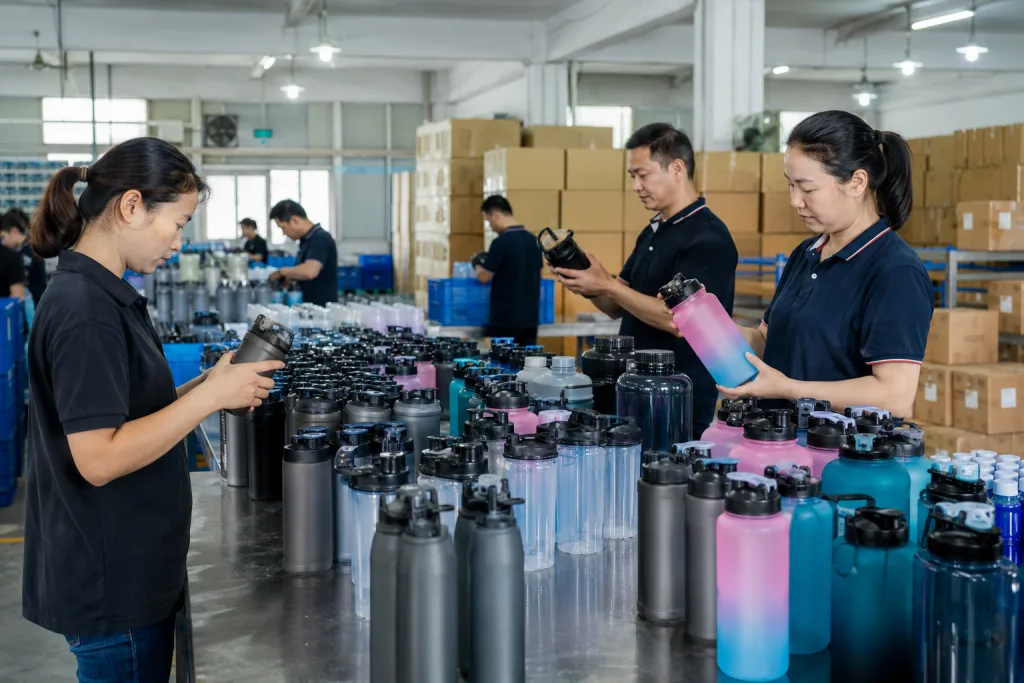
Key Takeaways
- A serious manufacturers gym water bottle quote should include MOQ, lead time, print method, and AQL target in the first reply
- Typical factory MOQ starts at 3,000-5,000 pcs for a custom gym water bottle, with 20-35 days production after sample approval
- For Europe and North America, ask for REACH, food-contact declarations, and drop-test or dishwasher-test data before you approve mass production
- A bulk shaker bottle program usually fails on lid tolerance, seal quality, and carton packing, not on the bottle body itself
If you are sourcing a manufacturers gym water bottle program for a fitness brand or gym chain, the hard part is not finding a factory. It is sorting a real production partner from a trader who can quote in 30 minutes and leave you with broken lids, sloppy prints, and a shipment you cannot use. We see that mistake often. The bottle has to survive drops from 1.2 m, dishwasher cycles, odor checks, lid wear, and branding that still looks clean after 10,000 uses.
Buyers in Europe and North America usually start with one question: can this supplier handle bulk fitness water bottle orders without turning every detail into a custom project? That is the wrong question to ask first. In Zhejiang and across China, the real test is whether the factory runs tooling, QC, and packaging with discipline. A serious plant will quote MOQ, mold lead time, print method, and carton spec up front, before you chase them three times. We have seen PO typos on lid color, and that tiny miss turns into a 5,000-piece headache.
What buyers really mean by OEM
When a procurement manager asks for a manufacturers gym water bottle program, they usually do not mean a generic bottle with a logo slapped on it. They mean a supplier that can hold resin choice, mold fit, decoration, packaging, and repeatability across one or more SKUs. That is the line between a one-off buy and a supply program you can reorder every quarter. We run this exact split on the shop floor all the time; a 1 mm wall change can move the whole quote.
For a custom gym water bottle, material comes first. Tritan copolyester, PP, PETG, and stainless steel sit on different cost sheets and different compliance paths. A 750 ml Tritan bottle with a flip lid is one job; a 500 ml bulk shaker bottle with a protein insert is another. If your brand sells through retail, the cosmetic bar is tighter than a distributor sports water bottle program shipped in plain master cartons. QC pulled the sample last week and found a lid gap at 0.6 mm, which is the sort of thing buyers flag fast.
Ask for these basics in the first round:
- Capacity, wall thickness, and weight tolerance
- Decoration method: silkscreen, UV print, laser, or heat transfer
- MOQ by color and by logo version
- Production lead time in days, not vague weeks
- Packaging detail: polybag, egg crate, inner box, master carton
A supplier in Zhejiang that handles export work will answer these points cleanly. A weak one will circle around them. This is the wrong question to ask if you still want a cheap quote first; the math does not work. In China, a PO typo on capacity or carton count usually tells you enough before sample approval.
MOQ, price, and timing
Most buyers fixate on unit price and miss the real number: landed cost to your warehouse. For a bulk sports water bottle order, factory price is only one line. Tooling, print setup, carton spec, freight cube, and reject rate all hit the invoice. We see this go sideways when someone chases a $0.03 saving and eats a delayed shipment.
As a working range from a China factory, a standard custom fitness water bottle in PP usually lands around USD 0.85-1.40 FOB at 3,000-5,000 pcs. A Tritan body with a custom lid can move to USD 1.60-3.20 FOB, depending on mold changes and decoration. A custom logo shaker bottle with a sealed insert sits higher because the lid stack is more complex and QC pulled the sample for leak testing at 1.2 kg pressure. The buyer flagged it, and rightly so.
Lead time matters more than buyers admit. A realistic run looks like this:
- Sample and artwork confirmation: 5-10 days
- Tooling or mold modification: 15-30 days if needed
- Mass production: 20-35 days after deposit and sample approval
- Ocean freight to Europe or North America: 18-40 days depending on lane
Factories in Zhejiang will quote a fast number, then slip once the order has three colors or mixed lids. That is the wrong question to ask. A distributor gym water bottle buyer should pin down the gate dates in writing: sample sign-off, pre-production sample, bulk start, final inspection, and shipment. We run this off the line every week, and a PO typo on lid color or carton count can cost 2-3 days before production even starts.
Checklist for bottle specs
The fastest way to avoid a bad custom sports water bottle order is to write the spec like an engineer. We run quotes off a drawing or a signed sample, not a product photo. For repeat programs, lock the dimensions and decoration area first, then work back to color and packaging. One typo on a PO can push a 24 mm lid into a 28 mm neck, and that waste shows up on the line.
Use this checklist before you approve a custom gym water bottle or customizable fitness water bottle:
- Capacity: 500 ml, 750 ml, or 1000 ml exact fill line
- Body wall thickness: 1.2 mm to 2.0 mm depending on material
- Thread fit and lid seal type: silicone ring, TPE gasket, or integrated seal
- Drop test target: 1.2 m to 1.5 m, depending on retail use
- Dishwasher tolerance: top rack only, if applicable
- Odor and stain resistance requirements
- Logo area size in mm and maximum print colors
- Carton pack count and master carton burst strength
Do not approve a bulk gym water bottle if the factory cannot show a measured sample report. QC pulled the sample, checked weight, tolerance, closure torque, and leak test, then marked it against the master. That is not paperwork for show. It is how you keep 1 pallet from turning into 12 pallets of returns.
If you are buying for a chain, standardize the core body and swap only the branding panel or lid color. That keeps replenishment simple across 30 stores without requalifying the full product. We have seen this go sideways when a buyer tried to change the cap and the neck finish at the same time. The math does not work.
Shaker bottles are a different job
A bulk shaker bottle looks simple until the first complaint lands: leaking lids, loose flip caps, or powder packed under the mixing grid. Same silhouette as a sports bottle, different failure mode. A custom made shaker bottle needs tight hinge control, stable thread pitch, and a seal that still holds after 30 wash cycles on the line.
For gym retail, the buyer wants a custom shaker bottle that can take powder, ice, and a bag ride across town. The graphic is secondary. If the body passes and the closure fails, the review still goes bad. We test a custom logo shaker bottle for:
- Leak resistance after 20-50 open-close cycles
- Thread stripping under normal hand torque
- Odor retention after protein use
- Impact resistance at the lid corner
Factories in China that do this well usually keep shaker production off the normal drinkware line. Good sign. We ship those parts separately because a customizable shaker bottle is not the same job as a plain water bottle. Ask for an ASTM-style drop test or an internal equivalent, plus a clear statement on dishwasher safety. We saw one PO with “dishwaser safe” on the spec sheet; QC pulled the sample and the lid seal failed at 40 degrees.
For bulk shaker bottle orders, 5,000 pcs MOQ is common if you want a custom mold or a special lid color. If you only need a stock body with printed branding, the MOQ can be lower, but the design control drops with it. That is the math, and it should be written down before the sample round. We have seen buyers push for a 2,000 pcs color change, then complain when the factory refuses the exact Pantone.
Compliance for Europe and North America
Compliance is where sourcing discipline shows up in the paperwork. If you ship a distributor sports water bottle into Europe or North America, verbal assurance does not clear customs. Ask for food-contact declarations, REACH material declarations where they apply, and factory quality records tied to the exact SKU. We check the file before the line starts printing.
For stainless or plastic drinkware, the supplier should show material traceability, ink or coating data, and packaging that does not carry odor. QC pulled a 500 ml sample last month and the inner sleeve had a mild film smell. That got the buyer’s attention fast. A BSCI audit helps on social responsibility, but it does not replace product compliance. Buyers mix those up all the time, and that is the wrong question to ask.
What a clean compliance file should include:
- Bill of materials and resin grade
- Food-contact declaration for the exact material
- Test reports from a named lab when required by your market
- Packaging and label content for FNSKU or retailer barcode use
- Country of origin and HS code alignment
If you import a customized sports water bottle into the US, confirm whether your retail customer wants carton marks or item labels changed for warehouse intake. On one PO, a buyer flagged a one-letter typo in the carton mark, and it held the shipment for 9 days. For Europe, check language and recycling marks early. The math does not work when a small art mistake turns into a reprint. In Zhejiang, the better factories will flag it before print approval.
How to compare suppliers
The quickest way to compare manufacturers gym water bottle candidates is to force one quote format on every supplier. Do not accept body-only pricing from one factory and a full set from another. That is how fake savings sneak in. Ask for the same basis each time: EXW or FOB, same artwork count, same packing method, same defect allowance. On our line, a PO once missed the carton spec by one line, and the “cheap” quote turned into a rework bill.
Then score them on four points:
- Responsiveness: can they reply within 24 hours with real numbers, not “checking” forever?
- Process control: do they show sample sign-off, QC checkpoints, and an AQL target?
- Tooling discipline: can they explain mold life, maintenance, and lead time in months or shots?
- Export readiness: can they handle carton labels, palletization, and mixed SKU packing?
A good bulk fitness water bottle supplier sends more than polished photos. We want dimension drawings, test samples, and a packing proposal that fits the way you ship. QC pulled the sample on a 74 mm mouth bottle and found the lid torque drifting, so the nice brochure stopped mattering. A distributor fitness water bottle buyer should also ask whether the factory can split production across colors without moving the print position. That is the kind of detail that keeps repeat orders from looking mismatched across gym locations.
China has plenty of factories, but geography is the wrong question to ask. A Zhejiang plant with export habits and a clear process usually beats a louder name that cannot explain its own line. If a supplier stays vague on lead time, or says every request is “no problem,” we have seen that go sideways. Ask for the numbers, the sample path, and the packing sheet. Then compare.
Send your bottle spec, get a real quote
We can price your custom sports water bottle program with MOQ, lead time, and compliance details, so you can compare factories on facts, not promises.
Frequently asked questions
What MOQ should I expect for a custom gym water bottle order?
For a standard custom gym water bottle, expect 3,000-5,000 pcs MOQ for a serious export factory in China. If you want multiple colors, special lids, or custom molds, MOQ can rise to 8,000-10,000 pcs. A stock body with one-color print may be lower, sometimes 1,000-2,000 pcs, but you give up control on shape and branding area. Always ask whether MOQ is per design, per color, or per SKU. That detail changes your budget fast.
How much should I budget per unit FOB?
For a bulk sports water bottle, a common FOB range is USD 0.85-1.40 for PP, and USD 1.60-3.20 for Tritan or more complex closure systems. A bulk shaker bottle usually costs more because the lid, seal, and insert add parts and QC time. Pricing also changes with print colors, packaging, and whether you need a custom mold. Do not compare quotes without checking if carton packing, logo setup, and sample fees are included.
What compliance documents do European buyers usually need?
For Europe, ask for food-contact declarations, material traceability, and any relevant REACH-related statements for inks, coatings, or additives. If the bottle is stainless or plastic, request the exact SKU test file, not a generic factory certificate. Many brands also want BSCI for social compliance, but that is separate from product safety. If you need retail-ready packaging, confirm barcode placement and recycling marks before print approval to avoid a 7-14 day delay.
How do I reduce leak complaints on a shaker bottle?
Start with the closure system. For a custom shaker bottle or custom logo shaker bottle, leakage usually comes from seal geometry, thread tolerance, or hinge wear. Ask for a leak test on every pilot sample and a cycle test of at least 20-50 open-close operations. Use a torque spec on the cap and request a pre-production sample from the exact mold cavity if possible. If the lid is complex, do not skip drop testing at 1.2 m or higher.
Can one supplier handle both gym chains and distributors?
Yes, if the factory is set up for repeat export orders. A distributor gym water bottle program usually needs stable packaging, fast reorders, and consistent print, while gym chains often need location-specific branding and staggered drops. The supplier should support mixed-SKU carton packing, barcode labels, and color control across runs. In Zhejiang, better factories can run 20,000-50,000 pcs per month on mainstream bottle lines, but you still need to confirm your SKU shares tooling and closure parts with existing production.