Key Takeaways
- A practical growler RFQ should specify 64 oz capacity, 304 stainless steel, wall thickness, lid type, logo method, carton drop standard, and target FOB price
- Most custom growler projects need 1,000-3,000 pieces MOQ per color, with 7-12 days for samples and 30-45 days for bulk production after deposit
- Your PO should separate product cost, logo charge, packaging, spare parts, testing, and freight terms instead of hiding everything in one unit price
- AQL 2.5/4.0 inspection, REACH or LFGB documentation, and vacuum performance testing should be agreed before mass production starts
Buying a custom growler looks simple until your RFQ comes back with 201, 304 stainless, “304 inside only,” three cap structures, loose capacity claims, and logo charges that do not match the sample invoice. We see this weekly. If you are comparing manufacturers growler options from China, lock the spec sheet first: steel grade, wall thickness in mm, tested volume, cap material, gasket type, logo size, and packing. Otherwise the supplier will steer the quote, and the math doesn't work.
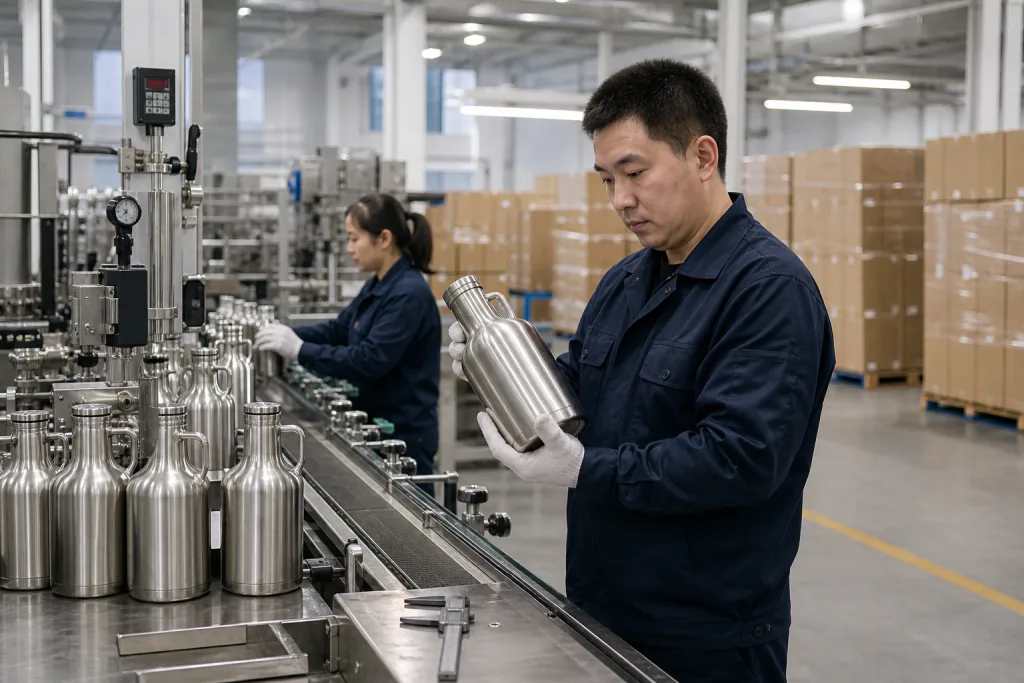
BottleForge Industrial is based in Hangzhou, Zhejiang, and we quote drinkware projects every week for European and North American buyers. Our factory output is about 450,000 stainless drinkware units per month, with typical growler MOQ from 1,000 pieces per color. On the line, QC pulled a 64 oz sample last month because the laser logo was 3 mm lower than the approved drawing. The process below follows how we run an actual order: RFQ, sample, approval, PO, inspection, and shipment.
Start With A Tight RFQ
A weak RFQ usually says, “Please quote customized growler, 64 oz, logo, best price.” That will not work. A canteen factory or growler manufacturer will fill the blanks with whatever is already on the line, then you lose 12 days fixing details that should have been clear on day one. A tighter RFQ gives the supplier a drawing-level target, even before you have formal CAD files; last month we saw one PO typo list “640 oz,” and QC pulled the sample before the carton label went to print.
For a stainless custom growler, state the capacity in both fluid ounces and milliliters, for example 64 oz / 1,900 ml. Confirm whether that means nominal full capacity or usable fill line; the difference can be 80–120 ml on a growler body. Specify food-contact 304 stainless steel for the inner wall and outer wall, or 316 stainless if you need a higher-cost coastal or marine positioning. For vacuum products, ask for double-wall construction, copper plating if needed, and a test target such as hot water above 60°C after 12 hours at 20°C room temperature. We run that check with a calibrated probe, not by hand-feel. The buyer flagged it once.
Your RFQ should also define the commercial use. A distributor growler for outdoor retail needs different packaging from a canteen promotional order for an event sponsor. A distributor drinkware program may need barcode labels, master carton markings with 3-side printing, and mixed color packing by 24 pcs per carton. A brand owner may care more about powder coating texture and lid feel than shaving USD 0.08 from the inner tray. We have seen this go sideways when the buyer asks for a “gift box” but means a 350 gsm retail box with spot color control.
Put these RFQ line items in writing: body material with steel grade and thickness, cap material with thread type, gasket material with food-contact requirement, finish with coating target, color Pantone with tolerance, logo method with size in mm, packaging with drop-test request, certification needs, target order quantity, delivery port, Incoterm, and expected launch date. If you want quotes from several canteen suppliers in China, send the same sheet to every canteen supplier. Otherwise you are not comparing price; you are comparing interpretations. That math does not work.
Build The Quote Line By Line
Do not judge the quote by the FOB unit price alone. We have seen a USD 5.20 growler beat a USD 4.85 growler after logo, box, testing, and spare lid costs were added. Ask the canteen manufacturer to break the PO cost line by line, the same way your finance team will read it. On one 3,000 piece order last April, the buyer flagged a missing gasket line after QC pulled the pre-production sample, and that one small part changed the margin by USD 0.11 per unit.
A clean quotation for a custom canteen or customizable growler should show these lines at minimum:
- Product unit price: for example FOB Ningbo USD 5.10 per piece at 3,000 pieces, with capacity, steel grade, wall thickness, and lid type written on the same line.
- Logo cost: laser engraving may be USD 0.18-0.45 per position; silkscreen may need a screen charge of USD 40-80 per color, and the artwork file should match the sample mark position in mm.
- Packaging: price the plain white box, kraft box, retail color box, insert card, and outer carton separately; do not bury a 5-layer export carton inside the unit price.
- Tooling or mold fee: usually zero for stock shapes, but USD 800-3,500 for special lids or private molds, with the mold ownership and lead time stated.
- Testing and documents: REACH, LFGB, FDA food-contact documentation, or ASTM-related packaging tests where required, plus who pays if the first report fails.
- Spare parts: extra gaskets, lids, handles, straws, or replacement caps for after-sales support; we normally quote these by 100 piece bags so the warehouse can count them fast.
For Europe, buyers often ask for REACH and LFGB-related food-contact confirmation. For North America, FDA food-contact compliance and Prop 65 review may matter depending on the sales channel. This is the wrong question to ask: “Do you have certificates?” Ask which material, coating, lid seal, and printing ink were covered. We had one PO typo list “304 stainless” on the body but the approved lid BOM used a silicone gasket from a different batch, so our lab clerk stopped the document pack before shipment.
Check the quote validity. Stainless steel pricing moves, and powder coating vendors raise prices during peak season when the line is full. We usually hold formal FOB quotes for 15-30 days. If a canteen vendor promises a six-month price with no volume commitment, the math does not work. Last September, one coating supplier changed black powder by USD 0.06 per piece after our 18 kg carton drop test schedule was already booked.
Sampling Is A Paid Engineering Step
Samples are not souvenirs. They are the first engineering control point. On a customized canteen or custom growler order, the sample must answer a clear question before the line moves. A stock sample proves the shape, grip, and drinking feel. A pre-production sample proves Pantone color, logo position, retail box fit, and real assembly with the gasket installed. Different job. QC pulled one canteen customizable sample last month because the cap sat 1.2 mm proud after the silicone ring was changed.
For a standard manufacturers growler project, we run 2-3 days for an existing blank sample, 7-12 days for a logo sample, and 12-18 days for a pre-production sample with retail packaging. If you need custom molded caps, add 20-35 days for tooling and T1 samples. Express shipping to the US or EU is usually 3-6 working days, depending on destination and customs. The buyer often asks, “Can you send it faster?” Wrong question. If the logo file arrives as a low-res JPG instead of AI or PDF, one saved day turns into 4 days of rework.
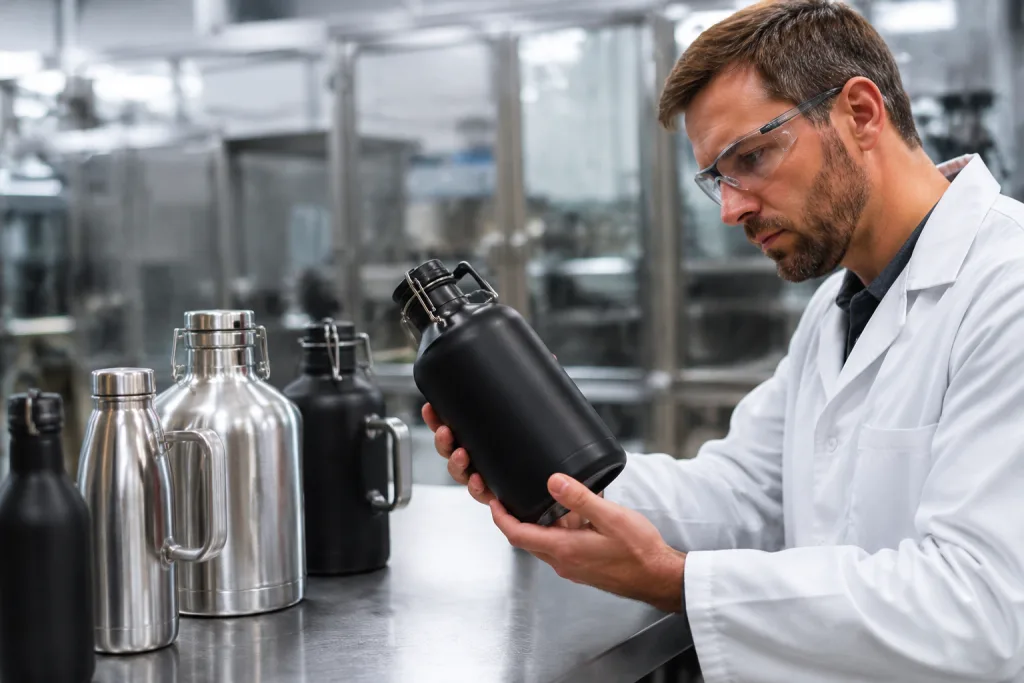
Your sample approval sheet should use measurable checks, not “looks good.” Confirm empty weight, capacity, mouth diameter, wall thickness, coating thickness, lid torque feel, gasket fit, and carton dimensions. We check mouth diameter with a digital caliper, and for growlers we record capacity after filling to the shoulder line, not after guessing from the CAD drawing. For powder coating, use a Pantone reference and a physical swatch if possible. Screen photos fail here; two monitors can make the same canteen customized color look like two separate SKUs.
Logo approval needs the same discipline. Laser engraving lasts well on stainless or coated bodies, but contrast changes with coating color and laser depth. Silkscreen works better for bright colors and larger artwork, but it scratches when ink curing is weak. Heat transfer gives finer detail, yet adhesion must be tested. Ask the canteen vendors to send a rub test video or a sample after tape testing. We use 3M tape on the printed area, and we have seen this go sideways when a buyer approved only the mockup with the logo 5 mm too close to the bottom curve.
Do not approve bulk production from a beauty photo. Approve from a physical sample, a signed spec sheet, and a packaging layout.
Turn Approval Into A Clean PO
After sample approval, lock the spec in the purchase order. This is where loose email wording starts costing money. A PO that says “3,000 pcs customized drinkware” is not enough. It needs the exact model, color split, logo position in mm, packaging version, inspection standard, shipment term, and payment schedule. We had one buyer type “mat black” on a PO instead of “matte black”; QC pulled the sample before mass coating, or 3,000 growlers would have gone the wrong direction.
A clean PO for a distributor canteen or distributor growler order usually includes these line items: product SKU with buyer item number, supplier model number with capacity, material and finish, logo method with logo file name, packaging file name with carton quantity, unit price, quantity per color, delivery date, FOB port, and consignee instructions. If you sell through retail or ecommerce, add barcode type, FNSKU if needed, warning labels, suffocation markings for polybags, and carton drop-test requirements. Simple rule: if your warehouse needs it to receive stock without asking questions, put it on the PO.
Payment terms depend on the relationship and order size. For new B2B buyers, 30% deposit and 70% balance before shipment is common in China. Larger repeat orders may shift to 30/70 against bill of lading copy or agreed credit terms. Be careful with factories that accept a 10% deposit but cannot show an AQL 2.5 inspection plan, pressure test record, or coating adhesion check. The math doesn't work. Cheap cash terms do not replace production control on the line.
For bulk lead time, plan 30-45 days after deposit and final artwork approval for regular stainless growlers. Add 7-12 days for multiple coating colors, printed gift boxes, or third-party lab testing. From September to November, Zhejiang and other China export regions fill up with holiday and Q1 retail production, so book capacity earlier. We run into this every year: a buyer asks for 20 days, then the vessel cut-off is 18 days away and the cartons still need drop testing. A canteen manufacturer with honest scheduling beats one who promises fast delivery and misses the ship.
Control Production Before Inspection
Final inspection matters, but it is too late as the first quality check. We start control before the 304 stainless sheets go to the cutting table and before the powder booth warms up. Ask your canteen supplier for a dated production plan: material arrival, body forming, welding, polishing, vacuum testing, coating, logo decoration, assembly, packaging, and final inspection. We run this on a simple Excel line schedule, and the merchandiser signs off each station date. No schedule, no visibility. If the supplier cannot show it, your order is probably bouncing through 2 or 3 subcontractors, and you will not know where the delay or defect started.
For stainless growlers, the defects we see most are dented bodies, weak vacuum insulation, uneven coating, lid leakage, silicone odor, logo misalignment, and dirty packaging. QC pulled the sample last month and found 7 dented 64 oz bodies in one tray because the semi-finished goods were stacked without PE sleeves. Wall thickness is often around 0.4-0.6 mm depending on model and cost target. Thinner material saves money, but the math does not work for outdoor retail. A 128 oz body with a thin gauge gets punished in carton drop tests and in real use. Do not chase the thinnest possible gauge.
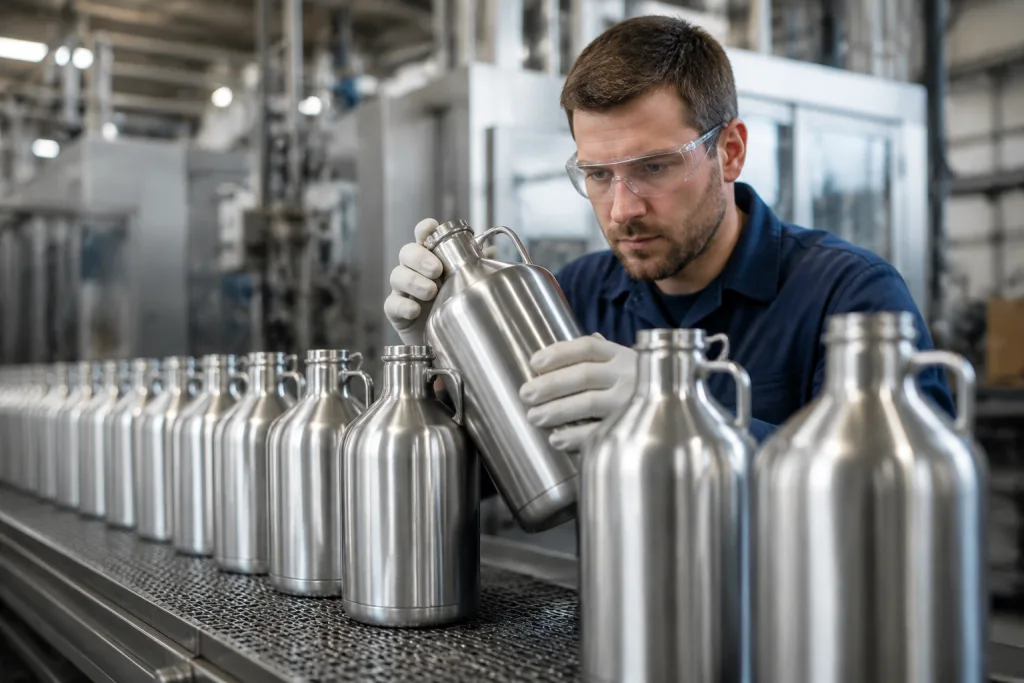
Quality checkpoints should include incoming material verification, vacuum performance test, leak test, coating adhesion test, logo position check, and packaging drop review. For vacuum, we usually record hot-water temperature at filling and again after 6 hours, not just write “pass” on the QC sheet. For inspection, buyers often use AQL general inspection level II, with critical defects 0, major defects 2.5, and minor defects 4.0. Define critical defects clearly. Leakage, sharp edges, wrong food-contact material, serious rust, wrong logo, or unsafe packaging should never be treated like a minor scratch. We have seen this go sideways when a buyer called lid leakage “major” and then had no rejection basis at loading.
If you are working with 2 or more canteen manufacturers or canteen distributors, use one QC checklist for every factory. Claim handling gets faster when photos, defect names, and sampling rules match. For a China-based order, you can use your own inspection agency, the supplier’s QC report, or both. At BottleForge in Zhejiang, we prefer buyers to inspect before balance payment because it protects both sides from arguments after the container has left Ningbo or Shanghai. One buyer once flagged a PO typo on carton marks 3 days before loading; catching it on the line was cheaper than re-labeling 420 cartons at the warehouse.
Plan Cartons, Freight, And Reorders
Most sourcing problems show up after the product is made. Carton size, pallet height, barcode placement, and shipping marks are boring until a warehouse rejects the delivery. For a customized growler, lock the packing plan before mass production: plain inner box, retail box, or ecommerce-ready pack. We had a buyer flag a PO with 64 oz growlers because the box was written as “white box” and the art file showed a color box. Those are not the same thing. A retail box looks good on paper, but if the flute strength is weak, it gets crushed in transit. For heavy 64 oz growlers, we run a stronger outer carton and stop the line from overpacking too many units into one master carton.
For 64 oz stainless growlers, master cartons usually hold 12-24 pieces, depending on body size and carton structure. Gross weight often lands at 14-22 kg. That is the wrong place to be heroic. Keep the carton weight practical for warehouse handling in Europe and North America, where a fork operator will reject awkward loads fast. If you need Amazon-style prep, spell out FNSKU labeling, single-unit drop resistance, carton labels, and no mixed SKU cartons unless your fulfillment plan allows it. Our QC pulled a sample last month where the barcode sat 8 mm too close to the seam; the scanner missed it.
Freight terms should match how you buy. FOB Ningbo or FOB Shanghai is common if you already have a forwarder. EXW can look cheaper, but then local trucking, export handling, and customs paperwork sit on your side. DDP is handy for a 300-piece trial, yet you still need to know who owns duties, tax, and compliance records. We ship a lot under FOB because the math works better and the paper trail stays clean. For most distributor drinkware buyers, that is the cleanest starting point.
Before the first order ships, talk about reorders. A canteen vendor should confirm whether coating color, lid design, and packaging material can be repeated after 6-12 months. Keep a signed golden sample at your office and one at the factory. We have seen this go sideways when a buyer assumed the powder coat code would stay the same, then came back 9 months later and the shade shifted by one batch. If your promotional canteen line turns into a repeat retail SKU, reorder stability matters more than saving USD 0.08 on the first PO. That is where a reliable canteen factory earns its margin.
Send your growler RFQ for a line-item quote
Share capacity, quantity, logo, packaging, and target market. We will return a practical FOB quote with MOQ, sample timing, and QC notes.
Frequently asked questions
What MOQ should I expect for a custom growler order?
For a stock stainless growler with your logo, a realistic MOQ is usually 1,000 pieces per color. If you need powder coating in a special Pantone color, 1,000-2,000 pieces per color is more practical because coating lines have setup loss. For a private mold cap or special body shape, expect 3,000-5,000 pieces and a tooling fee. Some canteen suppliers will quote 300-500 pieces, but the unit price, color control, and packaging options are usually weaker. For distributor programs, we suggest starting with 2,000-3,000 pieces so FOB pricing, carton efficiency, and logo costs make commercial sense.
How long does a manufacturers growler project take from RFQ to shipment?
A normal timeline is 1-3 days for RFQ clarification, 7-12 days for logo samples, 2-4 days for buyer approval, and 30-45 days for mass production after deposit and final artwork. Add 5-10 days if you need third-party testing, and more if custom tooling is required. Sea freight then depends on destination: roughly 25-35 days to many European ports and 18-30 days to common North American ports, before local delivery. If your launch date is fixed, work backward and include inspection time. Rushing sampling is the fastest way to approve the wrong product.
Which logo method is best for customized drinkware?
For stainless growlers, laser engraving is the safest long-term option because it does not peel and handles outdoor use well. It usually costs about USD 0.18-0.45 per position depending on size and surface. Silkscreen printing is better for bold color logos, often with a USD 40-80 screen charge per color, but adhesion must be tested on powder coating. Heat transfer works for detailed artwork or gradients, but it adds cost and needs rub and tape testing. For premium custom drinkware, many buyers use laser engraving on the body and a printed retail box for color branding.
What certifications should I ask from a canteen manufacturer?
Ask for documents that match your market, not a random certificate bundle. For the EU, REACH and LFGB-related food-contact testing are common requests. For the US, FDA food-contact compliance is usually relevant, and Prop 65 review may be needed depending on materials and sales state. Factory audits such as BSCI, ISO 9001, or similar social and quality systems can help if you sell to retailers. Also ask for material declarations for 304 stainless steel, silicone gaskets, coatings, and inks. Certificates should show the tested material or product type, test date, lab name, and standard, not just a generic factory brochure.
Can one supplier handle growlers and other canteen customized items?
Yes, if the supplier has a real drinkware supply chain instead of only trading one model. A capable canteen supplier can usually handle stainless growlers, sports bottles, travel tumblers, kids bottles, and some glass or infuser bottles. The advantage is consistent logo files, packaging structure, QC standards, and shipping coordination across your range. The risk is assuming every canteen vendor is strong in every material. Stainless vacuum products, plastic lids, glass bottles, and coating work need different controls. Ask for monthly capacity, sample room photos, current export markets, and past inspection reports before giving one supplier your full customizable drinkware program.