Key Takeaways
- Choose material first: stainless steel growlers often run 0.4-0.6 mm wall thickness, glass versions usually cost less but ship heavier.
- A realistic MOQ for custom growler orders is often 1,000-3,000 pcs, with 30-45 day lead times after sample approval.
- Decoration changes the economics fast: one-color silkscreen, laser engraving, and full-wrap print do not have the same scrap rate or cost.
- For Europe and North America, ask for REACH, food-contact declarations, and AQL 2.5/4.0 inspection terms before you pay a deposit.
If you are buying from manufacturers growler bottle suppliers, the first mistake is treating every 64 oz bottle like a commodity. It is not. A glass growler, stainless growler, or swing-top PET bottle can look close on a spec sheet and behave differently on the line, in cold-chain handling, in decoration yield, and in freight. We have seen a buyer push back on a 1.2 mm wall spec, then call back after the first carton test because the handling issue was real. The right choice depends on how you sell, how you ship, and what your customer sees when the case is opened.
The practical way to source in China or Zhejiang is to lock four things first: material, closure, decoration, and compliance. After that, MOQ, lead time, and pricing get easier to compare. A serious canteen factory or canteen manufacturer should quote in 24 hours, send samples in 7 to 12 days, and run 30,000 to 80,000 units per month depending on the model. QC pulled the sample on one job and found a PO typo on the cap color code; that is the level of detail we watch. For retail, hospitality, or distributor channels, this is the question to ask first.
Start with the channel
Before you compare suppliers, decide where the bottle will sell. A growler for brewery taprooms is not the same product as a promotional bottle for a distributor network or an ecommerce bundle. Taproom buyers care about stackability, easy refilling, and a closure staff can open fast. Retail buyers care about shelf appeal, carton breakage rate, and whether the decoration still looks sharp after 20 dishwasher cycles. Distributor drinkware programs care about landed cost, case pack efficiency, and whether the bottle can sit inside a broader custom drinkware line without creating awkward inventory.
This is the first question we ask on the line. If the buyer is a brewery, a hotel group, or a sporting goods chain, we need to know whether the bottle ships empty, filled, or as a gift set. A custom growler for a promotional campaign can live with a lower-cost closure and simpler print. A customized growler for retail cannot. We have seen the math go sideways when a buyer priced a taproom bottle like a shelf item. The channel decides the spec. Not the other way around.
Channel-driven questions to settle early
- Will the bottle be sold through retail, taproom, hospitality, or distributor canteen programs?
- Does the end user need carbonation retention, hot-fill tolerance, or cold beverage storage only?
- Is breakage, denting, or return rate the bigger risk?
- Will you need custom canteen packaging, barcode labels, or FNSKU prep later?
Pick the right material
Material decides most of the job on the line. For a premium custom growler, stainless steel is still the default when the buyer cares about dent resistance, insulation, and how the bottle feels in hand. Most double-wall stainless growlers run on 18/8 or 304 stainless, with vacuum insulation and wall thickness around 0.4-0.6 mm. That extra metal adds weight and freight, but we ship fewer dent claims. Glass is the easier call for brewery programs and lower-cost retail lines. It is simple to decorate, simple to inspect, and easy to source from canteen suppliers in China, especially in Zhejiang, where tooling and glass finishing are mature.
PET or Tritan-style options sit between those two. They work for some customized drinkware programs when the buyer wants lighter cartons and lower freight. QC pulled the sample and the scratch marks showed up fast, so you need to be direct about heat resistance and surface wear. For a premium spirits, coffee, or craft beverage canteen custom program, stainless usually wins. For a distributor growler built for event giveaways, the cheaper material is the right call. We have seen that math work out badly when someone tries to make a giveaway look like a premium bottle.
In procurement terms, the choice is margin against damage rate and brand perception. A broken unit on arrival is not a low-cost unit.
When you talk to a canteen factory, ask for actual weight, gauge, and finish specs. “High quality stainless” is sales copy, not a spec sheet. Ask for the outer diameter, body height, lid torque range, and drop-test result. We once caught a PO typo on the lid finish code, and the buyer flagged it only after the pre-shipment check. That is the difference between a canteen manufacturer and a canteen vendor reading a catalog.
Lid and seal are the risk point
The closure is where most growler problems start. Swing-top, screw cap, push-button, and vacuum cap systems each solve a different job. A swing-top works well for breweries because it is fast to open and close, but the gasket and latch pressure have to stay consistent. A screw cap is cheaper for a custom canteen line, and the math works on price, but it looks less premium unless the thread pitch and liner are controlled. For carbonated beverages, seal integrity beats decoration every time. We have seen a 1 mm gasket change turn into a leak complaint after 500 km of transport or one hot warehouse day.
Ask manufacturers growler bottle candidates how they test leakage. You want inverted hold tests, pressure retention, and temperature cycling on the record. Last month QC pulled a sample that failed after 12 hours at 45°C, and the buyer flagged it before the line ran. For export to North America and Europe, the better canteen manufacturers will also tell you whether their closures pass odor and migration checks under the relevant food-contact expectations. If you are buying a customized canteen or customizable growler for alcoholic beverages, put closure testing into sample approval, not after production. That is the wrong question to ask too late.
- Use swing-top for brewery identity and repeated refill use.
- Use screw cap for lower-cost distributor canteen orders and broad retail placement.
- Use vacuum caps only when insulation and premium positioning justify the cost.
Decoration should match the margin
Decoration is part of the job, not a finish-line add-on. It moves MOQ, lead time, and scrap tolerance. On the line, a one-color silkscreen on glass or powder-coated stainless is still the cleanest route for a custom growler when you want unit cost under control. Laser engraving fits stainless when the buyer wants a permanent mark and a calmer look. Full-wrap printing or multi-color transfer adds steps fast, especially when the artwork has gradients, hairline text, or compliance marks. We have seen a canteen promotional bottle look fine in a mockup and fail at the seam once the cylinder hits the jig.
For custom drinkware buyers in China or Zhejiang, the better factories show print position drawings, not just renderings. Ask for the real artwork tolerance, especially if the logo has strokes below 0.3 mm or small text under 4 pt. QC pulled the sample on one job because the PO had a typo in the logo file name, and the buyer flagged it before the line ran 5,000 pcs. If you are buying canteen customizable items for a distributor program, keep the decoration system simple across SKUs. One body, one closure family, two decoration methods is easy to reorder; six mixed variants is where the math stops working.
Decoration methods that hold up
- Silkscreen for bold logos and lower setup cost.
- Laser engraving for stainless steel and permanent branding.
- Pad print for small logos on curved caps or handles.
- Heat transfer only when the artwork needs that extra process.
Compliance is not optional
If you ship to Europe or North America, compliance has to be written down before the first PO. For stainless and glass growlers, we ask for food-contact declarations, REACH support where it applies, and test reports tied to the exact material batch or decoration method. If a supplier hands over a report but cannot link it to your bottle, that paper is dead weight. We have seen that go sideways on a 5000 pcs order, usually after QC pulled the sample and found the ink system was different from the approved one. A bottle, cap, gasket, and coating can each need its own confirmation.
In China, a lot of canteen suppliers can turn a decent sample in 7 days. Fewer can keep the file clean when the repeat order lands at 20,000 pcs and the buyer flags a missing lot code. That is the line between a commodity shop and an export partner. Ask for ISO 9001, BSCI if your retail customer wants social compliance, and a clear AQL standard for inspection. AQL 2.5 for critical and major defects and AQL 4.0 for minor defects is common, but some buyers go tighter for premium shelves. The math does not work if the factory treats paperwork as an afterthought.
For brewery and foodservice buyers, lock down the carton master pack, drop-test target, and whether each bottle ships in an individual box or in bulk. We run into this on the line all the time: one PO said “1000 pcs/carton” when the buyer meant 100 pcs/carton, and the loading plan was wrong before production even started. A custom canteen or custom drinkware program can fail in freight before it fails in design.
MOQ and pricing should be modeled together
Too many buyers start with unit price and pay for it later in hidden charges. For manufacturers growler bottle sourcing, the right question is landed cost by channel. A common custom stainless growler quote runs USD 3.20 to 5.80 ex-works for 500 ml to 750 ml single-wall or basic insulated models at 1,000 to 3,000 pcs; USD 5.80 to 9.50 for vacuum-insulated versions, with the lid spec and surface finish moving the number. Glass units usually look cheaper at the factory gate. We have seen freight, breakage, and outer carton spec erase that gap fast.
MOQ usually comes from decoration setup, lid sourcing, and carton format. On the line, a Zhejiang canteen plant may accept 500 pcs for a stock body with custom print, but 1,000 to 3,000 pcs is the range we see for a true custom canteen program. Lead time is usually 30 to 45 days after sample approval, plus 7 to 12 days for samples, plus freight. One buyer once sent a PO with the logo file name wrong by one letter, and QC pulled the sample back before print. For a seasonal distributor canteen order, build in one extra week for artwork correction and one extra week for QA recheck.
Do not ignore container loading efficiency. A bottle that is USD 0.60 cheaper ex-works but takes 12 percent more carton volume can wipe out that saving in ocean freight. The math does not work for mixed-SKU canteen distributors. The best canteen vendors will give packing dimensions, units per carton, gross weight, and pallet count without a second chase. We ship that data before the buyer asks twice.
Use the sample to expose weak suppliers
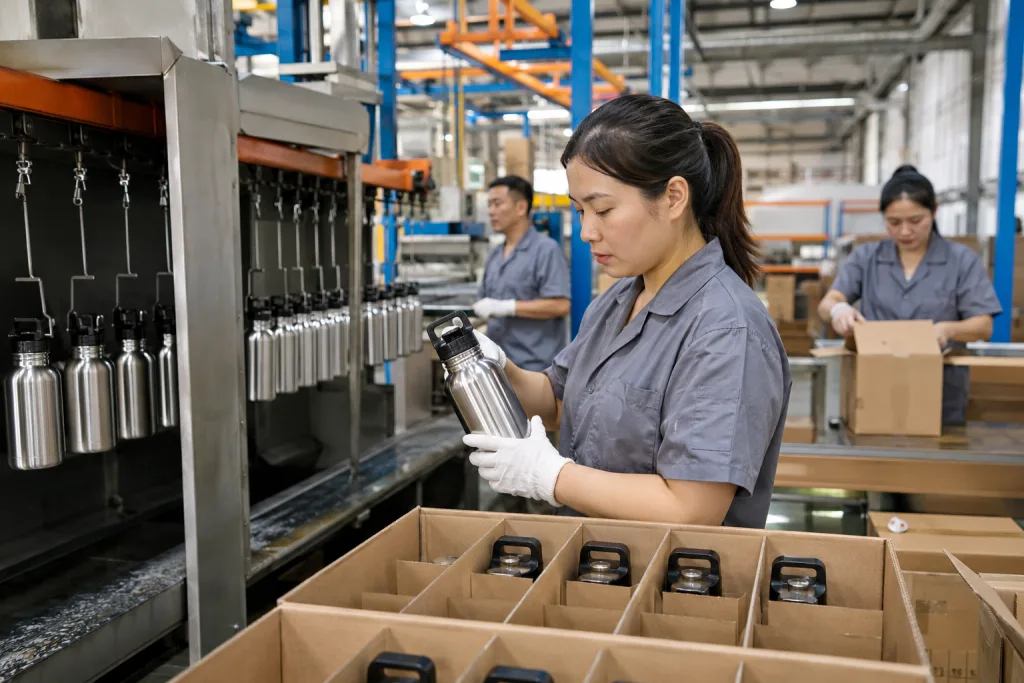
The sample stage tells you whether you are dealing with a disciplined canteen factory or a supplier that talks ahead of its line. Do not sign off from photos. Put the sample on the bench and check welds, cap threads, gasket fit, print alignment, odor, and coating consistency. On stainless growler bottle runs, we also check interior weld marks, the vacuum seam, and sharp edges at the mouth. On glass, the first thing we look at is lip thickness, then stability on a flat table, then chip resistance at the finish. QC pulled a sample last month with a 1.2 mm burr at the rim. That is the sort of miss that turns into a buyer complaint later.
Ask for three samples if the order matters: one pre-production sample, one decorated reference sample, and one packed sample. That is not fussiness. It is cheaper than finding out the custom growler bottle print has drifted 2 mm after mass production. We have seen this go sideways on a 5,000-piece order when the buyer flagged a logo shift and the factory wanted to argue the file was “close enough.” It was not. Good drinkware factories accept the process because it cuts disputes. Weak suppliers tell you to trust the factory. That is the wrong question to ask.
For a branded custom canteen program, put the approval in writing with photos and measurements. Lock down the color code, logo size, carton marks, and defect criteria. If the PO says 500 ml and the sample is marked 550 ml, fix it before the line starts. We also keep the approved sample tied to the reorder file, because repeat business only works when the next shipment matches the first one. Distributor drinkware programs live or die on that discipline.
Request a growler quote with real specs
Send your target volume, material, closure, and decoration. We will quote a custom drinkware program that matches your market, not just your photo.
Frequently asked questions
What MOQ should I expect for manufacturers growler bottle orders?
For a true custom order, expect 1,000 to 3,000 pcs for most stainless or glass growlers. Some stock-body programs can start at 500 pcs, but once you change lid, print, coating, or carton spec, the MOQ rises fast. A Zhejiang canteen factory with mature tooling may support smaller runs, but price per unit usually climbs 15-30%. If you need multiple SKUs for distributor canteen channels, keep each SKU simple so the total program stays workable.
How much does a custom growler usually cost ex-works?
A simple glass growler can land in the USD 1.20 to 2.80 range ex-works depending on size, lid, and decoration. Stainless options often start around USD 3.20 and can run to USD 9.50 or more for vacuum-insulated builds with premium caps. Add setup charges, test reports, and carton customization. For Europe and North America, freight and duty can add another 20-45% to landed cost, depending on mode and HS code.
What compliance documents should I ask for?
Ask for food-contact declarations, REACH support for Europe where relevant, and test reports tied to your exact materials and decoration. If you need social compliance, request BSCI or equivalent factory audit records. For custom drinkware sold in the US, also confirm whether the product requires California Prop 65 screening based on inks, coatings, or accessories. The key is traceability: the report must match the batch, not just the product family.
Is stainless better than glass for a custom canteen program?
Stainless is better when you need durability, lower breakage, and a more premium feel. Glass is better when you want a lower entry price and a brewery-style presentation. Stainless growlers often use 0.4-0.6 mm wall thickness and can be vacuum insulated, which helps with temperature retention. Glass is simpler to produce and decorate, but shipping claims rise if your packing is weak. For distributor growler programs, stainless usually wins on total cost of ownership.
How long does sampling and production usually take in China?
A normal sampling cycle is 7 to 12 days if the mold or body is already available. Production for approved custom orders is often 30 to 45 days, depending on season, decoration complexity, and packaging. If you are sourcing from Zhejiang or another export-heavy region in China, factory capacity matters as much as price. A canteen manufacturer with 30,000 to 80,000 units per month can usually handle repeat programs better than a small workshop, but you still need to lock artwork and packaging early.