Key Takeaways
- A true borosilicate glass bottle manufacturer should quote wall thickness, lid spec, and decoration method in one document, not in separate emails.
- For most wellness programs, 300 ml to 750 ml custom glass water bottle SKUs are easier to control than oversized 1 liter formats.
- Target 3,000 to 10,000 MOQ for bulk borosilicate glass bottle programs if you need custom printing, retail packaging, and stable reorders.
- Ask for REACH, LFGB, and a sample AQL plan up front; China sourcing gets expensive when you discover noncompliance after production.
If you are sourcing manufacturers glass water bottle programs for a wellness brand or a sustainable retail line, the real decision is not “glass or not.” It is whether the bottle survives carton drop tests, prints cleanly, clears compliance, and still fits the channel margin. We see buyers miss that point on the first round. In Zhejiang and across China, there are plenty of borosilicate glass bottle suppliers. The hard part is telling a real borosilicate glass bottle manufacturer from a trading layer that adds lead time and hides defects.
Start with the buying logic, not the catalog. Lock the wall thickness, lid system, decoration method, and MOQ before you ask for quotes. A borosilicate glass bottle factory usually runs 3,000 to 10,000 units per SKU, and 25 to 35 days after sample approval is normal when the line is booked. At BottleForge in Hangzhou, we run 300,000 units a month. That matters. If a supplier cannot reserve furnace time and packing slots, your launch slips. QC pulled a 500 ml sample last week with a 1.2 mm neck mismatch; that is the kind of issue that turns into a PO typo, then a late shipment.
Start With the Four Buyer Decisions
Most buyers burn days arguing about bottle shape before they settle the commercial terms. That is backwards. For a custom glass water bottle program, lock four decisions first: volume, closure, decoration, and compliance. Get those wrong and the sample still looks fine while the line starts rejecting cartons. A borosilicate glass bottle customizable enough for your brand still has hard limits; glass thickness, cap torque, and label adhesion all hit breakage rate and shelf appearance.
Volume drives the carton count, freight, and retail math. A 500 ml bottle ships cleaner, fits more units per master carton, and usually costs less to pack than a 750 ml format. Closure choice matters just as much. A bamboo lid can work on a promotional borosilicate glass bottle line, but if the buyer flagged leakage in transit, a stainless cap with silicone seal is the better call. Decoration is the third decision: screen print, decal, laser, or a printed sleeve. Compliance closes the door. For Europe and North America, ask for REACH documentation, LFGB where needed, and a food-contact declaration before you talk price. A 12-day sample cycle with missing paperwork is cheaper than a 18-day rework after QC pulled the sample for a bad migration file.
- Volume: 300 ml, 500 ml, or 750 ml are the practical commercial bands.
- Closure: bamboo, stainless, PP, or a hybrid lid with silicone seal.
- Decoration: one-color silkscreen, 360-degree print, or laser-marked logo.
- Compliance: food-contact declaration, REACH, and sampling plan.
Borosilicate vs Soda-Lime
If you are sourcing bulk glass water bottle inventory for wellness retail, the glass chemistry is not a footnote. Borosilicate glass bottle bulk sourcing is usually the safer pick because borosilicate handles thermal shock better and feels more solid in hand. We run tea-fill samples at 90°C and then move them to cold water; soda-lime shows stress faster. It is not indestructible, and nobody should pitch it that way, but it takes hot-fill use and cold-to-warm shifts better than standard soda-lime glass. That matters when your customer is pouring tea, citrus water, or post-workout infusions.
A legitimate borosilicate glass bottle manufacturer should be able to state the wall thickness range, usually around 1.5 mm to 2.5 mm for retail drinkware, and explain how that thickness changes breakage risk and unit weight. Thicker glass can cut damage in transit, but freight cost goes up fast. In Zhejiang, we see factories push low unit prices by trimming glass weight to 180 g instead of 220 g. The math does not work if you care about drop rate. For a bulk borosilicate glass bottle order, ask for a pre-shipment drop standard and a defined carton count. QC pulled a sample with a 2 mm neck finish once, and the buyer flagged a PO typo that changed carton count from 24 to 12. Do not buy on appearance alone. A bottle that fails a 60 cm drop from the carton edge is a bad program, even if the sample felt solid in your hand.
Ask for weight, wall thickness, and carton configuration together. If the quote leaves out one of those, the supplier is not pricing the real product.
What Customization Actually Changes
Customization is where a lot of buyers overrate flexibility. A borosilicate glass bottle custom project can cover several options, but every change hits cost, tooling, or lead time. We have seen a simple shoulder tweak turn into a new mold, and that is a 45-day problem, not a 5-day one. Logo placement changes the decoration method. Lid color changes the sourcing list. If you want a customizable glass water bottle line that still leaves margin, spend on the parts shoppers see and the line can repeat without drama.
The easiest custom choices are printed logos, lid finish, sleeve style, and packaging inserts. A borosilicate glass bottle customized with one-color screen print usually costs less and holds up better than a full-wrap decal on high-volume SKUs. Laser marking looks clean, but the contrast depends on the glass finish. The buyer flagged a white-on-clear mark as too faint on sample no. 2, and QC pulled the sample back. If your buyer wants a premium sustainable look, a frosted body with a one-tone logo and a recycled paper carton does the job. That works well for a custom borosilicate glass bottle without forcing the MOQ out of range. For reference, most borosilicate glass bottle manufacturers in China set a lower MOQ for decoration-only changes than for new molds. We ship decoration-only runs at 3,000 units; a true custom glass water bottle shape usually moves to 6,000 to 10,000 units, and that math is the part people try to ignore.
- Lowest-friction change: logo print and carton artwork.
- Moderate change: cap color, sleeve, and accessory set.
- Highest friction: new bottle body mold or special neck finish.
Pricing Without the Noise
Factory pricing for a borosilicate glass bottle wholesale program should be read as a stack, not a single unit number. A supplier borosilicate glass bottle quote might show $1.05 FOB Ningbo for the bottle alone, but that tells you little if the lid, insert, carton, and export carton testing add another $0.45 to $0.80. We run quotes this way on the line every week. For a clean custom glass water bottle estimate, ask for the full manufacturing stack, then compare line by line.
In the real market, a bulk glass water bottle quote is shaped by four variables: glass weight, cap material, print method, and packaging density. A lighter bottle with thinner carton board often looks cheap on paper, and then the freight bill shows up and kills the margin. QC pulled the sample last month and found a 12 g swing in bottle weight, which changed the carton count per case. A good borosilicate glass bottle supplier will give you freight impact in kilograms per case, not just unit price. That matters because a distributor borosilicate glass bottle business lives or dies on landed cost, not factory ex-works pricing. For chain retail, ask for a landed-cost model at 5,000 and 20,000 units. The second number tells you whether the price holds or falls apart.
Watch the sample stage too. Sample freight, mockup charges, and color matching can burn a few hundred dollars before production starts. We saw a buyer flag a PO typo on the cap color code and the whole sample loop moved back three days. That is normal. What is not normal is a factory that cannot convert the sample into stable repeat production. In Zhejiang and in other parts of China, that gap usually means you are dealing with a trading layer, not a true borosilicate glass bottle factory.
Quality Checks That Matter
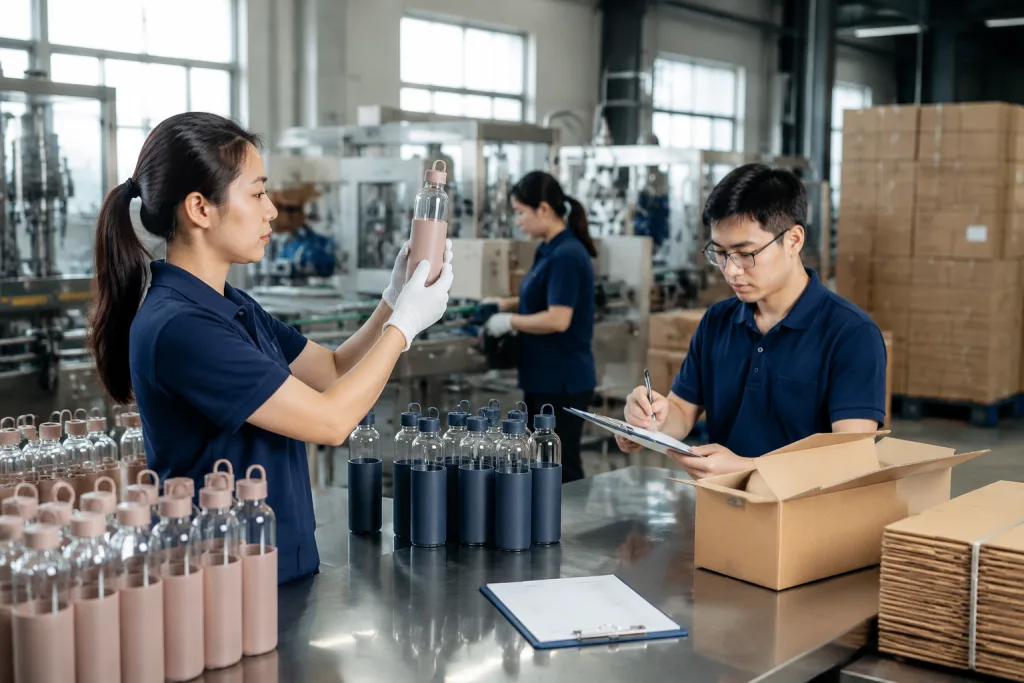
Quality control has to be written so a line leader can run it without guessing. On glass drinkware, “strict QC” means nothing. We check measurable items: dimensional tolerance, surface defects, closure fit, leakage, drop resistance, and carton integrity. A borosilicate glass bottle manufacturer should put an AQL plan on paper and break out incoming, in-process, and pre-shipment checks.
For retail buyers, I usually set AQL 2.5 major and 4.0 minor at final inspection unless the channel asks for tighter numbers. Amazon changes the priority fast. Leakage and transit damage matter more than a tiny scuff. For a branded wellness set, print alignment and lid color consistency carry more weight. Ask for photos from the actual line, not just catalog shots. We run inspection tables, carton drop checks, and packing flow every day on export orders. If a factory cannot show that, it is usually buying parts from outside and piecing the order together.
One test we use is a 24-hour inverted leak check on three samples per style. Another is a 1-meter outer carton drop on finished packs. Simple. Practical. A buyer once flagged a PO typo on the carton count, and QC pulled the sample before it left the dock; that saved a reprint. For a customizable borosilicate glass bottle, the decoration also needs a rub test. If the logo fades under light abrasion, the bottle will look tired before the first reorder.
How to Vet Suppliers in China
You will meet borosilicate glass bottle suppliers, borosilicate glass bottle vendors, and borosilicate glass bottle distributors who all sound the same over email. They are not the same on the line. A real borosilicate glass bottle manufacturer owns, or tightly controls, mold work, glass forming, decorating, and packing. A borosilicate glass bottle vendor may just buy from three factories and add margin. That is fine for some programs. For a custom order with a 35 mm neck finish and a 5,000 pcs MOQ, the extra handoffs are where delays show up.
Ask direct questions. What is the factory’s monthly output? What is the MOQ by decoration method? How many days from sample approval to mass production? What certifications can be produced for the exact SKU? You want numbers, not sales talk. We run into buyers who ask for “fast” and then act surprised when the first sample takes 12 days and repeat production takes 28 days. That is normal in Zhejiang. Anything much shorter deserves scrutiny unless the SKU is already on the line. Also ask whether the factory has BSCI or other social audit coverage if your retailer requires it. We once saw a PO typo change “LFGB” to “LFGF”; QC pulled the sample and caught it before shipment. Check the actual production site, not just a sales office in Hangzhou or Shenzhen.
When you speak with a borosilicate glass bottle distributor or distributor glass water bottle channel, ask who owns the design and tooling. If the answer is vague, the reorder path is weak. We have seen this go sideways when the buyer flagged a second order and the distributor had to go back to a third-party mold owner for approval. That is the wrong question to dodge. For export buyers, the second shipment should be easier than the first, not harder.
A Practical Sourcing Workflow
If you want to move from inquiry to purchase order without burning six weeks, keep the workflow tight. We run this in four steps. First, send a one-page spec sheet with volume, target unit price, lid preference, logo method, packaging style, and destination market. Second, ask each borosilicate glass bottle manufacturer to quote in the same format. Third, request one pre-production sample and one packed sample. Fourth, compare landed cost, not just FOB. On a 20,000-piece order, that difference can be the whole margin. The buyer flagged a missing carton spec on a PO last month, and the line had to stop for a day. That is the wrong question to ask after you place the order.
For sustainable retailers, push for a clear packaging story too. A borosilicate glass bottle promotional program should not feel cheap in the carton. Use recyclable paper, drop unnecessary plastic inserts, and keep the pack count efficient. We saw a 3 mm paperboard insert fail drop testing at AQL 2.5, so QC pulled the sample and the buyer came back asking for a flatter tray. If your line is going into chain stores, choose a master carton count that fits pallet logic, not a designer's preference. For a distributor borosilicate glass bottle order, logistics discipline matters as much as styling. A smart distributor glass water bottle program survives because the product is easy to reorder, easy to inspect, and easy to ship. That is what buyers in Europe and North America actually pay for.
One last point: confirm the factory can repeat your chosen decoration on reorder without drift. A customized borosilicate glass bottle that changes print shade between lots is not customized in a useful way. It is a rework problem. We have seen a pantone match hold on the first 5,000 units and slide on the second run because the buyer approved from a photo instead of a wet sample. Fix that before the PO, not after.
Get a sourcing quote that holds up
Send your target volume, decoration method, and market destination. We will turn it into a workable glass bottle specification and factory quote.
Frequently asked questions
What MOQ should I expect for a custom glass water bottle order?
For a normal custom glass water bottle with existing mold and logo printing, MOQ usually starts around 3,000 units per SKU. If you want a new bottle shape or a heavily customized borosilicate glass bottle, expect 6,000 to 10,000 units. Decoration method matters too. Simple one-color screen print is easier to launch than full-wrap decoration or specialty packaging. A borosilicate glass bottle factory in Zhejiang may quote lower MOQ for repeat styles, but you should still ask for MOQ by color, lid, and carton version because those can trigger separate minimums.
How much does a borosilicate glass bottle bulk order cost?
For a bulk borosilicate glass bottle program, simple FOB factory pricing often falls somewhere around $0.90 to $1.80 per unit for basic styles, but the real answer depends on weight, lid material, packaging, and decoration. A better quote shows bottle, lid, carton, and export carton separately. For a custom borosilicate glass bottle with printed logo and retail box, add $0.25 to $0.90 per unit depending on finish. Ask for landed cost at 5,000 and 20,000 units so you can see freight sensitivity before you commit.
What tests should I request from a borosilicate glass bottle manufacturer?
At minimum, ask for leak testing, drop testing, and a decoration rub test. For export to Europe or North America, also request food-contact documentation, REACH-related declarations, and where relevant LFGB support. A borosilicate glass bottle manufacturer should be able to explain the AQL standard used for final inspection, often AQL 2.5 major and 4.0 minor. If the product includes a lid with silicone, confirm seal performance after temperature cycling. For a promotional or retail program, also ask for carton drop and compression checks.
Is a borosilicate bottle better than regular glass for retail?
Usually yes, if the customer will use it for tea, infused water, or mixed hot and cold liquids. Borosilicate has better thermal shock resistance than standard soda-lime glass, which makes it the safer commercial choice for premium drinkware. It also tends to position better in wellness and sustainable retail. The trade-off is cost: a customizable borosilicate glass bottle often costs more to source and pack than a basic glass alternative. If your product will sit in a gift box and never see heat, the upgrade is less critical. If it will be used daily, borosilicate is the better commercial bet.
How do I know if I am dealing with a real factory or a trading company?
Ask for factory address, production capacity, line photos, certification copies tied to the exact SKU, and sample lead time. A real borosilicate glass bottle factory will usually give you a monthly output figure, such as 300,000 units, plus a realistic lead time like 25 to 35 days after sample approval. A trading company often gives better English but weaker operational detail. If they cannot explain mold ownership, inspection flow, and reorder consistency, you are probably not speaking directly to the borosilicate glass bottle manufacturer.