Key Takeaways
- Choose the product platform first: bottle, tumbler, canteen, or growler affects MOQ, tooling, packing, and lead time by 10–25 days
- A 304 stainless steel vacuum bottle at 0.45–0.55 mm wall thickness is a safer B2B default than thin promotional stock
- For repeat orders, confirm AQL, color tolerance, carton drop test, and spare lid policy before negotiating FOB price
- Laser engraving is stable for premium customized drinkware, while silkscreen can be better for large logo areas above 35 mm
Buying manufacturers drinkware is not hard because options are scarce. It gets hard when 20 factories quote the same RFQ and all say “yes,” even if one is running old lid molds and another has no leak-test jig on the line. Price alone is the wrong question to ask. The real bill usually appears later: Pantone color drift over 1.5–2.0 ΔE, cartons failing a 76 cm drop test, lids leaking in QC, launch dates slipping, or a logo that looks tired after 300 dishwasher cycles.
For B2B buyers, start with four decisions: product platform, material/compliance route, decoration process, and supply model with clear shipment timing. BottleForge Industrial works from Hangzhou, Zhejiang, with production partners across China, and our typical custom drinkware MOQ starts at 1,000 pieces per SKU, with 25–40 day mass production after sample approval. We run into this often: the buyer wants 12 colors at 1,000 pcs total, but the math does not work once the line changes powder, fixtures, and barcode labels for each SKU.
Start with the product job
The first decision is not the logo. It is the job the drinkware must do for your buyer. A distributor drinkware program for outdoor retail has different failure points than a conference giveaway or a private-label canteen line for schools. We have seen this go sideways: the buyer sends a PO for “bottle, black, 304,” but the sample room is holding two bodies with different wall thicknesses, 0.45 mm and 0.60 mm. If you skip this step, you may compare a USD 2.20 single-wall bottle with a USD 6.80 vacuum canteen as if they are interchangeable. They are not.
For daily retail and corporate gifting, 500 ml to 750 ml stainless steel bottles remain the safest volume range. They fit most cup holders, keep freight within reason, and leave enough straight surface for laser marking or silkscreen branding without fighting the curve. On our line, a 65 mm body diameter is easier to print cleanly than a tapered 82 mm body; QC pulled the sample last month because the logo climbed 3 mm at the seam. For a custom canteen used in camping, sports, or military-inspired ranges, buyers often choose 800 ml to 1,200 ml capacity, a wider mouth, and a stronger shoulder profile. A customized growler or customizable growler is a different category again: 1.5 L to 2 L bodies, heavier cartons, stricter leak testing, and closer control of lid gasket compression.
You also need to decide whether the product is promotional, retail, or industrial-use. Canteen promotional projects can accept simpler packaging if the price target is tight; a plain white box and 24 pcs carton may pass. Retail programs need barcode labels, color boxes, warning text, and sometimes Amazon FNSKU or marketplace carton labels. The buyer flagged it before because the PO said “EAN sticker,” but the artwork file carried a UPC-A code. Small mistake. Big delay. Distributor canteen and distributor growler orders usually need repeatable SKUs and stable reorder pricing, not just a one-time factory deal.
My practical rule: if you expect reorders over 5,000 pieces per year, do not treat the first order as a cheap trial. The math does not work if the lid changes after shipment and the second batch cannot match the first. Build the specification properly from day one, including lid material, coating type, carton strength, and spare parts availability. We run a simple spec sheet before mold or coating approval: body size, mouth inner diameter in mm, coating code, gasket material, carton drop-test requirement, and MOQ for replacement lids.
Pick material before decoration
Customized drinkware goes wrong when the buyer approves the look before the base material. We see it on the line: a nice logo proof, then QC pulls the sample and finds the cup body denting after a 60 cm drop test. The body material controls taste safety, heat retention, dent resistance, and the test reports you can hand to a retailer. For stainless steel, the common B2B spec is 304 food-grade stainless for the inner wall and 201 or 304 for the outer wall, depending on price point. A stronger retail bottle usually uses 304 inside and outside, with 0.45–0.55 mm wall thickness before forming. Thinner bodies can reduce FOB cost by USD 0.20–0.45, but dent complaints go up; we have seen 3 claims in one 5,000 pcs shipment when the buyer pushed the gauge too low.
For plastic lids, ask for PP, Tritan, or food-grade silicone details, not just “BPA free” printed in the catalog. Short question. Big difference. If you sell in Europe, REACH and LFGB may matter. For North America, buyers often request FDA food-contact declarations, CPSIA for kids’ items, and sometimes ASTM-related testing depending on the channel. A serious canteen manufacturer should quote testing costs before production, not after goods are packed. We run this check at quotation stage because one buyer once sent a PO with “silicon” instead of “silicone,” and the lab paperwork had to be corrected before the pre-production sample could move.
Glass bottle projects look clean, but they need stronger packing and a higher breakage allowance. Our packing team usually asks for a 5-layer export carton and molded pulp tray after the first drop test cracks the shoulder. Aluminum is light and cheaper, but it needs lining and gives you less room for error if the lining quality is weak. Stainless steel is still the best-balanced choice for customizable drinkware because it handles vacuum insulation, powder coating, engraving, and rough container loading better. The math does not work if the product looks premium online but arrives with 2% broken units.
If you ask a canteen supplier only for the lowest price, the easy cuts are hidden: thinner gauge, cheaper coating, lighter carton, or recycled material without proper declarations. We have seen a buyer flag a 12 kg master carton that should have been 14 kg after the supplier reduced the board weight. In Zhejiang and broader China supply chains, solid factories can produce both value and premium grades. The buyer’s job is to define which grade you are buying, then lock it in the spec sheet before the deposit is paid.
Decide how custom is custom
“Custom” is a dangerous word on a PO. It might mean a 1-color logo on stock inventory, or it might mean a new mold, new cap, Pantone-matched coating, custom box, and exclusive shape with a lockable lid. Those jobs do not belong in the same schedule. We run stock canteen customizable orders in 18–25 days after artwork approval if the logo file passes our AI/CDR check and the powder coat is already in warehouse. A full canteen customized with new tooling can take 45–70 days before mass production, especially when the lid or handle needs mold adjustment after the first T1 sample. Last month QC pulled a lid sample with a 0.6 mm gap at the hinge. That alone cost 6 days.
For most B2B buyers, we split customization into four working levels, because quoting “custom drinkware” as one line item is the wrong question to ask:
- Logo only: laser engraving, silkscreen, pad print, or heat transfer on existing models. MOQ can be 500–1,000 pieces, depending on color and model. For laser, we check logo stroke width first; anything under 0.3 mm often looks broken after engraving.
- Color and logo: powder coating or spray painting with Pantone target, then logo work after coating cure. MOQ usually starts at 1,000–3,000 pieces per color. The buyer may approve Pantone 186C on paper, but the coating booth still needs a physical color panel before we run the line.
- Packaging custom: color box, insert card, retail label, barcode, FNSKU, or master carton mark. Add 7–12 days if artwork is not ready. We have seen this go sideways from one typo on the PO, such as “matte balck” printed across 3,000 retail boxes.
- Structural custom: new lid, new body shape, new handle, or special filter. Tooling can range from USD 800 to USD 6,000+ per component. The mold shop will ask for 2D drawings in mm and a 3D file, not just a competitor photo from Amazon.
Laser engraving is clean on stainless steel and holds up well after daily use. It is the wrong choice if you need exact Pantone logo color. Silkscreen keeps cost down for simple artwork, but curved canteen bodies and textured powder coating can make thin letters look soft at the edge. Heat transfer gives more color detail. Ask for dishwasher resistance and adhesion testing before you approve bulk; our QC team normally uses a cross-cut tape test and checks the print after a 60°C wash cycle.
A good custom drinkware factory should push back when artwork is unrealistic. For example, a 0.2 mm thin line on a curved powder-coated 750 ml bottle will not print consistently over 10,000 units, no matter how nice the mockup looks. The math doesn't work. We had one buyer flag this after pre-production samples, and changing the logo stroke to 0.45 mm saved the order from random missing lines in mass production.

Compare factories by control points
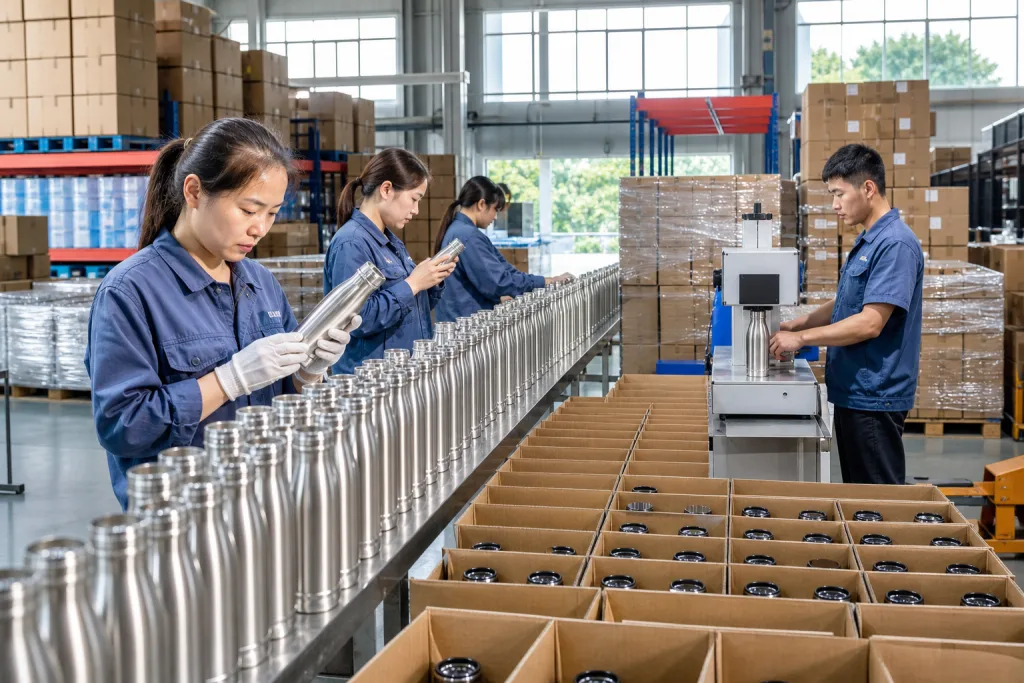
When you evaluate canteen manufacturers, do not stop at catalog range. Catalogs are easy. Process control is harder. A capable canteen factory should show how it controls deep drawing, seam welding, polishing, vacuum testing, powder coating, assembly, and final packing. On the line, QC should know the weld bead target in mm, which vacuum tester is running, and why one canteen failed after the 95°C hot-water check. For vacuum drinkware, leak rate and heat retention are not “QC details”; they are the product.
Ask for factory metrics. At BottleForge Industrial, our stainless drinkware production network in China supports about 300,000 units per month across bottles, tumblers, canteens, and growlers, with project MOQs commonly from 1,000 pieces and pre-production samples in 7–12 days. For larger distributor drinkware orders, we normally recommend a pilot run or golden sample approval before releasing full mass production. We run this step because one buyer once approved “matte army green” by email, then flagged the first carton as too gray under D65 light. Fix it at sample stage.
Useful questions include: What AQL level do you use for final inspection? Can you support AQL 2.5 for major defects and 4.0 for minor defects? Is vacuum testing done 100% or by batch sampling? What is the carton drop test standard? Are spare lids packed at 1–2% for distributor after-sales support? Can you provide BSCI, ISO 9001, or social audit documents if a retailer requests them? Ask to see the inspection sheet too. A real one has defect counts, carton numbers, gauge readings, and photos, not just a stamped “PASS” from someone in the office.
There is also a difference between a trading canteen vendor and a factory-controlled canteen manufacturer. Trading companies work if they control the QC file and answer technical questions fast. If nobody can tell you the stainless grade, coating line capacity, or gasket material, the math doesn't work. We have seen this go sideways: the PO said 304 stainless, the supplier used mixed lids, and QC pulled the sample only after the buyer flagged a rust spot. You are not buying from a controlled supply chain. You are buying hope with a logo on it.
Price the full landed risk
FOB unit price matters, but it is only one line in the buying decision. A USD 0.35 saving can disappear fast if cartons crush, the coating chips, or the supplier misses the peak season window. For custom canteen and customized growler programs, freight volume bites hard. A 1,000 ml vacuum canteen may pack 24 pieces per master carton, while a 2 L growler may pack only 12. That shifts ocean freight per unit and warehouse handling on arrival.
Put these items in one table: FOB price, MOQ by color, sample fee, sample lead time, mass production lead time, packaging cost, testing cost, inland freight, payment terms, defect allowance, and tooling ownership. We run into buyers who compare only FOB, MOQ, and sample fee, then the math falls apart after artwork changes and carton upgrades. The buyer flagged a missing carton spec on the PO, and that one typo added a week.
Payment terms change risk. A normal China export structure is 30% deposit and 70% balance before shipment, often after final inspection. For a new account, inspection rights matter more than shaving the balance date. If the supplier refuses third-party inspection, that is a bigger warning than a slightly higher FOB price. QC pulled the sample, checked the lacquer thickness, and found a pinhole at the rim.
For promotional orders, simpler retail packaging can hit the price point. For retail and distributor canteen programs, do not cut the carton. Use 5-ply export cartons for heavier items, keep gross weight under 15–18 kg where possible, and confirm inner bag or divider requirements. Packaging is boring until it fails. We have seen a 2 kg growler ship fine on paper and split a corner box in transit.

Build a reorder-friendly specification
A first order should produce a repeatable item, not just a shipment. We see this with canteen distributors, brand owners, and private-label importers who plan seasonal reorders. The PO should not stop at “750 ml black bottle with logo.” It needs capacity tolerance, stainless steel grade, coating finish, lid color, logo size, print position, packing method, barcode rules, and the inspection standard. On our line, a 750 ml spec with a ±15 ml tolerance saves a lot of back-and-forth later.
For color, use Pantone references and allow a realistic tolerance. Powder coating on metal does not behave like ink on paper. A Delta E target or an approved physical color chip beats a fight over a phone photo; the buyer flagged a “dark navy” that came back two shades off under warehouse light, and we had to recheck the panels with a spectrophotometer. For logo placement, state the distance from base or seam, not just “centered.” If the canteen has a handle or strap, put the pull strength and material in writing—this is the wrong question to leave open.
Keep one golden sample in your office and make the supplier keep one in the factory. For repeat orders, compare production against that sample before packing. QC pulled the sample on one 5,000-piece run, and we caught a lid embossing shift of 3 mm before it hit cartons. That habit cuts arguments fast, especially when staff changes on either side.
If you are building a distributor growler or custom growler line, spare parts matter. Ask whether lids, gaskets, straws, filters, and handles can be reordered on their own. A low-cost product with no replacement lid plan creates after-sales waste. BottleForge Industrial in Hangzhou, Zhejiang usually recommends 1% spare lids for standard retail orders and 2% for heavier outdoor or school-channel products where caps go missing more often. We shipped one school order where the PO typo said “50 spare lids” instead of “500”; the math did not work, and the buyer caught it before loading.
Choose the supplier model deliberately
There is no single best supplier type. The right fit depends on order size, compliance load, and how much drawing support you need. A 3,000-piece promotional canteen order can run fine with a flexible vendor if the artwork is simple and the ship date is tight. A 6-SKU retail program needs harder project control, written QC checkpoints, and stable material sourcing. A canteen factory that lives on stainless bottles can do 304 stainless well and still stumble on glass lids or plastic accessories.
If you are a new importer, pick a canteen manufacturer or export partner who calls out the trade-offs before they take the deposit. You want the person who says, “That lid looks good, but it adds 12 days and USD 0.28,” or “This matte coating looks clean, but we keep seeing fingerprint complaints after carton drop tests.” We had a buyer flag a PO typo on the lid color code once, and QC pulled the sample before the line started. That pushback saves money. The math works.
For experienced canteen distributors, consistency comes first: same model code, same carton size, same coating texture, same heat-retention result, and lead time that stays within the same 3-day band. For brand owners, the goal is different: a finish no one else has, packaging that opens cleanly, or a customizable canteen family in 500 ml, 750 ml, and 1,000 ml. Those are two different buying jobs.
China stays strong for customized drinkware because the chain is tight: steel forming, lid injection, silicone parts, coating, printing, packaging, and export booking sit close enough for one team to control. On our line, a 0.3 mm lid tolerance shift can change the feel in hand. Density still does not replace discipline. Your supplier should turn the commercial target into a locked spec, then protect it through sampling, production, inspection, and shipment.
Send your drinkware specification for a factory review
Share capacity, material, logo, MOQ, and target market. We will check feasibility, pricing drivers, lead time, and avoidable production risks.
Frequently asked questions
What MOQ should I expect for manufacturers drinkware in China?
For standard stainless steel custom drinkware, expect 1,000 pieces per SKU as a realistic starting MOQ. Some logo-only stock models can run at 500 pieces, but color customization usually starts at 1,000–3,000 pieces per color. A custom canteen with new lid tooling or special coating may require 3,000–5,000 pieces to make setup costs sensible. Growlers are often higher risk because of size, carton volume, and leak testing, so many factories prefer 1,000 pieces minimum. If a supplier offers 100 pieces at a very low price, check whether it is existing inventory, whether QC is included, and whether the same price applies to repeat orders.
How long does a customized canteen order usually take?
For a stock canteen customized with logo only, a normal timeline is 7–12 days for sampling and 25–40 days for mass production after sample approval. Add 7–12 days if you need custom color boxes, barcode labels, or FNSKU work. If the project includes a new mold, new lid, or custom handle, allow 45–70 days before the first mass shipment. Ocean freight to Europe or North America can add 25–45 days depending on port and season. For seasonal launches, approve artwork and packaging at least 90 days before your required warehouse date.
Which logo method is best for customizable drinkware?
Laser engraving is the most stable choice for premium stainless steel drinkware because it will not peel and handles daily use well. It works best on stainless or powder-coated surfaces where a metallic or contrast mark is acceptable. Silkscreen is better when you need solid brand colors and a larger print area, usually above 35 mm wide. Heat transfer or UV printing can handle multi-color artwork, but you should request adhesion and dishwasher testing. For canteen promotional orders, silkscreen often gives the best cost balance. For retail customized drinkware, laser or tested heat transfer is usually safer.
How do I know if a canteen supplier is reliable?
Ask for process details, not just photos. A reliable canteen supplier should state stainless grade, wall thickness, coating method, lid material, MOQ, lead time, and AQL inspection level. They should support pre-production samples, keep a golden sample, and allow third-party inspection before shipment. For vacuum canteens, ask whether leakage and insulation tests are 100% checked or sampled by batch. Useful documents include BSCI, ISO 9001, REACH or LFGB reports, and food-contact declarations. Also test communication: if a supplier cannot explain why one lid costs USD 0.20 more than another, they may not control production deeply enough.
What should distributors specify on a drinkware purchase order?
A distributor drinkware PO should include more than model name and price. Specify capacity, stainless grade, wall thickness if known, coating finish, Pantone target, logo process, logo size and position, lid material, packaging, carton marks, barcode rules, inspection standard, spare parts, and shipment terms such as FOB Ningbo or FOB Shanghai. For canteen distributors, add spare lid percentage, usually 1–2%, and confirm whether replacement gaskets can be purchased later. State AQL levels, commonly 2.5 for major defects and 4.0 for minor defects. Attach approved artwork and golden sample photos to reduce disputes.