Key Takeaways
- A practical custom bottle order usually starts at 3,000-5,000 units with 25-35 day lead time after sample approval.
- For stainless steel, 304 with 0.4-0.5 mm wall and a 0.6-0.8 mm base is a normal commercial spec.
- AQL 2.5 major and 4.0 minor is common for mass production QC, but you should name the exact defect list.
- FOB China pricing for a basic customized drinkware bottle often moves by $0.35-$1.20 depending on lid, coating, and decoration.
You are not buying a bottle. You are buying a repeatable run, a print result, a carton spec, and a ship date your sales team can stand behind. That is the real job when you source from manufacturers drink bottle factories in China or Zhejiang.
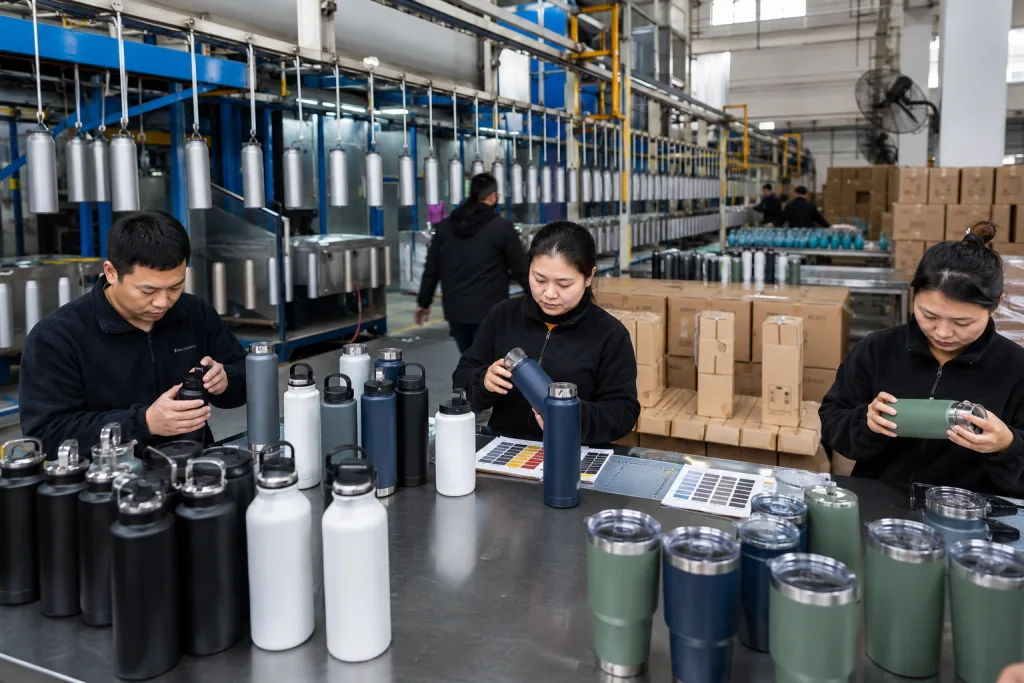
The hard part is not finding a canteen manufacturer or a canteen supplier. It is turning a loose idea into an order we can run on the line: material, lid, wall thickness, decoration method, and a QC plan that catches defects before they hit your warehouse. We see this every week in Zhejiang. A buyer once sent a PO with the color code typo in one line, and QC pulled the sample before production started. That sort of catch saves 12 days. Buyers who define the spec tightly get cleaner quotes, fewer rejects, and less back-and-forth from China.
Start With the Use Case
Start with the buyer’s job, not the catalog name. A procurement manager for a canteen distributor needs a bottle that can take cafeteria handling and still look clean after 200 uses. A retail brand owner wants shelf pull and a low return rate. A school or gym program cares more about leak resistance and carton density than decorative trim. Same bottle family. Different spec.
Ask four questions before you send a quote request: who uses it, where it sits, how it gets washed, and what failure hurts most. That tells you whether you should ask for a stainless steel canteen custom build, a custom growler for beverage programs, or a simpler customizable canteen for promo use. We run this every week in Zhejiang, and the buyer who writes only “customized drinkware” gets a fuzzy number back. The buyer who writes “500 ml 304 stainless, powder coat, screw lid, laser logo, 5,000 pcs, drop-tested” gets a production answer. QC pulled the sample twice on one job because the PO had a typo on the lid color.
Use-case translation matters:
- Retail brand: tighter finish control, cleaner carton presentation, and a narrow color tolerance.
- Promotional canteen: lower unit cost, simple print, higher MOQ, shorter lead time.
- Distributor drinkware program: repeatability, spare parts, and reorder consistency.
That first page of the brief should already tell the canteen factory what success looks like. If it does not, the math does not work.
Lock the Bottle Spec
Now lock the physical spec. The phrase manufacturers drink bottle covers too much ground. Decide material, capacity, wall structure, lid type, and finish. A 500 ml single-wall aluminum bottle behaves differently from a 750 ml double-wall stainless bottle. Price, weight, carton count, and failure mode are not comparable.
For stainless steel, 304 is the standard commercial choice for most export orders. If the bottle goes into higher corrosion or premium positioning, 316 can be justified, but it will cost more. Typical wall thickness on a decent production bottle sits around 0.4-0.5 mm for the shell, with 0.6-0.8 mm at the base if the structure allows it. On the line, we have seen a buyer push back on 0.35 mm shells after QC pulled the sample and found dent marks from a 1.2 m drop test. If a canteen manufacturer offers much thinner metal at a low price, ask how they control denting, vacuum integrity, and weld quality. For plastic or Tritan-style builds, ask for the resin grade and whether it meets FDA contact requirements and REACH expectations for Europe.
Capacity changes the math too. A 350 ml customized canteen may pack better and lower freight cost, but the unit price can stay close to a 500 ml bottle because tooling and finishing dominate. A 1,000 ml custom growler uses more material and usually needs a stronger carton spec. We shipped a 750 ml run where the buyer flagged a PO typo on carton size, and the real freight came in 12% over budget. In Zhejiang, mature canteen manufacturers will quote these breaks clearly if you ask for full dimensions, not just volume.
Do not approve a quotation until the supplier names the material grade, thickness, lid structure, surface finish, and print method in writing.
A good spec sheet removes the guesswork from the canteen supplier relationship and makes later QC meaningful. The wrong question is, "Can you make it cheaper?" Ask for the exact build first, then compare quotes on the same 2 mm lid gasket, the same 0.5 mm shell, and the same print method.
Price the Order Correctly
The first quoted price is not the real price. Price tooling, samples, unit cost, decoration, inner packing, outer carton, and freight assumptions as separate lines. For one 500 ml stainless bottle job we ran last month, the buyer flagged a PO typo on the lid spec and the quote had to be rebuilt line by line. Standard shapes can keep the mold or setup fee at $0-$80, but a custom lid, embossed logo, or nonstandard finish can add $150-$800. That is the number that changes vendor comparisons.
A simple stainless custom drinkware bottle often lands around $2.10-$3.80 FOB China at 3,000 pcs. A promotional bottle with powder coat, laser logo, and custom lid can move into the $3.90-$6.20 range. A custom growler with heavier walls and larger volume usually sits above that. For exact margin math, ask the factory for FOB first, then add duty, inland freight, and a 2% carton damage allowance on your side. That is the real landed cost. We see buyers skip this and the math does not work.
Price breaks matter. At 1,000 pcs, you are paying for short-run inefficiency. At 5,000 pcs, the same line may give you a better print rate and tighter carton loading, and QC pulled the sample to check carton compression at 7 kg before release. If your channel reorders every quarter, the wrong question is “What is the cheapest first order?” Ask for the stable reorder price at 5,000 pcs.
Always ask for:
- FOB unit price by quantity tier
- Sample charge and sample lead time
- Decoration cost per color or per location
- Carton and master carton cost
- Any test or certification fee
Sample Before You Commit
Sampling is where a lot of custom canteen and customized drinkware programs are won or lost. One physical sample tells you more than ten email rounds. Ask for a pre-production sample built with the final material, finish, print, and lid. If you are buying from China, especially from a Zhejiang canteen factory, make them label it production-intent, not a hand-polished show piece. We run into this all the time. The buyer flagged a glossy demo cup once, then the actual run showed a different sheen under the same light.
Check the sample against a short list. Does the cap thread bite cleanly, or does it cross-thread after two turns? Does the bottle sit flat, or wobble 1-2 mm on the granite table? Is the logo centered and legible at 1 meter? Does the coating show orange peel, dust, or color drift? Is the gasket seated the right way? If it is a vacuum bottle, does it hold temperature to spec? That is the real test. A canteen customized sample should survive basic abuse before you talk about mass production. We have seen this go sideways when buyers approved a canteen promotional sample from photos and the hand feel was dead in the first carton.
For a distributor canteen program, I also ask for one carton sample. Check how 12, 24, or 48 units are packed, how the dividers sit, and whether the outer carton crushes under stack pressure. Packaging is part of the product. If you are shipping customized canteen units into a warehouse with mixed pallets, carton strength affects your loss rate. QC pulled the sample and found one corner only had 3 mm of buffer, which is a bad joke if the truck ride is rough. A capable canteen manufacturer will not push back on this request; the math does not work if you skip the sample and eat a rejected lot later.
Write the QC Rules
Write QC rules before production starts, not after. Buyers get burned here. If your PO says only “inspect quality,” the factory will default to its own standard, and that standard is usually whatever keeps the line moving. Spell out the checks and tolerances, and you control the outcome. For most bottle programs, we run a basic incoming, in-process, and pre-shipment routine. Use AQL 2.5 for major defects and AQL 4.0 for minor defects unless your brand risk is unusually high. This is the wrong question to skip.
Your defect list needs detail. “Bad appearance” is useless on the floor. Major defects include leaking lids, distorted threads, visible dents over 2 mm, missing coating, wrong color, and logo misalignment beyond tolerance; QC pulled the sample on one order last month because the print shifted 1.8 mm off center. Minor defects include small scuffs, slight print variation within an agreed range, or packaging marks that do not affect retail use. For a customized growler or custom drinkware line sold in Europe, ask for REACH-related documentation if coatings, inks, or plastic parts are involved. For the North American market, ask for material declarations aligned with FDA contact expectations where relevant. We’ve seen this go sideways when a buyer approved the color chip but forgot to lock the coating spec.
A practical QC plan for a canteen distributor order can include:
- 100% visual check on print and lid fit before packing
- Leak test on a defined sample, often 5-10%
- Drop test on carton samples from 76 cm or 1 m, depending on pack style
- Temperature or sealing test for vacuum builds
If you buy from a canteen supplier in Zhejiang or elsewhere in China, ask for photos and a defect report before balance payment. We ship these every week. A simple report should show defect counts, carton photos, and at least one lid-fit check from the torque gauge station. Good factories are used to this. Weak vendors push back as soon as the process is written down, or they try to send only beauty shots with no defect summary. The buyer flagged that once on a PO with the lid color typo, and the pushback told us everything.
Plan Shipping and Documents
Shipping is where a clean bottle order turns messy. We have seen a 5,000-piece canteen run look perfect on the line and still slip because the carton count, pallet height, or paperwork was off by one line. Decide early on FOB or CIF. Most buyers who know the math pick FOB China, because freight and insurance stay visible. If you are buying through a distributor drinkware channel, lock the carton label plan early: SKU, color, quantity, barcode, all of it.
Check the commercial set before the truck leaves the gate: commercial invoice, packing list, bill of lading, and any customs certificate your market asks for. QC pulled the sample once and found a carton label typo on a PO, one extra digit in the SKU, and that tiny mistake held the freight for 4 days. If your retail channel uses FNSKU or another barcode system, confirm the unit and carton label layout before the factory prints. For a mixed-SKU canteen vendor order, this is the right question to ask. A label error costs more than the bottle.
For a standard export run from Zhejiang, a realistic schedule is 7-12 days for final sample confirmation, 20-30 days for production, and 5-35 days for ocean transit, depending on destination. Air freight moves faster, but it only makes sense for small urgent replenishment. If your reorder is tight, ask the canteen manufacturers to reserve raw material before sample approval so the line can start right after sign-off. That is normal here, and it can save a week. We've seen it go sideways when the buyer waited until the PO was final before booking stock.
The best buyers treat logistics as part of the spec. Carton size, pack count, and pallet height should be written with the same care as the bottle finish, or the warehouse will flag it later and the math does not work.
Use Reorder Discipline
The first order is the easy one. The second order tells the truth. If the first production run from a canteen manufacturer came through clean, lock the reference sample, approved artwork, and carton spec before you release the next PO. We keep a one-page control sheet on the desk: exact dimensions, approved Pantone reference, lid code, gasket material, packaging layout. No guesswork. That is how you stop drift when a one-off custom canteen trial turns into a steady program with canteen distributors across three regions.
Reorders show who can actually support you. A serious canteen factory keeps archived samples, printed artwork, and material records, and QC pulled the sample before the line restarted. We shipped one batch after a buyer flagged a 2 mm logo shift on the cap, and the fix was simple because the old file was still there. That matters when you need a fast run of canteen promotional stock before a seasonal push, or when a distributor canteen account asks for a revised logo placement without changing the bottle body. If the supplier cannot match the same result after six months, they were not a real manufacturing partner.
For brands building a wider line, the same discipline applies across customized canteen, customizable canteen, and customized drinkware programs. You can run one decoration method on a standard bottle and a different one on a custom growler, but the QC rule stays the same. We have seen this go sideways when a PO typo changed the lid code from `L-03` to `L-30`, and the rework ate a week. Consistency keeps returns down and margin intact. In Zhejiang and across China, the factories that win repeat business hold that standard on a 5,000-unit run without excuses.
Send the spec. Get a real production quote.
If you already know the capacity, material, and decoration, we can turn it into a factory quote, sample plan, and QC checklist fast.
Frequently asked questions
What MOQ should I expect for manufacturers drink bottle orders?
For a standard custom stainless bottle, 3,000 pcs is a normal starting MOQ, and 5,000 pcs is common if you want custom color or special packaging. A simple canteen promotional build may go lower, sometimes 1,000-2,000 pcs, but your unit cost will rise. For a custom growler or heavier customized drinkware item, expect the MOQ to move up because materials and assembly time are higher. In Zhejiang, a capable canteen factory will quote tiered pricing, so ask for 1,000, 3,000, and 5,000 pcs side by side.
How do I check whether a canteen manufacturer is reliable?
Ask for factory photos, export history, sample references, and a QC workflow. A serious canteen manufacturer should show production lines, welding or forming equipment, and packing controls. Look for BSCI or similar social audit evidence if your buyer requires it, and ask for REACH or material declarations when selling into Europe. Reliability also shows up in response time: if they can quote a full spec within 24-48 hours and send a pre-production sample in 7-12 days, they likely run a real operation rather than a trading-only desk.
What is a realistic FOB price for a custom canteen?
A basic customized canteen in stainless steel often lands around $2.10-$3.80 FOB China at medium volume. Add more for powder coating, laser engraving, special lids, or higher-grade steel. A custom growler usually costs more because of size and material weight. If you are comparing canteen suppliers, make sure the quote includes the same carton count, decoration method, and inspection scope. A $0.40 difference can disappear once you add packaging or a better lid.
What QC standard should I put in the PO?
Use a written inspection standard with AQL 2.5 for major defects and AQL 4.0 for minor defects unless your brand risk needs tighter control. List exact major defects: leakage, wrong capacity, broken seal, missing logo, wrong color, sharp edges, and coating failure. For customized drinkware sent to retail, also include carton drop-test expectations and label accuracy. If you buy from a canteen supplier in China, request photo evidence and a signed inspection report before balance payment.
How long does production usually take in Zhejiang?
For a standard custom run, 20-30 days after sample approval is realistic, with 7-12 days for sample sign-off if the artwork is ready. If the order involves special lids, new tooling, or a complex canteen customized finish, add a few days. Ocean freight from China can add 5-35 days depending on destination. If you are running a distributor drinkware program with fixed delivery windows, build in a 2-week buffer before your promised ship date.