Key Takeaways
- Typical MOQ for a double wall order starts at 500-1,000 units, with 20-35 day lead time after sample approval.
- A good spec should lock 18/8 stainless steel, 0.4-0.6 mm wall thickness, and a vacuum leak test standard.
- For logo work, silkscreen is usually best under 2 colors; laser engraving costs more but holds up better on a customized canteen.
- For EU and North America, ask for REACH, FDA contact safety, and AQL 2.5 inspection records before shipment.
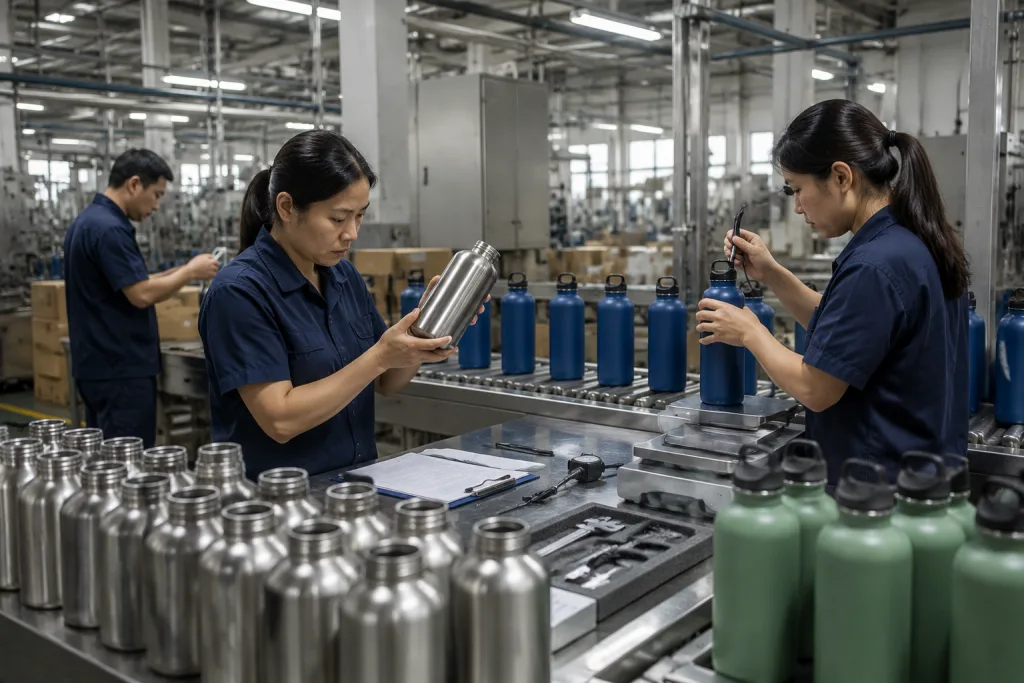
You are not buying a “nice bottle.” You are locking in a production run that has to take dents, leaks, logo wear, packing mistakes, and whatever the end user does after first use. That is why manufacturers double wall bottle sourcing gets messy fast if you do not define the build before you ask for prices. In Zhejiang and across China, factories quote fast, but the quote only means something when the wall structure, stainless grade, finish, and test standards are pinned down. We run samples through a drop check on the line at 1.2 m, and that is where the shortcuts show up.
For a B2B buyer, the job is not finding a cheap canteen supplier. It is getting one clean order that a canteen factory can repeat at scale with stable QC. If you are buying custom drinkware for retail, promotion, or distribution, the gap between a usable sample and a profitable shipment is often 2 mm of wall detail, one missing pressure test, or a lid spec typed wrong on the PO. The buyer flagged it, and the whole carton plan moved. Treat the order like a production file, not a sales inquiry.
Start with the actual buyer scenario
Picture the procurement manager at a canteen distributor in Germany. Sales wants a 500 ml manufacturers double wall bottle for a spring campaign. The same shape also has to work in matte black for retail and in stainless steel for distributor drinkware bundles. The wrong first move is chasing a unit price. We run into that every week. You need a usable order file.
Lock the basics first: capacity, outer diameter, height, lid type, logo method, packaging. For a normal custom drinkware run, a canteen manufacturer in Zhejiang will ask for these before they quote. Leave them vague and you get sample-grade numbers that fall apart once tooling, carton changes, and inspection costs land on the sheet. On one 750 ml job, the buyer flagged a 2 mm neck change after the PO was already typed, and the line had to stop. A practical order sheet should include:
- Capacity: 500 ml or 750 ml
- Body material: 18/8 stainless steel, inside and outside
- Vacuum construction: double wall
- Surface: powder coat, matte paint, or brushed metal
- Logo: silkscreen, laser, or embossed mark
- Packaging: bulk pack, white box, or color box with barcode
That is the gap between a canteen customizable concept and a real PO. The buyer who defines the job first usually gets the better production slot in China. QC pulled the sample on a 500 ml build when the carton code had a typo, and nobody wanted that scramble twice.
Lock the bottle spec before pricing
A bottle that looks right in a catalog can still miss the mark if the wall is too thin or the neck finish is off by 0.2 mm. For manufacturers double wall bottle sourcing, the core spec needs to be plain and locked down. Run one material standard and one wall target. Most export-grade stainless bottles land around 0.4-0.6 mm wall thickness. Below that, dent rates climb fast. Go thicker and you add weight, then freight starts eating the margin without much gain.
Ask the canteen factory to put the steel grade in writing. 304 stainless is the usual baseline for a customized drinkware line; 316 only makes sense when the buyer has a real corrosion case, like salt air or harsh wash cycles. For hot and cold retention, ask for a test window with the fill temperature, ambient temperature, and result. “12 hours hot” is sales copy. A serious canteen supplier will show the test method and the numbers. If they cannot, the line is not ready for a distributor canteen program. We have seen that end in rejected samples and a PO typo that turned 12 hours into 18 by mistake.
Give the lid the same attention. A custom canteen can fail on the cap seal while the body is fine. Ask for the silicone gasket material, torque range, and leak test method. QC pulled the sample on one 500 ml run because the cap backed off after a 1.0 m drop. Put a 24-hour inversion test in the sheet and keep it there. That is the right bar for a canteen manufacturer serving Europe and North America. Anything looser gets expensive later.
Price the order like a buyer, not a shopper
Once the spec is locked, the pricing starts to mean something. A 500 ml custom canteen in bulk can land anywhere from USD 2.20 to USD 4.80 FOB China, depending on the lid, finish, and packaging. We ran a 12-day quote on one line last month; the buyer flagged the gift box as the cost spike, not the bottle. Laser engraving, gift boxes, and a special Pantone color all add real money. A promo canteen with basic silkscreen and bulk packing usually stays near the lower end. A premium customized canteen with powder coat and a two-tone lid sits higher. That is the math.
Do not stop at the ex-factory number. For North America and Europe, landed cost is the question: FOB, carton count, outer carton strength, pallet pattern, and shipping mode. We have seen a cheaper bottle turn into the expensive one after breakage and chargebacks. QC pulled the sample at 1.2 mm carton board and the corner crush failed; that is the kind of detail a buyer pays for later. A solid canteen vendor should tell you units per carton, carton size, gross weight, and whether the pallet stack stays stable in warehouse receiving. For a distributor channel, those numbers matter as much as the bottle.
When you ask for pricing, ask for two or three build options. One canteen customizable option for promo volume. One mid-tier custom drinkware option for retail. One premium customized growler-style option if you need larger capacity. We ship quotes that way because a single number creates fake debate. The buyer asked us to fix a PO typo once — the lid code was wrong by one digit — and the whole schedule slipped a week. Give the commercial team room without reopening the design.
Use samples to expose weak points
A sample is not a souvenir. It is a stress test. Order one pre-production sample and one decorated sample. Check the cap threads by hand, measure logo placement against the drawing, inspect the paint edge at the base, and shake the bottle for any hollow ring that points to weak vacuum control. On one run, QC pulled a cap that caught at 1.5 turns instead of 1.0; that kind of miss shows up fast. If your market cares about premium touch, a canteen customized finish must survive handling, not just photography.
For custom drinkware, the sample stage should include real use checks. Fill it with boiling water, close the lid, wait 10 minutes, then verify cap safety and seal performance. Run the same test with ice water. Leave the bottle on absorbent paper overnight. One tiny leak on a sample usually turns into a batch complaint, and the math does not work when that happens. If the bottle is sold as a custom growler or customizable growler format, test the carrying handle, mouth size, and closure fatigue too.
Use the sample to confirm branding behavior. Some coatings take ink cleanly; others show edge bleed or logo wear after abrasion. A solid canteen manufacturer will tell you which decoration method matches which coating, and which 0.3 mm shift will get the buyer flagged. If they cannot say that, they are acting more like a canteen vendor than a technical supplier.
QC the shipment before it leaves China
Inspection saves bad orders. We see it on the line all the time. For export drinkware, use an AQL plan, not visual guessing. AQL 2.5 for critical and major defects is a normal starting point for bottles going into retail or distribution. Put the scope in writing: leak test, vacuum retention check, logo registration, color consistency, carton drop test, and barcode readability. QC pulled the sample last week and found one cap seal out by 0.3 mm; that is the sort of miss that turns into a container dispute.
In Zhejiang and other manufacturing centers in China, the stronger factories run monthly output in the hundreds of thousands of units. A canteen factory with 300,000+ units/month is not automatically better, but it can usually hold a tighter schedule if the line is organized. A normal first run for a custom canteen order might be 5,000 to 20,000 units, with 25-35 days after sample sign-off. Rush orders can happen, but only if your spec is already fixed. We had a buyer push back on a 12-day cut from this schedule; the math did not work once the new lid mold was added.
Before shipment, confirm carton marks, inner pack count, and whether the final pack matches your distributor drinkware channel. If the goods go to Amazon or retail fulfillment, barcode placement and carton dimensions must stay stable. If the goods go direct to a canteen distributor warehouse, stacking strength and pallet label accuracy matter more. One missed carton code can stall an entire container. We once saw a PO typo on the outer carton mark, and the whole 40HQ sat until reprint.
Choose the supplier type that fits the channel
Not every buyer needs the same partner. A promotion-heavy supplier can be the wrong fit for retail, and we have seen that go sideways fast. A buyer ordering 5,000 logo bottles for a trade show wants speed. A brand owner launching a premium double wall bottle wants finish control, carton art, and paperwork that passes review on the first pass. Match the factory to the channel.
For high-volume promo work, pick a supplier that can repeat one-color printing on a pad printer or silk line without drifting off register. For retail, the plant needs to hold cap torque, coating gloss, and box print within the same spec on every reorder. For a custom double wall bottle or custom growler program, ask about mold control, closure tests, and REACH plus food-contact files. If the quote comes through trading layers, ask which plant owns the tooling and who signs QC. That is the real question, not the brochure wording.
The mistake is assuming every supplier can do every job. A factory that ships customized bottle runs for the EU may still miss distributor reorders if the carton size changes from 24 pcs to 20 pcs and nobody updates the packing list. Ask how they handle repeat color matching, reorder tolerance, and spare lid inventory. QC pulled the sample on a 0.3 mm neck finish mismatch once, and that kind of miss tells you whether you are talking to a real bottle factory or just a quoting desk.
Write the order so reorders stay easy
The best B2B drinkware orders are dull to repeat. Good. Your first PO should set the pattern for the next three. Keep the spec sheet tight and exact: product code, capacity, steel grade, finish code, logo file version, carton pack, and test standard. That is how a double wall bottle line stays steady across seasons. It also gives your sales team a clean path when the buyer asks for one more variant without reopening the whole job.
Build one master file for the buyer, one production file for the factory, and one QC file for inspection. Keep photo references for logo placement and a signed sample record. We have seen a 2 mm logo shift turn into a long email thread over one carton of 1,000 pcs. If the buyer flagged the blue as off by one shade, you want the signed sample and the same Pantone note on the PO, not a debate after the line has already run.
A practical buyer does not chase every feature. They choose the right custom drinkware build, verify the sample, lock the QC terms, and keep the reorder path clean. The math does not work any other way. That is how a double wall bottle manufacturer becomes useful instead of just available.
Send your spec, get a real factory quote
We can quote your custom canteen order from drawing, sample photo, or target price, then lock the QC points before production starts.
Frequently asked questions
What MOQ should I expect for manufacturers double wall bottle orders?
For most export programs, expect 500-1,000 units for a standard model and 3,000+ units if you need a new color or packaging. A canteen factory in Zhejiang may accept a lower trial run, but the unit price will usually rise. If you want a canteen customized logo plus color box, budget for 15-20% more than a plain bulk pack order. For repeat orders, the MOQ can sometimes drop because the tooling and print setup are already in place.
How long does production usually take in China?
For a normal custom canteen run, sample approval to shipment is often 25-35 days. If the design is simple and the factory has stock components, 20-25 days is realistic. New tooling, special lids, or complex decorated custom growler formats can push that to 40-50 days. In China, the schedule depends less on the sales promise and more on how quickly you approve the sample, artwork, and carton spec.
What compliance papers should I request from a canteen supplier?
Ask for food-contact material declarations, REACH-related documentation for EU-bound goods, and any relevant test reports covering stainless steel, coating, and silicone parts. For North America, buyers often also ask for FDA contact safety support. If the factory is a serious canteen manufacturer, they should provide traceability by batch and a QC report with AQL results. Do not accept only a sales PDF.
Which logo method is better for a custom canteen?
Silkscreen is usually the best choice for 1-2 colors on a canteen promotional order because it is cost-effective and clean. Laser engraving is better when you want a permanent mark on a premium customized drinkware item, especially on brushed steel. Embossing or debossing works when the mold and body shape support it, but it adds cost. Choose based on your sales channel, not on what looks impressive in a sample room.
How do I reduce defects on a distributor drinkware order?
Use a signed golden sample, AQL 2.5 inspection, and a clear defect list before production starts. Put leak testing, logo placement, and carton compression strength in writing. For a distributor canteen shipment, ask the canteen vendor to keep spare lids and gaskets from the same batch. If you are handling a large custom drinkware program, one missing pack detail can create more returns than a slightly higher factory price ever would.