Key Takeaways
- Leakage is usually a lid and tolerance problem, not a body problem; ask for 100% lid fit checks and drop testing at 1.0 m.
- For a bulk coffee travel mug, a 0.5-0.6 mm inner wall and full vacuum draw are safer than chasing the lightest weight.
- MOQ is often 500-1,000 pcs for coffee mug custom work, but packaging and print changes can push it higher.
- Insist on AQL 2.5 for appearance and 0 for critical leaks, plus REACH and LFGB or FDA documentation where required.
Most travel tumbler orders go wrong in dull, costly ways: lids leak after the second shipment, powder coating chips at the rim, vacuum performance slips, and print looks clean until the first hot wash. We see this on the line. If you are buying from manufacturers coffee tumbler programs for a coffee brand or corporate gift run, you are not buying a cup. You are buying process control across stainless steel, lid tooling, decoration, packing, and inspection.
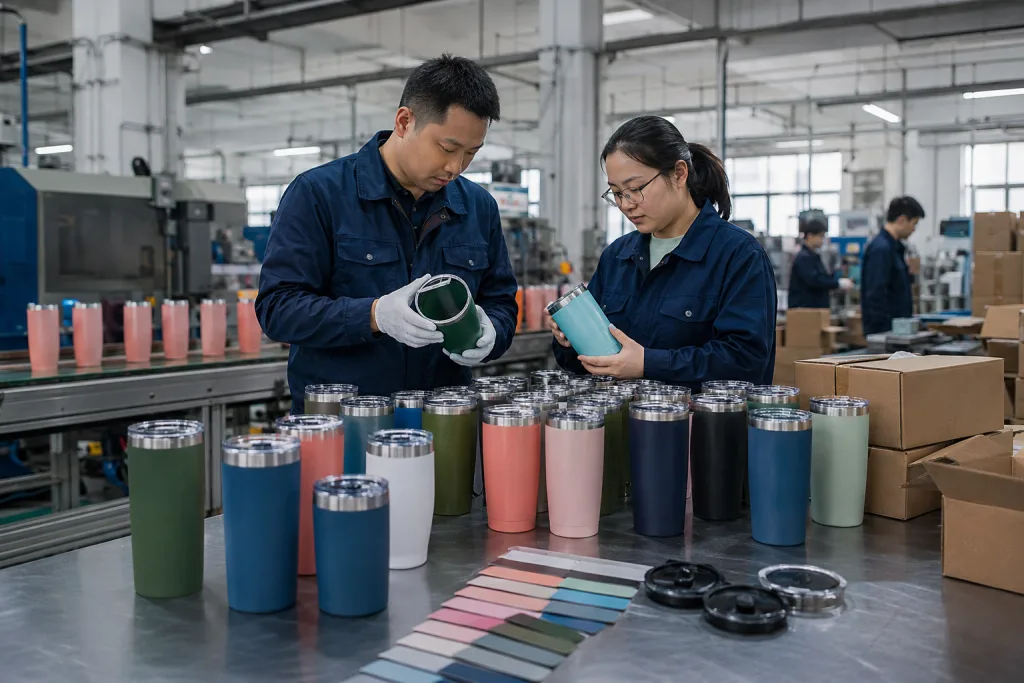
The brief matters more than the first sample. A good coffee mug factory in Zhejiang or elsewhere in China can run stable bulk coffee tumbler orders, but only if you spell out wall construction, 304 or 316 grade, coating thickness, lid seal design, test standards, and carton logic before the line starts. BottleForge runs 500,000 units per month with a 25-day standard lead time for stable SKUs, and the same rule holds anywhere serious: stop failure before production begins.
Where tumbler programs actually fail
The fastest way to burn budget is to treat a coffee tumbler like a plain stainless cup. On the line, the shell is the easy part. The trouble shows up in the lid, gasket, rim coat, and weld. We have seen a sample pass photos, then fail after 48 hours in a 65°C dishwasher test because the vent opened too freely or the seal shrank. In Zhejiang, plenty of factories can ship a clean-looking pilot run. Holding the same tolerance on 3,000 units after the second mold cycle is the real test.
The failure modes are the same ones we check every week with QC calipers and a torque gauge:
- Leakage: lid seal diameter off by 0.3-0.5 mm, or silicone hardness too low.
- Temperature loss: vacuum layer compromised by weld inconsistency or pinholes.
- Coating damage: powder coat thinner than 60-80 microns near the top edge.
- Bad user feel: lid opens too stiff, straw hole misaligned, or drinking spout too sharp.
- Print failure: logo scratches, laser mark looks weak, or condensation makes ink look cloudy.
If you are buying coffee mug promotional products for a show, the buyer may only notice the finish and the logo. For a retail SKU, those same defects come back as returns and chargebacks. This is the wrong question to ask: not "can you make it," but "what will fail first, and how do you catch it?" A real coffee mug manufacturer should give you the defect rate, the inspection point, and the test. If they dodge that, you are talking to a reseller with a catalog, not a factory.
Ask for the defect map before you ask for the quote. On a real run, the cheaper number means nothing if the lid starts leaking on carton three.
Body construction and vacuum risk
The body looks like the easy part to tweak, but on a stable line it is usually the least risky. For a bulk coffee travel mug, we run 304 stainless for both inner and outer shells unless the buyer has a real corrosion case for 316. 304 is the standard workhorse on coffee mug bulk programs. 316 costs more and only earns its keep when the cup faces harsh wash chemicals or a niche spec. Ask for the mill cert, not a sales promise. A coffee mug factory direct quote should show steel grade, body thickness, and the vacuum retention target. We had one PO with a typo on the grade field, and QC pulled the sample before the line started.
Thickness is where buyers try to shave grams and then wonder why cartons come back dented. For standard 12 oz to 20 oz insulated tumblers, a practical spec is 0.35-0.45 mm on the outer wall and 0.5-0.6 mm on the inner wall. That keeps the cup stiff enough for automated polishing and box packing, with a dent rate the warehouse can live with. Go thinner and the rejects climb. Go thicker and you spend more steel while losing the lightweight feel the buyer wanted. The math does not work any other way, and we have seen this go sideways on a 20,000-piece run.
Vacuum integrity is the gate that matters. Ask for heat-retention and cold-retention claims tied to a fixed fill, ambient temperature, and written test method. A decent manufacturer should tell you whether the cup stays at 60°C or above after 6 hours, and the start temperature they used. If the answer is loose, process control is loose too. On one batch, the buyer flagged a 7°C swing between samples, and that was enough to stop loading at the carton stage.
Do not ignore the bottom weld. A lot of weak products fail because the bottom cup and liner are off center, which gives you rocking on flat tables and lid alignment trouble. Ask for a flatness tolerance and a sample from the same cavity that will run your order. This is the wrong question to ask as a broad quality check; you want the number, the cavity, and the gauge used on the line. In one inspection, a 1.2 mm wobble showed up before packing, and the lot never left the floor.
Lids decide the return rate
Most buyers burn time on body color and ignore the lid. That is the wrong order. The lid is where the user feels opening force, sip resistance, and leak control. If it fails, the whole bulk coffee mug order gets labeled cheap, even when the shell is solid. For coffee mug custom made programs, treat the lid as its own part number, with separate drawings, seals, and test limits.
Use a hard spec for the gasket. Silicone around Shore A 50-60 is common for a seal that holds without making the lid stubborn. If the seal is too soft, it creeps and leaks under heat. If it is too hard, it feels brittle and stops recovering after repeated use. Ask the coffee mug supplier to state whether the gasket is removable, overmolded, or press-fit. Removable gaskets are easier to wash, but they can work loose in transit. Overmolded lids look cleaner, and the line sees fewer assembly errors, yet service is tougher.
Set the lid cycle test in writing. A realistic target is 3,000-5,000 open-close cycles for retail and at least 1,000 for lower-cost coffee mug promotional products. Ask for a 1.0 m drop test with hot water inside; people drop full tumblers, not empty samples. If the lid has a slider or push button, require a travel test after thermal cycling. We have seen a 0.2 mm warp show up after 10 swings between 4°C and 60°C.
This is where many coffee mug distributors get caught. They buy a clean-looking body from a coffee mug supplier list, then find the lid is an off-the-shelf compromise with no drawing, no seal spec, and no cycle data. The buyer flagged it on first use. In private label work, the lid drives repeat orders and complaints. A serious coffee mug private label project needs custom lid drawings, not a logo swap.
Decoration that survives use
Logo failure is usually self-inflicted. Buyers approve artwork on a screen and forget a curved stainless wall is rough on ink. For coffee mug customized programs, pick the decoration method for real use, not for looks alone. Silkscreen works for a simple logo on smooth powder coat. Laser engraving gives a clean premium mark, but on a dark finish it can read too quietly. Heat transfer and UV print carry fine detail, yet they depend on prep control and the right topcoat. We run these tests on the line with the same sample, not a showroom proof, because that is where the weak setup shows up. If a supplier cannot explain adhesion, abrasion resistance, and dishwasher exposure, the math does not work.
Ask for real testing, not opinions. A proper coffee mug factory should show tape pull, 50-cycle abrasion, and dishwasher resistance results. On a bulk coffee tumbler for corporate gifting, one scratched logo can sink the whole campaign. We have seen that go sideways after a buyer accepted a pretty sample and skipped the rub test. Keep the decoration zone away from the rim and the bottom weld, where hands and racks hit hardest. For coffee mug custom work, a logo set 20-25 mm below the lip usually holds better than a full wrap that crosses a seam and starts to split at the edge.
Powder coat matters too. A standard 60-80 micron finish suits most matte and textured looks, but the cure has to stay on target. Overcure can make the coating brittle; undercure leaves it soft. QC pulled the sample and found one batch at 72 microns but with uneven gloss, which is the kind of detail that turns into a buyer complaint later. If you are sourcing from a coffee mug factory in China, ask whether the powder is RoHS or REACH compliant and whether the line is dedicated to food-contact drinkware or shared with hardware products. Shared lines are not a deal breaker, but they need stricter cleaning and segregation, and a PO typo on finish code or color code can waste a full run.
Packaging is part of the product
Retail damage often starts in the carton, not on the line. We have seen a bulk travel mug pass QC with a clean finish, then show paint chips after one loose inner tray and an overstuffed master carton. Ask the factory to engineer the pack, not just drop the cup into a white box. For coffee mug in bulk programs, the usual spec is 1 unit per inner box with a molded insert, then 24 or 48 pieces per master carton, depending on size and carrier limits. If the order is retail-bound, call for carton drop testing and vibration testing. The math is simple.
Match the pack to the channel before you sign off. Amazon often needs an FNSKU label, a suffocation warning, and carton dimensions that fit the fulfillment model. Corporate gift orders can use individual polybags, but the outer carton still has to stop rub marks on the printed surface. A buyer once flagged a typo on the PO carton size, and the line packed to the wrong spec for 800 pieces before QC pulled the sample. That kind of miss turns a coffee mug promotional products order into a complaint, even when the cup itself is fine.
Packaging also moves freight cost. A 20 oz tumbler with a double-wall box and molded insert can add 30-60 g per unit. That sounds small until you ship 10,000 pieces. We ship the net weight, gross weight, and carton volume before PO approval because the buyer needs the freight number, not a guess. One carton spec change can shift a load from 12 pallets to 14. This is the wrong question to ask after production starts.
In Zhejiang, factories that export every week usually handle this better than trading desks do. They know packaging is not a cosmetic detail. It is the last QC gate before damage turns into a claim, and the line learns that fast when a carton comes back crushed from a 1.2 m drop test.
QC gates that keep claims down
You do not need heroic inspection. You need the right gates, in the right order, every run. For manufacturers coffee tumbler programs, the line usually starts with incoming material checks, then weld and vacuum checks in process, then final cosmetic and functional inspection. On one 20,000-piece order, we caught a lid gasket typo on the PO before the cartons moved, and that saved a week of rework. If a factory says they only inspect at the end, expect scrap, hidden rework, or both. Good process control costs less than sorting finished goods.
Use AQL, not loose language. For critical functions like leakage, set 0 accepted defects in the sample plan. For major cosmetic defects, AQL 2.5 is standard on a lot of export work. For minor issues like dust specks under the base coat, AQL 4.0 can be fine, depending on the market. Ask for a written inspection standard with photos that show pass and fail. If the factory gives only verbal approval, you are paying for interpretation later. That math does not work.
For compliance, ask for the exact documents your channel needs. In North America, that usually means FDA-related food-contact declarations and California Proposition 65 screening, depending on finish and ink. For Europe, REACH and LFGB are the usual starting point, and your importer may also ask for traceability data. A serious coffee mug manufacturer should keep batch records for steel coils, lids, and decoration lots; on the line, we keep coil lot numbers to 1 roll and lid inserts to 5,000 pcs. If they cannot trace a problem back to a production date, they cannot fix the root cause either.
One more thing: make the factory send production photos and, for larger orders, a pre-shipment video of leak testing and packing flow. This is not theater. We have seen a buyer flag a 12 mm carton crush mark in the video before the shipment left, and that saved a claims fight later. It lets you catch line drift before containers leave China.
Spec your tumbler before the quote
Send the drawings, target tests, and pack plan first. Better briefs get cleaner pricing, fewer surprises, and faster factory confirmation.
Frequently asked questions
What MOQ should I expect for a custom coffee tumbler order?
For a normal coffee mug custom or private label run, MOQ is often 500-1,000 pcs per color and 1,000-3,000 pcs if you need a new lid or special packaging. If you want multiple logo placements, expect the factory to split MOQ by decoration method. At a serious coffee mug factory in Zhejiang or elsewhere in China, a stable SKU can sometimes be repeated with lower re-order thresholds, but first orders need enough volume to cover tooling, print setup, and QC. For very complex lids, the practical MOQ rises fast because the factory has to amortize mold and testing cost.
How do I know if the tumbler will leak in transit?
Do not rely on one hand-held sample. Ask for a 100% leak test on the lid assembly, then a random drop test on finished units with hot water inside at around 70-90°C. A good coffee mug manufacturer should also test after thermal cycling, because a lid that seals at room temperature can fail after heating and cooling. For a bulk coffee travel mug, request the actual gasket material, hardness, and tolerance. If the factory cannot tell you the silicone spec, assume the leak risk is higher than they admit.
What materials should I specify for a retail-ready tumbler?
For most coffee mug bulk programs, 304 stainless steel is the default for both shells. Use 316 only if the channel justifies the extra cost. Keep inner wall thickness around 0.5-0.6 mm and outer wall around 0.35-0.45 mm for standard insulated sizes. Ask for REACH or LFGB-aligned documentation if you sell into Europe, and confirm the powder coating or print inks are food-contact appropriate. A coffee mug supplier should give you a material declaration, not just a sample photo.
How much can branding survive on a powder-coated tumbler?
A good coffee mug customized finish can take everyday use, but the decoration method matters. Silkscreen is fine for simple art, laser engraving is durable but subtle, and UV or heat transfer needs stronger process control. Ask for abrasion results, tape pull, and dishwasher exposure data. If you are buying coffee mug promotional products for gifting, small logo wear may be acceptable. If you are selling retail, set a clearer standard and reject weak adhesion before shipment.
Should I buy factory direct or through a distributor?
If you need a custom program, coffee mug factory direct usually gives you better control over lid tooling, packaging, and QC. A distributor can be useful for small fast-moving orders, but it often adds a layer between you and the actual process owner. For a coffee mug private label project, factory direct is usually the cleaner path because you can define AQL, packaging, and compliance documents with the people running the line. If you are still comparing a coffee mug supplier directory or coffee mug supplier list, use it to find candidates, then move quickly to the factory audit stage.