Key Takeaways
- A 304 stainless bulk coffee travel mug usually needs 0.5-0.7 mm wall thickness and a vacuum leak check under 1.0 kPa loss.
- For a coffee mug custom order, ask for AQL 2.5 for major defects and 4.0 for minor defects, plus a defined drop and thermal test.
- A practical MOQ from a China coffee mug factory direct supplier is often 1,000-3,000 pcs, with 25-35 day lead time after sample approval.
- A lid is the usual failure point: insist on silicone seal compression, cycle testing, and spill testing at 45-degree tilt, not just a photoshoot sample.
Most buyers do not lose money on a manufacturers coffee travel mug order because the design is bad. The loss shows up on the line. A 3,000-piece PO looks fine on paper, then QC pulls a sample and the lid starts weeping after two weeks, the powder coat chips in transit, the logo ghosts after dishwasher use, and the mug is still warm when the buyer expected hot at lunch. That is a production problem, not a marketing problem.
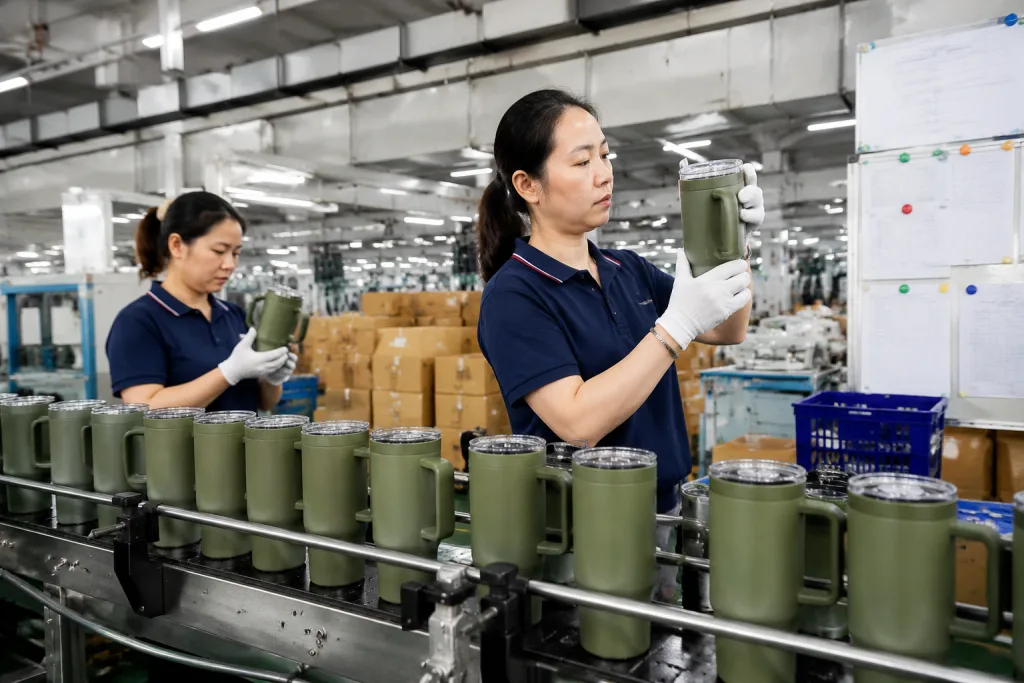
If you are sourcing a bulk coffee mug or bulk coffee tumbler for retail, promo, or corporate gifting, you need to think like a factory and a QA manager at the same time. We run this every week in Zhejiang. A good coffee mug factory will point out where the vacuum seal, print, or coating can fail; a weak one will blame usage and ask for a new sample. The buyer flagged it for a reason. This guide is about locking down the failure modes before you approve the first coffee mug custom made sample, so you cut rejects, claims, and rework later.
Why samples lie
A sample tells you almost nothing about production stability unless you already know the process behind it. That is the first failure mode. We have seen a hand-finished prototype hide mold mismatch, uneven coating thickness, weak welding, and lid tolerance drift that only shows up at 3,000 pieces or 30,000 pieces. In Zhejiang, where export drinkware runs at scale, the sample room is usually tighter than the line. Normal. QC pulled a cup at 24.6 mm once and the bulk run came back at 25.1 mm. Do not approve on appearance alone.
Ask the coffee mug manufacturer for the process map, not just the sample. You want the steel grade, the inner and outer shell thickness, the vacuum method, the lid material, and the print process in writing. For a coffee mug promotional order, I would ask for a pre-production sample made on the same mold, same coating line, same ink, and same carton spec as mass production. If the factory cannot show that, the math does not work. You are buying a one-off prototype, not a stable bulk coffee mug program.
Watch the usual mismatch: the sample is laser-engraved, but the bulk run uses pad print; the sample has a thicker gasket, but production swaps to a cheaper insert; the sample is tested at room temperature, while finished goods ship in summer heat. A serious coffee mug factory direct supplier talks about process capability, not just decoration. We had one buyer flag a PO typo on the lid color code, and the whole lot would have gone wrong if we had not caught it at packing. That is the tone you want.
Lid leaks are the real enemy
If a travel tumbler fails in the field, the lid is usually guilty. Not the cup body. Not the carton. The lid. We have seen 0.3 mm of gasket mismatch turn a clean sample into a return job after the buyer flagged it on day one. Buyers often stare at insulation numbers and miss the seal stack, which is where most claims start. A bulk travel mug can look solid on a shelf and still leak in a backpack because the vent path, thread engagement, and gasket compression are off by a fraction of a millimeter.
Spec the lid like a functional component, because it is one. For a coffee mug customizable project, ask for silicone hardness in Shore A, gasket compression tolerance, thread count or bayonet engagement depth, and a spill test at 45 degrees for at least 30 seconds. We run that check on the line with a torque gauge and a simple water fill, because pretty samples do not pay claims. Ask for a rotational open-close cycle test of 3,000 cycles. A cheap lid may survive a logo mockup and fail after 200 uses. That is the wrong question to ask if you are buying coffee mug in bulk; the math on returns is uglier than the freight bill.
Include a practical test that mirrors real use: hot coffee at 90-95 C, lid closed, tumbler inverted or tilted, then shaken lightly. A factory should report whether any seepage appears at the pour spout, slider, or pressure vent. QC pulled the sample, wiped the rim, and checked the vent hole with a 10x loupe after the tilt test. If you are buying coffee mug private label for retail, that lid test matters more than a glossy render. Your customer will not forgive a leak, even if the finish is beautiful.
Leak claims are expensive because they are invisible at inspection and obvious in use. Spec the seal, not the slogan.
Insulation claims can be inflated
“Double wall vacuum insulated” is not enough. We run this check on every quote: ask the manufacturers coffee travel mug supplier to state the start temperature, room temperature, lid open or closed, and the target temp at 6 hours and 12 hours. If those four points are missing, the number is sales copy, not a spec. A proper test should follow an ASTM-style retention method or the factory’s own written equivalent, repeated lot by lot.
Where it goes wrong is usually simple: a thin inner shell, a weak vacuum, or a base bridge that pulls heat out fast. We have seen a 0.3 mm weld seam change the result after one shift on the line, and we have seen QC pull the sample only to find the vacuum cavity dented during handling. A solid plant in China tracks this with leak testing and thermal sampling by lot; a loose one says “all okay” and ships.
If you are sourcing a bulk coffee tumbler for a national promo, this is the wrong question to ask: “What is the best number?” Ask for the number that survives daily use. A coffee mug factory with discipline can tell you whether the mug stays above 60 C after 6 hours under defined conditions. That beats a 12-hour claim that falls apart after the lid is opened twice. For corporate gifting, steady performance wins. Inflated specs just create buyer pushback later, and we have seen that go sideways on a PO with one typo in the test note.
Decoration fails under use
Decoration fails fast once the mug starts working. Buyers often focus on the logo and ignore the abuse it takes in real use. A print that looks clean on day one can scratch, fade, or lift after dishwashing, rub marks in a tote bag, or contact with acidic drinks. The art file is usually fine. The weak point is the adhesion system, surface prep, or cure profile.
For a coffee mug custom made or coffee mug customized program, match the decoration method to the service life you promised. Screen print works for a short-run coffee mug promotional products order if the buyer accepts a limited lifespan. Laser engraving holds up better on coated stainless steel, but we still check coating color and contrast on the actual line sample, not a render. Full-color transfer can work too, but only if the ink chemistry and cure cycle stay stable. Ask the coffee mug manufacturer for rub testing, dishwasher cycle testing, and a crosshatch adhesion result before you sign off. We have seen this go sideways when the buyer approved from a PDF.
Packaging is part of decoration protection. If the carton insert lets the mug move 5-10 mm in the shipper, the logo can arrive scuffed even though the print itself passed QC. That sounds small until a 5,000-piece order lands and one side of every unit shows the same wear line. For coffee mug promotional products or coffee mug private labeling, the print spec and carton spec need to be written together. Separate them, and the math does not work.
Steel, coatings, and smells
Material trouble usually shows up after the buyer starts getting complaints. Wrong steel grade rusts first at the weld seam, and we see it when polishing leaves compound residue behind or the passivation step is skipped. For food-contact drinkware, 304 stainless is the normal call for most travel mugs, and you still need REACH for the EU plus the relevant FDA food-contact expectations for the US market. If a factory pushes 201 stainless as a premium bulk coffee mug, that is a cost cut. Not an upgrade.
Odor tells you the same story on a different line. We have shipped mugs that came back smelling like plastic, adhesive, or machine oil because the lid resin, gasket compound, or wash cycle was wrong. Buyers often miss this because the sample looked clean on the table. That is the wrong question to ask. Ask for material declarations on silicone, PP, Tritan, or any lid insert, and make the supplier do a rinse plus a hot-water smell check. QC pulled one sample at 80°C and the odor was still there after 10 minutes. For a coffee mug supplier directory search, drop any plant that cannot name the resin grades and food-contact papers without thinking.
Coating is where the sample room can fool people. Matte powder coat looks strong, but if the cure is short by 5 to 8 minutes, the surface stays soft and marks early. Gloss scratches in a different way. Bare stainless shows fingerprints and seam lines. You pick the failure mode you can live with. For a coffee mug wholesale line built for daily use, I would take a satin finish with a tougher scratch profile over a soft-touch skin that looks clean on day one and looks tired after 12 days in transit.
MOQ, lead time, and real factory capacity
Capacity is a failure mode too, just less glamorous. We run into it on the line all the time. A coffee mug factory can quote a low MOQ and still miss your ship date if the line is full or they are juggling export orders. A useful factory metric is monthly output. At BottleForge-level scale, a serious drinkware plant in Zhejiang may run 200,000 to 500,000 units per month across multiple lines, but that number only matters if your SKU fits the tooling and the schedule. A tiny custom lid can hold up the whole order.
For most coffee mug OEM manufacturer programs, the practical MOQ is often 1,000 to 3,000 pcs per color or per logo variant, with 25 to 35 days after sample approval. QC pulled the sample once and found the lid mold needed a 0.3 mm vent fix before mass production. If a supplier promises 7 days on a complex insulated mug, they are probably using stock goods and decorating them fast. That may work for a coffee mug promotional order, but it is not the same as a true coffee mug private label launch. You need to know which one you are buying.
Write down the order breakpoints before you ask for quotes: unit count, decoration method, carton count, color count, and whether you need retail inserts or FNSKU labels for an Amazon channel. The buyer flagged a PO typo on carton count once, and it changed the freight math by 18 kg. A coffee mug distributor who knows the channel will ask those questions immediately. A weak coffee mug distributor will only ask for the logo file and then guess. That is the wrong question to ask. Guessing gets expensive when you are shipping from China to North America or Europe.
How to write a usable spec
A spec that works is short and exact. It names the body, lid, finish, print, packaging, test plan, and acceptance criteria. If you are buying from coffee mug manufacturers in China, put the numbers in the purchase order, not buried in email. State material grade, wall thickness, capacity tolerance, vacuum retention requirement, drop height, leakage test, and AQL. Attach photos of the approved sample with callouts. That is how we keep the argument off the line later.
For a bulk coffee mug or bulk travel tumbler launch, the floor-ready minimum is 304 stainless steel, 0.5-0.7 mm wall thickness, BPA-free lid components, AQL 2.5 major and 4.0 minor, carton drop test from 60 cm, and no leakage during a 45-degree tilt test. QC pulled the sample on one job and found a 0.3 mm wall gap at the seam; that stopped a bad batch before packing. If you need coffee mug promotional products, add Pantone references, print location, and the color delta you will accept. If you need coffee mug private labeling, add barcode placement, retail carton artwork, and the compliance marks for your market. The buyer flagged a PO typo on barcode size once, and the cartons had to be reprinted.
Most disputes start when the buyer assumes the factory already knows the end use. That is the wrong question to ask. A coffee mug factory direct team can run production well and still need exact instructions for retail packaging, gifting sleeves, or distributor case packs. We have seen this go sideways on a 12-day ship plan because the spec said "gift box" and nothing about insert thickness. Make the spec measurable. When the cartons leave Zhejiang, that is what keeps the job clean.
Spec the failures out before you buy
Send your target capacity, logo method, and market. We’ll help you define the right coffee mug custom spec for bulk production in China.
Frequently asked questions
What is a realistic MOQ for a custom travel tumbler order?
For a typical coffee mug custom or travel tumbler program, many factories in China set MOQ at 1,000-3,000 pcs per SKU, depending on body color, lid tooling, and decoration method. A simple stock-body bulk coffee travel mug with one-color print may start at 500 pcs, but once you change the lid or require special coating, the MOQ rises. Ask the coffee mug factory whether the MOQ is per color, per logo, or per carton configuration. That distinction affects your landed cost more than the headline number.
How do I test whether the lid will leak in production?
Use more than a visual check. Ask for a tilt test at 45 degrees for at least 30 seconds, then an inversion test with hot water at 90-95 C. For higher-risk programs, request a cycle test of 3,000 open-close operations and check the silicone gasket compression after cycling. A good coffee mug manufacturer will also report whether seepage appears around the drinking port, slider, or vent. Leak issues are the main reason bulk travel mug orders turn into claims.
What material should I specify for a coffee travel mug?
For most retail and corporate programs, 304 stainless steel is the practical default for the cup body. It gives you a better balance of corrosion resistance and cost than lower grades. For the lid, specify food-contact PP or Tritan where needed, plus silicone seals with defined hardness. If you are targeting Europe or North America, ask for REACH paperwork and food-contact declarations. A coffee mug supplier that cannot state the resin grades clearly is not ready for a private label run.
How do I know if the thermal claim is real?
Ask the factory to define the test condition in writing: starting water temperature, ambient temperature, lid closed or opened, and the target temperature after 6 or 12 hours. Without those conditions, the claim is not useful. A practical bulk coffee tumbler spec should mention the test method and sampling frequency by lot. If you are sourcing from a coffee mug factory in Zhejiang or elsewhere in China, insist on a repeatable internal test record, not just a one-time demo result.
Should I use screen print or laser engraving?
It depends on the use case. Screen print is cheaper for coffee mug promotional products and short-run campaigns, but it can wear faster. Laser engraving is usually more durable on coated stainless steel and works well for coffee mug private label retail. For a premium coffee mug customizable program, confirm the actual production coating before choosing the mark method. The best choice is the one that survives the expected handling, washing, and abrasion, not the one that looks best in a sample photo.