Key Takeaways
- Most coffee mug manufacturers in China start custom travel tumbler MOQs at 3,000 units, with 25-35 day lead times after sample approval.
- A 304 stainless steel body with 0.5-0.7 mm wall thickness is the practical baseline for retail-grade bulk coffee tumbler orders.
- For corporate gifts, a coffee mug custom made program often wins on print flexibility, while coffee mug private label programs win on repeatability.
- Ask for AQL 2.5 inspection, REACH or LFGB paperwork, and carton-drop testing before you approve a coffee mug factory direct order.
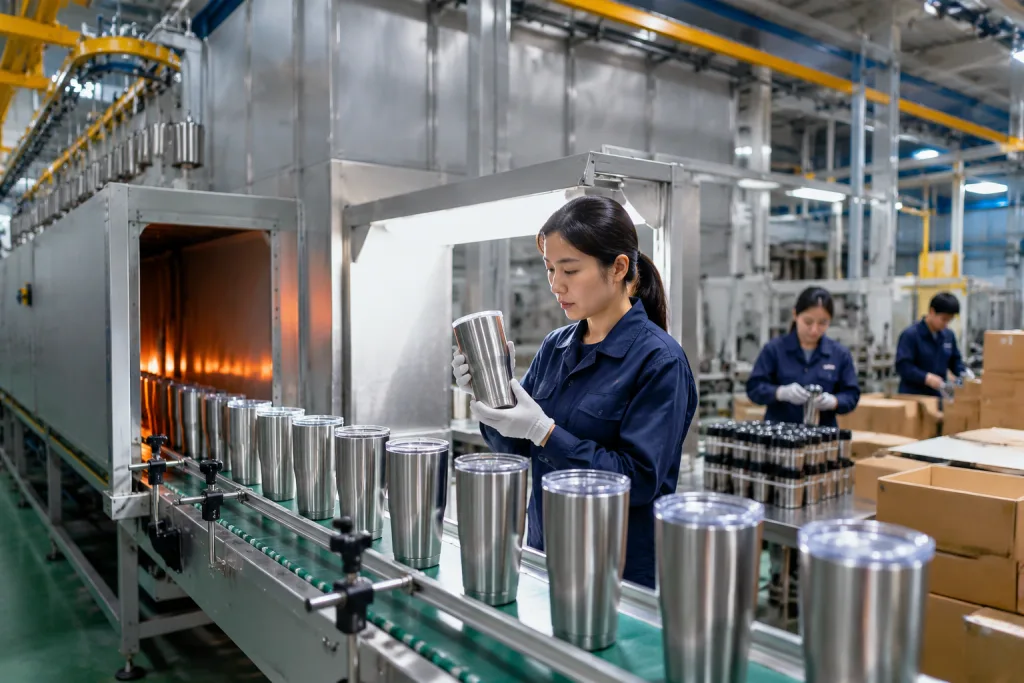
If you are sourcing a manufacturers coffee mug program for coffee brands or corporate gifts, the real decision is not the mug shell. You are checking lid fit, wall thickness, coating wear, print method, carton pack-out, and whether the factory can hold the same spec at 3,000 units or 30,000. We run this on the line every week in Zhejiang, and that gap is what separates a clean reorder from a warranty mess.
For a bulk coffee mug or bulk travel tumbler program, the supplier has to match the use case. A 12 oz desk mug, a 16 oz commuter tumbler, and a 20 oz gift set are not the same SKU. The buyer flags the wrong lid or a loose carton, then QC pulls the sample and the math stops working. Buy on price only, and you usually pay later in leaks, crushed boxes, and decoration that fails in transit.
Spec Table: What Actually Differs
Buyers say “travel mug” and send five different targets. The line sees the split fast. A bulk coffee travel mug for office use does not need the same lid as a commuter tumbler for cold drinks, and a coffee mug promotional item has a different cost ceiling than a retail SKU. Start with a spec table. It keeps the discussion honest.
| Use case | Typical size | Material | Decoration | Best fit |
|---|---|---|---|---|
| Office gift | 12-16 oz | 304 stainless steel, PP lid | Silkscreen or laser | Fast turn, moderate branding |
| Retail coffee brand | 14-20 oz | 304 or 316 stainless steel | Powder coat, laser, wrap print | Repeat orders, higher margin |
| Promo campaign | 16 oz | Single-wall or light double-wall | 1-color print | Lowest landed cost |
| Premium gift box | 12-20 oz | 304 stainless steel, silicone base | Full wrap, engraving, gift box | Brand presentation |
That table is how we compare coffee mug manufacturers. Not “best.” Match the spec to the channel. For Amazon or DTC, lid seal and finish consistency matter more than a fancy insert. We had one buyer flag a 0.3 mm lid gap on a sample, and QC pulled the part before packing. For a corporate program, carton count, barcode labels, and on-time delivery matter more than shaving $0.20 off unit cost. A serious coffee mug factory will quote those points cleanly, with no guessing.
Lid, Wall, and Finish
The lid is where most low-cost tumbler programs fall apart. A decent bulk travel tumbler should pass a 90-degree inversion test for 30 seconds with no seepage. We run that test on the line with dyed water, and QC pulled the sample if the gasket left even a damp ring. Hot drinks need pressure relief too. Too loose, and the buyer flags it. Too tight, and the customer cannot pop it open with one hand, which turns into returns.
For the body, 304 stainless steel is the default. Use 316 only when the application justifies the extra cost. In Zhejiang, a polished outer shell with an inner liner around 0.5 mm to 0.7 mm is the practical range for a retail coffee mug custom order. One PO we saw had “0.05 mm” typed in by mistake. That question got solved fast, because the math does not work. Go thinner and dent resistance drops. Go much thicker and unit cost and weight climb fast, which matters in a bulk coffee mug shipment crossing the Pacific.
Finish choice changes both the shelf look and the reject rate. Powder coat holds up better, but it adds a process step and one more chance for dust marks at the spray booth. Gloss paint photographs well, but it scuffs sooner in transit. Laser engraving stays clean for a coffee mug custom made order because it does not depend on ink adhesion. For a coffee mug customizable surface across repeat campaigns, keep the decoration simple and repeatable. That is how you protect margin when reorders come in at 10,000 units instead of 1,000.
Price Bands by Buyer Type
Factory pricing only works when you tie it to the buyer type. A coffee mug distributor taking mixed stock needs a different ladder than a coffee brand placing a private-label run. For a standard 16 oz double-wall tumbler from a China factory, FOB usually lands at $2.20 to $4.80, with lid style, coating, and decoration moving the number. Gift box packaging adds $0.25 to $0.80. A custom mold or special lid pushes it up fast.
Buyers often chase the lowest quote and miss the landed cost. That is the wrong question to ask. A coffee mug supplier can shave $0.12 by cutting carton inserts, thinning foam, or skipping drop-test standards, then you eat damage on the container. We have seen that go sideways on a 40HQ. If you need coffee mug bulk pricing for retail, ask for body, lid, print, carton, inner box, and master carton on the same sheet. A proper coffee mug supplier list should let you compare those lines without guesswork.
For coffee mug in bulk programs above 5,000 units, the real gain comes from tooling reuse and stable artwork. QC pulled the sample and the 1.5 mm lid fit held. For a coffee mug promotional products order under 3,000 units, you will pay more per unit, but setup is faster and approval loops are shorter. The factory that knows the work will tell you where the cost sits and which line can be trimmed without creating reject risk.
Factory Direct or Distributor
There is nothing wrong with a distributor if you need speed, mixed SKUs, or local warehousing. We have shipped rush orders that way. But if you want control over artwork, lid options, and compliance papers, coffee mug factory direct is usually the better route. A Zhejiang factory can move from sample to production faster when you are not sending every lid gap question through a middle layer. On our line, a 2 mm logo shift gets flagged before we print the full run.
A coffee mug factory direct order also gives you cleaner visibility on MOQ. We run 3,000 units for one logo and one color on a basic private-label cup, while a distributor may split stock across several programs and blur the real unit cost. If you need coffee mug manufacturers that can support ongoing private label, ask for monthly output in black and white. A practical export factory in Zhejiang should handle 200,000 to 500,000 units per month across bottle and tumbler lines, with a 25 to 35 day lead time after sample sign-off for common specs. The math does not work if they dodge that question.
If you are buying for a brand, you are not really buying a mug. You are buying repeatability across carton, decoration, and delivery date.
That is why coffee mug oem manufacturer capability matters. The better supplier will document mold ownership, artwork tolerances, and reorder conditions. We had one buyer flag a PO typo on the carton mark, and QC pulled the sample back before the packing table started. If a supplier cannot explain those points in plain terms, they are not ready for a serious private-label program.
Private Label Versus Promo
A coffee mug private label program is built for repeat sales. A coffee mug promotional order is built for a date on the calendar. Same tumbler, different math. On the line, we keep private label on a tighter leash: finish delta within 0.3 mm, barcode-ready cartons, and a reorder file that does not break when the buyer comes back six months later. Promo work is simpler. Unit cost first, ship date second, decoration that still looks clean after cartons get dragged through three warehouses.
If you are a coffee brand, the cleaner move is usually a coffee mug private labeling setup with one core tumbler and two decoration paths: laser for premium retail and one-color print for volume promotions. That gives you a SKU story that sales can actually manage. We have seen this go sideways when the buyer keeps adding lid options and finish swaps after sample sign-off. A coffee mug customized program stays under control if you lock body color, lid color, and logo placement before QC pulls the first sample.
For corporate gifts, presentation matters more than in a standard wholesale sale, but the numbers still have to work. Ask the factory to quote insert cards, molded pulp trays, or a two-piece gift box as separate lines. Then you can see where the money goes. Last month we caught a PO typo on a gift order that doubled the box count, and the buyer flagged it before print. A good coffee mug manufacturer will give you both figures without making it a sales game.
Compliance, Testing, and Reorders
Any import order worth taking should come with a paper trail. For Europe, ask for REACH and food-contact declarations. For North America, get the FDA food-contact confirmation in writing. If coatings or inks are involved, ask which materials were tested and which layer was left out. We have seen buyers accept a certificate cover page and then get stuck when the lab scope was for the wrong finish. A factory in China that ships every week should know this drill.
Set the acceptance standard before the line starts. AQL 2.5 is common for general defects, but retail orders often need a tighter call. Ask for leakage testing, coating adhesion checks, and carton drop tests from 76 cm to 100 cm based on the route. On one 10,000-piece run, QC pulled the sample at 3 a.m. and found a lid warp at 0.8 mm; the buyer flagged it, and that saved a week. If your item is a coffee mug bulk promotion, you can live with looser cosmetic tolerance. If it is a premium retail SKU, that math does not work.
Reorders are where the account gets efficient or turns messy. Keep the approved sample, the artwork file, the lid spec, and the carton spec in one record. That is what lets a coffee mug supplier in Zhejiang repeat your order without asking you to re-approve every screw-up from the first run. We once caught a PO typo that changed a lid from 86 mm to 96 mm, and the line would have built 20,000 wrong units. The best coffee mug manufacturer runs on a clean production file, not guesswork.
Use-Case Fit by Buyer
If you are a coffee brand, the cleanest fit is usually a 16 oz or 20 oz bulk coffee tumbler with a powder-coated shell, 304 stainless steel body, and laser logo. We run that spec a lot in the line because it leaves room for retail margin and still survives repeat replenishment. A 20 oz sample with a 0.5 mm wall and a tight lid fit usually sells the case, while a buyer who pushes for a cheaper gloss finish is asking the wrong question.
For a corporate-gift buyer, a 12 oz or 16 oz travel mug with a gift box and one-color logo usually lands better. It feels finished without blowing up the budget. QC pulled the sample on one run because the box insert was 2 mm too loose, and that kind of miss shows up fast when the buyer is opening 500 units on a conference table. Keep the spec tight.
For distributors, the smart stock move is a narrow color set and one lid family. Too many SKUs kill turns; the math does not work. A useful coffee mug supplier directory should point you to factories that hold one body shape across laser, silk print, and UV print, not a pile of random models from different coffee mug distributors. We have seen this go sideways when a PO typo changed the lid code and the warehouse got stuck with 3,000 mixed cartons.
For brand owners in Europe and North America, the real question is simple: commodity item or repeatable branded platform? If you need the second, pick a factory with export discipline, clear QC reports, and the ability to handle coffee mug custom made work without letting cost drift. Zhejiang has plenty of factories that can do it well. China also has plenty that quote fast and miss later. Check the AQL 2.5 report, ask for the same mold number on the second sample, and do not sign the PO until the lid test passes.
Send your tumbler spec for a direct quote
Share size, lid, logo method, and target quantity. We can quote a bulk travel tumbler program with clear MOQ, lead time, and packaging options.
Frequently asked questions
What MOQ should I expect from manufacturers coffee mug suppliers?
For a custom travel tumbler, the common MOQ is 3,000 units per color and logo, though some Zhejiang factories will start lower at 1,000 to 2,000 for simple decoration. Once you want a new mold, special lid, or gift box set, expect the MOQ to rise to 5,000 units. If the supplier says they can do 300 pieces on a fully custom spec, check whether they are reselling stock instead of making it direct. A real coffee mug factory direct program usually needs enough volume to justify setup and QC.
How much does a bulk coffee travel mug cost FOB China?
A basic 16 oz double-wall stainless tumbler usually lands around $2.20 to $4.80 FOB China depending on steel grade, coating, lid, and print method. Laser engraving is often cheaper than a full-color wrap at scale, while gift box packaging can add $0.25 to $0.80 per unit. If you want a coffee mug private label program with a premium lid and better carton protection, budget closer to the upper end. Always ask for a line-by-line quote so you can compare the real landed cost, not just the headline unit price.
What documents should I ask a coffee mug manufacturer for?
Ask for food-contact compliance documents, REACH or LFGB where relevant, a recent factory audit if available, and the QC plan tied to AQL levels. For North American buyers, confirm the materials used in the lid, gasket, coating, and ink. If the supplier is serious, they should also provide carton dimensions, gross weight, HS code guidance, and sample photos from the current production line. A proper coffee mug supplier will not treat documentation as optional.
Is a coffee mug custom made order better than stock with logo?
It depends on your channel. For a one-off promotion, stock with logo is faster and cheaper. For retail, subscription, or corporate gift programs, a coffee mug custom made order is often better because you can control shape, lid style, packaging, and repeatability. The cost difference is usually worth it once you pass 3,000 units. If you need a coffee mug customizable platform for ongoing campaigns, custom manufacturing gives you more room to protect margin and brand consistency.
How do I choose between coffee mug distributors and a coffee mug factory?
Use a distributor when you need speed, mixed inventory, or local stocking. Use a factory when you need cost control, private label, and direct input on tooling and packaging. If your order is larger than 3,000 units or requires a repeatable SKU, factory direct is usually the better choice. A factory in Zhejiang or elsewhere in China can usually give you clearer lead times, better mold control, and more stable reorder pricing than a middle-layer supplier.