Key Takeaways
- Most children water bottle projects land between 3,000 and 10,000 pcs MOQ, with custom tooling adding 30-45 days.
- Tritan, PP, and 304 stainless steel solve different use cases; choose by drop resistance, weight, and odor control.
- For school programs, leakage performance and REACH/FDA paperwork matter more than a flashy custom logo kids bottle finish.
- A reliable children water bottle manufacturer should quote AQL 2.5 inspection, 15-25 day mass production, and export-ready packaging options.
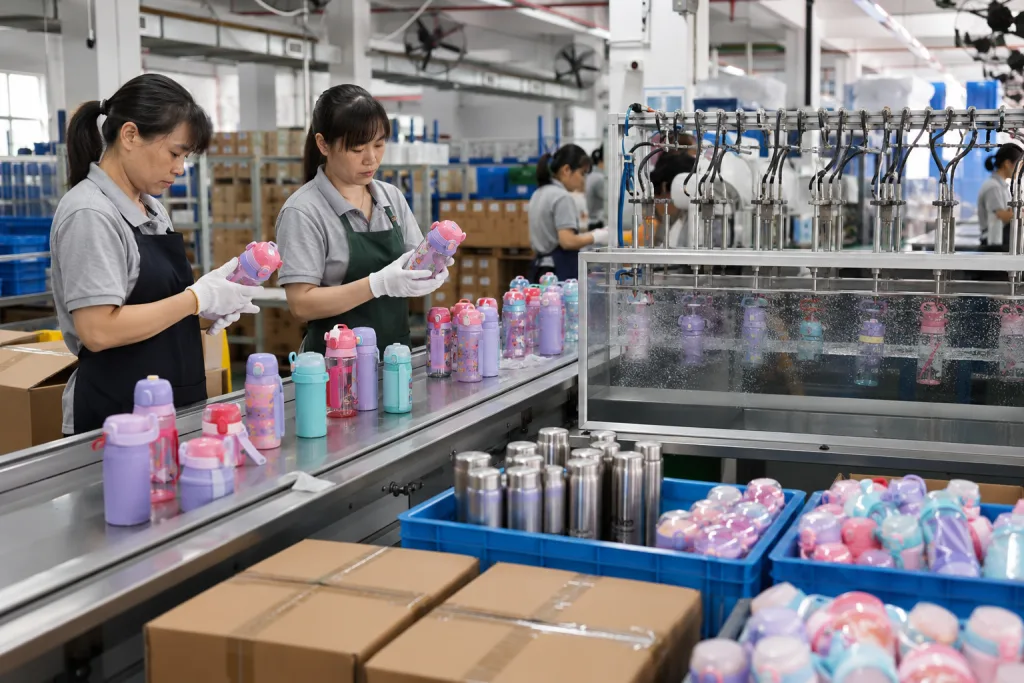
If you are sourcing for schools, distributors, or a kids brand, the first mistake is treating a children water bottle like a simple promo item. It is not. The bottle has to survive drop tests, clear safety checks, fit small hands, and still land at the right cost. On our line, the first pass is usually material, lid design, decoration method, and compliance.
That is where buyers in Europe and North America get tripped up. A sample can look clean on the bench and still fail on odor, leakage, dishwasher durability, or REACH paperwork once the order turns into 5,000 or 20,000 pieces. We saw a buyer flag a bottle because the PO said 350 ml and the sample pack said 360 ml. That small typo cost a week. If you buy from a children water bottle factory in Zhejiang or elsewhere in China, you need a clear check list, not guesswork. A lower MOQ often means fewer lid choices, while a fully custom children water bottle with a molded shape usually needs 30 to 45 days of tooling before mass production starts.
Start with the use case
Before you compare children water bottle manufacturers, lock the use case first. A school district buyer does not need the same spec as a retail importer selling a children water bottle customizable line on Amazon or through retail stores. School use means daily refilling, dropped bottles, and a lunchbox that gets tossed around. Retail use means the box, colorway, and shelf appeal carry more weight.
That choice changes the product. A bulk school water bottle should focus on leak resistance, easy cleaning, and a lid that survives 20,000 open-close cycles. A children water bottle promotional program can live with simpler construction if the goal is logo space and a low landed cost. A premium custom kids water bottle can justify a higher unit price if it uses Tritan, a secure lock lid, and a shape that fits car cup holders or a 90 mm backpack pocket. We run into this all the time in Zhejiang: the factory wants to sell what the line already makes, but that is the wrong question to ask.
Ask these questions before you request quotes: Will the bottle be washed every day? Will it sit next to books and lunch containers in a backpack? Is the target age 3 to 6, 7 to 10, or older? One buyer once sent a PO with the age range missing, and QC pulled the sample because the lid torque was set for older kids. The answers decide capacity, lid force, mouth size, and whether you should buy a children water bottle wholesale program or a more tailored custom children water bottle build.
Choose the base material first
Material choice is where buyers either save cash or build a pile of returns. For kids bottles, the common picks are Tritan copolyester, polypropylene, and stainless steel. They do not fail the same way. Tritan is clear, tough, and light enough for small hands. Polypropylene costs less and suits opaque bodies and simple molds. Stainless steel fits cases where thermal retention matters, but it adds weight and pushes up the quote.
For a bulk kids bottle program, the math comes first. A basic PP bottle often lands around USD 1.20 to 2.20 FOB, depending on capacity and lid parts. Tritan usually sits higher, often USD 2.50 to 4.80 FOB for a children water bottle custom spec with a decent cap. Double-wall stainless steel can go past USD 5.00 FOB fast, especially once powder coating, a silicone base, or a more complex spout is on the drawing. We run these numbers against MOQ and lid tooling every week. If the buyer wants a custom made kids bottle for a school fundraiser, PP is enough. If the goal is retail shelf appeal, Tritan is the safer commercial call.
Be direct on safety claims. For the EU, confirm REACH compliance and ask for full material declarations. For North America, ask for FDA food contact documentation. Do not trust the sales sheet by itself. QC pulled a sample once and the PO typo said "FDA" on a lid that had never been tested; the buyer flagged it before shipment. A real children water bottle supplier should show the test basis, not a brochure with too many logos.
Lid design decides returns
The lid decides returns. Leaks turn into claims fast, and a 20-cent lid problem can burn a whole order. On the line, we see this first in the cap torque check, not in the marketing photo. For kids, the best lid is usually the one that seals under rough handling without making the child fight it.
Straw lids work for younger kids, but they add cleaning risk and assembly mistakes show up quickly. Flip tops are fine for school bags, yet the hinge and lock need cycle testing, and we ask for the fixture report before we approve a run. A screw cap with a wide mouth is cheaper and tougher to make, but if the opening torque goes above 0.8 N·m, some children cannot close it properly. That is the wrong question to ask if the lid looks nice. When you evaluate a custom kids bottle or custom school water bottle, ask how many open-close cycles the lid passed. Good factories should show 5,000 cycles or more for a latch or button, plus the failure point.
For school accounts, we run best with one-hand opening, a silicone seal, and a spare gasket plan in the carton. For retail, a custom logo kids bottle can take a shaped cap if the seal stays stable across the shipment, not just on one golden sample. QC pulled the sample, the buyer flagged a loose gasket, and the fix was simple: tighter insert control and a second leak check at 40 kPa. This is where a children water bottle factory in China proves its value. Repeatability pays.
Compliance is not optional paperwork
Buyers who source from China sometimes treat compliance as a box-ticking exercise. That is expensive thinking. A children water bottle manufacturer should support the market rules you actually need: REACH for Europe, FDA food contact for the US, and, when the channel requires it, LFGB or CPSIA-related documents tied to the exact SKU. On the line, we have seen a printed logo pass while the colored straw failed on the same order. That is why the test scope has to cover printing, coating, straw, cap, and any soft-touch part.
For a children water bottle bulk order, ask for the full test scope, not a summary page. You want traceability on resin batches, pigment declarations, and sample retention. If you are a children water bottle distributor or children water bottle vendors serving three or more retailers, you need the same result on every reorder. One pallet should not be the clean pallet while the next one drifts on odor, wall thickness, or a 1.5 mm cap gap. A serious children water bottle supplier should also handle carton markings, country of origin, and retail barcode needs, especially if you run children water bottle wholesale programs across several markets.
Good compliance documents do not sell the bottle, but bad documents can stop a shipment at port or fail an account audit.
Do not wait until approval to ask for documents. Put them in the RFQ and make them part of the quote comparison. We have seen a buyer flag a PO typo on the model code, then the factory had to reissue the test file to match the paper trail.
MOQ and lead time shape the deal
The deal lives or dies on the numbers. A standard children water bottle manufacturer may quote 3,000 pcs MOQ for a stock mold with custom print. A true custom children water bottle program with a new mold usually starts at 5,000 to 10,000 pcs, depending on plant capacity and lid structure. We run this every week. If a supplier says full customization at 500 pcs with no tooling fee, the math does not work; you are probably looking at a modified stock item, not a real build.
For China sourcing, the clock usually splits into three blocks: 7 to 15 days for sampling and sign-off, 30 to 45 days for tooling if a new mold is on the table, and 15 to 25 days for production after the order is released. On our line in Zhejiang, a multi-line kids bottle plant can push 200,000 to 500,000 units a month, but your slot still depends on artwork, packaging, and payment terms landing on time. QC pulled the sample here before. A children water bottle distributor should care because a 10-day slip can kill a school-season launch or push a retail drop past the buyer’s window.
When you compare offers, ask if the quote is FOB Ningbo or FOB Shanghai, how many pcs go into each carton, and whether mixed SKUs can ride in one container. That is the wrong question to leave vague. A packing change from 24 pcs per carton to 48 pcs can move landed cost by 8% to 12% on a children water bottle wholesale program, and we have seen a PO typo on carton count create a very expensive rework at loading.
Print and branding choices change cost
Branding is not decoration. It changes durability, lead time, and unit cost. We run screen printing for simple logos on flat or slightly curved bodies. Laser engraving fits stainless steel and gives a permanent mark, but it does nothing for Tritan or PP. Heat transfer and wrap printing handle characters, gradients, and color blocks on a children water bottle customized for retail. Each method fails in a different way, and the buyer should ask about that before talking art files.
If you need a custom logo kids bottle for a school district, one-color print is usually the right call. Setup stays lower, and the ink holds up better after 30 or 50 wash cycles. For a children water bottle customizable program in retail, 2 to 4 colors can make sense if the margin covers the extra screen work. We have seen the math break when the buyer asked for five colors on a 3,000-piece order and still wanted school pricing. Ask the children water bottle vendors how they tested it: dishwasher resistance, scratch resistance, and adhesion after drop testing. A print that flakes on the first round of QC is dead on arrival.
One factory-floor detail matters here: if you want a detailed print on a translucent body, request a pre-production sample with the actual ink and the final mold, not a mockup. The color shift is real. A PMS 186 on screen can land three shades off once the line runs, and we have had buyers flag it only after the first 200 pieces were packed.
How to compare suppliers without wasting weeks
Most RFQs fail because buyers ask vague questions. We see it on the line all the time. If you need a children water bottle manufacturer, spell out the program: 350 ml or 500 ml, Tritan or 304 stainless, straw lid or flip lid, one-color logo or 4-color print, carton pack of 24 or 48, target market, and the compliance papers you need. That is the gap between random pricing and a quote you can actually use. A clean quote should let you compare children water bottle manufacturers on the same spec, not just chase the lowest number.
Use a scorecard. Keep it blunt. Rate each children water bottle factory on mold capability, MOQ flexibility, sample lead time, test reports, and response quality. Ask for an AQL 2.5 inspection plan. For repeat orders, ask whether they keep artwork, Pantone chips, and gasket specs on file. We have seen this go sideways when a lid torque spec changed by 0.3 N·m on the second order. A children water bottle vendor that cannot repeat the same result six months later is not one you can scale with. In Zhejiang, the better suppliers answer fast and put the details in writing; the weak ones talk big and leave gaps.
If your channel is school district purchasing, ask for proof of past institutional supply and carton labeling that passed a real receiving check. If your channel is cross-border retail, check barcode readiness, inner pack count, and drop test records. One PO typo on the master carton code can stall a shipment for days. The buyer who asks the right questions gets the right factory response.
Send your kids bottle spec for a fast quote
Share capacity, material, lid, artwork, and target market. We can map the right MOQ, compliance set, and lead time before you commit.
Frequently asked questions
What MOQ should I expect for a custom children water bottle order?
For a stock mold with custom logo, expect 3,000 to 5,000 pcs MOQ. If you need a new mold, many children water bottle manufacturers will start around 5,000 to 10,000 pcs. Some children water bottle factories in Zhejiang can do smaller trial runs, but the unit price rises fast. A true custom kids water bottle with unique shape, lid, or straw system usually needs tooling and a longer approval cycle. Ask whether the MOQ is per color, per SKU, or per artwork version before you compare quotes.
Which material is best for bulk kids water bottle programs?
There is no single best material. Tritan works well when you want clarity, impact resistance, and lighter weight. PP is cheaper and suitable for a bulk kids bottle or bulk school water bottle where cost matters more than transparency. Stainless steel is better if insulation matters, but it adds weight and cost. For school use, PP or Tritan usually gives the best balance. For retail, Tritan often wins because it looks cleaner on shelf and supports a higher retail price.
How do I check if a children water bottle supplier is compliant?
Ask for full test reports, not a one-page summary. For Europe, you should see REACH-related documentation and material declarations. For North America, request FDA food contact support and confirm whether any state-level requirements apply to your channel. A serious children water bottle supplier will also provide resin traceability, ink or coating declarations, and sample retention records. If they only send a catalog and a price list, treat that as a warning sign.
How long does production usually take in China?
For a standard custom children water bottle order, sampling can take 7 to 15 days. If tooling is needed, add 30 to 45 days before production starts. Mass production is often 15 to 25 days depending on order size and season. A children water bottle factory in Zhejiang may produce 200,000 to 500,000 units per month across several lines, but your order still depends on artwork approval, packaging confirmation, and deposit timing. Late artwork is one of the most common causes of delay.
What should I ask for in a custom logo kids bottle quote?
Ask for capacity, material, wall thickness, lid type, print method, carton pack, MOQ, FOB port, sample cost, lead time, and compliance documents. If the supplier offers a children water bottle customizable option, ask whether the logo can be screen printed, laser engraved, or wrapped. Also confirm whether the bottle is dishwasher-safe, whether spare seals are available, and whether the quote includes retail packaging or only bulk packing. The more precise your RFQ, the easier it is to compare children water bottle wholesale offers without guessing.