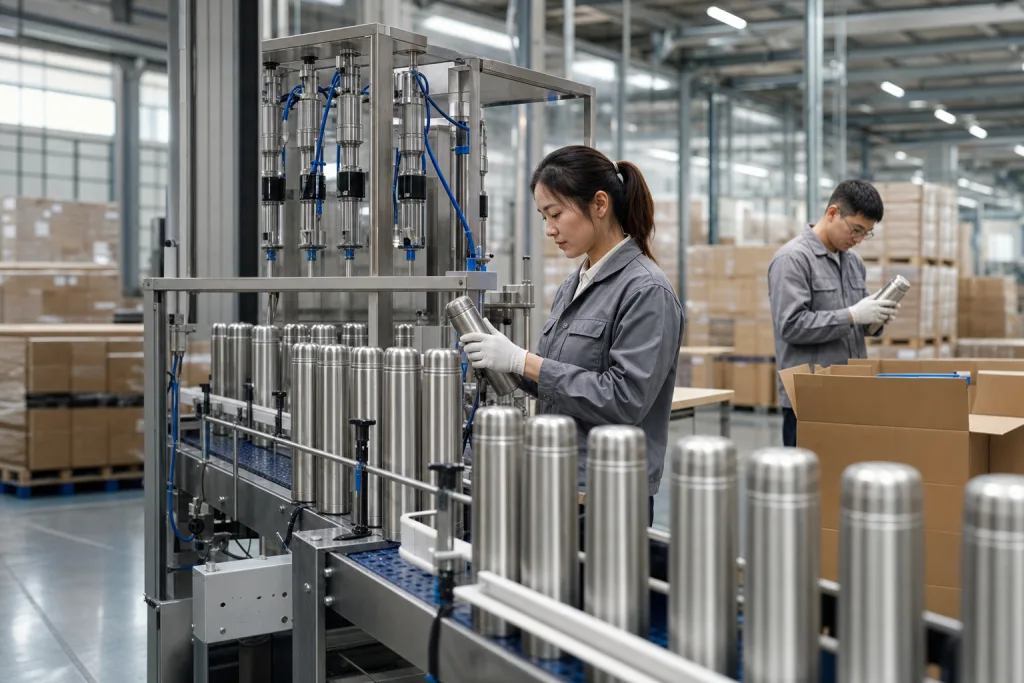
Key Takeaways
- Typical FOB factory pricing for a 500 ml stainless canteen starts around USD 1.85–3.20 at 3,000–5,000 units, before freight and duties.
- MOQ often falls into 300, 1,000, and 3,000 unit tiers, with setup costs dropping 18–35% as volume rises.
- Standard lead time is 20–35 days after sample approval; printed or laser-engraved projects with packaging work usually need 30–45 days.
- A Zhejiang canteen factory with 200,000 units/month capacity can usually handle mixed custom drinkware programs faster than small traders.
- REACH, LFGB, ASTM, and drop-testing should be confirmed before production, not after shipment booking.
If you are sourcing a manufacturers canteen program, the usual mistake is simple: buyers ask for unit price first, then find the real bill in tooling, decoration, packaging, and the 12-day slip caused by fixing specs after sample approval. For a B2B buyer, a canteen is not just a bottle. It is a supply chain call, especially when you need a custom canteen, customizable canteen, or a custom drinkware line that must clear a retail margin or a distributor target.
At BottleForge in Zhejiang, China, we see this every week from brand owners and canteen distributors in Europe and North America. A clean spec sheet saves 3 rounds of email and one sample remake; a vague one burns weeks. QC pulled a carton test last month, and the buyer flagged a 2 mm artwork shift that would have been expensive later. If you want a realistic buying process, start with cost drivers, then match them to MOQ tiers and production windows. That is the right order, not price first. It keeps you from paying USD 0.30 more per unit because the finish was wrong or the carton test got missed.
What actually drives canteen cost
Buyers often ask a canteen manufacturer for “your best price for 750 ml.” Wrong question. Capacity is only one line on the costing sheet. Material, wall thickness, coating, closure system, and decoration method all move the quote. A plain 18/8 stainless steel canteen with a 0.4 mm body may sit near USD 1.85–2.20 FOB China at 5,000 units. Change that to 0.5 mm steel, add powder coating, a silicone base, and a two-piece cap, and the line can add USD 0.35–0.80 per unit fast. Last month QC pulled the sample with a digital caliper: body wall was 0.38 mm, while the buyer’s PO said 0.4 mm.
Here is the practical breakdown buyers should ask for:
- Material grade: 304 stainless steel is standard; 316 raises cost by 12–20%, and we usually see buyers pick it only for saltwater, outdoor, or medical-channel orders.
- Thickness: 0.4 mm is common for value lines; 0.5 mm or 0.6 mm improves rigidity, raises gram weight, and changes how the body behaves during stretch forming.
- Finish: raw steel has the lowest loss; painted, powder-coated, or UV-printed surfaces need curing checks, tape tests, and more scrap allowance when the line has dust.
- Cap system: PP screw caps are cheaper than stainless lid assemblies; leakproof gaskets add small but real cost, especially when the buyer asks for 100% air-pressure testing.
- Packaging: color box, insert, barcode label, and master carton spec can add USD 0.10–0.45; a 5-ply export carton also changes pallet height and CBM.
A serious canteen supplier in China should quote by spec, not by generic size. We run into trouble when one offer uses 0.4 mm steel, another uses 0.5 mm, and both say “same 1L canteen.” The math does not work. If you are comparing canteen suppliers, ask for the same steel gauge, the same test standard, and the same carton count, such as 24 pcs per master carton instead of 48 pcs. Otherwise you are not comparing price; you are comparing shortcuts. We have seen this go sideways after a buyer flagged a leaking cap only after 3,000 pcs were packed.
MOQ tiers that make sense
MOQ is where buyers burn 3–5 working days going back and forth on quotes. A canteen factory usually prices in three workable breaks: 300 units, 1,000 units, and 3,000 units. At 300 units, you are covering engineering time, jig setup, color matching, and small-run loss on the line. At 1,000 units, the unit cost starts to look sane. At 3,000 units and above, printing screens, packaging setup, and carton labels spread out properly. We run these checks on a 500 ml body with a 0.5 mm wall, and QC pulled the sample last month because the logo sat 2 mm too close to the weld line. That is why a canteen customized order can look painful at first, then drop by 15–25% after one volume break.
For a typical 500 ml custom canteen:
- 300–500 units: good for sampling or a distributor canteen test; expect higher per-unit cost, fewer decoration choices, and a setup fee that does not disappear just because the PO is small.
- 1,000 units: the practical MOQ for most canteen custom projects; screen printing, laser marking, and standard white boxes start to make sense at this point.
- 3,000 units: better for canteen promotional campaigns or retail launches; pricing is usually strongest here because we can run longer batches with fewer changeovers.
Mixed SKUs are the trap. If you ask for four colors, two lid styles, and three logos in one order, the real MOQ is not 1,000 units. The math doesn't work. It becomes 1,000 per variant, or the supplier hides the pain in a surcharge that looks harmless until it hits your landed cost. We saw one PO list “matte balck” for one colorway, and the buyer flagged it only after the pre-production sample was packed. For distributor drinkware programs, keep one body, one cap, one carton, and one artwork file unless you have sell-through data strong enough to justify the split.
Lead time by process type
Lead time is not just production days. It includes sample approval, material booking, decoration, carton printing, and QC hold time. For a standard custom drinkware order from Zhejiang, China, we start counting after the buyer signs the pre-production sample. On a simple canteen, we usually need 5–7 days for sample confirmation, 20–35 days for bulk production, then 3–10 days for packing and export handling. QC pulled one sample last month because the silicone ring sat 0.6 mm proud of the lid groove. Small issue. It still cost 2 days.
Typical timelines look like this:
- Plain stock-style custom canteen: 15–25 days after deposit if 304 stainless sheet, caps, and color boxes are already in our warehouse.
- Printed or laser-engraved canteen customized order: 25–35 days after sample approval, including logo film setup or fiber-laser fixture checking on the line.
- Complex customized growler or double-wall project: 35–45 days, especially when we run powder coating, custom packaging, and a new vacuum test jig.
A canteen distributor planning a launch should back-schedule from the ship date, not the order date. This is the wrong question to ask: “Can you finish production in 18 days?” Ask whether the approved sample, carton artwork, barcode file, and deposit all landed on the same day. If you need delivery for a trade show in Europe, leave at least 60 days from first inquiry to warehouse receipt. In busy periods, a Zhejiang canteen manufacturer with 200,000 units per month may still put repeat tooling ahead of brand-new artwork changes. We’ve seen this go sideways when a PO had one digit wrong in the Pantone code and the buyer flagged it after mass printing. That is normal. What is not normal is promising 18 days on a project that clearly needs new tooling and third-party testing.
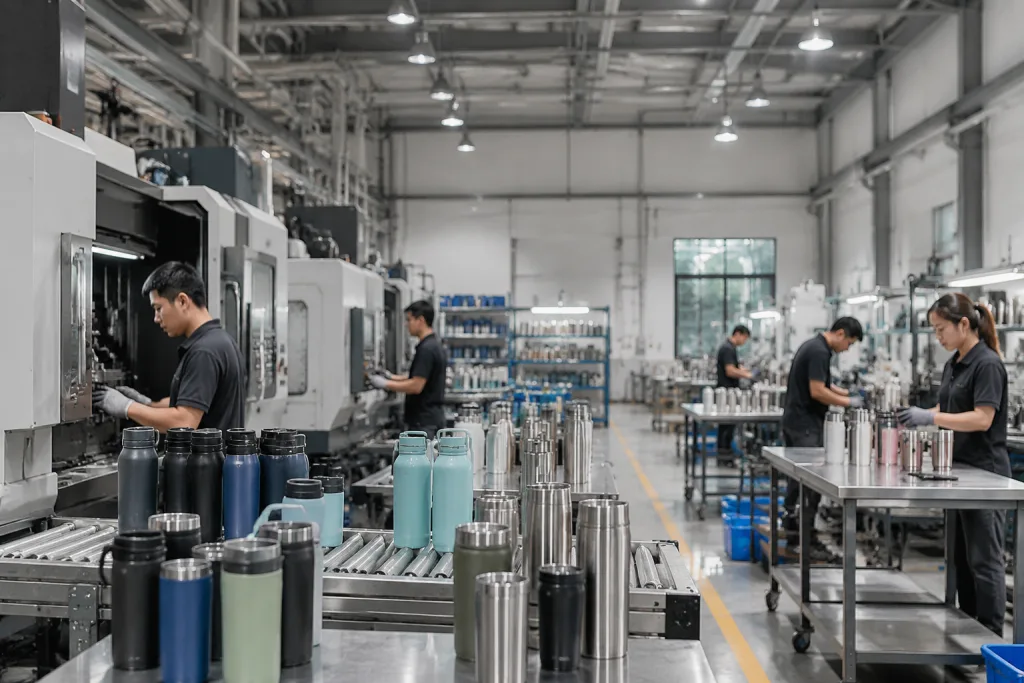
Decoration choices change margin
Decoration is where buyers lose margin fast. We see it on canteen orders every month: a 10,000 pcs run with one-color pad printing at USD 0.08 looks safe, then the retail team asks for a heavier finish and the decoration jumps to USD 0.55. The cup did not change. The process changed. On our Hangzhou line, QC pulled a sample last week with a 1.5 mm logo shift on a curved body, and the buyer flagged it before shipment.
Pick the method by sales channel, not by catalog photo:
- Silkscreen printing: low cost for bold logos on smooth surfaces; we usually keep the print area within a flat 60 mm zone to avoid edge distortion.
- Laser engraving: durable and clean on stainless steel custom drinkware; it works best when the logo has thick lines, not tiny 0.2 mm strokes.
- Full-wrap UV print: stronger shelf impact, but the setup cost is higher and curved bodies bring more rework; we have seen 3% scrap when artwork crosses the seam.
- Powder coat with logo reveal: premium hand feel, but the curing oven must stay stable and the surface prep has to be tighter; poor degreasing shows up as pinholes.
If you are comparing canteen vendors, ask whether the logo is done before or after final coating. Ask for the exact logo area in mm, the Pantone reference, and the allowed shift, such as ±1 mm instead of “normal tolerance.” Good canteen suppliers send artwork limits before sampling because decoration failures burn time and cartons. Bad ones say they can do anything. That is a warning sign. We once received a PO with “Panton 286C” typed wrong, and the line stopped for half a day while sales confirmed whether it meant Pantone 286C.
For export buyers, the cheapest decoration is not always the cheapest landed cost. This is the wrong question to ask. A logo that survives 50 dishwasher cycles is worth more than a logo that looks perfect on day one and fades after 10 washes.
Testing, compliance, and risk
A leaking lid is not just a container issue; it becomes a compliance file on the buyer’s desk. A real canteen factory should support REACH, LFGB where needed, and food-contact declarations for every material in the BOM, including the gasket compound. For North America, about 6 out of 10 buyers we quote ask for ASTM-style performance checks, plus odor, leakage, and drop testing. If the order goes to Amazon or retail shelves, barcode prep and carton labels must match FNSKU or distributor labels exactly; last March, QC pulled 18 cartons because one PO showed “matte balck” and the carton artwork copied the typo.
Check these before PO release:
- Material declaration: 304 or 316 stainless steel, PP, silicone, or Tritan as applicable, with supplier lot numbers kept against the production batch.
- Leak test: 24-hour inverted test for caps and gaskets; we run this on a flat stainless bench, not stacked in a carton.
- Drop test: 1.0–1.2 meters depending on your channel requirement, with the bottle filled to normal use weight.
- Coating adhesion: cross-hatch or abrasion check for painted canteen customized products; 3M tape results should be photographed before packing.
- Carton strength: edge crush or compression spec for export stacks, especially when a pallet goes over 1.6 m high.
In China, 20 factories can send a price in one afternoon. Maybe 5 can send clean documents the same day. That gap matters when your importer asks for a test report or your retailer asks for traceability. In Zhejiang, stronger export suppliers keep incoming material records, batch codes, and photo QC logs by order number; on our line, the inspector writes the gasket batch on the first-article sheet before mass assembly starts. This is not “extra paperwork.” The math does not work if a USD 0.08 gasket creates a 3% claim rate after delivery.
How to source without paying twice
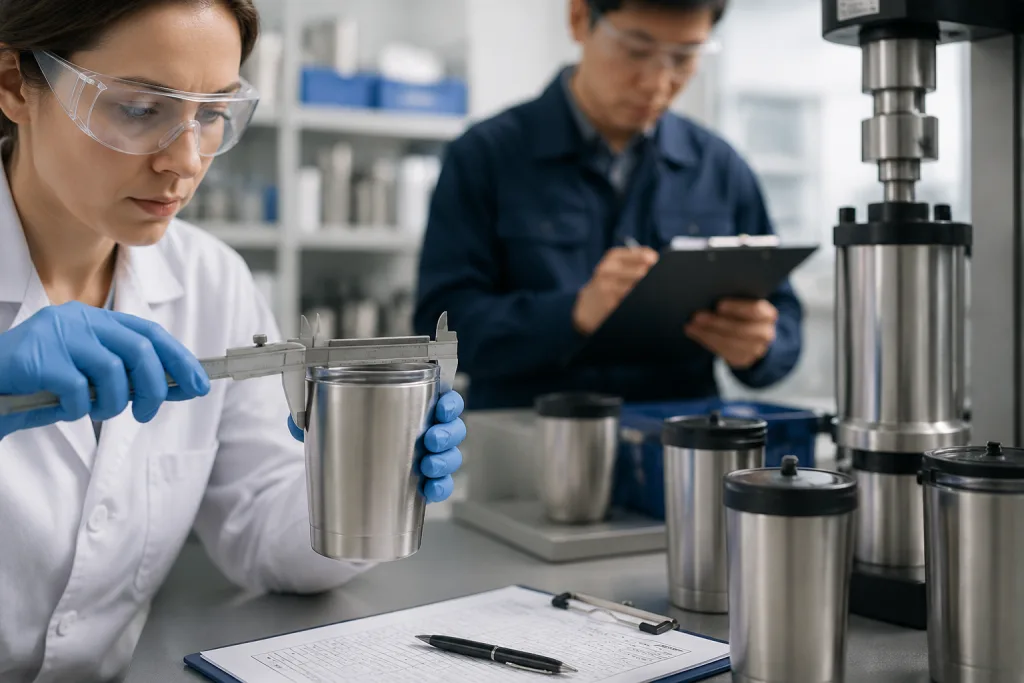
The cleanest sourcing process is still the basic one we run on the factory side: define the bottle, lock the landed target, approve a production-style sample, then release bulk. Simple. If a buyer starts with a low canteen quote and adds powder coating, laser logo, thicker carton, or a different cap after the PI, the math doesn't work. We have seen this go sideways on 5,000 pcs: USD 0.18 change fee per unit, 6 extra sample days, and a missed vessel. QC pulled the sample, measured the wall at 0.42 mm with a micrometer, and the buyer flagged it because the PO said 0.50 mm. Treat the first sample as a gate, not office paperwork.
Use this sequence:
- Fix order volume, sales channel, and target landed cost before the factory quotes.
- Choose one body size and one cap first; decoration can be checked against that shape with real artwork.
- Ask the canteen manufacturer for a spec sheet showing weight, wall thickness, carton size, and box count.
- Approve a sample with real print from the line, not a blank body or hand-finished showroom piece.
- Confirm lead time, packing photos, and inspection standard before deposit; for example, AQL 2.5 on logo, coating, leakage, and carton drop.
If you are a canteen distributor or a brand owner building a private label line, use one factory that can run custom canteen, customized drinkware, and replenishment under the same order file. A good Zhejiang partner cuts 12 email loops down to 3 because the artwork, mold drawing, and carton mark stay with one merchandiser. A weak one makes you chase every cap gasket, barcode sticker, and PO typo yourself; we once saw “matte black” entered as “mate black” and the buyer caught it only after packing photos. If your program needs a custom growler later, the same discipline applies: one spec, one sample, one contract, one production window.
Send your spec and get a real quote
Share size, material, logo method, and target MOQ. We’ll price it clearly, confirm lead time, and flag any risk before you place the order.
Frequently asked questions
What is the usual MOQ for manufacturers canteen orders?
For most custom canteen projects, MOQ sits at 300, 1,000, or 3,000 units depending on decoration and packaging. A plain stock-style body may start at 300 units, while a fully customized canteen with printed box, logo, and special cap usually needs 1,000 units. If you want better FOB pricing, 3,000 units is the point where setup cost spreads out properly. Small pilot orders are possible, but they carry a higher unit price and fewer finish options.
How much does a custom canteen cost from China?
A typical 500 ml stainless custom canteen from China often starts around USD 1.85–3.20 FOB at 3,000–5,000 units, depending on steel grade, thickness, lid type, and decoration. Add USD 0.10–0.45 for packaging, and more if you need premium carton print or special coating. Smaller orders can be 15–35% higher per unit. Zhejiang factories with stable tooling and higher monthly output usually give better consistency on repeat orders.
How long does production take for canteen customized orders?
Plan on 5–7 days for sample confirmation and 20–35 days for bulk production after approval on a standard canteen customized order. If you add complex printing, powder coating, or a custom box, total factory time can reach 30–45 days. Shipping time is separate. For Europe, sea freight often adds 25–40 days port to port, depending on the lane. Fast claims usually fail when buyers ignore sample approval time.
What documents should a canteen supplier provide?
Ask for a commercial invoice, packing list, material declaration, and any test reports required by your market, such as REACH or LFGB for food-contact materials. For retail or Amazon programs, also request barcode labels, carton marks, and photo QC records. A professional canteen supplier should confirm the steel grade, gasket material, and final carton quantity. If they cannot document the build, they are not ready for serious B2B volume.
Can one factory handle both custom drinkware and custom growler orders?
Yes, if the canteen manufacturer has separate tooling, welding, and coating lines for different product types. A factory with around 200,000 units per month can usually manage canteen, custom drinkware, and some custom growler SKUs, but only if schedules are planned around tooling changeovers. Ask whether the same inspection team handles all categories. That matters more than the sales promise. If the factory cannot control bottle neck tolerances or cap leakage, your repeat rate will suffer.