Key Takeaways
- Typical EXW pricing for a plain 450 ml borosilicate bottle starts around USD 1.05 to 1.65, before lid, decoration, and packaging.
- A custom borosilicate glass bottle usually needs 15 to 30 days for tooling and 25 to 35 days for production after sample approval.
- MOQ is often 3,000 to 5,000 units for a standard shape, but 8,000 to 10,000 units is common for a fully customized glass water bottle.
- For U.S. and EU buyers, REACH, food-contact declarations, and AQL 2.5/4.0 inspection terms matter more than a low unit quote.
If you are sourcing a manufacturers borosilicate glass bottle program for a wellness brand or a sustainable retail line, the first question is not whether glass looks premium. It is whether the landed cost, breakage rate, and replenishment speed still work after you add decoration, packaging, and freight. We have seen quotes start low, then jump once the buyer flags lids, silicone sleeves, custom cartons, and test items. A 0.8 mm print spec can move the price more than people expect.
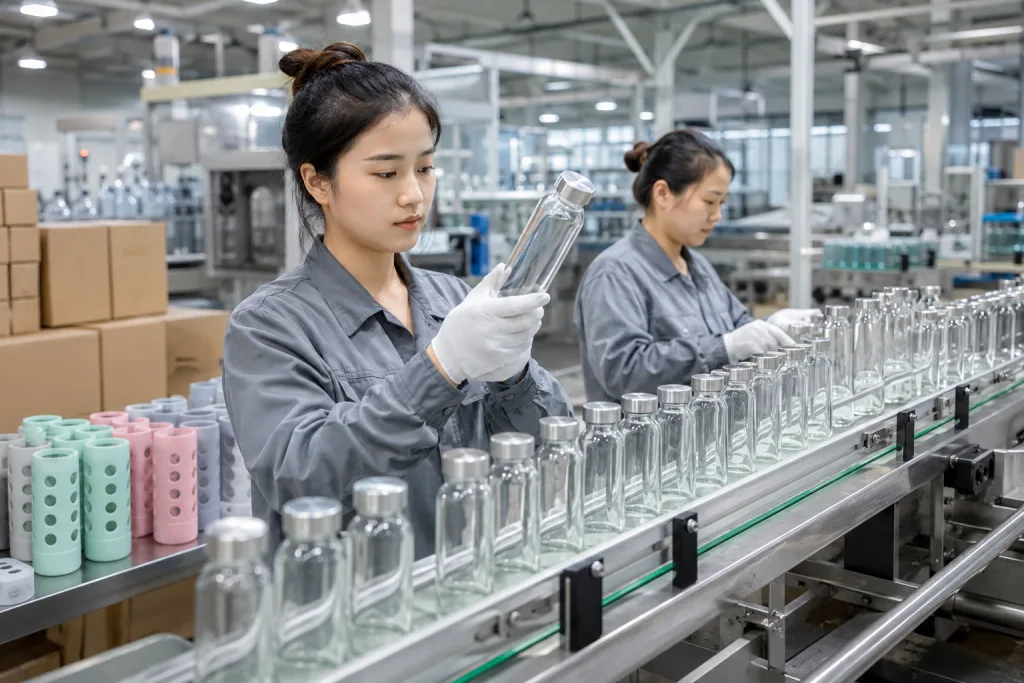
The smarter way to buy is to treat the order like an export project. In Zhejiang and across China, the factories that run this well give you a clear MOQ ladder, a production window, and a straight answer on what actually drives cost. At BottleForge Industrial, the line runs at 80,000 to 120,000 units per month, with 3,000 to 5,000 units as a practical starting MOQ for custom programs. That is the level of detail you want before you place a borosilicate glass bottle wholesale order.
What actually drives unit cost
Most buyers start with the bottle price and miss the parts that move it most. On the line, the real cost stack is glass weight, wall thickness, closure structure, decoration method, packing spec, and yield loss. A 350 ml bottle with a 1.8 mm wall is cheaper than a 500 ml bottle with a 2.2 mm wall because the glass mass changes fast. Ask for a thicker base and you pay for more raw material plus slower forming speed.
The cap is where the quote often jumps. A basic PP lid may add only USD 0.08 to 0.18, while a stainless-steel or bamboo-style closure can add USD 0.25 to 0.60. We had one buyer flag a bamboo cap drawing with the wrong thread spec, and QC pulled the sample before the line ran 2,000 pcs. A silicone sleeve for grip and impact protection can add another USD 0.20 to 0.45. Printing or laser marking on a custom glass water bottle usually adds USD 0.06 to 0.22, depending on color count and run size. If you want a borosilicate glass bottle custom line to look premium, those small numbers stack fast.
Packaging changes the math more than many distributors admit. A plain inner box may cost USD 0.12 to 0.20, while a retail gift box with insert and barcode can move to USD 0.35 to 0.80. We’ve seen this go sideways when a PO said “gift box” but left out the insert thickness, and the carton crushed in a 1.2 m drop test. If you need an Amazon-ready packout with FNSKU placement and drop-test protection, plan for more corrugated board, more labor, and a higher defect reserve. A smart borosilicate glass bottle supplier will quote the bottle separately from the packout so you can see where margin disappears.
Practical rule: on a 1,000-unit quote, packaging and closure choices can change landed cost more than the glass body itself.
That is why a serious borosilicate glass bottle factory in Zhejiang should give you a line-by-line quote. If the offer is only one lump number, you do not have enough information to compare borosilicate glass bottle suppliers fairly. We ran a 5,000-unit quote last month where one missing comma in the spec sheet hid a 0.3 mm wall change. That kind of typo matters.
MOQ tiers that make sense
MOQ should track the mold and the decoration method, not a random sales target. For a stock shape used as a bulk glass water bottle, 1,000 to 2,000 units is standard if you accept existing tooling and a single-color print. For a borosilicate glass bottle bulk program with custom cap color, branded carton, and sleeve, 3,000 to 5,000 units is a realistic starting point. Once the buyer asks for a new body shape or special embossing, we usually move the order to 8,000 units or more, because the mold cost and trial scrap have to be spread out. We run that math on the line every week.
There is a clear line between a borosilicate glass bottle wholesale order and a true custom borosilicate glass bottle program. Wholesale means lower risk, faster buying, and less control. Custom means you choose the volume, lid, print, carton, and sometimes the bottle profile. That gives the product line a stronger story, but it also ties up more cash in one run. A buyer once flagged a PO typo that turned 3,000 into 30,000; QC pulled the sample before it became a mess. A solid borosilicate glass bottle distributor will mix one stock model with one custom element so the MOQ stays workable.
- Stock shape, stock lid: 1,000 to 2,000 units
- Stock shape, custom print and carton: 3,000 units
- Custom lid color or sleeve: 3,000 to 5,000 units
- New mold or embossed logo: 8,000 to 10,000 units
If you are a sustainable retailer, the smart move is usually a customizable borosilicate glass bottle on an existing mold. You get tighter cost control, faster sampling, and less lead-time risk than a fully customized glass water bottle from scratch. The wrong question is, "How low can MOQ go?" On a 28 mm neck finish with a new carton, the better question is whether the margin still works after print, carton, and breakage allowance.
Lead time from sample to shipment
Lead time is where the quote and the shelf date usually split. For a stock borosilicate glass bottle with logo print, we run 3 to 7 days for sample approval, 20 to 30 days for production, and 5 to 10 days for export carton booking, depending on vessel space. A custom borosilicate glass bottle with a new mold is a different job: 15 to 30 days for tooling, 7 to 10 days for first samples, then 25 to 35 days for production after sample sign-off. QC pulled the sample on the line at 18 mm neck finish, and the buyer flagged a logo shift of 1.5 mm; that kind of issue adds a day or two if nobody catches it early.
A normal custom project from China lands in the 45 to 75 day range before ocean transit. Add 20 to 40 days for container booking, customs release, and inland delivery if you ship to Europe or North America in peak season. A factory that says two weeks is not giving you the full picture. The math does not work. We have seen that go sideways when a PO typo turned the carton count from 3,000 to 300 and the line had to stop for reconfirmation.
For a distributor borosilicate glass bottle program, buffer stock is the part that saves margin. If your reorder cycle is under 60 days, you need finished goods in China or a stock design that can move fast. In Zhejiang, the stronger factories keep common SKUs in partial semi-finished form, which can shave 7 days off the schedule. That does not remove risk, but it helps when a retailer doubles the forecast and asks for 20,000 pcs instead of 10,000. We ship faster when the preform and cap match the order, not when everything starts from zero.
Plan on 45 to 75 days before departure for a custom glass water bottle, then add transit on top of that.
What customization is worth paying for
Not every customization earns its cost. We run this calculation on the line all the time. If you are buying a customized borosilicate glass bottle for a wellness brand, spend on the parts the shopper touches or sees at shelf level. That usually means a better lid, a cleaner decoration method, or a sleeve that improves grip and drop resistance. Three changes, not ten. Those moves lift perceived value without forcing a new mold, and that is the math that works.
A custom logo print is the cheapest route. Screen print is usually the best value for one or two colors, while laser engraving works better on stainless parts than on bare glass. We had one buyer flag a PO typo on the lid color code, and that cost a day before QC pulled the sample again. Full wrap print, gradient decoration, or frosted effects add more steps and raise reject risk. For a promotional borosilicate glass bottle, keep the decoration simple and let the packaging do the heavy branding. For a premium retail item, a customizable glass water bottle with a matte coating, etched measurement lines, or an embossed mark can earn its place.
The trap is loading up the first order with every option. We've seen that go sideways. A borosilicate glass bottle customizable program should start with one or two variable features, then expand after sell-through data comes back. In practice, a branded lid color, one ink color, and a carton insert are enough for many retailers. On our 500 ml line, that keeps MOQ under control and sample approval faster. If you need a fully customized glass water bottle, lock the decoration method before you approve the sample, because a switch from silk print to decal changes lead time and final yield.
- Highest ROI: lid color, print, carton insert
- Medium ROI: sleeve, measurement mark, frosted finish
- Highest risk: new mold, complex embossing, multistep decoration
Quality checks you should demand
Glass breaks, and import buyers pay twice when the quality terms are vague. A borosilicate glass bottle manufacturer should spell out inspection by AQL, usually AQL 2.5 for major defects and AQL 4.0 for minor defects on finished goods. Put thickness tolerance, visible bubble limits, lid torque spec, and drop-test criteria in the PO. We run into the same problem on the line: one missing number, and the buyer flags the whole batch.
Ask for food-contact declarations aligned to REACH for Europe and the relevant FDA food-contact expectations for the U.S. A serious borosilicate glass bottle factory will provide material composition, migration-related documents, and packing confirmation. If the bottle uses a silicone sleeve, that sleeve needs its own declaration. If the closure includes bamboo, you need moisture and odor control specs, because we have seen that go sideways after a humid 18-day sea transit. QC pulled the sample, and the smell issue was obvious.
For a bulk borosilicate glass bottle order, the test package should include carton compression, transit drop, and thermal shock where relevant. A workable target is a 1.2 m drop test on packed retail units, plus a lid leak check on at least 30 samples per batch. Ask for the actual fixture photo, not a sales promise. A borosilicate glass bottle vendor that cannot explain these checks is selling you a commodity, not a managed export product.
China has plenty of factories that can make glass. Zhejiang has fewer that can make it consistently for export. That difference shows up in defect control, carton accuracy, and how they handle rework when a 1,200-piece lot comes back with one wrong carton label. This is the wrong question to ask if you only chase unit price.
How to compare suppliers without guessing
When you compare borosilicate glass bottle suppliers, do not line up the unit price and stop there. Ask each borosilicate glass bottle manufacturer to quote the same bottle volume, same wall thickness, same lid material, same decoration, and same packaging. We had one buyer flag a PO that mixed 1.6 mm and 2.0 mm walls on the same spec sheet; the “cheaper” line failed a drop test on the second carton. A distributor can help when you need mixed SKUs or a lower MOQ, but the mark-up should be written out.
A comparison sheet should show FOB price, MOQ, sample fee, tooling fee if any, production time, and valid certification. If you work with borosilicate glass bottle vendors through an agent, ask who owns the mold and who handles after-sales claims. On the line, we keep the mold tag tied to the cavity number, because that settles disputes fast when a buyer says the neck finish changed. A factory-owned custom mold is usually easier to support, but you still need a written agreement on repeat orders.
For sustainable retailers, a test order of 500 to 1,000 units of a custom borosilicate glass bottle makes sense only when the factory treats it as a pilot run and you accept the higher unit cost. For launch quantity, 3,000 units usually works better, and we ship that with a 30 percent safety stock. QC pulled a sample last month at 2.0 mm wall thickness, and the breakage rate held under AQL 2.5 after carton drop checks. That covers early breakage, seasonality, and the first replenishment window.
In China, the better suppliers will not dodge the hard numbers. They will tell you how much of the quote is glass, how much is decoration, and how much is packaging. We run that breakdown on every RFQ, because the math does not work any other way. That is the sign you are talking to a borosilicate glass bottle manufacturer, not a trading desk hiding margin in the middle.
Request a factory quote with real numbers
Send your target size, MOQ, lid style, and destination market. We will price the bottle, packaging, and lead time without guesswork.
Frequently asked questions
What is the usual price for a borosilicate glass bottle bulk order?
For a plain 350 ml to 500 ml borosilicate glass bottle bulk order, EXW pricing often sits around USD 1.05 to 1.65 per unit at 3,000 to 5,000 pieces. Add USD 0.08 to 0.60 for lids, USD 0.06 to 0.22 for print, and USD 0.12 to 0.80 for packaging depending on retail spec. If you ask for a custom mold, the unit price is not the real issue until you spread tooling over the full run. China pricing is competitive, but you need the full stack, not just the body price.
How low can MOQ go with a borosilicate glass bottle manufacturer?
A stock model can sometimes start at 1,000 to 2,000 units if the factory already has the mold and you accept standard packaging. A true custom borosilicate glass bottle usually starts at 3,000 to 5,000 units, and a new mold often pushes to 8,000 units or more. If a borosilicate glass bottle factory offers a very low MOQ on a fully custom shape, check whether the quote excludes tooling, decoration, or testing. A low MOQ is useful only if the unit economics still work for your margin.
How long does a custom glass water bottle order take from China?
For a stock shape with logo print, expect 20 to 30 days of production after sample approval. A custom glass water bottle with a new mold usually needs 15 to 30 days for tooling, 7 to 10 days for sampling, and 25 to 35 days for production. Add transit time after that: 15 to 35 days to Europe or North America by sea depending on route and port handling. A realistic total from approval to arrival is often 60 to 100 days, not counting customs delays.
What certifications should I ask for on borosilicate glass bottle suppliers?
Ask for food-contact declarations, REACH-related compliance for Europe, and any relevant migration or material documentation. If the bottle has a silicone sleeve or bamboo lid, request separate declarations for those parts. For quality control, ask for AQL terms, usually AQL 2.5 for major defects and AQL 4.0 for minor defects. A borosilicate glass bottle supplier should also be able to provide carton specs, drop-test method, and batch inspection records. Without those documents, your risk sits with you, not with the factory.
Is a distributor better than a direct borosilicate glass bottle factory?
A distributor borosilicate glass bottle source can be useful if you need mixed products, very low MOQ, or fast sampling across several designs. A direct borosilicate glass bottle factory is usually better when you want a custom mold, tighter control over decoration, and better visibility on pricing. The tradeoff is speed versus control. For a scalable wellness or retail program, direct factory sourcing in Zhejiang or wider China usually gives you a cleaner cost structure once your order reaches 3,000 units or more.