Key Takeaways
- Typical MOQ for a custom blender bottle is 1,000 to 3,000 units, with factory lead time around 25 to 35 days after sample approval.
- A reliable shaker bottle body usually uses PP or Tritan with 2.0 to 3.0 mm wall thickness; weak walls create odor, deformation, and cap issues.
- Ask for AQL 2.5 on critical defects, drop tests from 1.2 m, and leak checks at 100% for the first production run.
- China and Zhejiang factories can quote fast, but you still need a written spec sheet, approved artwork, and compliance documents before deposit.
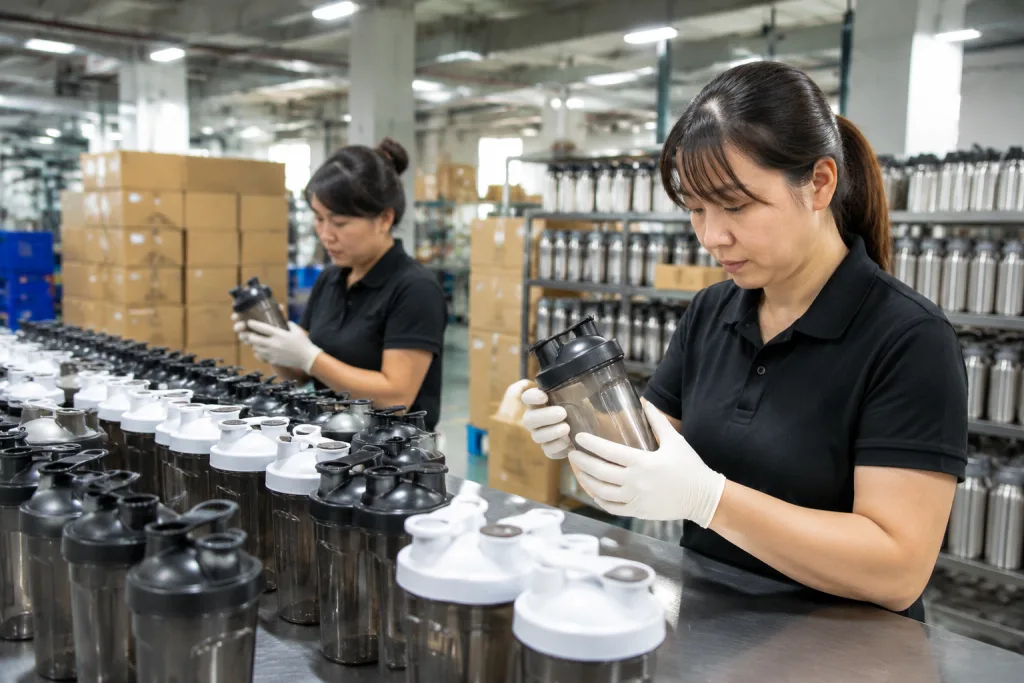
If you are buying manufacturers blender bottle programs for a private label, retail chain, or distributor line, the first question is not whether the bottle can be made. It is whether the factory can hold the spec, pass compliance, and keep the same result at your margin. In Zhejiang and across China, plenty of plants will quote a shaker bottle in 24 hours. Fewer can keep wall thickness at 1.5 mm, leak performance, and print registration steady after the first 5,000 units. We see the gap on the line.
You need a buying process that separates a real canteen manufacturer from a trading middleman, then checks the offer against your route to market. That means looking at MOQ, lead time, materials, and the paperwork your customers will ask for later: REACH, LFGB, FDA, BSCI, and a clean AQL report. QC pulled the sample on one 32 oz shaker we ran last week, and the buyer flagged a 2 mm cap mismatch before shipment. For a serious custom drinkware program, that is the wrong question to ignore.
What are you really buying?
When buyers search for manufacturers blender bottle, they are usually bundling three jobs into one: product development, sourcing, and risk control. The bottle is straightforward. The commercial part is not. You are buying something that has to hold up in transit, on a warehouse shelf, in a gym bag, through dishwasher cycles, and under brand review. If your channel is Amazon, retail, or a canteen distributor, one cracked lid can wipe out the margin on ten good units. We have seen that math go sideways on the line.
Start with the use case. Is this a protein shaker, a custom canteen for field sales, a custom growler for beverage promotions, or a general custom drinkware item with an agitator ball? A factory in Zhejiang will quote all four without blinking, but the tooling, cap design, and compliance scope are different for each one. A 500 ml polypropylene shaker is a molded-plastic job. A customizable growler in stainless steel may need double-wall construction, laser marking, and a different drop test. We run both kinds, and the buyer usually flags the cap first, not the cup.
Put the spec in writing before you ask for price. List capacity, material, lid style, sieve type, imprint area, carton count, and target market. If that is missing, you get a low quote for the wrong part. We see this with canteen suppliers, canteen vendors, and experienced customizable drinkware factories too. The quote looks clean until QC pulled the sample and found the artwork file was for a 58 mm wrap, not the 62 mm body. Then the PO has a typo, the sample is off, and everyone loses a week.
Which factory type fits your order?
The right sourcing call comes down to three things: lead time, customization depth, and unit cost. A direct canteen factory or canteen manufacturer fits better when you need control over mold details, lid fit, and print placement. A canteen supplier or canteen vendor can handle mixed SKUs and smaller runs, but tool changes get slower and cap edits are limited. A canteen distributor works when the buyer needs a broad catalog fast, though the price usually has one more margin layer. We see this on the floor all the time: one 500 ml bottle with a 2 mm cap tolerance is a factory job, not a trading job.
In China, a lot of buyers split the work: one plant for the base bottle, one service partner for cartons, labels, and freight booking. That can work if your team has people on the ground. For a first-time buyer, it often turns messy. If you are ordering a customized canteen, canteen customizable line, or a branded shaker bottle with full-color print, one accountable plant is easier to audit. Ask whether they run molding, assembly, and packing in-house, or whether half the order gets pushed to subcontractors. We had a buyer flag a PO typo on one shipment because the carton mark and bottle artwork came from two different vendors. A Zhejiang plant with in-house molding and assembly can hold a 30-day plan more reliably than a broker chasing other factories.
Look for these signs of a real manufacturing partner:
- Documented monthly output, such as 300,000 to 500,000 units per month
- Sample lead time under 7 days for stock tooling
- Clear QC checkpoints before packing
- Audit readiness for BSCI or ISO 9001
What spec sheet do buyers need?
A spec sheet does not need polish. It needs to kill confusion. For a manufacturers blender bottle order, the fields that matter are plain: capacity, finished height, body diameter, lid thread type, material grade, logo method, color code, carton pack, and test standard. If the order is for a customized canteen or customized growler line, add insulation build, steel grade, and coating type. For a blender bottle, write down the mixing part too: wire whisk ball, plastic mixer insert, or molded grid. QC pulled the sample on the line and found one buyer had written “mixing ball” in the PO while the drawing showed a grid. That kind of mismatch costs time.
Buyers who know the factory floor also list tolerances. A 550 ml bottle that lands at 510 ml or 590 ml is one thing for a giveaway run; it is a bad fit for retail. For PP bodies, 2.0 to 3.0 mm is a practical wall range depending on shape. For stainless steel drinkware, 0.4 mm to 0.5 mm 304 inner and outer walls is the spec we see on premium projects. If the plant cannot show material certification or a clear gauge statement, stop there. We have seen that go sideways fast. The same check applies to a custom growler or distributor growler order with a swing-top closure.
Your checklist should include:
- Material declaration: PP, Tritan, AS, 304, or 316
- Safety compliance: FDA, LFGB, REACH, Prop 65 if needed
- Decoration method: silkscreen, pad print, laser engraving, heat transfer
- Packaging: individual box, polybag, master carton, barcode, FNSKU if Amazon is involved
That is the difference between a clean custom drinkware program and a messy one. In Zhejiang, the better factories run this way every day, and they reply faster when the spec sheet has numbers instead of loose language. One PO typo can still waste a morning, but a tight sheet cuts that risk down hard.
How do you compare quotes?
Price comparison only works when every quote sits on the same basis. One factory may quote FOB Ningbo, another EXW Zhejiang, and a third bury mold amortization in the unit price. Ask each canteen manufacturer or canteen supplier to split out unit price, tooling, packaging, and sample cost. We see this go sideways all the time. A quote that is 12% lower means nothing if the carton spec drops from 5-ply to 3-ply or the lid insert is missing. That problem shows up on the line after the buyer has already approved the PO.
For mainstream plastic shaker bottles, a real FOB range usually lands around USD 1.20 to 2.80 per unit at 1,000 to 5,000 pieces, depending on material, print method, and accessory count. Stainless or insulated models move higher, often USD 3.80 to 8.50 or more. A canteen promotional order with one-color print and simple packaging should not be priced like a retail gift box program. The math does not work. If the quote comes in too low, check wall thickness, closure quality, and whether the resin is virgin or recycled. QC pulled the sample, measured the wall at 1.3 mm instead of 1.8 mm, and the cap flexed under hand pressure.
Use a scorecard instead of chasing the cheapest line. Rate each supplier on sample speed, QC documents, communication quality, and claimed monthly output. A plant that runs 200,000 to 500,000 units per month in China may cost a little more than a reseller, but you are paying for consistency. We ship re-orders on 4 to 8 week cycles, and the second batch has to match the first. The buyer flagged a typo on the PO once, carton size 42x42x48 cm instead of 24x42x48 cm, and that kind of mistake turns into freight pain fast.
Cheap is not the same as low-risk. In drinkware, the hidden cost is almost always the return rate.
What quality checks should you demand?
Quality control belongs in the PO, not in a promise. We run the line this way: pre-production sample, first-article signoff, and an AQL plan that names the defect classes. For a blender bottle, AQL 2.5 is the floor on critical defects, and retail buyers often push it tighter. Leak testing on the first production batch should be 100%, especially on flip lids, screw caps, and mixing caps. A scratch on the body is noise. A leaking cap kills the order.
For customized drinkware, ask how the factory checks lid torque, drop resistance, and odor after hot water exposure. We use a 1.2 m drop test onto a hard surface. That number matters. For dishwasher claims, ask for a cycle count; “dishwasher safe” with no count is buyer bait. If the factory says LFGB or FDA, ask for the report, not a screenshot. QC pulled the sample once and found 0.8 mm flash on the thread of a plastic body, which is enough to make assembly rough and leak risk go up.
A good canteen factory in Zhejiang or elsewhere in China will have its own QC routine, but your market standard is the one that counts. We ship with an inspection sheet that names the checks:
- Logo alignment tolerance
- Cap closure force
- Leak test method and duration
- Carton compression standard
- Color delta limit, if Pantone matters
If you are building a distributor drinkware program, these controls protect margin. Fewer defects mean fewer credits. That is the math. A buyer once flagged a PO typo on the color code, and the mismatch would have turned into a 3,000-piece headache if we had not caught it before packing.
How do you handle branding and packaging?
Branding is where a lot of buyers waste time. A custom canteen or customizable canteen does not need every print method on the table. It needs the method that matches the material, order size, and wear target. On the line, we run silkscreen for one or two colors because the setup cost stays low; laser engraving gives a cleaner premium mark on metal; pad printing fits curved caps and small detail areas. If you are ordering a custom growler or customizable growler, do not push a decoration method that flakes under condensation. We saw that go sideways on a 500-piece sample lot when the buyer wanted full-wrap art on a powder-coated body.
Packaging is part of the product. A retail-ready bottle may need a color box, barcode, hangtag, and master carton marks. If you sell into Amazon, FNSKU labeling and carton compliance have to be set before the goods leave China, not after the shipment is on the truck. For a canteen distributor network, the pack count should fit freight math and store handling. A 24-pack master carton can beat a 12-pack on pallet count, but the math does not work if the channel wants faster picking and mixed-SKU replenishment. QC pulled the sample last week and flagged a carton typo, so this is the wrong question to ask after production starts.
For canteen promotional campaigns, the pack can stay simple, but it still has to survive the trip from Zhejiang to Europe or North America. Ask for carton drop testing, not a box photo. We ship enough orders to know the weak point is usually the corner crush at 800 kg stack pressure, not the bottle itself. A decent bottle in bad packaging still arrives damaged, and the buyer will blame the factory anyway.
What should your buying checklist include?
Use this checklist before you issue a PO for manufacturers blender bottle or any related custom drinkware line. We run these checks on the floor before the buyer signs off:
- Confirm whether you are dealing with a factory, trading company, vendor, or distributor
- Lock capacity, material, wall thickness, and cap style in writing; one PO typo on wall thickness can turn a 750 ml bottle into scrap
- Ask for MOQ, sample time, and production lead time in days
- Request compliance reports for FDA, LFGB, REACH, or ASTM as needed; QC pulled the sample when one report showed the wrong batch code
- Require quotes on FOB, EXW, and, if relevant, DDP so you can compare landed cost line by line
- Approve artwork on a real sample, not a PDF alone; the buyer flagged a logo shift after print at 2 mm off-center
- Set AQL, leak test, drop test, and carton rules before deposit
- Confirm whether the plant can support reorders at the same spec in 30 to 45 days; 1,000 pcs in 32 days is workable, 18 days is not
This is where buyers separate a one-time order from a repeat supply line. A canteen distributors program, a distributor canteen line, or a distributor growler project lives or dies on reorder stability. We have seen this go sideways when the first lot was clean and the second lot came with a different cap torque and a new carton size. A plant in Zhejiang that can repeat your color, print, and assembly spec matters more than a quote that is 3% lower on paper. If the factory can hold a 1,000-unit MOQ and ship in under 35 days, you have something real. If not, the math does not work, and you should keep looking in China for a supplier that acts like a manufacturing partner, not a broker with a price sheet.
Send your spec for a factory quote
We can review your drawing, MOQ, and target market, then map a workable China sourcing plan with clear pricing and QC terms.
Frequently asked questions
What MOQ should I expect for manufacturers blender bottle orders?
For standard shaker bottles, MOQ is often 1,000 to 3,000 units. If you want a new mold, a special cap, or full-color decoration, some China factories push that to 5,000 units. A Zhejiang plant with existing tooling may do smaller test runs, but sample pricing will be higher. For stainless or insulated models, the MOQ can stay near 500 to 1,000 units if the supplier already has the base shell. Always ask whether tooling, print setup, and packaging are included. A low MOQ is useful, but only if the factory can repeat the order within 30 to 45 days later.
How much does a custom blender bottle cost FOB China?
A basic plastic shaker bottle often lands around USD 1.20 to 2.80 FOB China at 1,000 to 5,000 units. Add more for Tritan, multi-color printing, extra inserts, or premium packaging. Stainless steel versions or a custom growler can move into USD 3.80 to 8.50 or above depending on insulation and finish. Do not compare unit price alone. Ask for tooling, sample charges, and carton costs. A quote from a canteen supplier in China that looks 15% cheaper may be missing packaging or using thinner material.
What compliance documents should I ask for?
At minimum, ask for FDA or food-contact declarations, REACH where you sell into Europe, and LFGB if your customer needs German-market proof. For added assurance, request ISO 9001, BSCI if social compliance matters, and a current test report from an accredited lab. If the item is a customizable canteen or customized drinkware program with coating or print, ask for ink and coating safety confirmation too. Keep the reports tied to the exact SKU, not a random similar product.
Can one factory handle custom canteen and blender bottle lines together?
Yes, if the plant already runs both plastic molding and assembly, or has a stable network for stainless and plastic work. Many canteen manufacturers in Zhejiang can handle a custom canteen, a canteen promotional item, and a shaker bottle in one account, but the process should still be separated by SKU and QC plan. Ask how they manage tooling, color matching, and packing across product families. If the factory cannot explain production flow clearly, the range may be too broad for dependable repeat orders.
How do I verify a supplier is a real canteen factory?
Ask for factory registration, production photos with dated line shots, and a live video walk-through of molding, assembly, and packing. A real canteen factory or canteen manufacturer should know its monthly output, often 200,000 to 500,000 units or more depending on product mix. Check whether they own the mold shop or outsource it. Then request a sample with your logo, a QC report, and a delivery timeline in writing. If they cannot name their AQL standard or test method, treat them as a trader until proven otherwise.