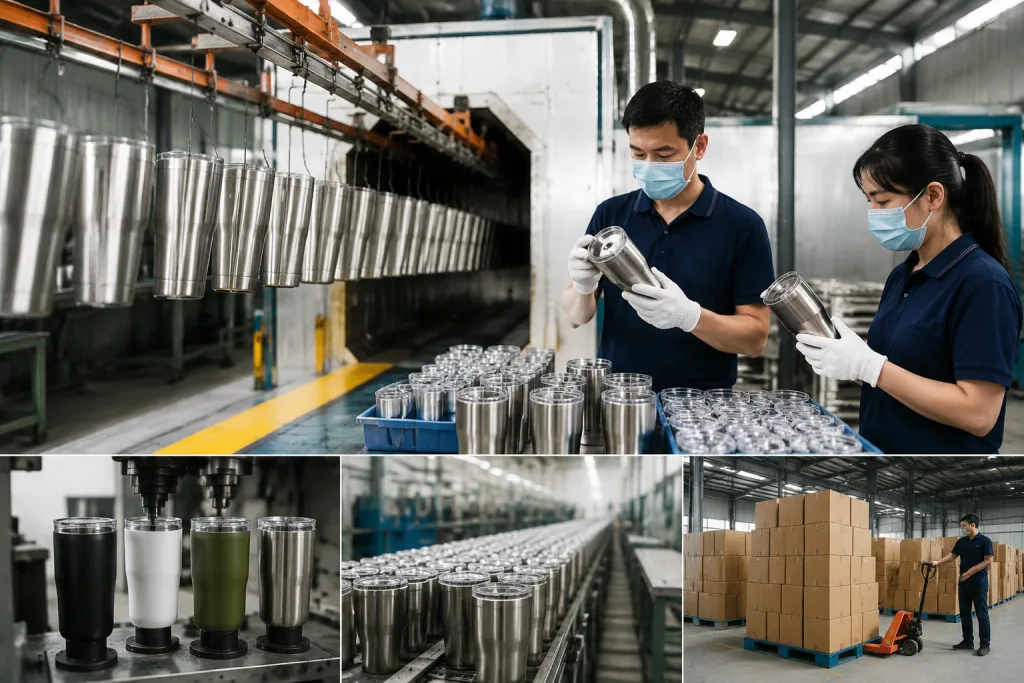
Key Takeaways
- A 20 oz double-wall 304 stainless beer tumbler usually starts around USD 2.85-4.60 FOB China at 1,000-3,000 pcs depending on lid, coating, and print
- For custom logo orders, realistic MOQ is 500-1,000 pcs per color/SKU; true mixed-color flexibility below 300 pcs usually costs 8%-15% more
- Standard production lead time from Zhejiang is 25-35 days after sample approval, with pre-production samples in 5-7 days
- Use AQL 2.5/4.0 inspection, REACH testing for EU, and ASTM/CPSIA checks when relevant to reduce claims and border issues
You are not buying a beer tumbler. You are buying landed cost, complaint rate, print quality, and a delivery date your sales team will have to defend. That is why sourcing from manufacturers beer tumbler suppliers needs more than a catalog and a low FOB quote. A tumbler that looks fine in photos can still fail on seam polish, lid fit, coating adhesion, or barcode labeling. We have seen a 0.3 mm seam gap turn into a rejected carton on day 2 of QC.
At our factory in Hangzhou, Zhejiang, we see the same pattern: buyers ask for price first, then spend two or three weeks fixing avoidable details. If you are comparing a canteen factory, a custom drinkware supplier, or a distributor growler source in China, the practical questions stay the same. What material, what decoration, what compliance, what MOQ, and what lead time can you actually trust? The buyer flagged a PO typo on the lid code once, and the line stopped for half a shift.
What are you really buying?
Procurement managers usually start with shape and capacity: 16 oz, 20 oz, 30 oz, stackable, handled, lid or no lid. That is the easy part. With manufacturers beer tumbler sourcing, you are buying six things at once: body construction, decoration compatibility, compliance paperwork, packaging discipline, replenishment speed, and how the factory reacts when QC pulls a bad sample from the line.
A basic custom canteen or beer tumbler spec sheet should include steel grade, single or double wall, vacuum retention target, body weight in grams, wall thickness, coating type, lid material, and logo process. For a common 20 oz vacuum beer tumbler in China, we run 304 inner and 201 or 304 outer, 0.4 mm inner wall, 0.5 mm outer wall, and powder coating at 60-80 microns. If the quote leaves those out, you are comparing guesses. The math does not work.
Ask whether the supplier is a canteen manufacturer, a canteen vendor, or a trading company wearing factory clothes. None of those labels is a dealbreaker. Control is the issue. A canteen factory with 300,000 units/month capacity and in-house laser marking will usually move faster on a logo change or color tweak than a canteen distributor passing work between workshops in Zhejiang. We have seen this go sideways on a PO typo for the pantone code; the buyer flagged it only after sample approval. A strong canteen supplier with audited partner plants can still be the right call if they keep QC tight and answer defects fast.
- Check if the tumbler is food-contact compliant for your market.
- Check if replacement lids are available for 12 months.
- Check if carton drop testing is part of outbound QA.
- Check whether the supplier can support your next line extension into custom growler or customized canteen SKUs.
If you are building a brand, consistency matters more than saving USD 0.12 on the first PO. One crooked lid batch can cost more than that in returns alone.
How do you compare price quotes?
Price trips up a lot of buyers because two suppliers can show the same photo and still quote different build specs. For a 20 oz vacuum beer tumbler, current FOB China pricing usually lands in these bands: USD 2.85-3.20 for a plain-color economy version at 3,000 pcs, USD 3.30-3.85 for better powder coating and a tighter lid fit, and USD 4.10-4.60 for premium finishes, special lids, or retail-ready packaging. We run this comparison on the line with a caliper and a lid leak test, because a 0.3 mm gap changes the story fast. Add around USD 0.08-0.18 for one-color silkscreen, USD 0.15-0.35 for laser engraving, and USD 0.35-0.90 for gift box packing.
When a canteen supplier or distributor drinkware source sends a low number, ask what is left out. This is the wrong question to ask only once; ask it line by line. Common omissions are mold charge, sampling fee, barcode sticker, FNSKU application, inner tray, desiccant, and export carton upgrade. The buyer flagged it on one PO with a typo on the carton mark, and the fix cost more than the print itself. If you sell through Amazon FBA or large retail, those small items move the real cost by 5%-12%.
Quote checklist you should request
- FOB Ningbo or Shanghai, not just “China price”
- MOQ per color and per logo artwork
- Unit weight and carton gross weight
- Master carton size and pieces per carton
- Sample cost and sample lead time
- Tooling cost if shape is new
- Extra charge for custom canteen accessories like straw lid or handle
At BottleForge in Zhejiang, typical MOQ for stock-shape customized drinkware is 500 pcs for laser logo and 1,000 pcs for printed logo per color. We ship from a packing bench with a 3-box drop test nearby, and QC pulled the sample when the outer carton came in at 12.8 kg instead of the quoted 11.9 kg. New molds are a different conversation. A customizable growler or customized growler body usually needs a higher opening volume because cap, neck, and leak testing add complexity.
Cheap freight often hides expensive defects. A lower FOB that creates a 3% claim rate is not lower cost.
Which material and build should you specify?
This is where an experienced buyer saves headaches. For beer tumblers and related custom drinkware, the standard commercial choice is 18/8 stainless steel, also called 304. It resists corrosion and handles acidic beverages well. We have seen buyers push back on 201 outer wall before the first sample, then the first salt-spray note came back ugly. A factory can quote 201 to cut cost, but the math only works on low-price promotional programs. For premium custom canteen and customizable canteen programs in Europe and North America, 304 inner and 304 outer is the safer spec.
Wall thickness changes dent resistance and mouth feel. Typical ranges are 0.4 mm inner and 0.45-0.5 mm outer for mainstream vacuum tumblers. On the line, we check the seam and the lip gauge together; if you go thinner, transport damage goes up. Go much thicker and the tumbler feels solid, but cost and shipping weight rise fast, and one PO typo on carton count will expose that on freight. Lid material is usually AS, SAN, PP, or Tritan based on design and budget. Ask for a BPA-free declaration and test reports, not verbal claims.
For coating, powder coat is the workhorse. It gives grip, color stability, and better scratch resistance than many spray finishes. A practical spec is 60-80 micron coating thickness with a cross-hatch adhesion result of 4B or 5B. QC pulled the sample after a 48-hour rub test once, and the soft-touch panel marked at the rim. If a canteen customizable design includes a soft-touch coating, ask about rub resistance because that finish can scuff during transit.
For thermal retention, avoid vague claims like “keeps cold all day.” Ask for a test condition. A normal vacuum beer tumbler should keep ice for several hours, but published claims vary because test methods vary. This is the wrong question to ask if the spec sheet has no numbers. For procurement, the safer route is to ask for the factory standard and compare samples physically.
- 304/304 steel for premium retail
- 304 inner with 201 outer for entry price projects
- Powder coat for durability and shelf appeal
- Tritan lid when clarity and crack resistance matter
If you plan to expand later into customizable growler or custom growler SKUs, standardize material specs now. We run the same compliance file setup across those models, and it keeps revisions down when the buyer adds a second lid code or a 750 ml size.
What should you ask before approving artwork?
Most complaints on customized drinkware are not about the cup. They are about the logo. A buyer signs off on a PDF, then the real print comes in 2 mm too small, 5 mm too high, or shifted off the seam line. Before you release production, approve a pre-production sample with a ruler on the bench: logo width, height, distance from the rim, and the position against the seam or handle reference.
The line runs four main decoration methods: silkscreen, heat transfer, laser engraving, and 360-degree digital print. For beer tumbler orders above 5,000 pcs, silkscreen still gives the best unit cost. It prints cleanly, but color registration and hairline strokes have a ceiling. Laser engraving works well on powder-coated steel and gives a tighter finish, though it will not carry every multi-color brand mark. Digital print is the better call for short runs and gradient artwork, but the math changes fast once you push volume.
Ask your beer tumbler supplier or distributor these practical questions:
- What is the maximum print area in millimeters?
- Can you match Pantone within a stated tolerance?
- What is the expected logo adhesion result after tape test or dishwasher simulation?
- Will there be fixture marks or registration breaks on wrap print?
- Can you provide a golden sample retained for reorder reference?
At our Zhejiang facility, pre-production sample lead time is usually 5-7 days after artwork approval, and mass production follows in 25-35 days. We once had a buyer flag a PO that said “center logo” but the file showed the mark 8 mm left; QC pulled the sample and caught it before the line started. If you need beer tumbler assortments with four body colors and two lid colors, ask for a packing matrix before deposit. Mixed-SKU orders fail in final packing, not at print.
Your reorder quality depends on the golden sample, not on the first PDF mockup.
How do you vet compliance and QC?
If you buy for Europe or North America, compliance is part of the product, not paperwork on the side. We run food-contact testing for the target market, and we pull REACH declarations when the spec calls for them. For children's items, ASTM and CPSIA come into play based on use case and accessories. A solid canteen supplier should tell you what is already on file, what still needs a test run, and which report belongs to which PO.
QC has to stay concrete. Ask for incoming inspection on steel coils, in-process weld checks, vacuum retention checks, coating adhesion, leak tests, and a final AQL inspection. A common shipment standard is AQL 2.5 for major defects and 4.0 for minor defects. Major defects on a beer tumbler usually mean leaks, vacuum failure, sharp burrs, wrong logo, obvious color mismatch, or carton count errors. Minor defects are light specks or small base scratches outside your approved limit sample. We have seen buyers wave this off and then chase claims for 12 days after arrival; the math does not work.
Useful factory questions include:
- Do you run 100% leak testing or only random checks?
- How many hours is your salt spray test for coated parts?
- Can you provide BSCI, ISO 9001, or social audit reports if required?
- Do you keep retained samples by PO and by color?
- What is your claim handling window after goods arrival?
A canteen distributor or canteen distributors without direct plant control can still work if they issue clear QC reports and own the after-sales response. We ship this every week from the line, and the buyer flags it fast when the report is vague. Avoid “quality is no problem.” That is the wrong question to ask. In Zhejiang and across China, the better suppliers talk in defect categories, sample sizes, and corrective actions, because that is what actually keeps a 304 stainless order on track.
What lead time is realistic for repeatable supply?
Lead time is a stack of steps, not a promise on a quote sheet. Sampling, steel booking, coating, print setup, packing, inspection, and vessel space all sit on the clock. For stock-shape manufacturers beer tumbler orders, a normal run is 5-7 days for the pre-production sample, 25-35 days for bulk after approval and deposit, then 2-3 more days if you want a third-party inspector on site. We run into trouble when a buyer asks for 12-day bulk delivery in peak season; that is the wrong question to ask unless the factory has raw material on hand and the line is already open.
Repeat orders move faster when the supplier keeps the same resin, carton spec, and color standard. We saw a PO typo once where the buyer wrote the lid color as "balck"; QC pulled the sample, caught it before packing, and the shipment still slipped 4 days because the cartons had already been printed. Ask whether your custom drinkware program can reserve common lids or cartons. That matters for a canteen distributor facing a 15-day promo deadline, or a canteen manufacturer brand customer sending monthly POs with the same 5000-unit MOQ. At BottleForge, black and white lids sit deeper in stock than clear colors, and that alone cuts a week out of some replenishment runs.
Repeat-order checklist
- Keep one approved golden sample in your office and one at the factory
- Lock packaging spec, barcode position, and carton marks
- Use the same steel and coating spec unless you formally approve a change
- Request a production schedule with milestone dates
- Confirm booking terms: FOB, EXW, or delivered basis
If you plan to widen the range into custom canteen, customized canteen, or distributor canteen lines, pick a supplier that can run related SKUs on one system. One stable China source for tumblers, bottles, and customizable growler items is easier to control than three vendors with different QC habits. We've seen that go sideways when one plant uses 304 stainless and another swaps to a cheaper grade without telling procurement.
When should you source direct from China?
Direct sourcing makes sense when your annual volume pays for the back-and-forth, when branding carries the sale, or when you need tight control over spec and packaging. At 5,000-50,000 units a year across tumblers, sports bottles, and custom growler formats, a Zhejiang factory usually gives cleaner cost visibility than buying only through a domestic stockist. We run those lines every week. The buyer sees the real carton count, not a guessed figure.
Direct is not the right call for every order. If you need 200 pieces next week for a local event, a domestic canteen supplier with stock in hand is the better move. Same if your team cannot cover sampling, compliance checks, shipping docs, and payment milestones. We have seen that go sideways on a typo in the PO, just one wrong carton code, and the whole booking slipped three days.
The wrong question is “factory or trader?” Ask who owns the result when the problem lands. Put the same questions to every canteen vendor, canteen suppliers, or canteen manufacturers you talk to: who approves artwork, who pays for remake on confirmed defects, who coordinates third-party testing, and who signs off on final inspection release. QC pulled the sample at 0.8 mm wall thickness and found a print shift on panel two. That is the level that matters.
For European and North American buyers, the cleanest path is simple: source standard shapes direct from China, keep specs disciplined, and do not over-customize the first order. Start with one strong beer tumbler SKU, one custom canteen extension, and one packaging standard. Once the supplier repeats color, print, and delivery, then widen into customizable drinkware families and larger seasonal buys. The math works better that way.
Get a workable quote, not just a low number
Send your target quantity, capacity, logo method, and delivery window. We will reply with practical MOQ, FOB pricing, and lead time from Zhejiang.
Frequently asked questions
What MOQ should I expect for a custom beer tumbler order?
For a stock-shape 20 oz beer tumbler, a realistic MOQ is 500 pcs for laser engraving and 1,000 pcs per color for silkscreen or standard printed logo. If you need a custom body color plus individual box, many China factories will hold at 1,000 pcs because coating setup and carton printing add waste. For a new mold or a customized growler body, MOQ often jumps to 3,000-5,000 pcs. If a supplier offers 100 pcs at factory price, check whether they are using stock inventory, charging a 10%-20% surcharge, or outsourcing to a distributor canteen partner.
How much should a manufacturers beer tumbler project cost landed?
A fair FOB China target for a mainstream 20 oz double-wall 304 stainless tumbler is often USD 2.85-4.60 depending on steel spec, lid style, coating, and logo method. Ocean freight, duty, domestic drayage, and fulfillment can easily add another USD 0.70-1.80 per unit depending on shipment size and destination. Gift box packaging adds roughly USD 0.35-0.90, and FNSKU labeling or barcode application can add USD 0.02-0.06. Ask every canteen supplier to quote FOB Ningbo or Shanghai with carton details, otherwise you cannot compare landed cost accurately.
What tests or certifications should I request before placing the PO?
For Europe, ask for food-contact compliance documentation and REACH-related declarations where applicable. For North America, request food-contact test support and any project-specific testing your customer requires. If the drinkware is intended for children, ASTM and CPSIA may become relevant depending on product design and accessories. On the quality side, ask for vacuum test records, coating adhesion results, and leak-test standards. A good baseline is AQL 2.5 for major and 4.0 for minor defects, with 100% leak testing for lidded drinkware. If social compliance matters, ask whether the Zhejiang or China factory has BSCI or ISO 9001 records available.
How long does sampling and production usually take?
For a stock-shape customized drinkware project, expect 5-7 days for a printed or laser pre-production sample after artwork approval. Bulk production usually takes 25-35 days after deposit and sample sign-off. Add 3-5 days for third-party inspection if you require one, and add a week in peak season. New molds can add 20-35 days before sample approval. If your order mixes several SKUs, such as a custom canteen, beer tumbler, and custom growler family, timeline risk usually sits in packaging coordination rather than body production. Ask for a dated production schedule, not just a verbal promise.
Should I buy from a factory, a trading company, or a distributor?
Buy from the party that can control quality and solve problems fastest. A direct canteen factory often gives better technical visibility, lower cost, and easier spec control once volume reaches 5,000 pcs or more per program. A trading company can still be a strong partner if they manage QC tightly and own claims without delay. A local distributor drinkware source is useful when you need small quantities or short turnaround. Ask who will provide the golden sample, who handles testing, who pays for confirmed defects, and who owns communication after shipment. Those answers matter more than the label on the business card.