Key Takeaways
- For a 64 oz stainless custom growler, practical MOQ is usually 500-1,000 pcs per color, with FOB China pricing often around USD 4.80-8.90 depending on construction and decoration
- A realistic production plan is 7-12 days for samples and 30-45 days for mass production after deposit and artwork approval
- Define wall thickness, neck finish, leak test standard, coating adhesion, and AQL 2.5 before the PO, not during inspection
- For Europe and North America, ask for REACH, LFGB or FDA food-contact declarations, plus packaging drop checks and barcode accuracy if shipping retail
You need a beer growler that looks right, keeps a decent seal for takeaway, survives parcel drop tests, and still leaves margin for your sales team. That sounds easy until the quotes hit the inbox: 18/8 or 18/10, single wall or vacuum, powder coat or bare steel, bamboo lid or PP cap, 500 pieces or 3,000 pieces. We have seen buyers get stuck on a 2 mm lid gasket and miss the real issue. Most bad orders are signed before the PO, not after.
If you are buying from manufacturers beer growler suppliers in Zhejiang, China, the job is not just choosing a bottle. You are buying a commercial item, managing risk, and getting the factory, your canteen supplier or distributor drinkware channel, and your compliance team onto one drawing set. QC pulled the sample on a 48-hour leak check, the buyer flagged a typo on the carton mark, and that was enough to delay shipment by a week. Here is what a clean order looks like from first RFQ to final inspection.
Start with the order brief
A North American craft beverage distributor sends a short RFQ for the growler program: 64 oz insulated stainless growlers, matte black, laser logo, single gift box, ship in 45 days. That is not enough for a clean quote. We can price it fast at a canteen factory in Zhejiang, China, but thin specs turn the first number into a placeholder, and the buyer flags it on the next round.
The brief needs commercial facts and physical facts. Commercial means order quantity, destination port, Incoterm, packaging level, target ship date, and whether the item is for wholesale, retail shelf, e-commerce, or promotional use. Physical means capacity tolerance, body diameter, height, steel grade, insulation structure, cap type, finish, logo method, and carton limits. We run into trouble when a PO says “standard packing” and nothing else; the pallet math does not work.
- Capacity: 1.9 L / 64 oz nominal, with fill tolerance of plus or minus 3%
- Material: body in 304 stainless steel, outer and inner; cap contact parts in PP or stainless plus food-grade silicone gasket
- Construction: vacuum insulated or single wall, depending use case
- Wall thickness: common range 0.4-0.5 mm outer and 0.4 mm inner
- Decoration: one-color silkscreen, laser engraving, or full powder coat plus logo
- Packaging: white box, color box, or PDQ; master carton weight below 15 kg if your warehouse asks for it
If you also buy general custom drinkware, keep the wording tight in the same brief. We see buyers source a custom canteen, tumbler, and growler in one season, then send three naming styles and one messy spreadsheet. That is the wrong question to ask. Terms like canteen custom, customizable canteen, or customized drinkware matter less than one disciplined data sheet that every canteen vendor, canteen supplier, and growler line can read without guessing. At BottleForge Industrial in Hangzhou, Zhejiang, QC pulled the sample twice when the logo callout and carton limit were on separate pages; one sheet fixed that.
Choose the right growler construction
The quickest way to waste money is to spec vacuum insulation for a simple takeaway program. The quickest way to miss the brief is to ship a single-wall custom growler to retail buyers who want cold hold through the day. Match the build to the channel.
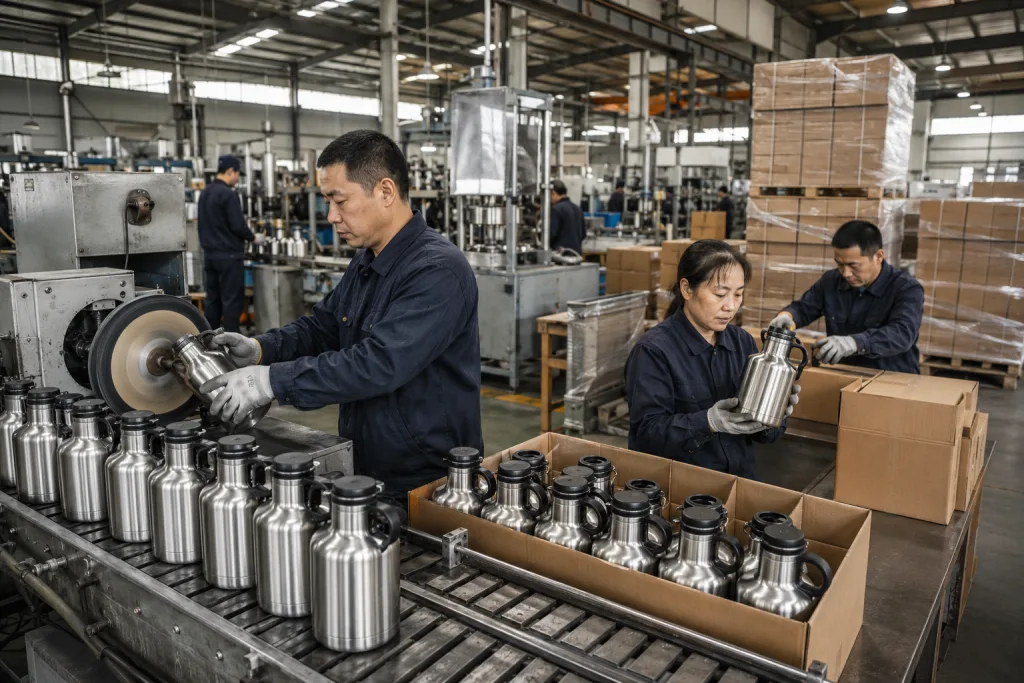
For taproom takeaway and local refill programs, many manufacturers beer growler orders run on single-wall stainless. We ship that setup a lot. It cuts cost, usually saves USD 1.20-2.50 per unit versus vacuum, and keeps the line simple. At 1,000 pcs, a 64 oz single-wall stainless custom growler usually sits around USD 4.80-6.20 FOB China, depending on finish and cap. If the buyer wants a heavier hand feel and a premium shelf read, vacuum insulated units usually land around USD 6.80-8.90 FOB at the same quantity. QC pulled the sample with a 1.2 mm wall on one run; that saved weight, but the buyer flagged it for feeling too thin in hand.
Cap and neck decisions matter more than buyers expect
Most leak complaints come from the closure, not the bottle body. Check the thread pitch, gasket hardness, and whether the cap torques down the same way on your line and in the customer’s hand. For carbonated fills, be careful with the claim set. A growler is not a pressure vessel unless it is built and tested for that use. This is the wrong question to ask if someone says, “Will it hold soda?” Ask the canteen manufacturers and canteen suppliers to put the intended use in black and white on the spec and the carton. We had one PO with a cap code typo, M28 written as M82, and that mistake would have sent the wrong neck finish straight onto the line.
Good buying language: “Suitable for cold beverages and short-term transport. No pressure-retention guarantee unless validated by agreed test protocol.”
If your catalog also includes canteen customizable or canteen customized formats, standardize the surface finish and cap color across SKUs. Shared parts cut MOQ pain. A canteen distributor or distributor canteen buyer may accept 500 pcs per SKU if the color and packaging stay shared, while a fully unique custom drinkware program usually starts making sense at 1,000 pcs or more. We have seen this go sideways when buyers try to split one cap across three neck sizes; the math does not work.
Lock decoration before sampling
Decoration locks the schedule because it sets artwork approval, fixture setup, and the inspection rulebook. We have seen buyers sign off on the shape sample, then switch from silkscreen to laser or ask for a second logo panel. That is where the calendar slips. One PO typo on logo size can force a new proof.
For a manufacturers beer growler order, the usual stack is powder coating plus screen print, powder coating plus laser engraving, or bare stainless with laser. Screen print gives stronger color on canteen promotional and customized drinkware jobs. Laser looks cleaner and wears well, but on some coatings it leaves a silver stainless mark that disappears at a distance of 2 m. If the item moves through a distributor growler channel, shelf impact is the point, not a brochure phrase.
- Silkscreen setup: lower unit cost, but artwork with fine lines under 0.2 mm can break on the line
- Laser engraving: no ink migration issue, strong abrasion resistance, but cycle time is slower by 15-20 seconds per piece
- Powder coat: premium hand feel; ask for cross-hatch adhesion testing and color consistency under D65 light
Sample lead time in Zhejiang is usually 7-12 days for a logo sample if the mold already exists. New tool changes can push it to 15-20 days. QC pulled the sample on a 500 ml growler once and found the bottom mark shifted 3 mm. Ask for three sample photos before shipment: front logo, bottom mark, and cap interior. If you are buying canteen custom, custom growler, and customizable drinkware in one package, ask for a decoration approval matrix with Pantone references, logo size tolerance of plus or minus 1 mm, and position tolerance of plus or minus 2 mm.
Pricing moves with decoration. At 1,000 pcs, one-position laser may add only USD 0.12-0.25, while a two-color silkscreen on coated stainless can add USD 0.18-0.40 depending on print area and reject risk. We have seen the math go sideways when a buyer flagged a “free logo” claim but never asked about process yield. That is the wrong question to ask.
Put QC terms into the PO
New buyers often write quality in vague terms: no scratches, no leaks, good print. The line cannot run on that. QC only works when the PO turns those words into numbers, defects, and test methods.
For a custom growler order, put the inspection points in the purchase order or a quality appendix: incoming, in-process, and final. For consumer drinkware, we usually write AQL 2.5 major / 4.0 minor unless the retailer sets a tighter target. Critical defects stay at zero. We once had a buyer flag a PO typo where “4.0” was typed as “40”; that one would have wrecked the whole acceptance plan.
- Critical defects: sharp edge on drinking contact area, failed leakage test, wrong barcode, mold contamination, food-contact odor issue
- Major defects: logo missing, coating peel over agreed area, wrong capacity beyond tolerance, dent visible at 30 cm
- Minor defects: small speck, slight color variance within approved limit, carton scuff not affecting product
Ask the factory to run the tests that match the product. We ship more cleanly when the PO spells out an inverted leakage test for 30 minutes, vacuum retention for insulated models, cross-hatch adhesion, salt spray for corrosion checks, and carton drop test for e-commerce packs. For food-contact compliance, Europe usually asks for REACH screening and often LFGB declarations for relevant contact materials; North America often asks for FDA-related material statements and sometimes ASTM packaging tests depending on channel. This is the wrong question to ask: “Can you confirm it’s good?” Ask for the test name, the sample count, and the pass/fail limit.
Do not leave out inspection photos from the line. We ask for first-article photos, semi-finished body photos, and packed-carton photos with a barcode close-up. On a Zhejiang line, that catches bad laser marks and off-center prints before pallets move. If one barcode is wrong, it can land in three warehouses before anyone notices. QC pulled the sample, and the mistake showed up in 18 seconds, not after shipment.
Plan production around real lead times
Once sample and artwork are approved, the buyer in our example places 2,000 pcs of 64 oz black vacuum growlers, packed in color boxes, FOB Ningbo. The factory says 35 days. That is not 35 days from the email. We count from deposit, approved pre-production sample, and signed packaging artwork. QC pulled the sample on the line at 9:40 a.m.; one box insert was 2 mm short, and that alone pushes the clock if nobody catches it early.
A realistic timeline for standard stainless drinkware from Zhejiang, China looks like this:
- Day 1-3: PI confirmation and 30% deposit
- Day 4-10: logo sample and packaging proof
- Day 11-15: final approvals and material booking
- Day 16-38: forming, welding, vacuuming if insulated, coating, decoration, assembly
- Day 39-42: final inspection and rework buffer
- Day 43-45: loading and export documents
If your order mixes a custom canteen, a customizable growler, and a travel tumbler, the schedule slips unless the components share the same tooling and lid set. We have seen buyers ask for all three in one shipment, then wonder why the box print proof adds 6 days. That is the wrong question to ask. Color boxes with inserts usually add 5-7 days, and FNSKU labels for marketplace fulfillment can add another checkpoint when the buyer flags the carton layout on the PO.
Factory capacity matters too. A medium-sized drinkware plant may run 300,000-500,000 units per month across categories, but the line is not a free-for-all. A growler with a wider body and handle eats more welding and coating time than a standard sports bottle. Ask how many growlers the plant ships per day, not just the monthly headline. Ask whether your order sits before or after a 20,000 pc seasonal run. Honest factories in China answer with numbers. The vague ones say "no problem" and you pay for that later.
Review packaging like a logistics buyer
Packaging is where commercial buyers lose margin without seeing it on the quote. A good bottle in a weak shipper turns into claims, relabeling, and warehouse complaints. We have seen a 1.2 mm carton spec fail on the line because the inner tray flexed. Do not leave packaging to the last week.
For a distributor drinkware program, decide first whether the carton is built for palletized B2B delivery, parcel shipment, or retail presentation. A single-wall growler in a white box can work for wholesale. A vacuum unit with premium coating usually needs a fitted insert, a bag, desiccant if needed, and tighter carton compression control. Master carton dimensions should fit your pallet and container plan, not just the factory shelf.
Ask for these packaging checks: barcode scan confirmation, carton weight, drop test from the agreed height, and photo confirmation of inner pack orientation. If your customer uses Amazon or other marketplace channels, add FNSKU placement and outer carton labeling to the approved pack-out sheet. The buyer flagged a PO typo on carton marks once, and QC pulled the sample before loading. If you buy from a canteen supplier that also ships custom canteen or customized canteen products together, standardize outer carton marks to cut receiving errors.
We usually cap master carton gross weight at 12-15 kg for easier handling and lower damage risk. On a 64 oz growler, that often means 12 or 16 pcs per carton depending on box style. Ask your canteen vendors or canteen vendor to show carton burst data if the shipment goes long-distance by sea plus inland parcel transfer. The math does not work when the freight savings get erased by one cracked pallet at receiving.
If you care about factory systems, ask about BSCI or similar social compliance audits and whether the plant runs under an ISO-managed process. Those are not a guarantee of perfect output, but they usually mean better document control, which matters when you reorder customized drinkware six months later and need the same pack-out. We ship repeat cartons this way all the time, and the audit trail saves a lot of back-and-forth.
Send your growler spec and get a practical quote
Share capacity, construction, logo method, packaging, and target price. We will review the spec, flag risk points, and quote realistic MOQ and lead time.
Frequently asked questions
What MOQ should I expect for a custom beer growler order?
For standard stainless models using an existing mold, MOQ is usually 500 pcs per color for simple decoration and 1,000 pcs for stronger pricing. If you need a unique lid color, custom color box, or mixed coating finishes, practical MOQ often rises to 1,000-3,000 pcs. Some canteen manufacturer or canteen factory suppliers in China will quote 300 pcs, but that usually comes with higher unit cost or limited options. For a 64 oz vacuum growler, the price break between 500 and 1,000 pcs is often USD 0.40-0.90 per unit FOB. If you are combining a custom canteen and growler program, shared colors and packaging can help the factory accept lower per-SKU quantities.
Is single wall or vacuum better for a distributor growler program?
It depends on channel and price target. Single wall works well for taproom takeaway, event merchandise, and canteen promotional programs where lower cost matters more than long ice retention. Vacuum is better for premium retail, gift sets, and distributor drinkware channels where end users expect 8-12 hours of temperature hold. On a typical 64 oz stainless body, vacuum construction can add around USD 1.20-2.50 per unit versus single wall at 1,000 pcs. It also adds more QC points, especially around vacuum integrity and coating yield. If you are unsure, ask the factory for both FOB prices and compare them against your resale margin instead of choosing by appearance alone.
What compliance documents should I request for Europe and North America?
For Europe, request REACH-related declarations for relevant materials and, where applicable, LFGB or other food-contact supporting documents for parts touching liquid or the mouth area. For North America, ask for food-contact material statements aligned with FDA requirements, plus test reports for coatings if your customer requests them. If the product is sold to kids, the document list changes, but standard growlers usually focus on food-contact safety, labeling, and packaging integrity. You should also request a specification sheet showing steel grade, silicone and plastic contact parts, and any third-party lab references. A serious canteen supplier in Zhejiang, China should be able to provide a document pack before mass production starts.
How do I control leakage and finish problems before shipment?
Put measurable tests into the PO. Require 100% leakage check during assembly and a sampled final leakage test with inverted hold for 30 minutes. For vacuum models, define the thermal retention benchmark or vacuum check method. For finish, approve a sealed master sample and state coating adhesion criteria, print position tolerance, and defect viewing distance, typically 30 cm under normal light. Use AQL 2.5 major and 4.0 minor unless your channel needs tighter control. A third-party final inspection in China usually costs far less than one rejected container claim. If your canteen distributors need barcode accuracy, add scan checks and outer carton photo evidence to the release checklist.
What lead time should I promise my sales team for a first order?
For a first order with standard mold and normal decoration, promise 45-60 days from deposit to vessel booking, not 30 days. Sampling usually takes 7-12 days, artwork and packaging approval can take another 3-7 days, and production commonly needs 30-45 days depending on season and order size. Before holidays in China, or if your order mixes customizable canteen, customized growler, and other custom drinkware items, add at least one extra week. For repeat orders with locked artwork and packaging, lead time can drop to 25-35 days. The safest approach is to ask the factory for a dated production calendar instead of a single number.