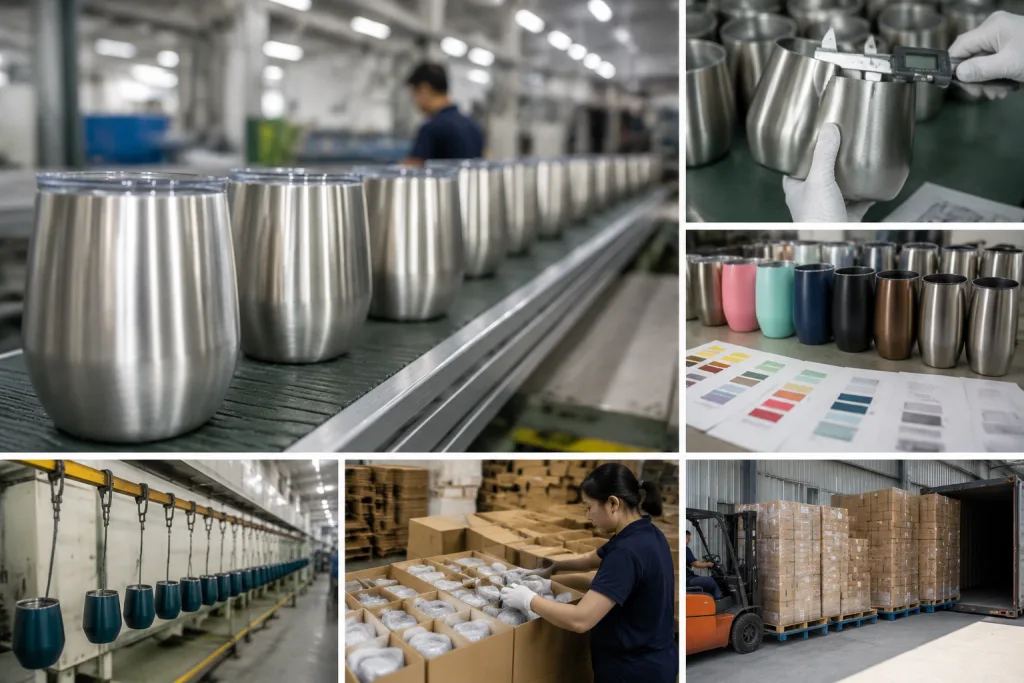
Key Takeaways
- A 12 oz double-wall 18/8 stainless wine tumbler typically lands at USD 2.25-3.80 FOB China at 3,000-10,000 pcs depending on lid, finish, and print
- Most factories in Zhejiang need 25-35 days for repeat orders and 35-45 days for first custom production after sample approval
- For retail programs, ask for AQL 2.5 inspection, LFGB or FDA contact compliance, and coating adhesion plus dishwasher-cycle testing before mass production
- MOQ often starts at 500-1,000 pcs per color for stock shapes, but fully new tooling usually needs 3,000-5,000 pcs to make sense
You are not buying a wine tumbler by shape alone. You are buying landed cost, defect rate, decoration yield, and a lead time your sales team can plan around. We see this go sideways fast when buyers start with the silhouette and ignore wall structure, print method, and the compliance file behind it.
We ship from Zhejiang, China, and the same mistake shows up with first-time B2B buyers of custom drinkware, custom canteens, and customized growlers. The wrong question is always “what is the cheapest quote.” Start with four points: body construction, decoration method, compliance scope, and order math. On one 20,000 pcs run, QC pulled the sample and found a 0.35 mm wall variance; that is the kind of detail that decides whether the project stays on track.
Start with the four buying decisions
If you are comparing five suppliers and the quotations look close, slow down. A manufacturer wine tumbler decision gets cleaner when you force every supplier through the same four buying points.
- Decision 1: Construction. Single-wall, double-wall vacuum, or copper-plated vacuum. For wine tumblers sold into gift, corporate, and lifestyle channels, double-wall vacuum is the standard pick. It cuts condensation and feels more premium. We run 18/8 stainless inside and outside, with body thickness around 0.4 mm.
- Decision 2: Decoration. Powder coat, spray paint, silk screen, heat transfer, laser engraving, or full-wrap printing. The right method depends on logo size, Pantone control, and whether the buyer flagged dishwasher resistance as a must.
- Decision 3: Compliance. Europe and North America do not ask for the same file stack. You may need FDA or California Proposition 65 support for the US, LFGB and REACH screening for the EU, plus drop-test and transit pack validation for ecommerce. QC pulled the sample on a 1.2 m drop once and the carton corner still split.
- Decision 4: Order economics. MOQ, tooling, carton pack-out, and freight density matter as much as unit price. The math does not work if the 6-pack master carton wastes half the pallet.
This is where buyers who normally source from a canteen supplier, canteen vendor, or canteen factory get caught out. They assume the same quoting logic applies across all drinkware. It does not. Wine tumblers use different lids, stems are removed so balance changes, and premium coatings show more because the product is held close and used socially. We’ve seen this go sideways when a PO said “mat black” and the buyer meant matte black. If your product line also includes a custom canteen, custom growler, or customizable drinkware set, align finishes and logo methods across the family early. That cuts approval loops and keeps color claims down later.
At BottleForge in Zhejiang, China, our first inquiry checklist is direct: target market, capacity, lid type, steel grade, finish, artwork method, MOQ, and target FOB price. If a factory cannot answer those points cleanly, you are not comparing real offers. On the line, that shows up fast.
Choose the right build specification
The body spec is where cost and quality split fast. A nice sample can still turn into a weak production item if wall thickness, vacuum consistency, or lid fit are not held tight. We have seen the line drift on a 0.4 mm wall and the buyer flagged it in the first carton.
What usually works best
For B2B programs, the usual spec is a 12 oz or 14 oz double-wall vacuum insulated wine tumbler in 18/8 stainless steel, with a clear AS or Tritan slider lid. Net weight often lands around 220-320 g, depending on shape and steel gauge. Mouth diameter is usually 80-90 mm, and that changes both drinking feel and the print area. QC pulled the sample at 84 mm more than once because the logo zone was too tight.
Ask for these details in the quote:
- Steel grade: 304 inside and outside, or 304 inside with 201 outside if you are aiming for a lower price point
- Inner and outer wall thickness: usually 0.4 mm / 0.4 mm
- Insulation type: vacuum only or copper-coated vacuum
- Lid material and gasket material: AS, Tritan, PP, silicone
- Base finish: plain stainless, sprayed base, or anti-slip pad
- Salt spray or coating durability standard if the finish is painted
The trade-off is direct. If you choose 201 outer steel, lighter wall thickness, and a basic AS lid, you can save USD 0.20-0.45 per unit FOB China. That works for a canteen promo or event giveaway. For retail, gift-boxed sets, or distributor drinkware accounts, the math often falls apart once returns, dents, and finish variation show up. We have shipped those jobs, and they go sideways fast.
Buy the build spec first, then negotiate the finish. Do it the other way around and you end up with pretty samples and unstable production.
If you already buy from canteen manufacturers or canteen suppliers, use the same engineering discipline here. Ask for vacuum retention data, leak test method, and lid torque or fit consistency. A serious canteen manufacturer or manufacturer wine tumbler supplier should send that without a push. We once caught a PO typo on lid color, and the whole carton mark was off by one code.
Match decoration to the sales channel
Decoration is where brand owners burn time, because everyone asks for “best logo” without naming the channel. A logo that works for a corporate giveaway can fail on Amazon FBA, grocery retail, or a distributor canteen catalog. We run into this all the time.
Here is the practical breakdown, based on what ships and what comes back with complaints:
- Powder coat + silk screen: Good cost balance. Typical MOQ starts at 500-1,000 pcs per color on a stock shape. It fits bold logos with 1-2 spot colors. Unit cost impact is often USD 0.12-0.30.
- Powder coat + laser engraving: Cleaner premium look, and the abrasion resistance is better. It works for simple logos. Cost adder often USD 0.08-0.20 depending on position and size.
- Spray paint + full-wrap heat transfer: Best for multicolor artwork and gradients. It costs more and the line is more sensitive to setup drift. Cost adder can be USD 0.25-0.60.
- Embossed or debossed branding: Usually needs tooling or a dedicated mold area. It makes sense for long programs above 5,000 pcs.
If you sell customizable canteen, customized canteen, or customized drinkware programs, ask the factory how they control Pantone variance across batches. QC pulled the sample, and the buyer flagged a Delta E shift on a navy run last month. Powder coat is never a perfect Pantone match; a variance around Delta E 1.5-3.0 may be acceptable depending on the color family, while fluorescent or metallic shades are harder.
For ecommerce, durability matters more than catalog gloss. Ask for:
- Cross-hatch adhesion test for coatings
- Rubbing alcohol resistance if logos may contact hand sanitizer
- Dishwasher recommendation, even if the item is hand-wash advised
- Carton dividers or polybag protection if matte coatings scratch easily
Many canteen distributors and canteen vendors also ask whether one logo method can cover a full family: wine tumbler, travel tumbler, custom canteen, and customizable growler. Usually yes, but only if the substrate and coating line are matched. This is the wrong question to ask first; the line has to hold the same finish across shapes. A capable canteen factory and canteen supplier should talk about process compatibility, not just send a logo mockup.
Price the order the way factories do
Most buyers ask for unit price before they know what drives it. We price from the bill of materials, press time, scrap risk, and how tight the cartons load on a pallet. That is the right frame. If you miss those four items, the quote looks random and the pushback gets messy.
For a stock 12 oz vacuum wine tumbler, typical FOB China numbers look like this. We run these numbers on the line every week, and the buyer usually asks where the spread comes from.
- 500 pcs: USD 3.20-4.20 each, depending on finish and logo
- 1,000 pcs: USD 2.80-3.60 each
- 3,000 pcs: USD 2.45-3.20 each
- 10,000 pcs: USD 2.25-2.90 each
Gift box packing can add USD 0.35-0.90. Tritan lids usually cost more than AS lids. Copper-plated vacuum can add roughly USD 0.10-0.18. Special retail cartons, barcode labels, FNSKU stickers, and pallet rules can add more than the logo itself if you are not careful. QC pulled a sample last month and the carton print typo alone caused a rework note, so this is not theory.
MOQ is not just a factory preference. It ties to coating line setup, logo screens, carton printing, and component purchasing. A stock-color item with one-color silk screen may run at 500 pcs. A custom Pantone body with two logos and a custom carton is more realistically 1,000-3,000 pcs. Fully new tooling for a unique body profile usually needs 3,000-5,000 pcs to amortize mold cost sensibly. The math does not work any other way.
This matters if you are a canteen distributor, distributor growler buyer, or canteen vendors group testing a new SKU. Instead of forcing a low MOQ on a fully custom item, consider a phased launch:
- Phase 1: stock shape, custom logo, 500-1,000 pcs
- Phase 2: custom color and retail box, 1,000-3,000 pcs
- Phase 3: exclusive tooling or bundled set, 5,000+ pcs
That path usually costs less than pretending a trial order should carry full customization economics. We have seen this go sideways when the buyer flagged a 500 pcs target for a mold-heavy part, and the line had to absorb the setup loss. A factory turning 300,000 units per month can take small runs, but somebody still pays for the changeover.
Audit compliance before you approve samples
A clean pre-production sample proves one thing: one sample existed. It does not prove compliance. For Europe and North America, you need the paper trail and the controls on the line.
Before you approve a manufacturer wine tumbler supplier, ask for these documents:
- Material declaration for stainless steel, lid, and gasket
- FDA or food-contact test support for the US market
- LFGB readiness and REACH screening for EU programs where applicable
- BSCI or Sedex audit status if your customers require social compliance
- ISO 9001 or equivalent quality system evidence
- AQL inspection standard, normally AQL 2.5 for major defects
The defect list is not glamorous. Paint dust shows up first. Then logo shift, vacuum loss, lid scratches, sharp rim edges, dents, and color drift. We pulled a sample once where the rim measured 0.8 mm on one side and 1.4 mm on the other, and the buyer flagged it in five minutes. Ask the factory which defects are critical, major, and minor. If they stall, the QC system is reacting after the fact.
For custom drinkware sold online, add packaging checks: drop test, carton compression, barcode scannability, and inner-pack count verification. For retail, confirm country-of-origin marking and warning label placement. On one PO, the buyer typed the carton count as 24 when the packer ran 12, and the whole shipment had to be relabeled. For youth-oriented programs, if the same supplier also offers kids lines, ask separately about ASTM or CPSIA where relevant. One document does not cover every SKU family.
Experienced canteen manufacturers and canteen distributors know the compliance scope changes by customer. A distributor canteen order for hospitality may need less retail packaging work than a branded DTC launch. A customized growler for alcohol-related gifting may need tighter decoration durability and cleaner legal text on the carton. The math does not lie. Approve the compliance matrix before the color sample, not after.
Pick a supplier you can scale with
There is no perfect supplier. There is only the one that fits your program. On a first order, buyers often chase reply speed and ignore production discipline. Fast replies help. Stable execution pays the bill.
When you evaluate a canteen manufacturer, canteen supplier, or manufacturer wine tumbler partner in Zhejiang or elsewhere in China, score them on these points:
- Sampling discipline: Do they send a drawing or spec sheet before they cut samples? We run that check on every new SKU.
- Change control: Do they log revisions for logo, finish, carton, and barcode, or do they keep updating the PO by WeChat? A typo on the carton mark can waste a whole print run.
- Capacity: Can they cover the next order if the first PO sells through in 45 days instead of 90?
- QC reporting: Will they send in-process photos, vacuum test data, and final inspection reports from the line?
- Export literacy: Do they understand FOB, EXW, DDP limits, HS code use, and booking cutoffs, or do they guess and hope the forwarder fixes it?
A supplier can be strong on canteen custom or customizable canteen jobs and still miss on retail-ready wine tumblers. The weak point is often not the metal body. It is the logo process, carton compliance, or mixed-SKU packing. We ask what share of their output goes to North America and Europe. We ask how much is private label and how much is domestic bulk trade. Those two numbers tell you how much hand-holding the account will need. We've seen this go sideways when a buyer assumed a flat packing spec would carry every market.
At BottleForge, we usually tell new buyers the same thing: if your launch volume is under 1,000 pcs, pick a proven mold and put the money into decoration and packaging. If your annual forecast is above 20,000 pcs, then talk about exclusive tooling, custom lids, or set bundling. That is not a sales line. It is the math. A 12 mm logo shift on a powder-coated cup can cost less than a new tool, and the buyer flagged it before shipment anyway.
The best canteen vendors, canteen distributors, and distributor growler buyers think in 12-month programs, not one PO. Your supplier should do the same. If they only quote today’s box price, they are not built for scale.
Build the RFQ so quotes mean something
If you want quotes you can compare, write a tighter RFQ. Most sourcing mess starts when three factories price three different builds under one product name. “Wine tumbler with lid” is not a spec. On the line, we see this every week.
Your RFQ should include:
- Capacity: 12 oz, 14 oz, or ml equivalent
- Construction: double-wall vacuum, 18/8 stainless, wall thickness target
- Finish: powder coat, spray paint, raw stainless, or special texture
- Decoration: silk screen, laser, transfer print, artwork size and position
- Lid type: slider, press-on, screw-on, gasket color
- Packaging: egg crate, white box, color box, gift set, pallet requirement
- Testing: FDA, LFGB, REACH, coating adhesion, drop test, AQL level
- Commercial terms: MOQ, target ship date, FOB Ningbo or Shanghai, payment terms
This is not just a wine tumbler issue. If you also source custom canteen, canteen customizable, canteen customized, customized growler, or customizable drinkware lines, use one RFQ template across the range. It makes price checks cleaner and shows where the risk sits. A canteen vendor may push mixed-color packing. A brand owner may care about Pantone lock and shelf impact. Put that in writing. The buyer flagged a PO typo on gasket color once, and the sample line had to remake 200 lids.
Good factories in China will answer a precise RFQ with a precise quotation, often within 2-3 working days for stock items. Sampling normally takes 7-10 days for simple logo work and 12-15 days for custom color or box development. First production is usually 35-45 days after deposit and final approval; repeat orders can drop to 25-35 days if components are standard. We ship to this schedule all the time, but only when the drawing is clean and the lid code matches the artwork file.
If a supplier avoids specifics, they are not protecting flexibility. They are protecting ambiguity. That usually gets expensive later, and the math does not work.
Send your RFQ, get a usable quote fast
Share capacity, finish, logo, packaging, and target market. We will review the spec, flag risks, and quote the right manufacturer wine tumbler option.
Frequently asked questions
What MOQ should I expect for a custom wine tumbler order?
For a stock mold, expect 500-1,000 pcs per color as a realistic starting point in China. If you want a custom Pantone body, one-color logo, and printed carton, many factories will push toward 1,000-3,000 pcs because coating setup, logo screens, and carton minimums all stack up. A completely new body shape usually needs 3,000-5,000 pcs to justify tooling. If you are testing a new channel, start with a stock shape and custom decoration. That keeps your cash exposure lower and usually saves 10-20 days versus a fully new development route.
How do I compare quotes from different drinkware suppliers fairly?
Force every supplier to quote the same spec: capacity, steel grade, wall thickness, lid material, finish, decoration method, packaging, and FOB port. A USD 2.55 quote and a USD 2.95 quote may be the same product on paper but not in build. One may use 201 outer steel, thinner walls, or a cheaper lid. Ask for unit weight in grams, carton size, and packing quantity. Those numbers expose hidden differences quickly. Also compare what is included: sample cost, logo plate, carton artwork, barcode labeling, and testing support. Without that, you are not comparing offers, only price tags.
Which logo method is best for a branded wine tumbler?
For most B2B projects, powder coat plus laser engraving is the safest premium option. It looks clean, resists wear well, and adds roughly USD 0.08-0.20 per unit depending on logo size. Silk screen is cheaper, often adding USD 0.12-0.30, and works well for bold spot-color branding, but it can be less durable if the coating or curing is inconsistent. Full-wrap transfer gives the strongest shelf impact for multicolor art, but it costs more and needs tighter QC. If your order is for distributor drinkware or hospitality, choose the method by channel, not by mockup appearance alone.
What compliance documents should I ask for when buying from China?
At minimum, request food-contact compliance support for your market, plus material declarations for the steel body, lid, and gasket. For the US, buyers commonly ask for FDA-related food-contact support and Proposition 65 screening where needed. For Europe, LFGB readiness and REACH screening are common checkpoints. Beyond lab reports, ask about the factory system: BSCI or Sedex audit status, ISO 9001, and final inspection standard such as AQL 2.5. If the item is for ecommerce, also ask for transit-pack validation. Documents alone are not enough; they must match the exact materials and production version you are buying.
How long does a custom wine tumbler project usually take?
For a stock shape with simple logo printing, expect 7-10 days for pre-production samples. If you add custom coating color, gift box, or transfer print, sampling may take 12-15 days. Mass production is usually 35-45 days after sample approval and deposit for the first order. Repeat orders often shorten to 25-35 days, especially when the lid, color, and carton are unchanged. If you are sourcing from Zhejiang, China during peak season before summer or year-end gifting, add at least 7-10 buffer days. Freight booking and carton confirmation delays often cause more slippage than the metal production itself.