Key Takeaways
- Leak complaints usually trace back to tolerance stack-up in lids and gaskets; require a 24-hour inverted leak test and torque range in your spec
- For 18/8 stainless bottles, specify body wall thickness such as 0.4 mm inner and 0.5 mm outer instead of accepting generic 'food grade steel'
- Most custom orders become workable at 1,000-3,000 pcs per SKU, with 35-45 day lead time after sample approval and 30% deposit
- Use AQL 2.5 for major defects, REACH/LFGB/FDA file checks, and drop/carton tests before balance payment to cut claim rates below 1.5%
You usually do not lose money on custom drinkware from one big factory mistake. The loss comes from small, repeat failures: a lid thread that starts binding after 200 cycles, a powder coat that chips in carton transit, a logo shade that drifts from lot to lot, or a compliance file that lands three days after the ship window. On a 10,000-piece order, one weak point can wipe out the margin fast.
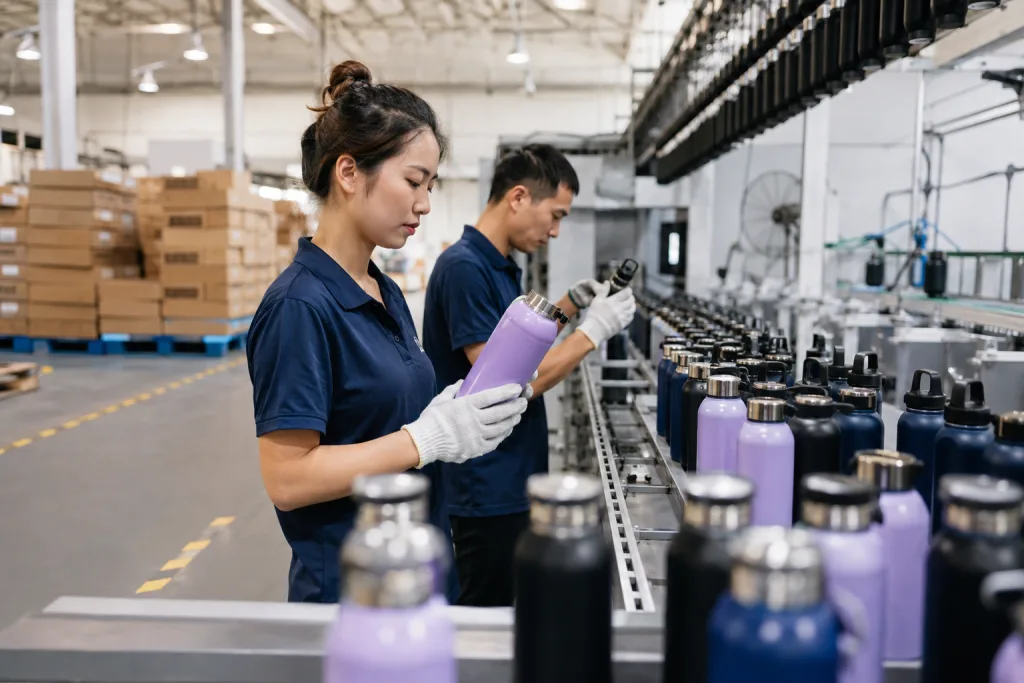
At BottleForge Industrial in Hangzhou, Zhejiang, we see this with new buyers from Europe and North America all the time. They ask for a quote, compare FOB China pricing, then find the spec was too thin after the PO is already signed. Our line can run 450,000 units per month, but speed means nothing if the drawing, test plan, and approval gates are set before mass production starts. QC pulled a sample last week with a 0.3 mm gap at the lid seat, and that kind of miss is the wrong thing to discover after tooling is locked.
Where bottle programs actually fail
Buyers usually start with unit price. Fair enough. A 500 ml single-wall stainless custom canteen may quote at USD 1.55 to 2.20 FOB China, while a vacuum insulated 18 oz bottle can land at USD 3.20 to 5.80 depending on lid, coating, and decoration. The gap looks like the main issue. It is not. We see the real damage later: rework, claim handling, launch delays, and dead stock from loose specs.
For manufacturer water bottles, the failure points are the same every season:
- Functional failure: leaks, poor insulation, cap cracking, straw blockage, odor retention.
- Visual failure: logo misalignment, color drift, orange peel coating, dented rims, weld marks.
- Compliance failure: missing REACH data, incomplete LFGB or FDA reports, unverified paint chemistry.
- Packaging failure: weak master cartons, barcode errors, missing FNSKU, insufficient drop protection.
- Project failure: optimistic lead times, unclear artwork approval, tolerance changes after tooling.
If you are sourcing from a canteen factory or canteen supplier in Zhejiang or elsewhere in China, treat the PO as an engineering file, not a shopping list. We run this with a product drawing, material grade, finish standard, logo method, packaging spec, test plan, AQL level, and approval checkpoints. On one 304 stainless run, QC pulled the sample and found a 0.4 mm lid gap that never showed up in the catalog shot. That kind of miss turns into a claim later. This applies whether you buy custom drinkware for a promo campaign, a retailer private label line, or a distributor drinkware program.
New buyers often think one sample proves the job. It does not. A pre-production sample proves appearance. A controlled pilot run proves the line can hold the spec. Ask for both if the order value justifies it. We have seen this go sideways on a USD 15,000 order because the PO had a barcode typo and the carton pack count was never locked. One extra approval stage costs less than a post-shipment dispute.
Leaks start with loose tolerances
A bottle that leaks 2% of the time is not a small problem. It turns into returns,客服 tickets, and repacks. Most leak issues do not come from one bad operator. They come from tolerance stack-up across three parts: bottle neck, lid thread, and gasket. Add a straw assembly or flip spout, and the risk climbs fast. We have seen a 0.2 mm neck drift wipe out a whole run.
When you source manufacturer water bottles, ask your canteen manufacturer or canteen vendor for actual neck finish dimensions and cap torque guidance. Do not accept vague wording like fits securely. The buyer flagged that line on a PO once, and they were right. A practical spec might include neck thread tolerance of ±0.15 mm, silicone gasket Shore A hardness 50-60, and closing torque range of 8-12 kgf·cm depending on lid type. For sports lids, specify cycle testing too. The math does not work without it.
What to require before mass production
- 24-hour inverted leak test on filled samples at room temperature
- 2-hour side-lay leak test for straw and flip-top lids
- 500 to 1,000 open-close cycle test for hinged caps
- Dishwasher disclaimer clearly defined if the lid is hand-wash only
- Spare gasket plan for orders above 10,000 pcs
For a custom canteen or customizable canteen sold into retail, define the force for one-hand opening and straw pull-out resistance. We run this check on the line with a spring gauge, not a guess. If the bottle is for children, ASTM-related safety considerations matter more, especially detachable small parts. A distributor canteen program that skips this will spend more on service tickets than it saves on tooling.
A leak complaint is usually a specification complaint that showed up late.
If you are buying customized drinkware for e-commerce, ask for a random in-line leak test and a final pre-shipment leak test under AQL. We commonly recommend AQL 2.5 for major defects and 4.0 for minor defects on bottles. QC pulled the sample on one Amazon order and found a lid warp at 1.3 mm; that batch never should have shipped. If your customer is an Amazon seller, carton orientation, polybag warning labels, and FNSKU placement belong in the same control sheet as the leak test, not in separate email threads.
Material shortcuts show up after launch
One easy way for a canteen supplier to make a quote look sharp is to leave the material line vague. Stainless steel is not enough. For custom drinkware, write the grade, thickness, and which parts are excluded. Most export buyers want 18/8 stainless steel, also called SUS304, for the body and inner wall. Some lower-cost parts, such as filter pieces, may use another grade, but that needs to be written into the spec. We have seen a PO typo turn “304” into “403”; QC pulled the sample and caught it before the line ran.
A proper spec for insulated manufacturer water bottles should read like this: inner wall SUS304 0.4 mm, outer wall SUS304 0.5 mm, copper coating on the outer side of the inner liner when thermal performance calls for it, food-contact PP lid, LFGB-grade silicone gasket. If you only write double wall bottle with logo, the buyer has no leverage when the factory swaps parts. That is the wrong question to ask.
Material shortcuts create several field failures:
- Rust spots: usually from lower-grade steel, contamination, or poor passivation handling on the line.
- Poor heat retention: thin walls, weak vacuum rate, or no copper layer where the drawing promised it.
- Metal taste or odor: contamination in production or poor cleaning before packing.
- Cracking lids: brittle plastic resin choice for cold-weather use, often after a 2-meter drop test.
For a customizable growler or custom growler, the risk is higher because the vessel is larger, heavier, and often sees carbonation or frequent open-close use. If you need a growler for beer, cold brew, or functional beverages, state clearly whether the container is for still liquids only. A 64 oz growler looks simple on paper, then the buyer flags pressure use and the math stops working. Most standard stainless growlers are not pressure-rated containers.
Ask your canteen factory for incoming material control records and migration test documentation. Buyers in Europe may request REACH and LFGB evidence; North American buyers often ask for FDA food-contact declarations and California Proposition 65 screening where relevant. A serious canteen manufacturer in China should already know this paperwork path. If they say they can provide it after shipping, assume delay risk now, not later. We ship around that problem every season, and it still turns into a 12-day delay instead of an 18-day delay.
Decoration fails faster than the bottle
You can have a structurally good bottle and still ship a bad product if the finish gives out first. On custom canteen orders, decoration is where the spec gets fuzzy. The buyer says matte black, Pantone match, laser logo, premium feel. The line hears commercial tolerance. That gap creates disputes, and we see it all the time.
For customized canteen and canteen promotional orders, lock the decoration method to each SKU. We run powder coating, spray painting, silk screen, heat transfer, water transfer, digital print, and laser engraving on different lines, and each one fails in a different place. Powder coating chips at the bottle base or thread start. Silk screen scratches under abrasion. Laser engraving changes depth and contrast. Digital print drifts from batch to batch. That is the wrong question to ask if the method is not fixed first.
Put numbers around the finish:
- Color tolerance against approved standard under D65 lighting
- Logo position tolerance, for example ±1.5 mm vertically and ±2 mm rotationally
- Cross-hatch adhesion requirement for painted surfaces
- Rub test count, such as 50 dry rubs and 20 wet rubs minimum
- Salt spray expectation if you have metal exterior trims
For premium retail custom drinkware, ask for one golden sample and have both sides seal it. Then state that the production lot must match that sample within the agreed commercial tolerance. QC pulled the sample on one job and found a 0.8 mm logo shift the buyer would have flagged on shelf. That matters when your canteen distributors reorder six months later and want the same look, same shelf line, same box.
Do not skip base protection. A lot of coating complaints come from carton friction, not the coating itself. If bottles sit in divided cartons without base pads, transport vibration will burnish the finish. We usually push egg-crate dividers or individual sleeves for dark matte colors. It adds USD 0.04 to 0.12 per unit, but the math still beats a 5% cosmetic claim on arrival.
Compliance paperwork can stop the shipment
The bottle can be ready and still miss the ship if the paper trail is loose. We see this with buyers who split orders across several canteen suppliers and assume the compliance file is standard. It is not. A factory declaration, a material report, and a SKU-level test file are different animals.
For manufacturer water bottles sold into Europe and North America, map the file set before deposit payment. We run this check on the line before we release a PO. A normal pack can include a material declaration, food-contact test reports, REACH screening, LFGB or FDA paperwork by market, a carton test record, and, when the customer asks for it, BSCI or other social audit records in the file. If your buyer team works to ISO-aligned procedures, ask for the factory QC flow and the corrective action format too.
Compliance failures look dull until they kill a vessel booking:
- Test report cites a similar item, not your actual SKU
- Lab report has expired or names a different supplier entity
- Colorant or coating report is missing for decorated parts
- Packaging leaves out market-specific warning text
- Barcode and country-of-origin marks do not match
If you are buying from a canteen manufacturer in Zhejiang, state the destination market on day one. We have seen the buyer flag a carton typo late because the EU art file used US warning copy. A factory in China can build the same bottle three ways depending on German retail, US promo, or Canadian e-commerce. The test route changes, the carton marks change, and the insert language changes too.
Our rule is simple: no mass production before the compliance path is approved. That does not mean every final report must land before assembly starts, but the material stack and test plan need to be locked. If you skip that gate, a painted lid or silicone colorway may need a new test, and then ETD slips by 12 days, not 2.
Packaging errors damage margins quietly
Packaging mistakes rarely show up in the quotation comparison. They show up when your warehouse team starts receiving crushed cartons, mixed sizes, wrong labels, or units that cannot ship to FBA without relabeling. We have seen a buyer lose two weeks on one PO because the carton mark said 24 pcs, the packing list said 20, and QC pulled the sample from the wrong box. For a canteen distributor or distributor growler program, that is where margin leaks out.
Start with transit basics. A 20 oz insulated bottle is heavy enough that weak export cartons fail under stacking load. Ask for master carton burst strength or edge crush spec, carton dimensions, gross weight, and the pallet plan. If the factory suggests 36 pcs per carton to save freight but the carton gross weight hits 19 kg and corner crush rises, the math does not work; you save USD 0.03 per bottle and pay it back in damages. We run this check on the line before the first full pack-out.
For customized growler and manufacturer water bottles, define packaging at unit, inner, and outer carton level:
- Individual polybag, tissue, or EPE sleeve requirement
- Gift box structure and board grade if retail presentation matters
- Master carton drop test, usually 76 cm for export validation
- Barcode location, carton mark layout, and scan test
- Pallet height and overhang rules for your warehouse system
If you sell through Amazon, add FNSKU placement, carton content labels, and appointment timing to the spec sheet. If you ship to a distributor drinkware network, ask whether they need assortment labels, lot coding, or retail-ready shelf cartons. The buyer flagged this on a 3,000-unit order once, and we had to rework 48 cartons because the labels sat 15 mm too low. Your canteen factory should not guess these details.
At BottleForge Industrial, we push buyers to approve a packaging sample, not just a product sample. It adds a few days in Zhejiang, but it prevents weeks of warehouse friction later. For most bottle programs, lead time runs 35 to 45 days after sample approval. If custom gift boxes or molded inserts are involved, add 7 to 12 days. Better to catch a wrong insert fit on our table than after the shipment lands.
Spec the process, not just the product
The best protection against failure is not one final inspection. It is a buying process that forces problems to surface early. Whether you work with canteen manufacturers, a canteen distributor developing private label, or a canteen supplier for promotional goods, the rule is the same: lock the critical points before volume. On our line, a 0.5 mm logo shift is enough to trigger a hold.
Use a simple approval ladder:
- RFQ stage: confirm material, capacity, MOQ, decoration method, packaging concept, target price, Incoterm.
- Sample stage: approve shape, color, logo, and hand feel.
- Pre-production stage: approve full spec sheet, QC checklist, carton marks, barcode file, and compliance route.
- In-line stage: check first articles, welding quality, coating consistency, leak test records.
- Pre-shipment stage: verify AQL result, packing ratio, photos, and document pack before balance payment.
For a lot of custom canteen projects, MOQ starts at 1,000 pcs per color per size for existing molds. Once you add a new lid, a mixed color run, or a custom gift set, 3,000 pcs is the number that usually makes sense. We’ve seen buyers push for 200 pcs with full customization and a rock-bottom FOB China price; the math does not work. Ask what got cut: Pantone control, dedicated screen setup, carton print, or inspection depth.
A capable canteen vendor in China should talk about vacuum yield, leak defect rate, and rework handling without getting defensive. Ask straight questions. What is the normal insulation test sample size? How is vacuum loss checked? What is the historical complaint rate on this lid family? QC pulled the sample before lunch, and that tells you more than a brochure.
If you are still comparing canteen suppliers, judge them on the questions they ask back. The supplier who asks about REACH, AQL, drop test, and barcode rules is usually the safer call than the one sending only a cheap quote. On manufacturer water bottles, the cheapest unit is often the most expensive program. We ship plenty of those, and the buyer flagged it after the first carton count was off by 24 pcs.
Send your bottle spec for a hard review
We will flag leak, coating, packaging, and compliance risks before you place the PO, with workable MOQ, lead time, and FOB China guidance.
Frequently asked questions
What MOQ should I expect for custom manufacturer water bottles?
For existing bottle molds, a realistic MOQ is usually 1,000 pcs per size per color, with logo decoration included. Simpler silkscreen projects may work at 500 pcs if packaging stays standard, but color and print setup costs raise the unit price. For insulated bottles with custom lids, gift boxes, or mixed accessories, 2,000 to 3,000 pcs is more typical. If you need a fully customized canteen body mold, tooling can start around USD 2,500 and move much higher depending on complexity. Always ask whether MOQ is based on SKU, colorway, or total order quantity. In China, some factories quote low MOQ but quietly remove carton customization, strict Pantone control, or pre-shipment inspection depth.
How do I check whether a canteen manufacturer is controlling quality properly?
Ask for the factory’s QC plan, not just a promise. You want incoming material checks, in-line inspections, leak testing, final AQL inspection, and corrective action records. A practical standard for drinkware is AQL 2.5 for major defects and 4.0 for minor defects. Ask what they record for vacuum performance, cap torque, logo position tolerance, and carton drop testing. For insulated bottles, request actual heat retention data, for example from 95°C fill temperature measured after 6 and 12 hours. Also ask for complaint rate by lid family if they have repeat export history. A factory in Zhejiang that can explain defect categories clearly is usually more dependable than one that only sends polished sample photos.
Which compliance documents do European and North American buyers usually need?
It depends on the market and the bottle construction, but common requests include food-contact declarations, REACH screening, LFGB-related testing for Europe, and FDA-oriented documentation for the US. If the bottle has painted or powder-coated surfaces, make sure the decorated parts are covered, not only the bare substrate. Many buyers also request BSCI audit records for their supplier files and packaging test records for transit validation. If you sell through major retail or import under a private label, ask your lab or compliance team to review the exact SKU before production starts. Do not rely on a report from a similar item. One mismatched lid material or silicone color can force re-testing and delay shipment by 7 to 14 days.
What lead time is normal for custom drinkware from China?
For standard models with custom logo and export packaging, 35 to 45 days after sample approval and deposit is normal. If you add a new lid color, special powder coat, gift box, or multi-pack retail set, lead time can move to 45 to 55 days. New tooling adds more. Sample development typically takes 5 to 10 days for simple logo work and 10 to 20 days if there are structural changes. Around Chinese holiday peaks, especially before Lunar New Year, add buffer time. Ask your canteen supplier whether lead time starts from artwork approval, sample approval, or deposit receipt. Those are not the same date, and many buyer schedules slip because that point was never written down.
What price range should I budget for custom canteen or growler orders?
For FOB China pricing, a basic single-wall stainless bottle often lands around USD 1.55 to 2.20 depending on size, print, and packaging. A vacuum insulated bottle is more often USD 3.20 to 5.80. A larger custom growler or customizable growler with handle lid and gift packaging can run from about USD 5.50 to 9.50, especially if the order quantity is under 3,000 pcs. Decoration method matters: laser engraving is usually more stable, while full-wrap print raises cost and defect risk. Carton and gift box choices can add USD 0.10 to 0.80 per unit. When comparing canteen vendors, always line up the same wall thickness, lid type, and packaging level before judging price.