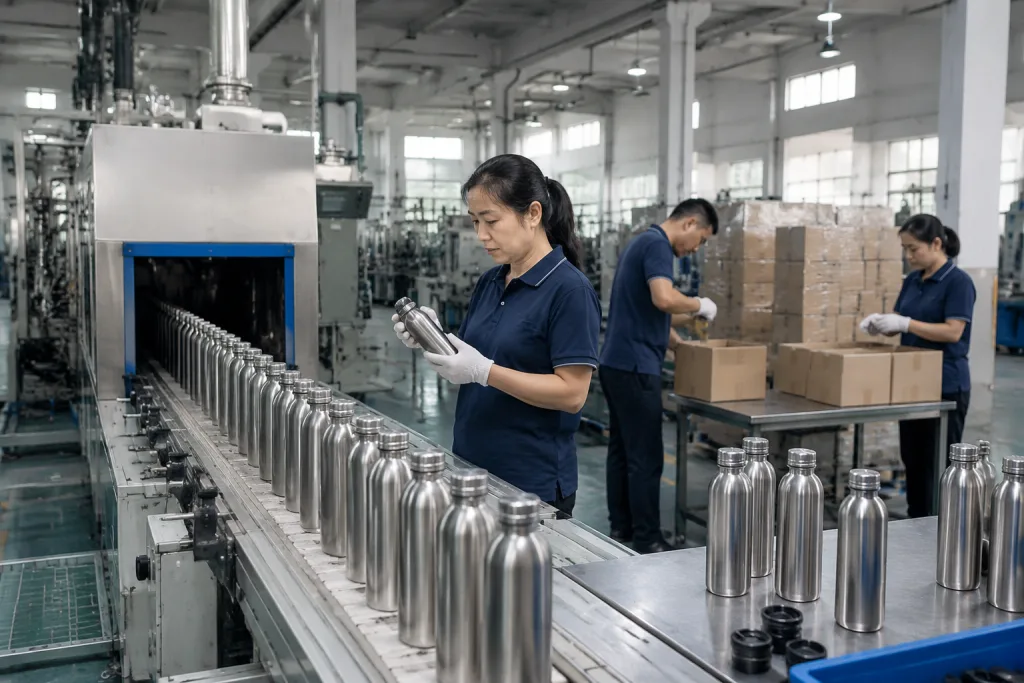
Key Takeaways
- For a 600ml double-wall stainless bottle, realistic MOQ is often 1,000 pcs per color and 3,000-5,000 pcs per model for custom tooling-free production
- A pre-production sample usually takes 7-12 days, while bulk lead time from Zhejiang factories is commonly 30-45 days after deposit and artwork approval
- Use AQL 2.5 for major defects and AQL 4.0 for minor defects, with leak, drop, coating adhesion, and carton drop tests written into the PO
- FOB China unit pricing for a standard 18/8 insulated bottle often lands around USD 2.90-5.80 depending on size, coating, lid type, and logo process
You need a manufacturer water bottle partner, not a catalog full of vague promises. The hard part is not finding a canteen manufacturer in China. Zhejiang alone has hundreds. The hard part is turning a sketch, logo file, compliance requirement, and target cost into a product that lands on time and passes inspection. We have seen a 0.5 mm wall spec turn into a packing dispute. One missed detail, and you pay later in rework, air freight, chargebacks, or dead stock.
A typical buyer order looks simple: 8,000 branded bottles for a retail launch or distributor canteen program in Europe or North America. Then the real questions start. Which steel grade, 304 stainless or something else? What wall thickness, 0.4 mm or 0.6 mm? Is the powder coat durable enough after 50 rub tests? What is the real MOQ by color? Can the canteen factory meet REACH, LFGB, or ASTM where needed? The buyer flagged the PO once because the cap code was typed wrong. This is how you should walk the order from RFQ to final QC.
Start with the order brief
Picture a procurement manager at a North American outdoor brand. The brief is 8,000 units of a 600ml insulated bottle for a fall launch, split into 4 colors, each with a one-color logo and retail box. The target landed cost leaves room for a FOB China price under USD 4.20. That is enough to open the call, not enough to get a quote you can trust from a canteen supplier.
A serious manufacturer water bottle RFQ should lock down these points before you compare prices:
- Body material: 18/8 stainless steel interior, or 18/0 if lower corrosion resistance is acceptable for dry-use items.
- Construction: single wall or double wall vacuum insulated.
- Capacity and weight: 600ml nominal, with a tolerance such as plus or minus 3%.
- Wall thickness: for example 0.4mm inner and 0.5mm outer body.
- Lid structure: screw lid, straw lid, chug lid, bamboo cap, carry loop.
- Finish: powder coat, spray paint, UV print, silkscreen, laser engraving.
- Compliance: REACH for EU, LFGB where requested, FDA contact compliance for US, CPSIA or ASTM if sold to children.
- Packaging: polybag, egg-crate divider, color box, master carton limits, FNSKU sticker if going to Amazon FBA.
Leave those out and the line starts guessing. One canteen vendor quotes a thin single-wall bottle, another prices a heavier insulated body, and the spread looks like margin until QC pulls the sample and the buyer flags the spec mismatch. In Zhejiang, China, we see buyers lose 8% to 15% of budget on this mistake. The math does not work.
If the program covers more than one SKU, say a custom canteen, custom growler, and travel tumbler run, ask each canteen factory for monthly capacity by category. A factory saying yes to everything may still only run 80,000 insulated bottles per month and push growlers out to a subcontractor. That is the wrong question to skip, because consistency and QC responsibility sit on the line with the actual producer.
What the quote should really show
Once the RFQ is tight, the quote should be tight too. You are not buying a photo. You are buying a process with cost drivers, and a serious canteen manufacturer or distributor drinkware sourcing team should show them line by line.
For a standard 600ml vacuum bottle from China, a useful quote often includes:
- Unit price FOB Ningbo or Shanghai: for example USD 3.35 based on 5,000 pcs.
- MOQ by body color: 1,000 pcs per color is common for powder coating.
- Logo setup: silk screen plate USD 35-60 per color, laser no plate charge but slower throughput.
- Packaging cost: plain white box included or retail color box at USD 0.18-0.45.
- Sample charge: USD 80-150 refundable on bulk order.
- Tooling cost: zero for stock mold, USD 2,000-6,000 if you insist on a customized canteen body or proprietary lid.
- Lead time: 7-12 days for pre-production sample, 35 days for bulk after deposit.
This is where we ask the hard questions. Is the quoted steel 304 inside and outside, or 304 inside and 201 outside? Is the lid polypropylene, Tritan, or ABS? Is the gasket silicone, and what hardness? Is the powder coat food-contact relevant anywhere? What percentage of the order is expected overrun or underrun? Most factories in Zhejiang, China work with plus or minus 5% quantity tolerance unless the PO states otherwise; QC pulled a sample at 52.8 mm neck finish and the buyer flagged it because the drawing said 53 mm. The math does not work if the quote leaves that out.
You should be suspicious of a quote that is both the cheapest and the least specific. Low price without structure usually means hidden changes later.
For canteen customizable projects, also ask whether art placement is manual or jig-controlled. On a canteen promotional order, the line can hold 2 mm on one side and drift 4 mm on the next if the fixture is loose, and that is enough for a buyer to reject goods even when the bottle itself is sound.
Sampling before you approve production
Your sample stage has to answer three things: does the bottle look right, does it work right, and can we run it the same way at scale. A lot of buyers treat the sample as a color check. That is the wrong question to ask for custom drinkware.
The usual sequence is stock sample, then pre-production sample, then golden sample signed off for mass production. We run the stock sample first to check shape and hand feel. The pre-production sample is where your actual color, logo process, packaging, and any canteen customized feature get tested. The golden sample is the reference our QC team pulls on the line when inspection starts.
For an 8,000-unit order, I would check these points on the pre-production sample:
- Actual capacity test at brim-full and usable fill line.
- Weight tolerance, such as 320g plus or minus 10g.
- Leak test after 30 minutes inverted.
- Vacuum retention if insulated, such as less than 10 degrees C rise over 6 hours in a controlled test.
- Color match against Pantone with realistic tolerance, especially on textured powder coat.
- Logo adhesion after tape pull and 100-rub test.
- Lid threading smoothness and torque consistency.
- Barcode, FNSKU, carton marks, and country-of-origin print.
If you are buying a customizable growler or customized growler with a handle lid, ask for filled-weight confirmation. A 1.9L growler that feels fine empty can turn awkward once filled. We saw that go sideways on a 1,200-piece batch last year, and the buyer flagged it before booking the ship. If you are a canteen distributor serving retail chains, carton dimensions and pallet utilization matter as much as unit price.
At this stage, good factories will tell you the process limits plainly. A laser logo on curved powder coat may show slight width variation. A full-wrap print can scuff more easily than a standard silkscreen. That answer beats a polished mockup every time, because the line still has to hold a 100-rub result after QC pulled the sample.
Lock the PO before mass production
Most disputes start with a thin purchase order. A PO should read like a technical agreement, not a one-line line item. If you are working with a canteen vendor, canteen suppliers network, or direct canteen factory in China, put the measurable requirements into the contract pack.
Your final PO pack should include:
- Approved artwork with dimensions and placement tolerances, such as logo centered within plus or minus 2mm.
- Bill of materials summary: body steel grade, lid resin, gasket material, strap material, finish code.
- Testing list: leak test, thermal retention, coating adhesion, drop test, carton drop test, dishwasher statement if claimed.
- Inspection plan: AQL 2.5 major, AQL 4.0 minor, zero tolerance for leakage and wrong artwork.
- Packaging standard: box style, insert type, barcode label position, carton gross weight max such as 12kg.
- Commercial terms: 30% deposit, 70% against inspection approval and copy documents, FOB Ningbo.
Do not leave these items verbal
That includes mold ownership, overrun tolerance, spare parts, and the claim window after arrival. We have seen a PO lose a tooling clause because the buyer typed “custom lid” instead of the mold number. If you developed a custom canteen lid or customized drinkware accessory, state who owns the tooling and whether the factory can sell the same part to others. This is the wrong question to leave open.
For social and compliance paperwork, request the current documents before production starts, not after. BSCI, ISO 9001, audit reports, REACH declarations, and test reports should match the factory legal name on your invoice. QC pulled the sample on one order because the report showed a different legal entity, and the buyer flagged it the same day. Plenty of canteen manufacturers can provide papers, but you want papers tied to the actual production site. At BottleForge Industrial, for example, our Zhejiang operation plans insulated drinkware in monthly batches up to 300,000 units, so capacity booking and paperwork timing are linked. If a supplier cannot tell you when your order enters the line, the math does not work.
Watch production like a buyer
After deposit, the order moves fast. Stainless tube cutting, drawing, trimming, necking, polishing, welding, vacuuming, coating, printing, assembly, and packing all leave room for drift. We run a line check at each gate. You do not need to stand over every machine, but you do need checkpoints.
A practical production control plan for manufacturer water bottle orders has three stages:
- Material check: confirm incoming steel, lid components, gaskets, and packaging before line start.
- During production inspection: around 20% to 30% completion, verify dimensions, finish, and print consistency.
- Final random inspection: when 100% packed and at least 80% boxed, inspect against AQL.
Common defects on custom drinkware are predictable. Dents around the shoulder, pinholes in powder coat, poor logo registration, dirty weld areas, weak vacuum on a small percentage of insulated bodies, and leaking lids due to gasket twist show up again and again. QC pulled the sample on a 500 ml bottle and found a 0.3 mm gap at the cap thread. That is the kind of miss that turns into a claim later.
You should ask for in-line photos and data, not only pretty production videos. Useful records include vacuum test pass rate, leak test records, logo first-piece approval, and carton drop results. If your order is urgent, ask for packed quantity by day. We had one PO with a typo on the carton mark, and the buyer flagged it before print. In China, the difference between a factory that packs 12,000 units per day and one that packs 4,000 can decide whether you ship on the booked vessel or pay storage and rollover fees.
For larger programs involving a canteen distributor or canteen distributors across regions, split shipments by SKU completion when the schedule is tight. A 40HQ container is efficient, but not if one late accessory stalls the whole launch. We have seen this go sideways on a 6-SKU run where one lid color was 3 days late. Two smaller sailings beat one blocked container.
Final inspection and shipment release
Once the goods are packed, discipline starts paying back. Final QC is not a box-ticking step. It is the last cheap chance to catch a bad lid fit, a print shift, or a barcode typo before the truck leaves the plant. We run the check against the signed golden sample and PO, not a generic template. On a 8,000-piece bottle order, that difference matters.
For an 8,000-piece run, final random inspection pulls cartons from across the lot and checks workmanship, function, labeling, and packaging. The line does not care about theory. Pass-fail rules must be set before inspection starts. If leakage is allowed as a minor defect, the math does not work. We have seen a buyer flag a 0.8 mm mouth gap and later get 3% returns. Leakage, wrong logo, wrong color assortment, or a mismatched barcode should be critical, or at minimum major with near-zero tolerance.
- Workmanship: no sharp edges, no exposed burrs, no base wobble beyond the stated tolerance, usually 1.5 mm or tighter.
- Function: 100% quick leak test on sampled units, lid fit, carry loop strength, and a torque check on threaded caps.
- Packaging: retail box print, scan test, FNSKU placement, carton marks, carton weight.
- Transit safety: carton drop test from the defined height, often 76 cm depending on carton style.
If the result sits on the border, do not release just because the vessel cutoff is close. Ask for sorting and reinspection. We ship on time when the lot is clean; we also ship late when release would just move the pain to the destination. A one-week delay is usually cheaper than claims, warehouse relabeling, or retailer penalties. We have seen this go sideways on distributor growler and canteen programs where one bad batch gets split across three customers.
Once QC passes, line up the shipping set: commercial invoice, packing list, bill of lading instructions, COO if needed, and test file copies. For North America e-commerce jobs, confirm carton labels and FNSKU before loading. For Europe, check that the outer carton marks and product declarations match. A PO typo on one carton mark can hold a container longer than the buyer expects, and customs does not care that the bottles themselves were fine.
After arrival, measure the supplier
The first shipment is not the finish line. It is the best proof you get. We use it to decide whether the supplier earns repeat business. A solid canteen supplier is not the one with zero issues. It is the one whose shipped result matches the agreed standard and who fixes problems without excuses. On our line, the first thing QC pulled was the cap torque sample, 18 samples against the spec sheet.
Measure the order against a short scorecard. Did the factory hit the agreed lead time of 35 to 45 days? Was the bulk color within approved tolerance? What was the inspection defect rate? Did the arrival shortage stay within the plus or minus 5% commercial tolerance, or was it exact? Were cartons pallet-friendly and scannable? How many customer complaints came back in the first 60 days? We once saw a PO typo turn "750 ml" into "750 pcs" on the carton art. That kind of miss tells you where the supplier is weak.
If you bought customized drinkware for retail, look at sell-through feedback too. Did end users complain about coating chips, weak carry loops, or hard-to-clean lids? If you sourced a customizable canteen or customizable growler for a promotion, did the logo still look clean after handling in transit? This is the wrong question to skip. These notes shape the second-round spec and the price talk. We have seen a matte powder coat pass AQL 2.5 at packing, then show chip marks after three weeks in a distributor warehouse.
Good buyers in Europe and North America do one more thing: they standardize what worked. They turn the approved bottle, lid, coating, print method, and carton spec into a repeatable platform. Then future custom canteen, custom growler, or canteen customized runs get simpler, cheaper, and faster. That is how you move from chasing quotes to managing a steady supply line from Zhejiang, China. We ship the next batch off the same master sample, same 304 stainless callout, same insert card, same shipper carton. Cleaner file. Fewer surprises.
Get a quote built around your exact bottle spec
Send your target price, volume, artwork, and market requirements. We will review the spec, flag risks, and quote practical MOQs and lead times from Zhejiang.
Frequently asked questions
What MOQ should I expect from a manufacturer water bottle supplier?
For a stock-mold stainless steel bottle, expect 1,000 pcs per color and 3,000 to 5,000 pcs per model as a practical MOQ. Some China factories will quote 500 pcs, but that usually means limited color choices, laser logo only, or mixed leftover components. If you need a custom lid, body shape, or exclusive mold, MOQ can rise to 5,000 to 10,000 pcs plus tooling. For a custom growler or kids bottle with more parts, the MOQ is often driven by accessory suppliers as much as the main factory. Always ask whether MOQ is based on total order, per color, per lid type, and per packaging style.
How long does a custom drinkware order usually take?
A realistic timeline is 7 to 12 days for a pre-production sample after artwork and details are confirmed, then 30 to 45 days for bulk production after deposit and sample approval. If your order includes a new mold, add 20 to 35 days for tooling and first-off confirmation. Peak season in Zhejiang and other China production hubs can add another 7 to 14 days, especially from August to November. If packaging is custom printed, check that box lead time matches bottle lead time. We often see bottle bodies finished on time while retail boxes arrive late and delay shipment by a full week.
Which tests matter most for stainless steel canteens and bottles?
For most B2B orders, start with leak testing, vacuum insulation testing for double-wall items, coating adhesion, and basic dimensional checks. For regulatory side, ask for material compliance aligned to your market: REACH and LFGB for Europe where required, FDA contact compliance for the US, and ASTM or CPSIA if the product is sold to children. AQL inspection should be written into the PO, commonly AQL 2.5 for major defects and AQL 4.0 for minor defects. If the bottle is for e-commerce, add carton drop testing and barcode scan checks. If you claim dishwasher-safe, test that claim rather than repeating a catalog statement.
Is it better to buy from a canteen factory direct or through a distributor?
Direct factory buying usually gives you better control over specs, artwork, and cost, especially above 3,000 pcs. You can discuss wall thickness, steel grade, lid resin, and QC directly with the production side. A distributor can still make sense if you need mixed categories, local stock, smaller MOQs, or faster replenishment. The tradeoff is usually less transparency on production source and less flexibility on custom details. If you work through canteen distributors, ask who owns the compliance file, who handles claims, and whether the actual China factory name can be disclosed on test documents and audit records.
What price range is normal for a custom insulated bottle from China?
For a common 500ml to 750ml double-wall 18/8 stainless bottle, FOB China pricing often falls between USD 2.90 and USD 5.80 depending on volume, finish, lid complexity, and packaging. A plain powder-coated body with one-color silkscreen at 5,000 pcs may be near the lower half of that range. Add a custom lid, retail gift box, multi-color print, or bamboo components and the price moves up quickly. Single-wall bottles are lower, often around USD 1.20 to USD 2.50. Always compare prices against exact specs, because a 0.35mm body and a 0.5mm body are not the same product even if the photos look identical.