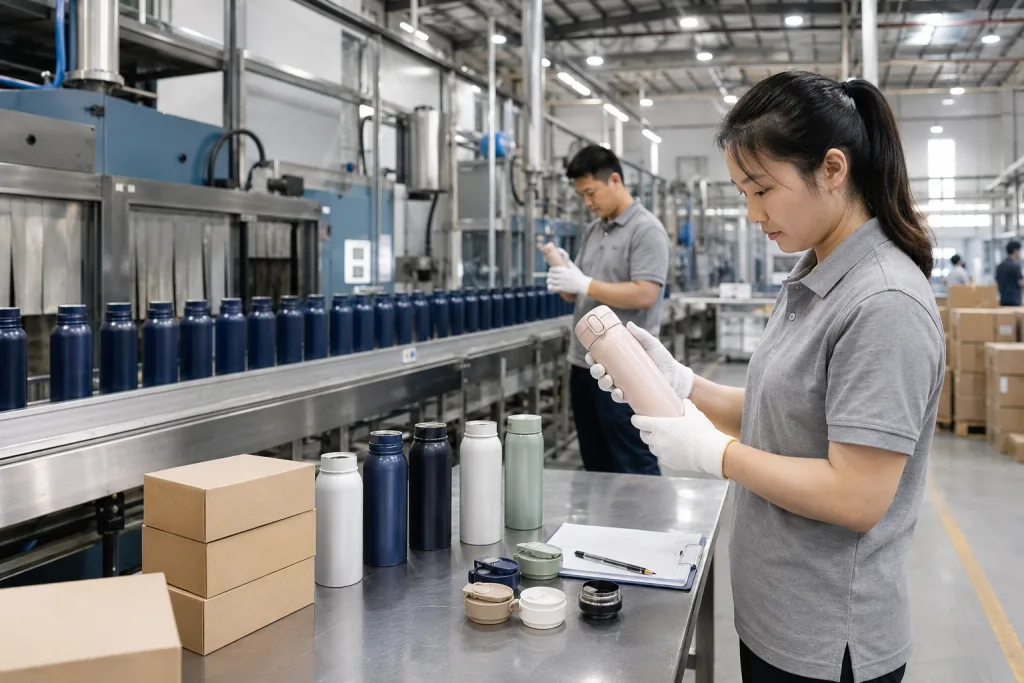
Key Takeaways
- For a 500ml stainless vacuum flask, MOQ is commonly 1,000 pcs per color, while logo-only repeat orders can start from 500 pcs
- A realistic FOB China target for a 500ml custom thermos is about USD 3.20-5.80 depending on steel grade, coating, lid style, and packaging
- Mass production lead time is usually 25-35 days after sample approval; new mold lids often add 18-25 days
- Ask for AQL 2.5 inspection, 100% vacuum test, and REACH or LFGB material declarations before deposit release
You are not buying a bottle. You are buying a stack of trade-offs: heat retention against cost, decoration against scrap, low MOQ against unit price, and speed against custom work. That is where a manufacturer vacuum flask project usually goes off track. The mistake shows up at quotation stage, not on the line. We have seen a cheap-looking quote turn into a loss after lid leaks, coating rejects, or a new retail carton for FBA added 1.2 yuan per set.
For outdoor retailers and promo brands, the decision usually comes down to four things: steel and vacuum structure, lid system, decoration method, and the production plan. In Zhejiang, we have watched buyers give up 8% to 15% of margin by mixing the wrong parts. QC pulled a sample last week with a 0.8 mm lid gap, and the buyer flagged it before shipment. That is the right problem to catch early. A solid framework lets you compare factory thermos options on numbers, not on a pretty sample alone.
Start with the four decisions
Most buyers starting a manufacturer thermos program look at shape first. That is backwards. Shape matters, but it comes after the four decisions that drive cost, scrap risk, and whether the vacuum flask ships on schedule.
- Decision 1: Usage scenario. A retail thermos for outdoor shops is a different job from a giveaway flask for a trade show. Retail needs stronger heat retention, clean shelf presentation, and fewer after-sales returns. Giveaway work pushes hard on unit cost, color count, and logo repeatability.
- Decision 2: Bottle structure. 304 stainless on both inner and outer walls is the baseline. For acidic drinks or a higher-end SKU, 316 inside can be the right call, but the price moves up. For a mainstream 500ml flask, we often run 0.4mm outer and 0.4mm inner wall. Go thinner and the line starts showing dents fast; QC pulled a sample with a flat spot after a 1.2m drop test.
- Decision 3: Lid system. Screw cap, flip lid, push button, or cup-cap all change leak control, mold cost, and complaint volume. This is the wrong question to ask after the artwork is approved. The lid decides how many returns you eat.
- Decision 4: Customization route. Silkscreen, laser engraving, powder coating, digital print, gift box, barcode label, and carton drop test each hit the quote in a different place. We have seen buyers miss a PO typo on the print position and blame the factory when the logo sits 5 mm off-center.
If you are comparing thermos suppliers in China, make every factory quote the same spec matrix. One supplier may include copper coating and a food-grade silicone seal, while another leaves both out. Then the low price means nothing. We ship a lot of sample sets, and the buyer flagged it fast when one quote was missing the sealing ring spec.
Compare like for like: steel grade, volume tolerance, heat retention method, lid material, coating system, decoration process, packaging, test standard, and shipping term.
At BottleForge Industrial in Hangzhou, Zhejiang, our rule is blunt: if the spec sheet is not clear enough for QC, it is not clear enough for purchasing. That applies whether you buy thermos bulk for retail chains or a customized thermos for a seasonal campaign. A vague BOM causes trouble on the line, and the math does not work any other way.
Choose structure before appearance
The core of any manufacturer vacuum flask is the stainless steel body and vacuum insulation system. Get that wrong, and no print, coating, or gift box will rescue the order. We run food-contact 18/8 stainless steel, also called SUS304, on the inner wall as the baseline. Many manufacturer vacuum flask buyers also specify SUS304 outside for consistency and corrosion resistance; one PO came in with “SUS304 OUTER/INNER” typed twice, and the buyer flagged it before we cut steel.
What should you ask for?
- Inner/outer material: SUS304/SUS304 is standard. SUS316 inner is an option for tea, acidic drinks, or a higher-end outdoor retail line.
- Wall thickness: 0.4/0.4mm is a common commercial spec. 0.5mm outer gives better dent resistance on premium units, and the extra 0.1mm shows up in the hand.
- Vacuum method: Ask whether the bottle includes a copper-plated insulation layer. On a 500ml body, it can lift thermal performance, especially on larger capacities with a wider shoulder.
- Heat retention test: For a 500ml bottle filled with 95 degrees C water, many retail buyers target at least 55 to 65 degrees C after 6 hours, depending on body size and mouth diameter. QC pulled the sample at 6 hours once and got 57 degrees C, which passed; the buyer still asked for the full chart.
- Cold retention: 12 to 24 hours with ice is common, but ask for the exact test protocol. The math does not work if one factory uses a full ice bath and another uses three cubes.
The trade-off is simple. Better insulation and thicker steel raise material cost and body weight. For a promotional thermos, that is usually the wrong question to ask. For a thermos distributor supplying outdoor stores, it usually is the right one. Outdoor buyers notice performance fast, and a 3% return rate will wipe out the saving on a cheap body.
Check the bottom construction and neck welding too. A bad weld can pass a first sample and fail after transport vibration on a 1.2-meter drop test. If your thermos manufacturers in China cannot state their vacuum failure rate or rework standard, keep pressing. A disciplined thermos factory should tell you whether every unit gets a vacuum check and what reject threshold they run. In our Zhejiang line, 100% vacuum testing is standard, not a premium add-on.
Lids decide complaint rates
Buyers often treat the lid as a spare part. That is the wrong question to ask. On the line, the lid is where complaints start: leaks, odor, cracked hinges, misthreading, poor flow, and a pain to clean. We have seen a 0.5 mm gasket groove turn into a full return case. If you are sourcing bulk thermos for outdoor retailers, spend more time on lids than on trendy colors.
Common lid routes
- Simple screw cap: lowest risk, lowest mold complexity, and usually the best choice for leak control and long service life.
- Cup-cap design: the classic vacuum flask format for camping and worksites. Cost is a bit higher, but buyers read it as a stronger outdoor spec.
- Push-button pour stopper: convenient for daily use, but the extra springs, seals, and hinges mean more failure points and tighter QC.
- Flip straw or sip lid: common for sport and travel, though we do not push it for very hot liquids because cleaning and scald risk get messy fast.
Spell out lid materials in the PO: PP, Tritan, stainless cap shell, food-grade silicone gasket hardness, and whether every food-contact part meets REACH, LFGB, or FDA requirements for your market. Europe and North America buyers should not leave this vague. QC pulled the sample apart once and found a gasket spec missing from the BOM; that kind of typo burns a week. China factories that export regularly can usually provide declarations and migration test support, but only after the BOM is locked early.
Leak testing belongs in the order standard. We run a 100% inverted leak test on assembled units, then random vibration and hot-water pressure checks during inline QC. If you buy a customizable thermos with multiple lid color combinations, ask how the factory controls part mix-ups. The buyer flagged it on one order because a black gasket went into a white lid. Wrong gasket installation is a classic source of field complaints.
For distributor thermos programs with repeated annual orders, it is often smarter to keep one proven lid platform and refresh only the coating or graphics. You cut tooling risk, keep spare parts compatible, and make after-sales easier. This is boring work. It protects margin, and the math works.
Decoration changes both cost and scrap
The gap between thermos custom and thermos promotional usually starts in the decoration stack. A buyer asks for a logo, then adds Pantone matching, gift box foam, laser serial numbers, and retail barcode labels. We have seen one extra process push the unit price up by USD 0.18 and add two scrap points on the line.
For stainless flasks, the main decoration options are:
- Powder coating: durable, good hand feel, and a wide Pantone range. It works well for outdoor retail. On a 500 ml body, it usually adds about USD 0.25-0.60 per unit, depending on finish and how often the color is changed.
- Spray paint: lower cost and acceptable for some promotional thermos projects. It does not hold up as well as powder coating, and QC pulled the sample when the buyer flagged early edge wear after a 1 m drop test.
- Silkscreen print: cost-effective for 1-2 spot colors on smooth areas. It fits thermos bulk orders, but the setup fee still applies, and textured coatings need a different screen mesh or the print shifts.
- Laser engraving: clean, durable, and hard to fake. It is a strong fit for customized thermos programs that need a premium brand position and a serial code on the body.
- Heat transfer or digital wrap: good for complex graphics, but registration and abrasion testing matter. A 0.3 mm misalignment can turn a sharp sleeve into a reject.
The right question is not which finish looks best on the sample table. It is which one survives truck transit, retail handling, and repeated washing. Ask your thermos supplier for adhesion and abrasion test standards before you approve the PO. For coated bodies, cross-hatch adhesion and tape tests are normal; for print, rub tests and dishwasher disclaimers should be written into the artwork sign-off.
Custom packaging needs the same control. A white box with a sticker may cost USD 0.12-0.20. A full-color gift box with EVA insert can run past USD 0.60-1.20. For Amazon or other e-commerce channels, we also check FNSKU labels, suffocation warnings, carton drop performance, and master carton weight limits under 15kg or 18kg, depending on the warehouse.
We have seen thermos quotes from China look cheap because they leave out packaging assembly labor and barcode application. That math does not work. Do not approve artwork until the dieline, print tolerance, and carton mark details are signed off; one PO typo on the carton mark can cost a full reprint.
Price benchmarks that are actually useful
You do not need the cheapest quote. You need a quote that is complete enough to predict your landed margin. For a standard 500ml manufacturer vacuum flask with SUS304 double wall body, powder coating, one-color logo, standard screw lid, and white box, a rough FOB China price band is USD 3.20 to 5.80 at 3,000 pcs. At 1,000 pcs, you may see USD 3.60 to 6.50 depending on decoration and carton complexity. We run this comparison on the line with a sample cup scale and a carton sample before we trust the number.
Why is the range so wide?
- Steel grade and body weight change the raw material cost by a few hundred grams per 1,000 pcs.
- Lid design and mold amortization change assembly cost, and a new lid can add a few thousand dollars in tooling.
- Coating line efficiency changes with color quantity and changeovers on the powder booth.
- Packaging style can add more than a first-time buyer expects, especially when the buyer flags a printed inner box and insert tray.
- Compliance testing, inspection level, and reject allowance affect real factory cost; QC pulled the sample and found one dent at AQL 2.5.
For low-MOQ custom thermos projects, be careful with “free setup” language. The setup is not free; it is just hidden elsewhere. New screen charges might be USD 25-50 per color. Laser jig fees, barcode labeling, and drop-test samples may be quoted separately. New lid tooling can run from a few thousand dollars to far more depending on complexity. We have seen buyers miss a PO typo on the logo color and eat a rerun.
A capable thermos manufacturer in Zhejiang or wider China should also be transparent about capacity. If a factory says it can produce 500,000 units per month, ask how many are vacuum flasks, how many lines are powder coating, and whether your order sits behind domestic peak-season business. A more useful metric is stable monthly output on comparable SKUs. BottleForge typically plans vacuum flask projects with MOQ from 1,000 pcs per model and lead times of 25-35 days after deposit and pre-production approval, with repeat runs often faster. That is the wrong question to ask if the plant cannot show you the packing table and the vacuum pump count.
For outdoor retail, paying USD 0.30 more for stronger coating or a proven leak-proof cap can be the right move. For a thermos vendor supplying event merchandise, that extra spend may be unnecessary. Match the spec to the channel, not to the loudest sample in the room. We ship both jobs, and the math does not work the same way.
Audit the factory, not just the sample
A polished pre-production sample tells you almost nothing about how a factory runs at 10,000 units. You need to audit the production system. That matters when you buy from thermos manufacturers or manufacturers thermos sources in China for Europe and North America.
Ask direct questions:
- Quality system: Do they run incoming inspection, inline inspection, and final inspection? What AQL level do they use, like AQL 2.5 for major defects?
- Social and process audits: BSCI, ISO 9001, Sedex, or equivalent. One audit card is not the whole story, but the factory should know what each one covers.
- Lab controls: Can they run vacuum retention checks, salt spray for coated parts, leak tests, and basic migration support through third-party labs?
- Traceability: Can they trace lids, gaskets, and cartons by lot? We check this by box code on the line.
- Corrective action: What happens if 3% of units fail leak test in final assembly? If the answer is “we sort it later,” the math does not work.
If you are buying supplier thermos or suppliers thermos offers from trading companies, that can still work, but responsibility for claims and rework has to be clear. A trader with strong QC can beat a weak factory. The problem is opacity. You should know who makes the body, who assembles the lid, and who signs off final QC release. We have seen this go sideways on a missed gasket spec, 2.2 mm instead of 2.5 mm.
For North American buyers, request ASTM-relevant testing where applicable for the product category and packaging claims. For Europe, REACH and food-contact compliance should be addressed early. If the flask is for children or sits near kid-use expectations, the test scope changes. Put the intended market statement in the RFQ. One wrong line on the PO can force a full retest.
The good factories in Zhejiang, China do not dodge these questions. They answer fast because they deal with them every day. If answers stay vague after two rounds of questions, the risk is already on the table.
Build the order plan backward
The final buying decision is not just the unit price. It is the calendar. We have seen a custom thermos order miss a launch because the buyer counted production days and forgot sample sign-off, carton confirmation, testing, booking, and customs clearance.
Work backward from the delivery date on your PO. A realistic timeline for a customized thermos order looks like this:
- 3-5 days for revised quotation and artwork check
- 7-10 days for pre-production sample with logo
- 2-5 days for your approval cycle
- 25-35 days for mass production
- 2-3 days for final inspection
- 5-10 days for export booking and port handling in China
- Ocean transit based on route, often 25-40 days to Europe or North America
If a new mold is involved, add 18-25 days for tooling and validation. Need lab testing before shipment? Add another 5-10 working days, depending on scope. On the line, a new cap mold can pass first shots and still lose time if the buyer flags a 1.5 mm logo shift on the sample.
For thermos distributors and thermos distributor buyers, a staged launch is the cleaner move. Start with one or two core colors, a standard carton, a proven lid, and simple decoration. We ship that way when the math is tight. After sell-through comes back, expand into more aggressive thermos customizable options. It cuts dead stock and keeps packaging from going obsolete.
Decide Incoterms early. FOB Ningbo or Shanghai is standard for many Zhejiang factories. If you ask for DDP too early, you blur the real factory cost and make supplier comparison messy. First validate the product and the factory; then sort freight. That order matters. A buyer once sent a PO with the wrong port code, and it cost three days before booking even opened.
A manufacturer vacuum flask project works when every step has an owner, a deadline, and a written acceptance standard. QC pulled the sample, checked the lid torque, and the order moved. That is how you turn one sample into a repeat supply program instead of a scramble.
Get a workable vacuum flask quote, not guesswork
Send your target capacity, lid type, decoration, quantity, and deadline. We will reply with a clear spec-based offer, MOQ, lead time, and testing plan.
Frequently asked questions
What MOQ should I expect for a custom stainless vacuum flask?
For a standard 500ml custom thermos, MOQ is usually 1,000 pcs per model per color from a China factory with regular export business. If you use an existing body and lid with only a logo change, some thermos supplier programs can start at 500 pcs for repeat orders. New mold lids, special Pantone powder coating, or gift boxes often push practical MOQ higher because setup loss and packaging minimums increase. If you are a promotional buyer, ask for one body with 2 to 3 stock colors rather than a fully custom shape. That typically gives you the best balance of cost and flexibility.
How do I compare quotes from different thermos manufacturers fairly?
Use one RFQ sheet and force every thermos manufacturer to quote the same line items: capacity, steel grade, wall thickness, lid material, gasket type, coating process, logo method, packaging, inspection level, test requirement, and Incoterm. Ask for FOB China pricing at the same quantity, such as 1,000 pcs and 3,000 pcs. Also request carton size, gross weight, sample fee, and production lead time. A quote that is USD 0.40 lower can become worse if it excludes copper coating, barcode labels, or 100% leak testing. The safest comparison is total delivered spec, not headline unit price.
Which tests matter most for outdoor retail vacuum flasks?
For outdoor retail, focus on heat retention, leak testing, coating durability, and food-contact compliance. A practical minimum is 100% vacuum check, 100% inverted leak test, and final inspection to AQL 2.5. For coated bodies, ask for adhesion and abrasion testing. For Europe, REACH-related material declarations and relevant food-contact support are common requirements. For North America, confirm the applicable food-contact and packaging standards for your channel. If the product claim says 12 hours hot or 24 hours cold, ask for the exact test method, starting temperature, fill volume, and ambient conditions before approving artwork.
What price range is realistic for bulk thermos orders?
A realistic FOB range for thermos bulk is broad because the specification drives cost. For a 500ml SUS304 double-wall flask with powder coat, one-color logo, and white box, expect about USD 3.20 to 5.80 at 3,000 pcs from an established China supplier. Lower-cost versions with spray finish or simpler packaging can dip below that, while premium lids, 316 inner steel, digital wrap, or gift boxes can go above USD 6.00. At 1,000 pcs, unit cost usually rises by USD 0.30 to 0.80. If a quote looks unusually low, check steel weight, leak standard, and packaging inclusion first.
How long does a manufacturer vacuum flask order usually take?
For an existing bottle platform, plan about 7 to 10 days for a logo sample and 25 to 35 days for mass production after approval and deposit. Add 2 to 3 days for final inspection and roughly 5 to 10 days for export handling and vessel booking in China. If you are developing a new lid or body mold, add around 18 to 25 days before sample approval. Ocean transit to Europe or North America often adds 25 to 40 days depending on route. If your launch date is fixed, build the schedule backward and leave at least 10% time buffer.