Key Takeaways
- Lock steel grade and wall construction first; 18/8 inner + 0.4 mm outer wall is a common baseline for 500 ml bulk thermos.
- Expect MOQ from 1,000-3,000 pcs per model/color and 25-35 days lead time after sample approval in Zhejiang, China.
- Decoration choice changes defect risk: laser has lower fallout, while multi-color silk screen needs tighter AQL control on registration.
- Ask for REACH, LFGB or FDA contact compliance, vacuum retention data, and AQL 2.5/4.0 inspection before paying balance.
You usually do not have a thermos problem. You have a margin, compliance, and delivery problem hiding inside a bottle project. Outdoor retailers need a durable item that does not come back in returns season. Promotional buyers need a custom thermos that lands at the target cost, prints cleanly, and ships on schedule. The first quote is easy. The real work is sorting which details move quality, lead time, and claims risk before the line starts.
At BottleForge Industrial in Hangzhou, Zhejiang, we see the same pattern from Europe and North America: too much attention on shape and color, not enough on steel grade, vacuum yield, decoration limits, and AQL 2.5. Last month QC pulled a sample with a 0.4 mm lip mismatch, and the buyer flagged it before packing. China has plenty of factory thermos options, and that is the problem. The right one comes down to four calls you need to lock early: body construction, insulation performance, branding method, and commercial terms.
Start with the four buying decisions
If you are sourcing a manufacturer thermos program, do not start with the lid color chart. Start with four decisions that control the whole job.
- Decision 1: body structure. Single wall is the wrong spec for this category. For a stainless vacuum bottle, run double-wall vacuum construction, usually 18/8 stainless steel, with an inner wall around 0.35-0.4 mm and an outer wall around 0.4-0.5 mm. QC pulled a shell at 0.32 mm once, and the buyer flagged it before we packed the first carton.
- Decision 2: performance target. A 350 ml commuter bottle and a 1,000 ml outdoor flask do not use the same claim language. Set a real hot and cold retention standard, for example 12 hours hot above 55 degrees C or 24 hours cold below 10 degrees C, based on fill temperature and room conditions. The math does not work any other way.
- Decision 3: branding method. A promotional thermos often lives or dies on logo quality. Silk screen, heat transfer, powder coat with laser reveal, UV print, and embossing each have different cost, scrap risk, and wear life. We run laser reveal on the line when the buyer wants a sharp mark that does not wash off after 200 cycles.
- Decision 4: commercial terms. MOQ, packaging, carton drop standard, spare lids, AQL, and Incoterms matter more than a small unit-price reduction. A PO typo on the carton count can turn a good quote into a mess, and we have seen that go sideways fast.
Outdoor retailers usually care about dent resistance, leak prevention, and repeatable color matching across replenishment orders. Promotional buyers usually care about lower MOQ, faster art approval, and a price band such as USD 3.80-6.50 FOB for 500-750 ml customized thermos programs. Those are different jobs. If your supplier thermos quote ignores that split, you are comparing numbers that do not mean the same thing.
At our Zhejiang facility, typical MOQ is 1,000 pcs per color for standard molds, monthly capacity is around 600,000 units across vacuum drinkware, and normal production lead time is 30 days after deposit and pre-production sample sign-off. We ship to that schedule when the paperwork is clean. That is the baseline we use when buyers compare thermos manufacturers in China.
Choose steel, lid, and structure carefully
The biggest buying mistake with bulk thermos is treating every stainless grade as the same. It is not. For food-contact vacuum bottles, 18/8 stainless steel, also called SUS304, is the normal choice for brand positioning and corrosion resistance. We have seen buyers try to save on the outer wall with 201, then the first salt-spray test comes back ugly. If your market is Europe or North America and you want fewer complaints, 304 on the outer shell is easier to defend.
What to specify on the RFQ
- Capacity tolerance: for example 500 ml plus or minus 3%
- Inner material: SUS304, 0.35-0.4 mm
- Outer material: SUS304 or SUS201, 0.4-0.5 mm
- Mouth diameter: 45-55 mm depending on use case
- Base diameter and height limits for cup holders or backpack pockets
- Lid material: PP, Tritan, or stainless cap with PP inner
- Seal type: food-grade silicone ring, hardness usually 50-60 Shore A
Lids deserve more attention than they get. Most leakage claims come from lid threading, gasket fit, or straw assemblies, not the bottle body. On the line, QC pulled one sample that looked fine until we hit the torque gauge: the cap started slipping at 0.8 N·m, and that is where the buyer flagged it. If the design includes a carry handle, ask how it is fixed. Ultrasonic welding, metal pin assembly, and overmolded structures fail in different ways, and the wrong choice can turn a 20,000-piece order into rework.
Cheap lids create expensive after-sales work. Saving USD 0.12 on the closure can cost you 3% in returns.
For outdoor channels, powder coat plus a simple screw cap is still the lowest-risk structure. For promotional thermos orders, we can build more fashion-driven lids, but the math does not work the same way: more parts mean more assembly labor, more leak paths, and a higher defect allowance at final inspection. One PO typo has caused this exact headache before, with the cap code mixed up and the buyer expecting a straw lid on a screw-top body. That order needed a full recheck before we could ship.
Set performance claims you can defend
Every thermos supplier talks about long insulation. Fewer can show the test sheet. Ask for it. A serious thermos factory should lock down fill temperature, room temperature, test time, and pass-fail criteria before the line runs.
For a 500 ml manufacturer vacuum bottle, we use a simple check: fill with 95 degrees C water, seal it, hold at 20 degrees C ambient, then read at 6, 12, and 24 hours. On a good body with a tight lid, you may still see above 70 degrees C at 6 hours and above 55 degrees C at 12 hours. For cold hold, start with 0-4 degrees C water or ice water; “stays cold all day” is the wrong question to ask. QC pulled the sample at 12 hours on one batch and the buyer flagged the claim because the number on the PO did not match the actual curve.
Vacuum quality is hidden once the shell is closed. Ask your manufacturer thermos source how they check it. Common factory checks are vacuum retention sampling, immersion leak checks, and spot testing after powder coating, because an oven at 180 degrees C can upset some assemblies. If a supplier cannot state reject rate or retest steps, we’ve seen that go sideways fast.
Useful tests for outdoor and promotional channels
- Leak test: inverted static test, usually 30 minutes to 2 hours, with the cap torqued the same way every run
- Heat retention: recorded temperature drop curve, not a slogan on the carton
- Salt spray: for coated parts when corrosion resistance is on the spec sheet
- Dishwasher statement: only if the print, coating, and lid parts survive repeated cycles
- Drop test: especially for retail cartons and handle designs; 1.2 m is a common starting point
Do not oversell. If your customized thermos is hand-wash recommended, say it plainly. If the bottle is not meant for carbonated beverages, print that on the insert. Clear usage limits cut complaints and protect reviews. We ship a lot of these, and the returns usually start with a typo on the spec sheet or a promise the lid cannot keep.
Branding methods change cost and fallout
If you buy a custom thermos or run thermos custom programs, decoration is where the quote starts lying. I have seen a cheap logo method turn into the expensive one after 3% rejects, rework, and a buyer holding approval for 12 days while the line waits.
Silk screen works for 1-2 spot colors on smooth shells. On our screen printer, it usually adds around USD 0.10-0.25 per unit, depending on color count and print size. Registration tolerance is the trap. On a curved bottle, 6 mm text or tight multi-color art will push fallout up fast, and QC pulled the sample for that exact reason on a 500 pcs pilot.
Laser engraving runs slower, but it holds up. On powder-coated bodies with a stainless reveal, the mark stays clean and the variation risk is low. It usually adds around USD 0.18-0.40 per unit. For outdoor retailers, this is the safer call. The buyer flagged a 0.3 mm logo shift once; laser made the issue disappear.
Heat transfer handles complex artwork and gradients. It suits promo brands that want campaign graphics on a 5,000 pcs order, but adhesion and scratch resistance depend on the coating under it. Ask for tape test and rub test standards. We ship with that check on the line because one bad PO typo, usually the wrong coating code, can sink the whole run.
Embossing or debossing needs mold changes or dedicated tooling. It only makes sense when the volume pays for the steel, and 5,000 pcs is the floor we usually see.
Ask these questions before approving art
- What is the maximum print area in mm?
- What Pantone matching tolerance is realistic on powder coat?
- Will the logo sit over a seam, curvature break, or anti-slip texture?
- What is the decoration defect allowance under AQL?
A customizable thermos for distributor thermos channels should be easy to repeat. That means approved PMS references, coating code, logo position drawing, and signed golden sample. If you reorder six months later from Zhejiang or another China production line, these records keep color drift and logo placement from turning into a fresh dispute. We have seen this go sideways when the buyer changed one Pantone note and expected the same result. The math does not work.
Price the full landed cost, not unit only
Most buyers start with FOB. Fair enough. But if you only compare the FOB unit price, you miss the cost that lands on your dock for thermos bulk projects. A 500 ml thermos manufacturer quote can sit anywhere from USD 3.20 to 5.90 FOB Ningbo or Shanghai, depending on steel grade, coating, lid structure, and packaging. That spread is normal. The real question is what sits behind the number.
Break the quote into at least seven lines: bottle body, lid assembly, decoration, packaging, test cost, tooling or setup, and spare parts. We run this split on the line before we release a PO. If a supplier thermos offer looks too cheap, one of those lines is missing, or the buyer flagged a typo on the spec sheet and the pricing never caught up.
- Packaging: white box, color box, PDQ, and mailer-safe packaging can add USD 0.18 to more than USD 1.00 per unit. We once reworked a 48 mm neck bottle because the buyer wanted retail packing that would survive a 1.2 m drop test.
- Inspection: third-party QC is small money compared with a bad shipment. Budget a few hundred dollars, not zero. QC pulled the sample on one 10,000-unit order and caught a lid torque issue before loading.
- Spare components: extra lids or gaskets at 1-2% are cheap insurance for after-sales support. A missing gasket on a PO line item is how a small claim becomes a big one.
- Carton efficiency: a poor pack-out can raise freight cost by 8-15%. The math does not work if the carton size leaves half the container as dead air.
For promotional channels, you may accept a lower-grade gift box if the campaign is short-lived. For retail, weak packaging is false economy. Ask for carton dimensions, units per carton, gross weight, and drop-test standard. If you sell through Amazon FBA, you also need labeling rules such as FNSKU placement and carton compliance. A good manufacturer vacuum bottle partner should send carton data before mass production, not after. We've seen that go sideways when the label position was left for last.
Terms matter too. Typical China terms are 30% deposit and 70% balance before shipment, with sample lead time around 7-10 days and mass production 25-35 days. If you are buying from new thermos suppliers, keep first orders simple and avoid too many custom parts. A 3-color print, a special lid, and a custom box on the first run usually turn into delay. Complexity hides cost.
Qualify the factory before you scale
You do not need the biggest factory thermos source in China. You need one that can repeat your spec without drama. Qualification should be boring and evidence-based. We run this check on the line before anyone talks about scale.
Start with the basics: business license, export history to Europe or North America, and social compliance if your customer asks for it. BSCI comes up often in buyer audits. For product compliance, ask what they can support on food-contact materials: REACH where relevant, LFGB for Germany or EU-focused programs, FDA-related declarations for the US market, and material reports for silicone and plastics. For kids or specialty use, ASTM-related requirements may enter the picture depending on the accessory design. QC pulled the sample on a 304 stainless body and found the cap gasket was the weak point, not the bottle.
A practical qualification checklist
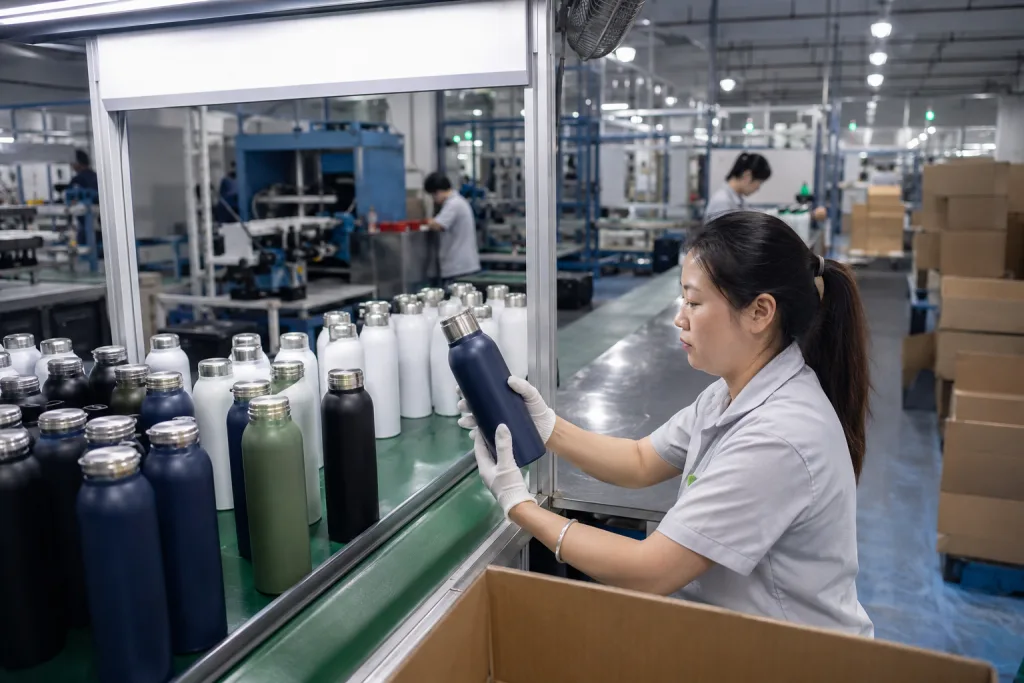
- Factory audit or live video walk-through of welding, vacuuming, polishing, coating, and packaging lines
- Documented IQC, in-process QC, and final QA standards
- AQL plan, often 2.5 for major defects and 4.0 for minor defects
- Calibration records for torque tools, thermometers, and gauges
- Corrective action examples from previous issues
Ask for defect photos, not just certificates. Good manufacturers thermos teams can show what they reject: pinholes in coating, scratches on stainless, logo misregistration, dented rims, weak vacuum, loose handles. That tells you they understand the product at production level, not just sales level. The buyer flagged a PO typo once, and the cap code did not match the drawing; that kind of miss usually shows up again in packing if nobody checks.
At BottleForge Industrial in Zhejiang, we usually recommend a pre-production sample, then a pilot lot check at 5-10% production completion for new custom thermos programs. That catches decoration or assembly drift before the whole order is packed. If your annual demand is above 20,000 units, lock a specification sheet and golden sample under revision control. That is how distributors thermos programs stay consistent over multiple POs and seasons. We have seen this go sideways when a buyer treated the pilot as optional; the math does not work once 12,000 units are already boxed.
Match the bottle to your channel
A thermos distributor serving outdoor specialty shops should not buy the same bottle spec as a thermos promotional campaign vendor. The channel sets the brief. On the line, we see this fast: a 500 ml body that looks fine in a sample can fail a drop test once the carton is only 3 mm too loose.
Outdoor retail: prioritize 500-750 ml and 1,000 ml sizes, powder coat grip, a simple leak-resistant cap, and proven vacuum performance. Buyers in this channel will accept a higher FOB if returns stay low. A realistic MOQ is 1,000 pcs per color on standard molds, or 3,000 pcs if you need special components. We put money into closure quality and carton protection before decorative work; the buyer flagged a cap torque issue at 1.2 N·m, and that was the right problem to fix.
Promotional brands: the sweet spot is often 350-600 ml, lower weight, broad logo area, and flexible packaging. Unit price is the first fight, so use standard molds and standard lid platforms where possible. If the order is event-driven, ask whether stock color bodies can shorten lead time to 15-20 days after art approval. We shipped one rush job in 18 days because the PO typo had the logo position called out twice, and nobody wanted a second proof cycle.
Distributors and importers: if you sell through multiple accounts, build a core platform first. One body shape, two lid options, three standard coatings, and two decoration methods cover more use cases than ten niche SKUs. This is how thermos distributors cut inventory risk while still offering a customized thermos range. QC pulled the sample, checked the weld seam at 0.8 mm, and the math held up.
The best supplier thermos strategy is usually boring: choose a body that is easy to manufacture, a lid that is easy to seal, and a decoration method that is easy to repeat. Fancy features are fine when they solve a real buying need. They are expensive when they only make the quote deck look interesting. If you want a manufacturer vacuum bottle project that survives second and third orders, standardize what the customer cannot see as much as what they can.
Need a manufacturer vacuum bottle quote you can trust?
Send your target size, logo method, MOQ, and destination market. We will reply with a practical spec and FOB quote within 24 hours.
Frequently asked questions
What MOQ should I expect for a custom stainless vacuum bottle?
For a standard mold 500-750 ml bottle, MOQ is usually 1,000 pcs per color and around 3,000 pcs if you need a new lid component, unusual coating, or dedicated color box. Some thermos suppliers in China will quote 500 pcs, but that often means limited color choices, stock parts, or higher unit pricing. If you need a fully customized thermos with Pantone body color, custom packaging, and logo decoration, build your budget around 1,000-3,000 pcs per SKU. For outdoor retail, that volume usually gives enough room to control coating consistency, spare parts planning, and carton efficiency.
How do I compare quotes from different thermos manufacturers fairly?
Ask every thermos manufacturer to quote the same structure: steel grade, wall thickness, capacity, lid material, decoration method, packaging, MOQ, FOB port, sample cost, tooling cost, and lead time. Then compare landed cost drivers, not just unit price. A quote at USD 3.60 FOB can become more expensive than USD 4.10 FOB if packaging is weak, defect rates are higher, or spare lids are not included. Require carton dimensions, gross weight, and AQL standard in writing. For first orders, ask for 1-2% extra accessories and a pre-production sample. That small discipline usually saves more money than negotiating another USD 0.05 per bottle.
Which logo method is best for a promotional thermos order?
For most promotional thermos projects, choose based on artwork and defect tolerance. One-color or two-color logos on smooth powder coat work well with silk screen and are usually the lowest cost. Expect around USD 0.10-0.25 per unit depending on size and colors. If you need better durability and a more premium finish, laser engraving on a powder-coated body is safer, often around USD 0.18-0.40 per unit. Heat transfer is useful for gradients or campaign artwork but needs more careful adhesion testing. If your deadline is tight, laser often reduces approval disputes because there is no color registration issue.
What compliance documents should I request for Europe and North America?
For Europe, ask about food-contact support such as LFGB-oriented testing where applicable, REACH-related declarations for relevant materials, and reports for stainless steel, PP, Tritan, and silicone components. For North America, ask for FDA-related food-contact declarations and any supporting test reports your importer requires. If the bottle includes coatings or complex accessories, ask what parts were actually tested, not just whether a generic report exists. Also request factory quality documents: AQL plan, leak-test standard, and insulation test method. Certificates alone are not enough. You want product-level evidence tied to your exact customized thermos configuration.
How long does production take for bulk thermos orders from Zhejiang, China?
For a standard model with normal decoration, sample lead time is often 7-10 days and mass production is 25-35 days after deposit and final sample approval. During peak season, especially before Q4, add another 7-10 days. New tooling, custom lids, or complex gift packaging can extend the schedule to 40-50 days. Shipping from Zhejiang, China under FOB terms then depends on your route, but your real risk is usually not ocean transit. It is approval drift on color, logo, or packaging. The fastest way to keep lead time stable is to freeze the spec early and avoid changing artwork after the pre-production sample is signed.