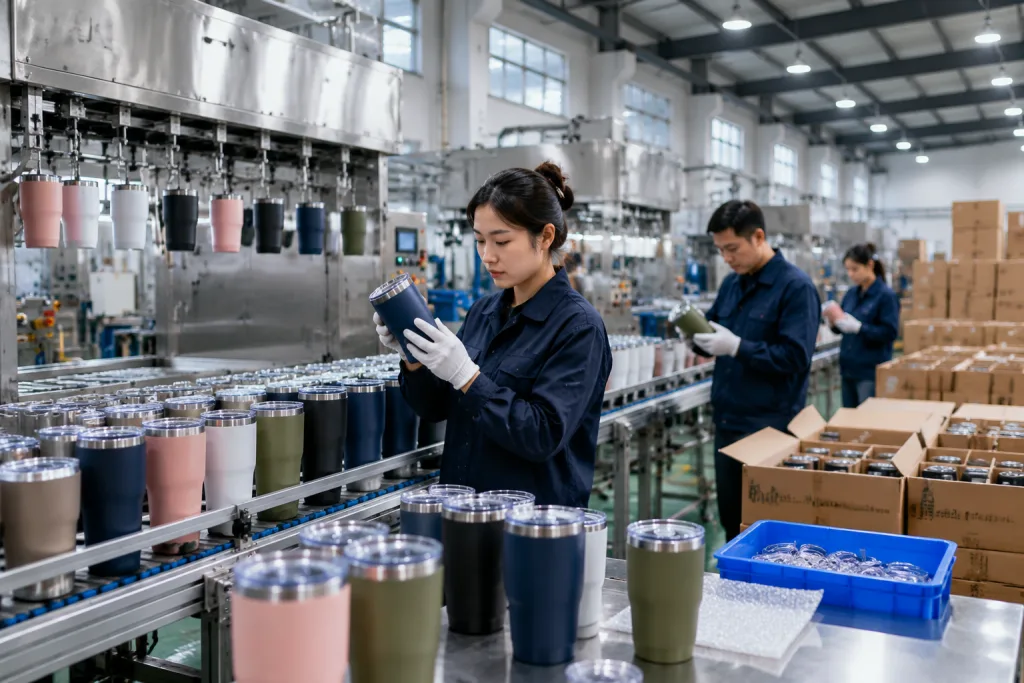
Key Takeaways
- A 20 oz double-wall 18/8 stainless travel tumbler typically lands at USD 2.85-5.80 FOB China, depending on lid, coating, and decoration
- Common MOQ starts at 1,000 pcs per color for stock molds, but custom lid or body tooling usually pushes practical MOQ to 3,000-5,000 pcs
- Normal production lead time is 25-40 days after sample approval; new tooling or complex packaging can extend total timeline to 45-65 days
- Powder coating, leak-resistant lids, gift boxes, and multi-position printing are the biggest cost drivers after stainless steel weight
You usually do not lose a tumbler order because the cup is weak. You lose it when the schedule slips: tooling lands after artwork sign-off, a lid fails leak testing at QC, or a 35-day quote turns into 58 days because print and packaging were never priced from the start. If you are buying a manufacturer travel tumbler for a coffee brand launch or a corporate-gift run, the issue is not finding a cup. It is locking cost and lead time before you send the PO.
At BottleForge Industrial in Hangzhou, Zhejiang, we run this problem every week with buyers asking for a bulk travel tumbler, a coffee mug custom made, or a coffee mug private label program. China can still pencil out, but only if you price the whole build: body, lid, finish, print, inserts, cartons, testing, and freight terms. Last month one buyer missed a 2 mm lid-change note on the drawing, and that typo on the PO became a new sample round. The math does not work if you only quote the cup.
What the base cup really costs
When you ask a manufacturer travel tumbler factory for a price, the first number is often only the shell. That is not dishonest; it is just incomplete. We see this on the line all the time. A proper FOB quote from Zhejiang or another China sourcing base should split the tumbler body, lid, decoration, and packaging.
For a standard 20 oz travel tumbler with double-wall vacuum insulation, 304 stainless steel inner and outer, and a clear AS or Tritan-style slider lid, these are the factory-direct ranges we run at 3,000 pcs:
- 12 oz to 14 oz basic tumbler: USD 2.40-3.40 FOB at 3,000 pcs
- 20 oz standard tumbler: USD 2.85-4.20 FOB at 3,000 pcs
- 30 oz large tumbler with handle or advanced lid: USD 4.30-6.80 FOB at 3,000 pcs
The spread comes from metal weight, and this is the wrong question to ask if you only compare capacity. A cup with a 0.4 mm outer wall and 0.3 mm inner wall costs less than one built with a 0.5 mm outer wall and a heavier base. On a bulk coffee tumbler program, that gap can move unit cost by USD 0.18-0.35. QC pulled the sample and weighed it at the bench, and the buyer flagged the cheaper spec in 2 minutes. If your team wants a premium hand feel, ask for the actual gram weight in the quotation, not just the ounce count.
For coffee brands buying a bulk coffee travel mug line, the cup body is usually only 65% to 78% of total ex-factory cost. The rest sits in the lid system, surface finish, printing, and carton setup. We saw a PO once with a typo on the box spec, and the correction added a full carton charge. A coffee mug factory direct offer that looks cheap can turn into a different number once you add powder coating, a metallic logo, and a retail-ready gift box.
A useful buying habit: ask every coffee mug manufacturer to quote three versions side by side—blank cup, cup with one-color logo, and cup with final packaging. That closes most of the price gap between suppliers.
The four cost drivers buyers underestimate
If you are sourcing a bulk coffee mug or bulk travel mug, four line items move the quote fastest. We run this every week, and the buyer usually misses at least one.
1. Lid complexity
A simple press-on slider lid is the cheapest route. A screw lid with silicone gasket, flip top, or leak-resistant lock can add USD 0.35-1.20 per unit, depending on material and assembly. On the line, a 2 mm gasket groove or one extra spring in the latch changes the cycle time. If you need a true leak-resistant tumbler for commuters, put the test rule in writing before sampling. We define it as no visible leakage after a 45-degree inversion for 30 seconds and no burst leak after horizontal laydown for 10 minutes. Without that, suppliers in China quote different things under the same wording, and the math does not work.
2. Surface finish
Spray paint is cheaper than powder coat, but powder coating gives better scratch resistance and a firmer hand feel. Typical adders:
- Spray color: USD 0.12-0.25
- Powder coat matte: USD 0.22-0.45
- Special texture or metallic finish: USD 0.35-0.70
For coffee mug promotional products, finish consistency matters because event buyers line up 300 or 500 units side by side and spot shade drift fast. QC pulled the sample last month and found a 1.8 ΔE swing on one batch. Ask for ΔE color tolerance if brand color matching is critical.
3. Decoration method
A one-color silk screen logo may add only USD 0.05-0.12. Laser engraving is usually USD 0.10-0.25. Full-wrap heat transfer or digital print can run USD 0.35-0.90, depending on coverage. A coffee mug customized for retail needs different decoration economics than a one-off corporate gift order. We once saw a PO typo on the logo size, 35 mm instead of 3.5 cm, and the buyer flagged it before we burned the screen.
4. Packaging
Bulk pack with egg-crate dividers is cheapest. A white box usually adds USD 0.18-0.35. A printed gift box with insert can add USD 0.45-1.10. Buyers chasing a coffee mug in bulk often ignore carton count, then freight jumps because the outer case goes from 24 pcs to 12 pcs.
If you are comparing a coffee mug supplier list or coffee mug supplier directory, make sure the quote states whether it includes desiccant, barcode label, instruction sheet, and drop-test-compliant retail packaging. We have seen this go sideways on a 304 stainless order because those small items were left out of the first quote.
MOQ tiers and where prices actually move
MOQ is not just a production rule. It is where unit cost starts to move. On stock molds from a coffee mug factory in Zhejiang, we usually quote 1,000 pcs per model and 500 pcs per color. For a bulk travel tumbler, the price steps that matter are 1,000, 3,000, 5,000, and 10,000 pcs. On the line, that is where the carton plan, coating batch, and print setup stop fighting the math.
Here is a working example for a 20 oz powder-coated tumbler with one-color logo and a standard clear slider lid:
- 1,000 pcs: around USD 4.40-5.10 FOB
- 3,000 pcs: around USD 3.45-4.15 FOB
- 5,000 pcs: around USD 3.20-3.85 FOB
- 10,000 pcs: around USD 2.95-3.60 FOB
The biggest drop is from 1,000 to 3,000 pcs. We see it every week. Material buying gets cleaner, the spray booth stays on one color longer, and pad print setup gets spread across more units. After 5,000 pcs, the savings still come, but they flatten out. If you are a coffee mug distributor serving promo accounts, do not take on dead stock just to save USD 0.12. The buyer flagged that exact pushback on a 3,000 pcs PO, and the math did not move.
Custom parts change the MOQ logic fast. A lid color matched to Pantone, a new base shape, or a handle from a new mold can push practical MOQ to 3,000-5,000 pcs, and tooling may land between USD 1,500 and USD 8,000. New stainless body tooling is the expensive part. A logo tool or a small injection tweak is a different animal. QC pulled a sample once with a 0.6 mm flash on the rim; that sort of issue is why tooling and output need to be discussed together, not in separate emails.
For coffee mug private labeling, ask for MOQ by decoration version. One body color with four logo versions is not the same plan as four body colors with one logo. A competent coffee mug oem manufacturer will split the SKU count, show which items share coating and packing, and call out what needs its own run. We have seen this go sideways when a PO typo listed four lids as one color code, then the buyer asked why the packing list did not match. If they cannot explain the split, expect trouble later.
Lead time from drawing to shipment
Lead time is where a lot of buyer guides go fuzzy. This section should not. For a manufacturer travel tumbler order using an existing mold, the normal timeline from approved artwork to FOB shipment is 25-40 days. If sampling happens before PO confirmation, total project time is usually 35-55 days. We run this every week, and the line still gets pinned up by one missing logo file or a PO typo on color code.
A workable breakdown is this:
- Quote and engineering review: 1-3 days
- Pre-production visual sample: 5-7 days
- Color or print revision: 3-5 days
- Mass production: 20-30 days
- Inspection and booking: 3-7 days
If you need new tooling, add 15-25 days for mold development and pilot verification. If the packaging is custom and retail-facing, add another 5-10 days for box proofing and transit testing. Before Q4 holiday shipping, some China factories stretch by 7-12 extra days because coating ovens and assembly tables get stacked up. The math does not work any other way.
BottleForge Industrial runs about 600,000 units per month across tumblers, bottles, and insulated mugs, but usable lead time depends on the bottleneck, not the brochure number. Powder coat lines, laser stations, and lid assembly are the choke points. QC pulled the sample at 2.1 mm print offset once, and the buyer flagged it immediately. That is why a blank cup can ship in 18 days while the same coffee mug custom order with two logo positions and a printed gift box needs 32 days.
If you sell on marketplaces, build in time for FNSKU labels, carton markings, and appointment delivery prep. A bulk coffee mug order for Amazon FBA that misses carton compliance by one line of text can lose a week after production is finished. We have seen that go sideways on a 1,200-carton shipment, and it was not a small delay.
Quality checks that protect your margin
A cheap cup that fails after arrival is not cheap. We have seen a 5000-piece order turn into a margin leak because the first carton test was skipped and the buyer only checked samples. For a bulk coffee tumbler or coffee mug bulk order, ask what quality plan is used, not just whether inspection is offered. The floor-level version is simple: incoming material check, in-process control, and final random inspection under AQL.
For most export orders to Europe and North America, a practical final inspection standard is AQL 2.5 major / 4.0 minor. That works with third-party inspectors and keeps the conversation clean when the buyer flags a defect at the PO stage. For travel tumblers, the key checkpoints usually include:
- Vacuum retention or insulation performance spot check
- Leak test for lid and seal
- Coating adhesion and scratch resistance
- Logo position, color, and rub resistance
- Thread fit and lid torque consistency
- Carton drop and barcode verification
If the tumbler is intended for food contact in the EU, ask for REACH-related conformity for applicable materials and LFGB or food-contact declarations as needed. On the line, we also check whether the lid resin matches the approved spec, because a 0.3 mm mismatch can pass a casual look and fail later. For the US market, buyers often request FDA-related material declarations and testing to applicable standards. For children’s products, ASTM and CPSIA considerations may apply, though most travel tumbler projects for coffee brands do not fall under kids category requirements.
Do not forget social and system audits if your customer requires them. BSCI expectations are common with European retail, while ISO 9001 documentation helps explain process consistency. This is where the math does not work if the factory cannot trace a bad batch back to a molding date, a lid cavity, and a QC sheet. A serious coffee mug supplier should be able to tell you what resin is used in the lid, what grade of stainless is in contact with beverage, and what batch records exist.
The most useful question you can ask a coffee mug manufacturer is simple: What are the top three defect modes on this model? An experienced factory will answer with specifics such as lid fit variance, powder coat pinholes, or logo registration shift. We had one buyer send a PO with the logo code typed wrong by one letter; QC pulled the sample, caught it, and saved a full reprint. That answer tells you far more than a polished brochure.
How to brief a factory without rework
Most delays come from the buyer side. The usual cause is an RFQ with missing specs sent to a coffee mug supplier or coffee mug factory. If you want a clean quote from a coffee mug manufacturer in China, brief it like a production engineer, not like a mood board.
Your RFQ should include:
- Capacity and target dimensions, for example 20 oz, fits car cup holder under 74 mm base
- Material callout, such as 18/8 stainless inner and outer, BPA-free lid
- Wall preference or target weight range if premium feel matters
- Lid type: slider, screw, flip, straw-compatible, leak-resistant standard
- Surface finish: spray, powder coat, gloss, matte, texture
- Decoration: silk screen, laser, wrap print, number of colors and positions
- Packaging: bulk, white box, printed gift box, master carton count
- Compliance needs: REACH, FDA, LFGB, drop test, barcode format
- Incoterm: EXW, FOB Ningbo, FOB Shanghai, or DDP if requested
- Target quantity and reorder estimate
If you are buying coffee mug custom made products for a campaign, put the delivery deadline and penalty risk in writing. We have seen buyers ask for a 12-day ship date on a finish that needs 18 days just for curing; the math does not work. The factory can tell you straight away whether stock colors are safer than custom Pantone coating. In Zhejiang, speed comes from using existing tooling and coatings, not from asking the line to promise a miracle.
For repeat programs, ask your coffee mug private label supplier to lock a golden sample and BOM. That means the body weight, lid material, coating code, logo file, carton spec, and inspection points stay fixed. QC pulled the sample before first run more than once because a PO typo changed the lid code by one digit; second orders drift fast when the paperwork is loose.
The buyers who get the best result are not chasing the lowest price. They define what cannot change, where tolerance is acceptable, and which cost lever they will trade. That is how a coffee mug customizable project becomes a stable SKU instead of a recurring headache.
Get a travel tumbler quote with real numbers
Send your target capacity, lid type, logo method, quantity, and delivery date. We will reply with MOQ, FOB pricing, and a workable production timeline.
Frequently asked questions
What is a realistic MOQ for a custom travel tumbler order?
For an existing tumbler mold, 1,000 pcs is a common starting MOQ in China, with some factories allowing 500 pcs per color inside a 1,000 pc total. The more useful commercial MOQ is often 3,000 pcs because pricing improves sharply and production is more stable. If you need a custom lid color, special finish, or retail gift box, 3,000 pcs is usually safer. If you want a new body shape or custom injection mold, practical MOQ rises to 3,000-5,000 pcs, and tooling can add USD 1,500-8,000 depending on complexity. Always ask MOQ by SKU, not just by order total.
How much does a custom logo add to each tumbler?
A simple one-color silk screen logo on a travel tumbler usually adds USD 0.05-0.12 per unit at volume. Laser engraving is commonly USD 0.10-0.25. Full-wrap transfer or digital decoration can run USD 0.35-0.90 depending on print coverage and artwork complexity. If you need two logo positions, metallic ink, or exact Pantone matching, the cost goes up again. For a coffee mug promotional order, decoration can be 3% to 15% of total ex-factory cost. Ask for artwork setup, print method, and logo durability test details in writing so you are comparing equal quotes.
How long does production take after sample approval?
For a stock mold travel tumbler, normal mass production is 20-30 days after final sample approval and deposit receipt. Add 3-7 days for final inspection, export packing, and vessel booking, so total factory lead time is usually 25-40 days. If the project includes new tooling, add 15-25 days. If packaging is custom printed, allow another 5-10 days for proofing and box production. During peak season, especially from September to November, coating and assembly queues in Zhejiang and other China factories can extend schedules by 7-12 days. Build buffer if your launch date matters.
What tests should I require for a bulk travel tumbler order?
At minimum, require leak testing, insulation verification, decoration adhesion check, and final random inspection under AQL 2.5/4.0. For lid performance, define the test method clearly, such as 45-degree inversion for 30 seconds and horizontal laydown for 10 minutes. For coated tumblers, ask for basic scratch or cross-hatch adhesion verification. If the product is for Europe, confirm applicable food-contact and REACH-related documentation; for North America, request material declarations and any market-specific food-contact compliance support. If the order is retail-packed, include carton drop testing and barcode scan checks. A written QC checklist prevents expensive arguments later.
Is FOB or DDP better when buying tumblers from China?
For experienced importers, FOB is usually the cleaner option because you control freight, customs brokerage, and landed cost visibility. Most tumbler buyers use FOB Ningbo or FOB Shanghai from Zhejiang-area factories. If you are new to importing or buying for a one-time corporate gift project, DDP can reduce coordination work, but compare it carefully because hidden logistics margins can be significant. On a USD 15,000 tumbler order, a weak DDP quote can erase your savings fast. Ask for carton dimensions, gross weight, HS code guidance, and loading quantity per 40HQ so you can evaluate shipping cost properly before choosing terms.