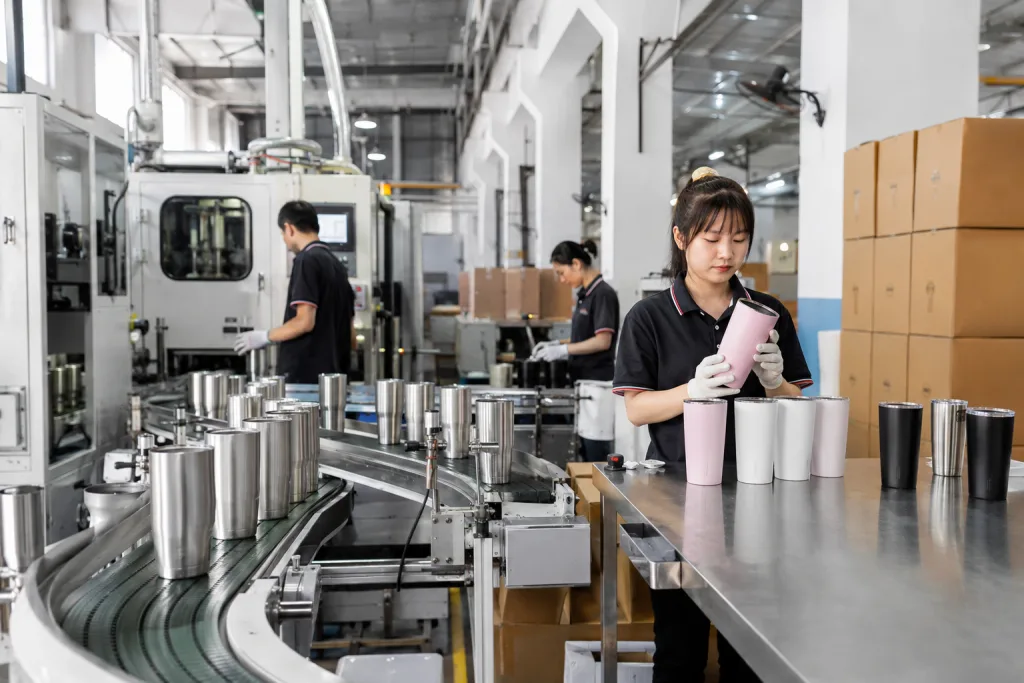
Key Takeaways
- A practical MOQ for a custom manufacturer travel mug is usually 1,000 to 3,000 pcs per color, with repeat orders often dropping to 500 pcs.
- FOB pricing for a 20 oz double-wall 18/8 stainless bulk travel tumbler commonly lands around USD 3.20 to 5.80 depending on lid, coating, and print.
- Reliable lead time is usually 35 to 50 days after sample approval and deposit, plus 7 to 15 days for pre-production samples.
- For drinkware, buyer risk often drops when specs include 304 stainless inner wall, AQL 2.5, REACH testing, and a clear leak-test standard.
You can source a travel tumbler from any catalog. The hard part is getting one that ships on schedule, clears compliance, holds heat the way the test sheet says, and still fits your target cost. That is where a lot of coffee brands and corporate-gift buyers get stuck. A clean sample means little if the lid starts leaking after 200 cycles, the print rubs off in transit, or the outer carton wastes 8 kg of air.
When you review a manufacturer travel mug quote from China, especially from Zhejiang, the real story sits in the spec sheet: steel grade, wall structure, lid resin, coating system, print method, MOQ, AQL, and packing. We run these lines every day, and the buyer usually flags the wrong item first. A 304 stainless callout with a 0.4 mm wall is one story; a vague "food-grade" note is another. Read each line against the buying impact, and you can compare one coffee mug factory direct offer with the next without guessing. That is how you cut claim rates, reduce rework, and buy with a straight face.
Start with the cup body
The first line on a spec sheet should state the body material, wall thickness, and vacuum build. For a manufacturer travel mug, the normal commercial base is 18/8 stainless steel, also called SUS304, on the inner wall. We run this all the time on bulk coffee tumbler orders for coffee brands, because acidic drinks, repeated washing, and long dwell time expose weak material fast. A cheaper inner wall saves a few cents, but the buyer flags stain risk, metallic taste complaints, and higher return rates.
For a 20 oz travel tumbler, the usual body spec is 0.4 mm inner wall + 0.4 mm outer wall. On promotional jobs, some factories in China will quote thinner walls to hit a sharp target price. Ask whether the thickness is nominal or minimum. That is the right question. We have seen 0.35 mm look fine on paper and then show denting on the line when the rim roll is weak or the carton gets crushed in transit.
- Best everyday spec: SUS304 inner, SUS201 or SUS304 outer, double-wall vacuum
- Better premium spec: SUS304 inner and outer, copper-coated vacuum layer for stronger heat retention
- Budget warning: single-wall stainless is cheaper, but not suitable for a serious bulk coffee travel mug line
If you are comparing a coffee mug manufacturer, a coffee mug supplier directory, or a coffee mug supplier list, ask for the exact steel declaration on the PI and test report, not just “stainless steel.” QC pulled the sample, then checked the mill marking and the wall gauge with a micrometer. In Zhejiang, the stronger factories will already have REACH or LFGB-related migration test experience and can tell you which models are built for Europe versus North America. A low opening quote does not tell you that.
Capacity, dimensions, and fit
Nominal capacity is a sales number. Usable fill volume is what the end customer gets in hand. A spec sheet may say 20 oz, 30 oz, or 40 oz, but you need to check whether that is brimful capacity or the fill line under the lid. For a coffee mug customizable program, that changes the drinking experience and the packaging claim on a gift set carton.
Dimensions matter just as much as ounces. Buyers for corporate gifting often chase logo area and forget cupholder fit, base diameter, and overall height. That is where the complaints start. A 20 oz bulk travel tumbler normally sits around base diameter 72 to 76 mm and height 175 to 215 mm. Push the base past 78 mm and a lot of car cupholders stop being a fit. Go too tall and the mug misses some office coffee machines and pantry dispensers.
What to confirm before tooling or artwork
- Brimful capacity vs usable capacity
- Base diameter and cupholder target
- Mouth diameter for ice cubes and cleaning access
- Net weight, usually 280 g to 420 g for 20 oz vacuum models
- Logo panel width after taper is considered
These points matter whether you are sourcing coffee mug in bulk for a retailer, a coffee mug distributor serving office supply channels, or a coffee mug promotional products program. We see the same mistake on the line: the PO says 20 oz, but the buyer flagged the lid line after the first sample came in 18 mm lower than expected. Good factories in China will send a dimension drawing with tolerance, often within plus or minus 2 mm on height and body diameter. If a coffee mug factory cannot provide that basic drawing, the math does not work and you are dealing with a trader-style process, not controlled OEM production.
At BottleForge Industrial in Zhejiang, repeat buyers usually lock in 2 or 3 body sizes and change only lids, colors, and logos. That keeps the coffee mug custom made range under control and reduces MOQ pressure across SKUs. QC pulled the sample, checked the 304 stainless body against the drawing, and the buyer approved the pack-out without another round of size debate.
Insulation numbers that matter
“Keeps hot 8 hours” is just sales copy unless the factory states the test method. A proper manufacturer travel mug spec should list starting water temperature, room temperature, fill volume, and the final reading at a fixed time. Without those details, two factories can print the same claim and mean two different results. We see that all the time on the line.
For a standard 20 oz double-wall vacuum bulk coffee mug, a usable commercial target is hot above 55 to 60 degrees C after 6 hours and cold below 10 degrees C after 6 hours, tested at room temperature around 20 to 25 degrees C. Premium builds with copper lining or tighter vacuum control can go past that. The wrong question is “what is the biggest hour count?” Ask for the exact method, the allowed production spread, and the sample size. On one batch, QC pulled the sample at 90 minutes because the plug on the base had a 1 mm gap.
When buyers skip the test protocol, they end up comparing sales copy instead of product performance.
Vacuum quality also drives yield. Weak vacuum retention means more rejects during aging tests, and that can push shipment back even when the first sample looks fine. Ask whether the factory runs 100% vacuum inspection or sample-based testing. For larger coffee mug private label orders, we usually see buyers ask for a pre-shipment report with insulation spot checks, leak checks, and cosmetic inspection at AQL 2.5 major / 4.0 minor. One PO typo on the fill volume, 450 ml written as 540 ml, wasted half a day because the test jig had to be reset.
If you sell through a coffee mug distributor network, consistency matters more than a flashy claim. End users remember a lid that leaks in a laptop bag or coffee that turns lukewarm before the train reaches the office. They do not care about an 11-hour lab line. A stable vacuum from an experienced coffee mug oem manufacturer in China beats an inflated spec every time, and we have seen that go sideways when a buyer chased a bigger number instead of a tighter process.
Lid design drives complaint rates
I’m rewriting the prose only, keeping the HTML tags and list structure intact, and tightening the wording so it reads like shop-floor buying guidance instead of generic copy.The lid drives most complaints on travel drinkware. A stainless body can be solid, then the slider, gasket, or thread cut turns the whole mug into a problem. For a bulk coffee travel mug order, read the lid spec with the same attention you give the steel spec.
Common lid materials are AS, SAN, PP, Tritan, and silicone for the seal ring. Each one changes cost and field performance. For hot-drink use in North America and Europe, a practical mid-level build is PP inner parts + AS or Tritan clear cover + food-grade silicone gasket. We run this setup a lot. If you want dishwasher resistance and better impact performance, Tritan usually earns its extra cost. For promotional gifting where the target FOB must stay below USD 4.00, basic slider lids are common, but the leak claim has to be honest. We’ve seen that go sideways fast.
Ask the factory one direct question: Is this lid splash-resistant, semi-leakproof, or fully leakproof when inverted? That wording is where a lot of claims problems start. A slider lid on a classic tumbler is often splash-resistant, not bag-safe. A screw lid with plug seal can be leakproof, but it adds cost and changes the drinking feel. The buyer flagged it, and the answer should be plain.
- Slider lid: lowest cost, good for desk use
- Flip lid: better for commuting, more parts to control
- Screw sip lid: stronger seal, slower drinking flow
- Handle lid assemblies: useful for larger bulk travel tumbler formats, but carton dimensions increase
For coffee mug customized or coffee mug custom projects, confirm that the lid survives at least 500 to 1,000 open-close cycles in internal testing. Also confirm whether spare gaskets are available. QC pulled the sample, and one missing silicone ring can turn into a full carton claim. Strong coffee mug manufacturers in Zhejiang know that. A 2 mm gasket error is enough to start trouble.
Surface finish and logo method
This is where a tumbler stops looking generic and starts reading as your brand. Surface finish drives scratch resistance, color match, and how well the logo stays put after production and use. The common choices are spray paint, powder coating, electroplating, PVD, and bare brushed stainless. On our line, powder coat is usually the safe commercial choice for a coffee mug promotional run because it gives a better hand feel, holds up better in carton friction tests, and does not push cost up like plated finishes. We usually run coating thickness around 60 to 80 microns. If a buyer asks only for the cheapest finish, that is the wrong question to ask.
Typical logo methods include silkscreen, heat transfer, laser engraving, and full-wrap digital applications. Each one fits a different job. For a coffee mug custom made for cafes, subscriptions, or retail resale, laser and clean silkscreen are still the most stable picks because there is less to go wrong on curved walls. For detailed artwork or 4-color graphics, transfer methods can work, but ask for dishwasher and abrasion results before you approve mass production. QC pulled the sample on one café order last year because the red shifted after the alcohol rub test, and the buyer flagged it right away.
Practical selection guide
- Silkscreen: low setup cost, usually 1 to 2 colors, good for coffee mug bulk programs; we normally make a positioning jig for each body shape
- Laser engraving: premium look, no ink wear, ideal on powder coat and stainless; 0.1 mm logo lines usually read cleaner than thin artwork
- Heat transfer: more design freedom, but quality depends on line control; if transfer temperature or dwell time drifts, edges can blur
- PVD body + laser: attractive for premium corporate gifts, typically adds USD 0.60 to 1.20 per unit; MOQ often starts at 1000 pcs per color
Ask for adhesion and abrasion test standards. A serious coffee mug factory direct partner should specify cross-hatch adhesion, alcohol rub, or dishwasher simulation where applicable. If your project is coffee mug private labeling for a long-term brand line, request a color standard such as Pantone reference plus acceptable visual tolerance. We ship against approved color chips all the time, but light pastel powder coat is where buyers push back most, since batch-to-batch variation shows faster than on dark matte finishes.
For buyers comparing coffee mug promotional products offers, remember that the cheapest print quote often leaves out artwork positioning jigs, curvature distortion review, and individual polybag protection. That math does not work if 3% of the logos land off-center on arrival. We have seen this go sideways from one small PO typo on logo orientation. Those small omissions cause most logo-quality disputes.
Packing, cartons, and shipping math
I’m rewriting this section in place, keeping the tag structure fixed and tightening the sales-engineer voice. I’ll preserve the specific numbers and shipping terms, and cut the generic phrasing.Outer carton efficiency is not glamorous, but it moves landed cost more than most buyers expect. A 20 oz vacuum tumbler can go 24 pcs or 25 pcs per carton, depending on the gift box and handle style. Add a color retail box and the carton cube grows, the container count drops, and ocean freight per unit can rise 8% to 20%.
For a bulk coffee tumbler program, ask for these numbers in the quotation:
- Unit net weight and gross weight
- Product size and gift box size
- Master carton dimensions
- Pieces per carton
- 20GP, 40GP, and 40HQ loading quantity
Corporate-gift buyers often need mailer-safe packing. Coffee brands usually want shelf-ready boxes with barcode labels. Those are different jobs. If you sell on Amazon, you also need FNSKU, carton marks, suffocation warning placement, and inner protection that can take a drop test. A tumbler that survives pallet loading at the distributor can still fail parcel handling. We have seen that go sideways more than once.
Lead time sits in the same buying decision. A normal custom order from China is often 35 to 50 days after deposit and artwork approval. New molds can add 20 to 30 days. At our Zhejiang operation, standard travel tumbler output reaches 300,000 units per month across multiple lines, but the real bottleneck is usually coating schedule or custom packaging, not cup forming. QC pulled the sample on a 3 mm box crush issue last week, and that sort of thing moves the ship date.
If you are building a coffee mug supplier list, look for factories that quote FOB Ningbo or FOB Shanghai clearly and say when EXW is the better call. Zhejiang suppliers usually ship through those ports, and the freight math should be plain. If it is not, the buyer flagged it for a reason.
Compliance, MOQ, and order control
The last lines on the spec sheet are the ones that protect margin: compliance, inspection, payment, and MOQ. For Europe, buyers usually ask for REACH. For the US and Canada, the file often needs California Proposition 65, FDA food-contact expectations, and, for children's items with accessories, ASTM references. For corporate gifts, BSCI or a similar social audit can come up. One SKU we shipped last quarter needed REACH plus a lid migration report; the buyer flagged the missing declaration before the PO cleared. Not every tumbler needs every test, but every project needs a written compliance path.
MOQ is where first-time buyers usually miss the point. A coffee mug supplier may quote 500 pcs, and that can mean blank stock only. True custom production with body color, lid color, and logo usually starts at 1,000 pcs per SKU, and some finishes need 3,000 pcs per color. We run into this on the line all the time: a buyer wants six Pantone lids and one logo, then the math stops working. If you need coffee mug customized assortments for campaigns, ask whether mixed lid colors or mixed logo versions can sit under one master order. That question matters more than the lowest headline MOQ.
Order control should include:
- Approved pre-production sample with signed artwork
- Written specification sheet attached to PI
- In-process checks for vacuum, lid fit, and logo position
- Pre-shipment inspection to AQL 2.5/4.0
- Clear claim window, usually within 15 to 30 days after receipt
Payment terms in China are usually 30% deposit, 70% before shipment for customized drinkware. That is standard. What matters is whether the factory can show photo records, cooperate with inspection, and repeat the same build on the next order without drifting. QC pulled the sample once and found a 1.2 mm lid gap; we stopped the run and reset the mold insert before packing. A dependable coffee mug manufacturer or coffee mug supplier is not the one with the cheapest sample. It is the one whose spec sheet survives line-by-line questions. That is how you buy a manufacturer travel mug program with fewer surprises and better repeatability.
Get a travel tumbler spec reviewed before you place
Send your target capacity, lid type, logo method, and quantity. We will review the spec line by line and quote practical MOQ, FOB pricing, and lead time.
Frequently asked questions
What is a realistic MOQ for a custom manufacturer travel mug order?
For stock-body models with only one logo print, a realistic MOQ is often 1,000 pcs per SKU. If you want custom body color, matching lid parts, and retail packaging, expect 1,000 to 3,000 pcs per colorway. Some China factories advertise 500 pcs, but that usually applies to existing stock with limited decoration. For repeat orders, MOQ may drop if the factory already holds your coating recipe, screens, and packing setup. If you are building a coffee mug private label line, ask whether mixed logo versions can run under one body color order. That can reduce inventory pressure without forcing a full new MOQ on every variation.
How much should I budget for a bulk coffee travel mug from China?
For a 20 oz double-wall stainless bulk coffee travel mug, FOB China pricing commonly starts around USD 3.20 to 4.20 for a basic powder-coated body with standard slider lid and one-color logo, at 1,000 to 3,000 pcs. A stronger lid, Tritan components, laser engraving, premium powder coat, or gift box can move pricing into the USD 4.50 to 5.80 range. Fully leakproof lids, handle assemblies, and PVD finishes push higher. You should also budget for mold charges if you need a new lid or body, usually from a few hundred dollars for small modifications to several thousand for full custom tooling. Always compare quotes on the same packing, same steel grade, and same test requirements.
Which tests should I require before shipping bulk travel tumbler orders?
At minimum, ask for leak test, insulation spot check, cosmetic inspection, barcode or packing verification if applicable, and food-contact compliance documents tied to the actual model. Many buyers use AQL 2.5 for major defects and 4.0 for minor defects on pre-shipment inspection. For Europe, REACH-related material compliance is common. For North America, buyers may ask for FDA-related declarations and Proposition 65 screening depending on channel. If the tumbler is going into parcel delivery, request a practical drop-test review on the packed unit. For logo-heavy coffee mug promotional products, add print adhesion checks such as alcohol rub or cross-hatch tape test. The key is to define pass/fail before mass production, not after cartons are on the water.
What logo method is best for coffee mug custom orders?
It depends on your channel and price target. One-color silkscreen is usually the most economical for coffee mug bulk orders and works well on powder-coated bodies. Laser engraving costs more but gives a cleaner premium result and avoids ink wear, which is useful for coffee brands and higher-end corporate gifts. Heat transfer or wrap decoration allows more artwork detail, but quality control becomes more sensitive to curvature, positioning, and abrasion resistance. If your order is for resale rather than one-off promotion, ask for a decorated sample after final coating and before mass production. Also confirm whether the print survives at least basic alcohol rub and handling tests. A cheap logo method that fails after a few uses damages your brand faster than a plain tumbler with no logo.
How do I choose between a coffee mug factory, trader, or supplier list contact?
Start with the spec response quality. A real factory or well-managed OEM partner should answer with steel grade, wall thickness, lid material, MOQ, lead time, carton data, and compliance scope in one quotation set. If a contact from a coffee mug supplier directory or coffee mug supplier list cannot provide drawings, test references, or process details, you are likely dealing with a trading layer. That is not automatically bad, but it usually means slower answers and less control over claims. Ask whether they own production, where the factory is located in China, monthly capacity, and whether they support third-party inspection. In Zhejiang, experienced drinkware factories often quote 200,000 to 500,000 units per month on core tumbler lines and can explain their coating, vacuum, and packing workflow clearly.