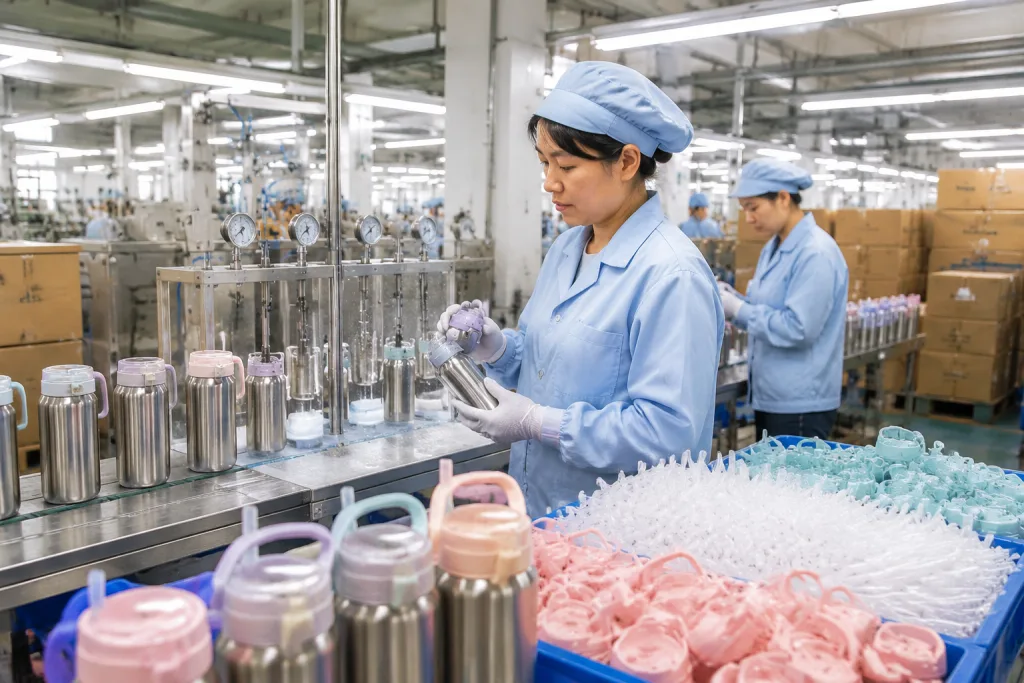
Key Takeaways
- Set measurable specs early: leak test at 30 kPa for 5 minutes, coating adhesion at 3M tape 610, and drop test from 1.0 meter on 6 faces.
- A realistic MOQ for a custom stainless toddler bottle is often 1,000-3,000 pcs per color, with 35-45 day production after sample approval.
- Use AQL 2.5 for major defects and AQL 4.0 for minor defects, plus 100% functional checks on spout, handle, and cap torque.
- For EU and North America, ask for REACH, LFGB or FDA contact compliance, CPSIA/ASTM checks where applicable, and migration reports before shipment.
You usually do not lose money on a toddler bottle order because of one big failure. It is the pileup: a straw valve that starts leaking after 200 cycles on the bend test, a handle that snaps in transit, print that rubs off after two warehouse lifts, or a lid that clears the pre-production sample and then drifts in mass production. If you buy from a manufacturer toddler bottle program in China, the real risk is not just design. It is whether you pinned down the unacceptable failure before tooling, sampling, and the line start running.
That gets sharper when the order comes from Zhejiang or wider China for retail, promo, or distributor channels. A toddler bottle takes rough handling, frequent washing, and a lot of parent scrutiny. We run about 600,000 units a month across stainless and plastic drinkware lines at BottleForge Industrial in Zhejiang, and the claims we see are usually traced to weak specs, not bad intent. One buyer once flagged a 0.3 mm gap in the lid stack-up on the PO, and that saved a repeat problem before QC pulled the sample.
Where toddler bottle projects actually fail
Buyers new to this category often treat a toddler bottle as a smaller customizable drinkware item. That is the wrong starting point. An adult sports bottle can survive a cosmetic flaw. A toddler bottle gets exposed fast. Parents spot odor, leaks, dents, hard-to-clean parts, and weak hinges on day one, and retailers see the return slip before the next reorder.
For B2B buying, split the RFQ into three buckets: appearance, compliance, and real use. A clean pre-production sample does not prove line stability. We have seen a sample pass with flying colors, then the hinge tolerance drift 0.3 mm after the first 3,000 units on the line. Plenty of canteen manufacturers and canteen suppliers can make one good piece. Fewer can hold the same fit, seal, and finish at 5,000 or 20,000 pieces. The buyer flagged it on the second carton, which is when the math stops working.
The practical way to buy is to think in failure modes. Ask what breaks, what leaks, what scratches, what goes out of tolerance, what triggers claims, and what delays customs clearance. Put each item into the spec sheet and the inspection plan. We run this with a go/no-go gauge on the cap thread and a 1.5 m drop test on packed cartons; that catches the weak spots before the shipment leaves Hangzhou.
- Design failure: weak hinge, unstable base, poor ergonomics for small hands.
- Material failure: odor in PP parts, low-grade silicone, thin 18/8 stainless walls, coating chips.
- Process failure: inconsistent welds, poor thread matching, bad print registration.
- Packaging failure: insufficient drop protection, barcode mismatch, mixed-color cartons.
- Documentation failure: missing test reports, incomplete labeling, wrong country-of-origin marks.
If you also buy custom canteen, customized growler, or general customized drinkware, do not reuse that spec sheet unchanged. Toddler bottle sourcing needs tighter functional limits and a closer look at child-use stress points. QC pulled the sample apart in less than 2 minutes on one job because the lid looked fine but the strap anchor was undersized by 0.4 mm. That is the kind of detail that saves a claim later.
Leaks start with weak interface specs
The most common complaint in a toddler bottle program is plain: it leaks. Not always at the factory. We see it after sea shipment, after the first dishwasher cycle, or after a child drops it twice on the floor. The leak usually starts at the interface between the lid, straw, spout, vent valve, and sealing ring. QC pulled one sample at 30 kPa last week and the ring shifted 0.4 mm under load.
If you leave those parts to a supplier's stock design, you are buying hidden risk. The math does not work. Lock the sealing structure and the test method in writing before we run tooling.
What to lock before tooling
- Silicone gasket hardness, usually 50-60 Shore A, with the lot code tied to the same compound spec.
- Thread engagement depth and cap torque range, for example 0.8-1.2 N.m, because loose threads show up after transport vibration.
- Valve opening force so a toddler can drink but the bottle does not free-flow when inverted, which is the wrong question to ask if the valve pops open at 180 degrees.
- Straw wall thickness and insertion retention force, checked against the mold cavity and pull test result.
For production QC in China, we normally recommend 100% inverted leak test on finished units for 3-5 minutes, then a sampled pressure test at 30 kPa. If the bottle is sold as spill-resistant rather than leakproof, put that on the pack and carton marks. The buyer flagged it on one PO because the carton said "leakproof" and the sample only passed spill-resistant criteria. That is where disputes start.
You should never approve a lid by hand-feel in a showroom sample. Approve it by torque value, leak test result, and cycle life.
For cycle life, ask for opening and closing tests of at least 2,000 cycles on the lid hinge and 500 insert/remove cycles on removable straws where applicable. A serious canteen factory or canteen manufacturer should fixture this in-house or send it to a lab in Zhejiang. We ship parts to a 2.0 mm pin gauge and a 500-cycle jig; if the supplier only says "no problem" without data, we've seen this go sideways.
This is where promo and wholesale buyers get caught. A canteen distributor or distributor drinkware program may tolerate a looser spec on adult drinkware, but toddler products need tighter functional control because end users do not handle them gently. One typo on a PO can turn "spill-resistant" into "leakproof," and that changes the claim, the test, and the liability.
Broken handles and dented bodies
The second failure mode is structural damage. Handles snap. Hinges loosen, bottle shoulders dent, and vacuum bodies deform in transit. We see it when the spec is too thin, the joining method is weak, or the pack-out is built for carton savings instead of impact.
For stainless toddler bottles, ask the factory to state the actual metal grade and thickness on the spec sheet. A workable baseline is 18/8 stainless for inner and outer walls, with outer wall thickness around 0.45-0.50 mm and inner wall around 0.35-0.40 mm. On the line, a buyer can miss this because a polished sample looks fine. The math does not work if the factory trims gauge by a few cents and you pay for claims later.
For plastic lids and handles, split the resin callout by part: PP for food-contact body parts, Tritan where you need clarity, and silicone for seals. Then write the drop test into the PO. For toddler bottle programs we run:
- 1.0 meter drop on 6 faces, 3 edges, and 1 corner with empty bottle.
- 0.8 meter drop with filled bottle where structure allows safe test handling.
- No functional failure after test: lid must close, threads must engage, and seal must remain effective.
If your channel is retail in Europe or North America, packaging carries almost as much weight as the bottle. We have seen dents show up after final inspection and before shelf placement. Specify carton burst strength, inner partition method, and pallet standard. For FOB Ningbo or Shanghai shipments from Zhejiang, claim rates often fall by 30-40% when buyers switch from loose inner packing to partitioned cell packs with top pads. QC pulled the sample, and the difference was obvious.
This discipline applies across canteen customizable, customizable canteen, and even customizable growler projects, but toddler bottles need tighter limits because a cracked handle turns into an immediate return. Any canteen vendor or canteen vendors you shortlist should show drop-test records, not just carton dimensions. The buyer flagged it in one review, and the typo on the PO was the easy part to fix.
Bad coatings, prints, and color mismatch
Decoration failures get expensive fast. They almost never stay on one bottle. If coating adhesion is weak or the oven cure is off by 15°C on the line, the same defect can run through the full lot before QC pulls the sample. Buyers spend days on Pantone approval, then skip the process that keeps that color on the bottle.
For a toddler bottle, the finish has to match the sales channel. That is the right starting point. Matte powder coat looks cleaner on shelf, but soft-touch paint gets marked in Amazon FBA cartons; we have seen scuff rings after one drop-test round with 6 bottles in one inner box. Silk screen works well on 3,000 pcs and up, but on a curved body the logo can drift 1 to 2 mm if registration is loose. Buyer flagged this before. Laser marking lasts, but the visual effect is limited, so the math does not work for every kids’ range.
Set these points before PO release:
- Master color standard with Delta E tolerance where relevant.
- Coating type: powder coat, spray paint, transfer print, or UV print.
- Adhesion method: cross-hatch test plus 3M tape 610.
- Dishwasher claim, if any, and the exact number of cycles supported.
For practical QC, ask for rub test, alcohol wipe test, and boiling water exposure checks on printed parts. We run these checks on the bench, not on paper. A common setup is a cotton cloth, 1 kg load, then 50 dry rubs and 20 alcohol rubs on the logo area. For standard exterior decoration, we recommend no visible logo loss after that. Premium programs should go higher. If a supplier answers with “passed internal test” but gives no count, this is the wrong question to leave open.
Color variation across production lots is the issue repeat buyers remember, especially canteen distributors. One powder batch to the next can shift, even when the part number looks the same on the drum label. We have seen this go sideways when the approved sample was glossy and bulk goods came out 5% lower in gloss at 60° angle reading. Keep a sealed approval sample and use it during inline inspection and pre-shipment inspection. If your order sits inside a bigger canteen promotional campaign or a broad distributor canteen assortment, lot-to-lot consistency matters more than a perfect first sample.
This is where experienced canteen suppliers stand apart from traders. Decoration control is process control. Artwork is only one piece. We check cure, film thickness, registration, and batch traceability; even a PO typo on color code can send the line to the wrong hopper.
Compliance gaps that delay or kill shipments
The worst failures are not dents or leak complaints. They are compliance gaps found after production. We’ve seen a toddler bottle pass drop and leak checks on the line, then get blocked because the wrong silicone grade was used, the lab only tested 4 parts instead of the full set, or the warning copy on the gift box did not match the target market.
For the EU, ask at RFQ stage about REACH, LFGB where relevant, and migration testing for every food-contact part. For the US or Canada, ask for FDA food-contact compliance first, then confirm whether CPSIA or ASTM checks apply based on the sales claim and packaging. This is where buyers get tripped up. A plain bottle is one case. A bottle packed with a character straw topper or child-claim accessory gets more scrutiny, and we’ve seen this go sideways over one line of copy on a color card.
Do not accept “can pass test.” That answer is useless. Ask for the exact BOM by component and the exact report scope from the lab. The lid, straw, bite valve, paint, ink, and silicone ring need to be listed where required, with material callouts such as PP, Tritan, or liquid silicone. If one 2 mm overmolded part changes after sampling, the old report may no longer cover the shipment. QC pulled the sample once, and the buyer flagged that the valve hardness had changed from 50 Shore A to 60 Shore A. The math doesn’t work if you try to ship on the old report.
- Request a component-level BOM with resin and colorant declarations.
- Match lab reports to the final SKU, not a similar bottle.
- Check labeling: age recommendation, care instructions, origin mark, and barcode placement.
- For social compliance, ask whether the site has BSCI, ISO 9001, or equivalent systems.
At BottleForge Industrial in Zhejiang, typical sample-to-report timing is 7-12 days for common chemical and migration tests, while mass production is usually 35-45 days after final approval. Build that into your launch timing. We run into the same pushback every season: the buyer wants to save 6 days by starting bulk before reports land. Then one carton mark is wrong, or one PO has a typo in the age grade, and the shipment shifts from vessel booking to relabel work. A buyer rushing a customized canteen or customized drinkware toddler bottle launch without testing slack usually pays later in air freight or relabeling.
Inspection plans that miss the real defects
Most factory inspections look active and still miss the defects that hurt sales. Cartons get counted. Colors get a glance. Dimensions get spot-checked, but no one tests straw retention, lid alignment, or leak performance after a drop from 1 m. That is a weak inspection plan, not a weak product category.
The checklist has to follow failure risk. For toddler bottles, cosmetic AQL is not enough. Use AQL for appearance, then add mandatory function checks. A common setup is AQL 2.5 major / 4.0 minor with 100% checks at critical assembly points. Critical defects should cover sharp edges the hand can reach, failed leak tests, missing parts, broken handles, and wrong compliance labels. QC pulled one batch where the gasket was 0.8 mm off-center; the carton still looked clean.
Points worth adding to your PSI checklist
- 100% cap thread engagement and gasket presence check.
- 100% inverted leak test or statistically strong inline equivalent.
- Sampled vacuum retention check for insulated bottles.
- Barcode scan verification and carton assortment check.
- FNSKU, suffocation warning, and origin mark confirmation when needed.
If the order is for Amazon, retail club, or a demanding distributor growler or distributor drinkware account, ask for inline inspection during the first 20% of production, not only final random inspection. That is when the line is still warm and the settings drift. We have seen the same mold run clean for 500 pieces, then the capping torque slips and defects start stacking.
Buyers sourcing from China should be direct here. Ask how defects are separated, how rework is logged, and whether the factory runs metal detection or visual sorting where that applies. A capable canteen supplier will give you a process answer. A weak canteen vendor will tell you quality is guaranteed and stop there.
How to spec the order before deposit
If you want fewer surprises, write a tighter purchase package. The best buyers do not send only artwork and capacity. They send a control document that leaves less room for assumption. That matters whether you buy a toddler bottle, a custom growler, or a broader customizable growler and custom canteen range from China.
Your spec pack should cover drawings, material calls, finish standards, test methods, packaging details, and defect definitions. It does not need to be fancy. It needs to be tight enough that the factory, QC, and lab all read the same target. We had a buyer flag a PO once because the body color said "blue" and the Pantone code was missing. That kind of gap turns into rework on the line.
- Product spec: capacity, dimensions, net weight, steel grade or plastic resin, wall thickness, and insulation expectation.
- Functional spec: leak standard, torque range, cycle-life target, straw retention, and drop-test criteria.
- Decoration spec: artwork file, Pantone reference, logo position tolerance, print method, and adhesion standard.
- Packing spec: inner box, master carton, barcode, pallet pattern, and carton drop requirement.
- Quality spec: critical/major/minor defect list, AQL level, and photo standard for approval.
Be realistic on the commercial side. For a custom stainless manufacturer toddler bottle program in Zhejiang or other China production hubs, MOQ is usually 1,000-3,000 pcs per design depending on lid structure and decoration. Sample lead time is often 7-12 days. New lid tooling can add 15-25 days and USD 1,500-4,000, depending on how many parts the lid carries. Typical FOB pricing can run from about USD 2.60 to USD 5.80 for mainstream stainless toddler bottles, with higher numbers for specialty lids, powder coat, or bundled accessories. The math does not work if the buyer wants a new mold, a low MOQ, and a rock-bottom unit price in the same order.
That level of detail also helps if you work with multiple canteen manufacturers or compare canteen distributors, because you are not buying promises. You are buying to a measurable standard. QC pulled the sample, checked the 0.2 mm logo offset, and the argument was over before shipment.
Send your toddler bottle spec for a factory review
We will review failure points, MOQ, FOB pricing, compliance scope, and lead time before you commit tooling or production in Zhejiang, China.
Frequently asked questions
What MOQ should I expect from a manufacturer toddler bottle supplier in China?
For a standard stainless toddler bottle with an existing body and a proven lid, MOQ is usually 1,000 to 3,000 pcs per SKU or color. If you want a fully new lid mold, lower-volume runs become less practical because tooling may cost USD 1,500 to 4,000 and the factory needs enough units to absorb setup and testing. For simple logo-only jobs, some China factories can go lower, but unit price rises quickly. If your program mixes colors in one carton or requires custom retail packaging, confirm whether MOQ applies per color, per print, or per carton assortment. That detail affects the landed cost more than many first-time buyers expect.
How do I verify a toddler bottle is really leakproof before mass production?
Do not rely on a hand sample and a verbal claim. Put the leak standard in the approved specification: inverted leak test for 3 to 5 minutes, pressure test at around 30 kPa, and repeated opening and closing cycles on the lid. For production, ask for 100% inverted leak checks or a documented inline equivalent with rejection records. Then require a pre-shipment inspection that repeats the test on random samples from packed goods. If the bottle uses a straw or bite valve, add insertion retention and valve deformation checks after hot-water exposure. A lid that passes at room temperature may fail after transport or warehouse heat.
Which compliance documents matter most for EU and North American buyers?
At minimum, ask for food-contact compliance matched to the destination market and the actual final SKU. For Europe, that often means REACH screening and food-contact migration testing, with LFGB commonly requested by buyers. For the US, FDA food-contact compliance is standard, and CPSIA or ASTM-related checks may matter if packaging or claims position the item closer to a children's product beyond simple drinkware. You also need a clear bill of materials covering stainless, PP or Tritan parts, silicone seals, paint, and inks. Reports should match the final colors and materials, not just a similar sample. Missing that detail causes avoidable delays in China export and destination-market clearance.
What defect rate is acceptable on a custom toddler bottle order?
For appearance defects, many B2B buyers use AQL 2.5 for major and AQL 4.0 for minor defects. But that is only part of the answer. On toddler bottles, critical functional points should be checked at 100%, especially gasket presence, cap fit, basic leak performance, and obvious structural issues like cracked handles or damaged spouts. In practice, you should treat leaks, sharp edges, missing parts, and wrong labeling as critical defects with zero acceptance. If the order is for retail or Amazon FBA, also add carton-level barcode and assortment checks because a clean product still creates claims if the packaging data is wrong.
How long does a typical custom toddler bottle order take from sample to shipment?
If you are using an existing bottle platform with custom color and logo, sampling is often 7 to 12 days and production about 35 to 45 days after final approval and deposit. A new lid or handle tool usually adds 15 to 25 days before production can start, plus extra time for fit correction if the first tool trial is not stable. Compliance testing can run in parallel, but you should still allow 7 to 12 days for common lab work. During peak season in Zhejiang and other China drinkware hubs, booking pressure can push mass production closer to 50 days, especially if packaging is custom.