Key Takeaways
- A 500 ml stainless thermos usually lands at USD 3.20-5.80 FOB depending on steel grade, lid, and finish
- Standard MOQ in a Zhejiang thermos factory is often 1,000-3,000 pcs per SKU, with 25-35 day lead time after sample approval
- Double-wall vacuum performance should target 12-24 hours hot and 24-36 hours cold, with test data from the factory
- For promotional thermos programs, laser logo runs are cleaner at 300-500 pcs, while full custom color often starts at 1,000 pcs
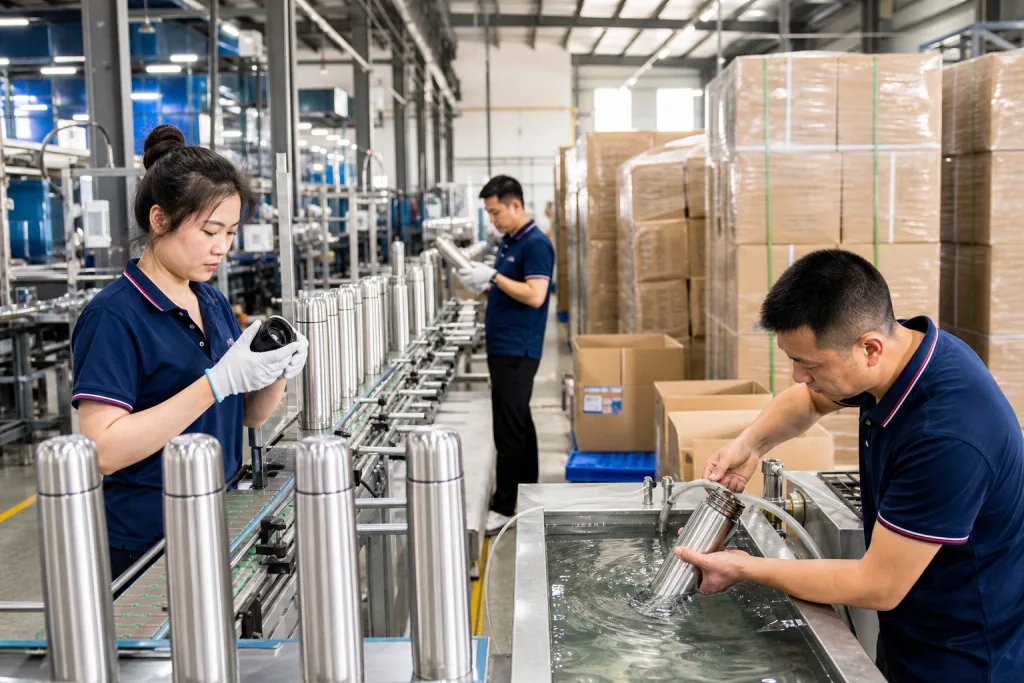
If you buy drinkware for outdoor retail or promotional programs, the wrong thermos charges you twice: first on the unit price, then again when customers return leaking lids or dead vacuum bottles. We see it on the line. QC pulled 32 samples from a 1,200-piece pilot run last month, and 5 failed the hot-water hold test after the vacuum check. A manufacturer thermos is not just a logo print. It is stainless grade and wall thickness, lid tolerance measured in mm, coating adhesion, carton drop strength, and whether the packaging protects the bottle after 18 days at sea.
In Zhejiang, where much of the stainless drinkware supply chain sits, sharp buyers do not ask for “a good thermos.” That is the wrong question to ask. They put factory thermos specs next to each other: 18/8 steel versus 304/316, 0.4 mm wall thickness versus 0.6 mm, screw lid versus push-button lid, and 500-piece MOQ versus 3,000-piece MOQ. We run these comparisons before quoting because the math does not work if a buyer wants retail-grade coating at promo pricing. If you want a custom thermos that passes retail checks and still leaves room for distributor thermos margin, ask for a clean spec sheet, a real sample, and test photos from the production floor.
Which spec wins for your use case
The cleanest way to buy a manufacturer thermos is to start with the selling channel, then lock the spec. Different job, different bottle. Outdoor retail does not buy like a 3,000 pcs promotional thermos drop, and a distributor thermos program has different pain points from a premium gift set. For hikers, cyclists, and campsite buyers, we run thicker shells, tougher coating, and tighter lid testing; last month QC pulled the sample after a 1.2 m drop test because the base dented 1.8 mm. For branded giveaways, the math changes: cost control, 2-day artwork approval, and a lid people can open with one hand in an office or car matter more than chasing the highest retention number.
Here is the practical split I use with buyers:
- Outdoor retail: 304 stainless, 0.5-0.6 mm body, powder coat, leak-proof lid, 18-24 hour heat retention. We check the mouth thread with a go/no-go gauge because one loose turn becomes a return claim.
- Promotional brands: 304 stainless, 0.4-0.5 mm body, matte paint or spray color, one-color print, strong carton presentation. The buyer usually flags logo position first, so we mark the print area in mm on the pre-production sample.
- Distributor thermos programs: stable SKU, low defect rate, moderate MOQ, standardized spare parts, repeatable color matching. This is where a 500 pcs lid stock buffer saves more trouble than changing bottle shape every season.
A thermos manufacturer in China or Zhejiang should quote these three paths without rebuilding the whole production plan. Same line, different control points. If the supplier pushes one spec for every channel, this is the wrong question to ask, and you are probably paying for features your customer never checks. We have seen this go sideways on POs too: one buyer typed “gloss black” while the signed sample was matte black, and production caught it only when the paint chip hit the line. A good thermos factory will show where to save 20% and where cutting corners creates leak claims, color complaints, or slow repeat orders.
Spec table that buyers actually use
Buyers usually ask for a one-page answer first, so put the spec table before artwork discussion. Good. For manufacturer thermos sourcing, the useful comparison is not just “cheap versus expensive”; it is capacity in ml, steel grade as written on the PO, lid mechanism, finish code, and who will buy it at retail. Our quoting desk checks 0.5 mm wall claims with a 0.01 mm digital caliper before we send the sheet, because one thin batch can change both shelf feel and the line yield. A Zhejiang supplier thermos team should quote this cleanly without three back-and-forth emails.
| Model | Capacity | Steel | Wall | Lid | FOB Range | Best Fit |
|---|---|---|---|---|---|---|
| Compact outdoor thermos | 350 ml | 304 | 0.5 mm | Twist cap | USD 3.20-4.10 | Day hikes, premium promo |
| Retail travel thermos | 500 ml | 304 | 0.5-0.6 mm | Button lid | USD 4.10-5.80 | Outdoor retail, general market |
| Premium vacuum thermos | 750 ml | 304/316 mix | 0.6 mm | Lock lid | USD 6.20-8.40 | Higher-ticket branded programs |
The table still hides the margin driver: lid tooling and decoration. A simple silkscreen logo can add USD 0.08-0.18 per piece, while a custom thermos lid can add USD 0.30-0.90 and 10-15 days to the lead time. We have seen this go sideways when the buyer flagged a 1.2 mm lid gap after QC pulled the sample, then asked us to hold the launch date. The math does not work. If you are buying thermos bulk for a chain or catalog program, that gap can turn a controlled launch into a slow one. For a first order, run one body and one lid; keep the same decoration route until sell-through is proven. That is how distributors thermos teams keep inventory risk under control.
Why stainless grade changes the outcome
Buyers often chase the outside finish first and leave the steel grade to the supplier. Wrong order. For a thermos manufacturer, 304 stainless is still the safe baseline for most export runs because it gives workable corrosion resistance without making the stamping line fight the material. We run 304 on most 3,000–10,000 pcs custom thermos orders; the cup body forms cleanly on the hydraulic press and the weld seam is easier to polish. 316 stainless makes sense for salt spray, acidic drinks, or hard outdoor use, but the FOB math usually does not work for standard retail programs. Last month a buyer asked for 316 on a basic 500 ml giveaway bottle, then pushed back when the quote moved up by 8%.
The inner liner and outer shell are not the same discussion. A common build is 304 inner and 201 outer, and QC pulled samples from that setup often pass normal use checks without trouble. For a more premium custom thermos, 304/304 gives a cleaner selling point and avoids the awkward question from a retailer who checks the spec sheet line by line. In our 20°C test room, a 0.5 mm wall with proper vacuum sealing can hold hot liquid above 60°C for 12 hours when the lid seals well. Small defects change the result fast. If the vacuum layer is weak or the mouth finish has a 0.2 mm burr, heat retention drops and the buyer flags it during pre-shipment inspection. A reputable thermos factory should show insulation data, not just a glossy photo from the sample table.
Ask for the test condition, not just the result. You need ambient temperature, fill temperature, lid type, and whether the bottle was preheated. Without those details, a “12-hour” claim is sales copy, not engineering data from the line.
For promotional thermos work, 304 with standard powder coating is normally enough. For premium outdoor retail, ask for 304/304, a thicker wall, and a scratch-resistant finish with a clear test method, such as a 3M tape pull after logo printing or a pencil hardness check on the coating. We have seen this go sideways when the PO says “premium finish” but the artwork file only calls out matte black. That typo becomes a dispute. This is how manufacturers thermos buyers separate a commodity bottle from a product retailers can price with confidence.
Decoration options versus volume
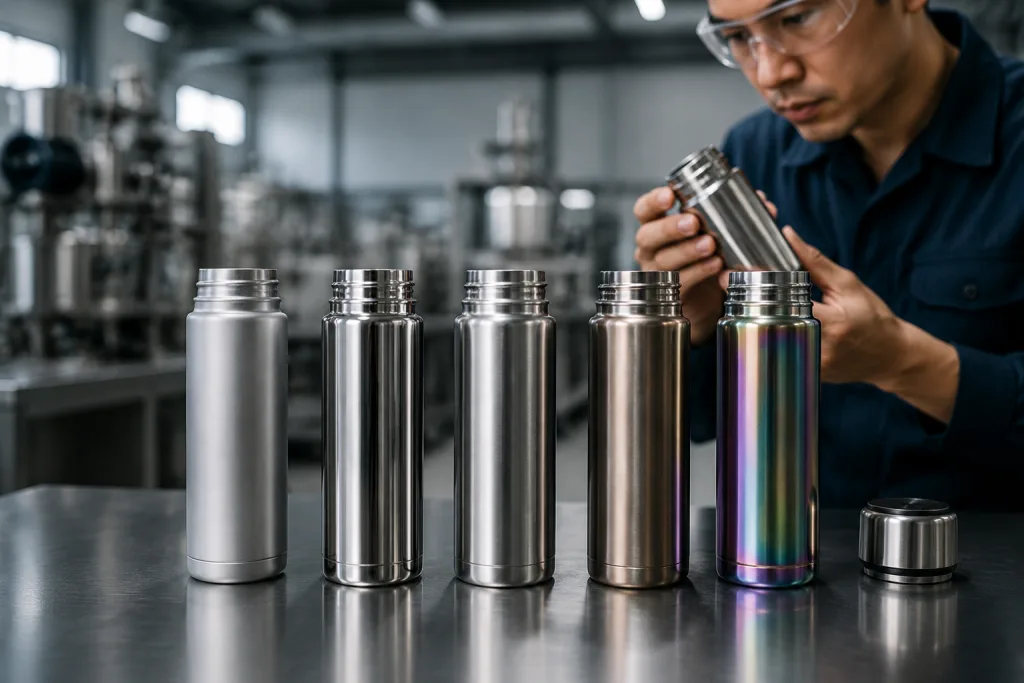
Decoration has to fit the order size. If a thermos supplier pushes the same logo method for 300 pcs and 5,000 pcs, they are saving trouble on the line, not protecting your margin. We usually quote laser engraving first for 300-500 pcs because there is no Pantone drift, no screen plate issue, and it looks clean on matte 304 stainless bodies. For 1,000 pcs and up, silk screen or heat transfer normally gives better unit cost, especially for a promotional thermos with one bold logo. The math does not work if you pay transfer-film setup for a 300 pcs trial order. QC pulled the sample last month because the buyer’s PO said “black logo,” but the artwork file was C:0 M:0 Y:0 K:90, not solid black.
For a customizable thermos, the usual sequence is:
- Laser logo: low setup cost, no ink, durable in dishwasher-style rub tests, best on bare metal or dark powder coat.
- Silkscreen print: cheaper at volume after the screen plate is made, best for one- or two-color branding on straight cup walls.
- UV or water transfer: stronger shelf impact for gradients and wrap designs, but QC needs tighter checks because curved shoulders can show stretching or pinholes.
- Custom color coating: good for retail lines with shelf blocks, usually needs 1,000-3,000 pcs per color and a signed color chip before spraying.
At factory level, a custom thermos with full-body color and matching lid often needs an extra 7-12 days over plain stainless. We run a film thickness gauge on powder coat, and a 0.2 mm lid color mismatch is enough for some retail buyers to flag it. If your channel is distributor thermos or thermos distributors with repeat replenishment, keep one stock color and one logo method. Simple wins. If your program is a retail launch, pay for the custom color only after the sell-through supports the MOQ and extra lead time. This is where a practical supplier thermos partner in Zhejiang earns its keep: it tells you when a thermos customized look is worth the added cost, and when we have seen it go sideways.
MOQ, lead time, and pricing reality
Buyers push for lower MOQ. Factories need a line schedule that doesn’t lose money. That is where the deal usually lands. In a Zhejiang thermos factory like ours, one model in one color usually starts at 1,000 pcs, and we can sometimes run 500 pcs when the shape is standard and the logo is only one-position laser engraving. For a new mold or a special lid, MOQ often jumps to 3,000 pcs because the tooling cost has to be spread out. Last month QC pulled a pre-production sample where the buyer changed the lid button by 1.5 mm after PO confirmation; at 500 pcs, the math doesn’t work.
Lead time is the same kind of practical problem. Logo and color sample approval usually takes 5-10 days if the artwork is clean and the Pantone code is written correctly. Mass production is often 25-35 days for standard thermos bulk orders, and 40-50 days if you need custom packaging or a new lid tool. We have seen 32 days become 46 days because the gift box dieline had the wrong barcode size on the PO. Freight can change the final landed cost more than a 5% factory discount, so FOB is the wrong single question to ask.
Pricing for a manufacturer thermos comes down to steel cost, vacuum process yield, decoration cost, and the packaging spec. A basic 500 ml retail thermos can quote at USD 4.10-5.80 FOB, while a premium vacuum bottle with a tighter lid, better coating, and thicker carton can move above USD 7.00. If a thermos manufacturer quotes far below that range, ask what got cut: 304 stainless thickness, spray finish control, or leak test time. We run 100% leak testing on the line with hot water and inverted trays. Cheap can get expensive fast after returns.
QC checks that protect your margin
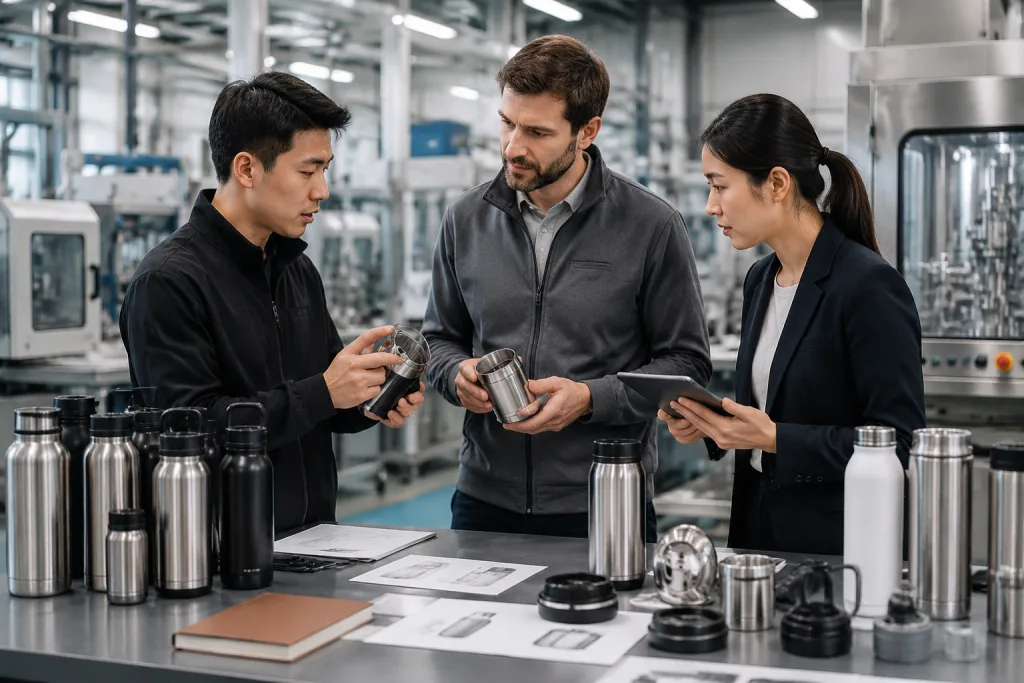
Good QC is not paperwork for a folder. For a manufacturer thermos order, we check the points the end customer will complain about first: leaking caps, weak heat retention, peeling paint, rubbed-off logos, and crushed export cartons. On the line, QC pulled 32 pcs from a 3,000 pcs run last month and found 2 lids with rough threads on the go/no-go gauge. That is the kind of issue that eats margin after delivery. A factory thermos program should work to AQL 2.5 for major defects and 4.0 for minor defects, with the sampling plan signed off before stainless cutting or coating starts.
Ask for these checks:
- Boiling-water retention test with 95°C filling water, plus a room-temperature control sample on the same bench
- Leak test with the bottle inverted for 24 hours, then a quick shake test after the cap is re-tightened
- Coating cross-hatch or 3M tape adhesion, checked after the paint has fully cured
- Thread smoothness on cap and mouth ring, not just “looks OK” by eye
- Drop test for inner carton and master carton, using the packed export weight shown on the shipping mark
If you buy through thermos suppliers or thermos vendors in China, ask for pre-shipment photos, carton count verification, and a real inspection report with defect photos. We run this before booking the truck, not after the goods are already sitting at Ningbo warehouse. For export buyers in Europe and North America, REACH-compliant finishes and food-contact declarations matter as much as the thermal result; the buyer flagged one PO typo before where “LFGB” was missing from the artwork approval sheet. A serious supplier thermos team in Zhejiang will build this into the process. You are not paying for a decoration house. You are paying for a repeatable export system.
Choosing a factory partner that scales
Scaling a thermos custom program comes down to one question: is the partner a factory, or is it a trader with a good catalog? Ask for monthly output, tooling limits, and how many lines are actually running. BottleForge Industrial, based in Hangzhou, Zhejiang, runs 300,000 units per month across insulated drinkware; on our floor that means laser welding jigs, vacuum test stations, and coating line capacity, not a sales promise. That matters when a launch moves from 2,000 pcs to 20,000 pcs and the buyer refuses a lid redesign.
For outdoor retailers and promotional brands, “Can you make it?” is the wrong question to ask. Ask, “Can you repeat the same lid torque, coating tone, and logo position on the re-order?” We run torque checks in N·cm, QC pulled the sample if the logo shifts 1.5 mm, and spare silicone gaskets need to be in stock before mass production starts. Ask how many days color matching takes, whether it keeps gasket inventory for repeat SKUs, and whether it can pack mixed SKUs under one export carton plan. If the sales answer is fuzzy, the shipment will be fuzzy too.
When you compare a thermos manufacturer, thermos supplier, or thermos distributor setup, choose the one that controls the line details and still quotes clean FOB terms. Simple as that. We have seen this go sideways when a PO says matte black but the artwork file says charcoal, and nobody catches it until pre-shipment inspection. A stable factory partner protects the repeat order, not just the first container your retail buyer approves for the season.
Compare your thermos spec with us now
Send capacity, lid type, and target order size. We’ll quote the right manufacturer thermos spec, MOQ, and lead time without guessing.
Frequently asked questions
What MOQ should I expect from a manufacturer thermos factory?
For a standard stainless manufacturer thermos with one color and one logo, MOQ is usually 1,000 pcs. Some Zhejiang factories accept 500 pcs for simple promotional thermos jobs, but once you ask for custom color, special lid tooling, or mixed packaging, the MOQ often rises to 3,000 pcs. If the factory says 200 pcs for a fully custom build, check whether it is truly making the product or just reselling stock. For distributors thermos programs, a stable MOQ matters because it keeps the next replenishment predictable.
How much does a custom thermos cost FOB?
A common 500 ml custom thermos in 304 stainless usually lands at USD 4.10-5.80 FOB with standard printing and a normal lid. A more premium insulated bottle with thicker wall, better coating, or a locking lid can move to USD 6.20-8.40 FOB. Laser logo is often only USD 0.08-0.18 extra per piece, while custom packaging may add USD 0.20-0.60. Exact pricing depends on steel grade, finish, and whether your thermos custom spec needs new tooling.
What thermal performance should I ask for?
For a retail-ready manufacturer thermos, ask for at least 12 hours hot retention and 24 hours cold retention under defined test conditions. Better outdoor models often reach 18-24 hours hot and 24-36 hours cold. Make sure the factory states the test environment, fill temperature, and lid type. A bottle tested with a preheated body and screw lid will perform differently from a standard room-temperature setup. Without those details, the claim is not useful for comparing thermos manufacturers.
Can I order promotional thermos samples before mass production?
Yes, and you should. Most thermos suppliers can provide sample units in 5-10 days if the order only changes logo or color. Sample cost is often USD 30-80 depending on decoration and shipping. For a promotional thermos campaign, approval before mass production is the cheapest insurance you have. If the sample is late or the factory refuses to share photos of the first article, that is a warning sign. Good thermos vendors in Zhejiang will show you the exact print placement and lid fit before they run bulk thermos production.
What standards matter for export to Europe and North America?
You should ask for food-contact material declarations, REACH-related coating compliance, and an inspection plan based on AQL 2.5 for major defects. If you sell on Amazon, the carton and label plan should also support FNSKU or retailer barcode requirements. Some buyers also request dishwasher suitability or odor-free lining proof. A serious thermos supplier in China should provide these documents without delay. If you are buying from a thermos factory in Zhejiang, ask early; fixing compliance after production is where time and money get wasted.