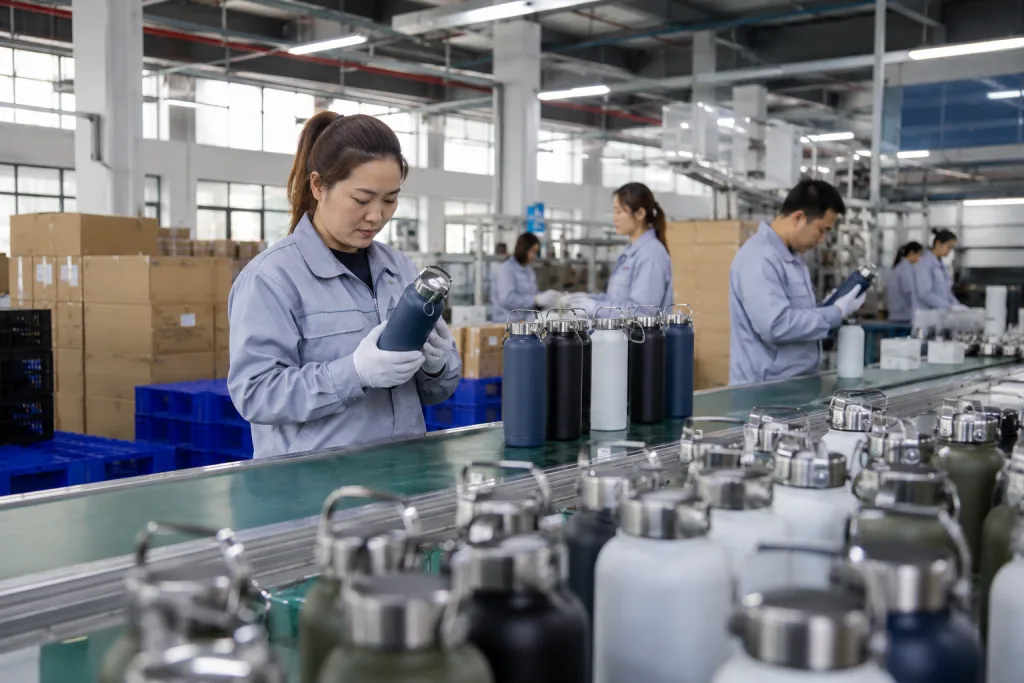
Key Takeaways
- A practical MOQ for a custom stainless thermos is usually 1,000 to 3,000 pcs per SKU, while stock-color logo orders can start around 500 pcs
- For a 500 ml double-wall 18/8 stainless item, typical FOB China pricing is about USD 3.20 to 6.80 depending on lid, coating, and print method
- Reliable production planning needs 7 to 12 days for samples and 30 to 45 days for mass production after approval
- Set insulation, leak, coating, and AQL standards before deposit; otherwise defect disputes usually cost 2% to 5% of the order value
You are not buying a bottle. You are buying a defect rate, a lead time, a landed cost, and a product your customer will judge on one cold train platform or one wet trail morning. That is why a manufacturer thermos bottle project goes sideways so often: buyers look at shape and print first, while the real money sits in steel grade, vacuum build, MOQ, and test control. We have seen PO typo cases where the buyer wrote 500 pcs, the sample was approved, and the line had to stop for a new carton plan.
For outdoor retailers and promo brands, the decision path is blunt. Lock four items early: use case, construction spec, branding method, and supply plan. We run this every week in Hangzhou, and the first quote is only useful if you already know whether you need a 350 ml commuter bottle or a 750 ml hiking bottle. A 0.4 mm wall and a loose lid spec will look fine on paper, then QC pulled the sample and found the cap torque failed after 12 openings. Zhejiang factories can quote fast on almost any custom thermos, but the math does not work if you wait until sampling to ask for steel grade, finish, or test standard.
Start with the commercial decisions
Most first-time buyers ask a thermos manufacturer for a catalog and price list. That is backwards. We see better quotes from China when the buyer first pins down the business model the bottle has to carry. A promo thermos for a campaign giveaway runs on a different cost logic than a distributor line for outdoor retail shelves.
The four decisions that matter first are:
- Who will use it: commuter, hiker, gym user, school market, or corporate gifting.
- How long it must perform: one event season, one retail year, or a long-term hero SKU.
- What branding has to survive: silkscreen, UV print, laser engraving, heat transfer, or embossed parts.
- How you will replenish: one large buy, seasonal reorder, or rolling distributor inventory.
If you cannot answer those four points, every quote from a factory thermos supplier will look similar, and you will compare the wrong numbers. A buyer once sent us a PO with the lid code typed one digit off; QC pulled the sample, the mismatch showed up in 20 minutes, and the shipment would have missed launch week. Outdoor retailers care more about temperature retention, grip, lid durability, and drop resistance. Promo brands care more about logo visibility, low MOQ, and deadline certainty.
At BottleForge Industrial in Zhejiang, China, we tell buyers to set a target retail price or delivered campaign budget before they pick a shape. That one step cuts the noise fast. A 750 ml powder-coated customized thermos with a carry handle and tea filter may look attractive, but if your delivered cost ceiling is USD 5.00, the math does not work. A simpler 500 ml model with one-color print may be the better fit.
You do not need the best bottle on the market. You need the right bottle for the claim, channel, and margin structure you plan to support.
Once that is clear, a manufacturer thermos quote becomes something you can judge instead of a spreadsheet full of mismatched assumptions.
Match the bottle to the use case
A thermos custom project should start with daily use conditions, not decoration. Two bottles can look the same in a catalog and fail in different ways once someone pours coffee, ice water, soup, or sports drink into them.
Outdoor retail use
For outdoor retailers, we usually start at 500 ml to 1,000 ml, double-wall vacuum, 18/8 stainless steel inside and outside, with powder coating for grip. On the line, outer wall thickness often sits at 0.45 mm to 0.50 mm, and the inner wall at 0.35 mm to 0.40 mm. Thicker steel takes dents better, but the math doesn't work if the bottle gets too heavy or the retail price slips. A 750 ml bottle around 420 g to 520 g is a normal target.
Promotional use
For promotional thermos orders, 350 ml to 500 ml usually ships faster because freight, carton count, and event handling stay under control. The buyer flagged it before: a tapered body looks nice, then the logo loses space and the print area gets cramped. If the audience is office staff, a one-hand flip lid sells the idea well, but we've seen that go sideways on leakage and hinge wear after repeated drops.
- Hot retention target: 6 to 12 hours for practical commercial claims.
- Cold retention target: 12 to 24 hours is common for retail positioning.
- Mouth diameter: 42 mm to 55 mm affects cleaning and ice filling.
- Base diameter: 68 mm to 75 mm matters for cup holders and shipping density.
A supplier thermos proposal should also state whether the lid uses PP, Tritan, silicone, stainless accents, or a mix. The cap causes more complaints than the steel body. QC pulled the sample, and the first issue was the button rebound, not the bottle shell. If your distributors thermos program needs low returns, ask for a leak test report, torque spec, and cycle test on buttons or hinges.
Buyers sourcing from China often fixate on bottle shape because the catalog pushes shape first. That is the wrong question to ask. Start from user behavior, then size the bottle around it. That is how you avoid overbuilding a giveaway item or underbuilding a retail thermos manufacturer SKU.
Choose the construction spec carefully
This is where cost and performance split. When you ask a manufacturer thermos bottle supplier for a quote, give the build spec, not just “stainless thermos” or “bulk thermos.” We run quotes on the same photo with three steel grades and two wall structures. The numbers move fast.
The working standard for a dependable thermos supplier is food-contact 18/8 stainless steel, also called SUS304, for the inner wall. On a few budget runs, the outer wall uses 201 stainless. That can pass on short-life promo orders, but for outdoor retail and 12-month replenishment, 304 on the outside is the safer call when appearance and corrosion resistance matter. QC pulled one sample with tea staining after a salt-spray check, and the buyer flagged it immediately.
- Inner steel: SUS304 is the baseline; ask whether a copper coating is added for insulation support.
- Outer steel: SUS304 or 201, based on budget and market position.
- Vacuum process: confirm whether each piece gets inline vacuum testing.
- Surface finish: powder coat, spray paint, brushed, polished, or special texture.
- Bottom design: anti-slip pad or exposed steel base.
For a factory thermos bottle sold into North America or Europe, ask for compliance support on REACH where applicable, LFGB or FDA food-contact expectations depending on the market, and ASTM/CPSIA relevance if the item is sold toward children. The wrong question is “do you have tests?” The real question is whether the report matches your lid material, colorant, and decoration. We have seen a PO typo on the cap color turn into a fresh test request because the lab sample and the mass order were not the same.
There is a hard trade-off between performance and visual complexity. A customizable thermos with a stainless lid, bamboo wrap, wide mouth, strainer, and carry loop looks good on a sales sheet, but every extra part adds assembly risk, replacement trouble, and scrap. On the line, one loose gasket can stop a 5,000-piece run. Scrap is not just the factory's problem. It comes back to you as delay or a higher unit price.
If you want stable replenishment from thermos manufacturers, keep the construction disciplined. The simplest bottle that still meets your claim usually gives the best margin and the least trouble.
Branding methods change cost and risk
Decoration is where a custom thermos starts to feel like a real product, or a cheap giveaway. It changes lead time, carton damage risk, and MOQ. No logo process, no real quote. We see buyers send a PO with just “logo as per AI file” and then wonder why the sample comes back off-center.
The main branding methods are simple enough:
- Silkscreen: low setup cost, works well for 1 or 2 spot colors, and fits simple cylindrical bodies.
- Laser engraving: durable and clean-looking, especially on powder coat where the base metal shows through after the fiber laser hits it.
- Heat transfer or water transfer: useful for multi-color graphics, but the line needs tighter control on curing and positioning.
- Digital UV: strong for short-run custom logo jobs, but scratch resistance has to be checked on the bench.
For promo orders, silkscreen is still the lowest-cost route on many thermos custom jobs. A single-color print on a stock bottle can save about USD 0.10 to 0.35 per piece versus a more complex process. On one 5,000-piece run, that gap paid for the carton insert change. For outdoor retail, laser logo or a restrained wrap print usually lasts longer in the field.
Ask where the decoration sits in the workflow. If the manufacturer thermos factory prints after final assembly, the reject flow is not the same as printing the body before lid fitting. That affects lead time, and the math is ugly. On a 2,000-piece custom thermos order, a 3% decoration reject rate means 60 pieces need remake or overrun stock, which is how a ship date slips by 4 to 6 days.
Artwork limits should be checked before sampling. Fine lines under 0.25 mm, metallic inks on textured powder, or wrap graphics too close to seams can fail for reasons the buyer did not see in the PDF. QC pulled one sample last month where the logo looked fine on screen but broke on the shoulder curve. A thermos customized for retail has to survive carton rub, hand oils, and dishwasher contact, even when the care note says hand wash only.
Good thermos suppliers in China will ask for vector artwork, Pantone references, logo size, and print position before they price tooling or setup. That is a good sign. It means the quote follows production reality, not catalog talk. We prefer that question up front, because a neat rendering does not keep a line moving.
Price, MOQ, and lead time realities
Once the bottle spec and branding method are locked, price talks get straight. For a standard 500 ml double-wall stainless bottle from Zhejiang, China, using a stock mold, powder-coated body, and one-color logo, FOB usually sits at USD 3.20 to 4.80 for 1,000 to 3,000 pcs. Move to a 750 ml custom thermos with handle lid, special finish, and engraved logo, and the FOB often lands at USD 4.80 to 6.80. New mold work adds USD 2,000 to 8,000 in tooling, and lid structure drives most of that bill.
MOQ changes with the amount of custom work:
- Stock bottle + stock color + one logo: often 500 to 1,000 pcs.
- Stock bottle + custom color: often 1,000 to 3,000 pcs.
- New lid or new body mold: often 3,000 to 10,000 pcs.
Lead time is where buyers usually miss the real schedule. Logo samples are often 7 to 12 days; new tooling samples run 15 to 25 days. Bulk production is commonly 30 to 45 days after sample approval and deposit. In peak season, especially before Q4 promo shipping, add 7 to 15 days. We have seen buyers plan around a holiday sell-in and then lose the window because the PO typo pushed artwork approval by three days.
Our own planning benchmark at BottleForge Industrial is up to 600,000 units per month across drinkware categories, with a common MOQ of 1,000 pcs for custom-logo stock models. That number only works if the line is booked in order. QC pulled a sample from the coating rack on one run and found a 0.3 mm logo misalignment; the reprint cost a day, but it saved a claim later. Ask the thermos vendor whether coating, printing, and packaging slots are reserved before or after material arrival. That choice often explains why one factory ships in 32 days and another needs 47.
Also confirm the quotation basis: FOB Ningbo, FOB Shanghai, or EXW. Zhejiang factories often ship through Ningbo because the trucking is simpler, and a 180 km inland move can change landed cost more than the buyer expects when comparing manufacturers thermos offers across provinces.
Control defects before they reach you
The right quality system is not desk paperwork. It is how you stop claims before the boxes leave China. On stainless drinkware, the clean move is to lock inspection criteria before the line starts, not after the buyer flags a dent or a leak.
We ask for pre-production sample sign-off first, then a short quality agreement that covers the points that actually fail in the plant:
- Leakage: 100% leak test during production, one by one.
- Vacuum retention: set one benchmark, such as hot water drop after 6 hours under stated conditions.
- Coating: adhesion and scratch criteria, with the same test tool every run.
- Decoration: logo position tolerance, color tolerance, and readability at arm’s length.
- Appearance: dent limit, weld mark limit, paint points, and base stability.
For shipment inspection, a lot of buyers run AQL 2.5 for major defects and 4.0 for minor defects. That is a workable start for bulk thermos orders. Premium retail programs often go tighter. The point is consistency. If one buyer calls a crooked logo a major defect and the factory calls it minor, the math does not work, and the argument starts before the report is signed.
Check the factory credentials that matter to your channel, such as BSCI for social compliance where relevant, ISO-style quality discipline, and recent material test records. Certifications do not prove a good bottle by themselves. We have seen that go sideways when incoming steel checks were missing, so ask who owns the mill cert review, lid fit check, and final random inspection on the line.
For Amazon or direct-to-consumer resale, packaging can sink the order faster than the bottle. If you need barcode labels, FNSKU application, drop-tested gift boxes, or bilingual warnings, put them in the quotation. One PO typo on carton marks can turn into a 2,000-piece relabel job at the warehouse. A thermos distributor problem often starts there, not in steel.
The buyers with the fewest thermos sourcing problems are the ones who write down the boring details early. That is cheaper than arguing over credit notes after arrival.
Get a thermos quote built on real specs
Send your target price, capacity, logo method, and market. We will reply with a practical MOQ, FOB quote, and sampling timeline from Zhejiang, China.
Frequently asked questions
What is a realistic MOQ for a manufacturer thermos bottle order?
For a stock stainless model with your logo, 500 to 1,000 pcs is realistic from many factories in China. If you want a custom body color, expect 1,000 to 3,000 pcs per SKU. If you need a new mold, such as a unique lid or body shape, MOQ usually moves to 3,000 to 10,000 pcs because tooling and setup costs need to be absorbed. For outdoor retail, it is often smarter to start with a stock mold and customize color, coating, and logo. That lowers risk while still giving you a branded product. Ask the factory whether MOQ is per color, per logo, or per mixed carton assortment, because that changes the true buy requirement.
How much should I expect to pay for a bulk thermos from China?
A normal FOB China range for a 500 ml double-wall stainless thermos is about USD 3.20 to 4.80 at 1,000 to 3,000 pcs, assuming a stock mold, standard lid, powder coating, and simple logo. Move up to larger capacity, premium lid parts, laser engraving, gift box packaging, or special finishes, and the price can reach USD 5.50 to 6.80 FOB. Very low quotes under USD 3.00 often mean downgraded material, lighter steel, simpler coating, or weak packaging. Ask for the exact steel grade, wall thickness, lid material, and packing spec before comparing suppliers thermos quotes. Without that, you are comparing photos, not products.
What tests should I require before approving a customized thermos?
At minimum, require a leak test, a vacuum or insulation performance check, decoration adhesion review, and a general appearance inspection. For a retail thermos manufacturer program, ask the supplier to define the hot-retention method, such as filling with near-boiling water and recording temperature drop after 6 hours. For powder-coated bottles, check scratch resistance and logo durability. If the item is shipping to Europe, ask for REACH-relevant support and food-contact documentation appropriate to your market. For North America, confirm the applicable FDA or state-level expectations depending on your sales channel. If packaging is important, add carton drop tests and barcode verification. AQL inspection before shipment is standard and worth the cost.
How long does a custom thermos order usually take?
For a stock bottle with a logo, sample lead time is usually 7 to 12 days. If there is custom color matching, special coating, or gift box work, samples can take 10 to 15 days. New mold development often needs 15 to 25 days for first samples, sometimes longer if the lid structure is complex. After final sample approval and deposit, bulk production is commonly 30 to 45 days. In peak periods, especially from late summer into Q4, add 7 to 15 days. Ocean transit is separate, so do not mix factory lead time with shipping time. A good thermos supplier will give you a milestone schedule for sampling, materials, production, inspection, and booking.
How do I choose between a promotional thermos and a retail-grade thermos?
Start from expected use and complaint tolerance. A promotional thermos meant for an event or corporate gift can use a simpler stock shape, basic lid, and one-color branding to stay in the USD 3 to 4 FOB band at moderate quantities. A retail-grade thermos usually needs stronger finish consistency, better temperature retention claims, more durable decoration, and tighter packaging standards. That pushes cost up, but it also reduces returns and supports shelf price. If your distributors thermos channel expects repeat orders, build for durability first. If your campaign is date-driven and cost-sensitive, simplify the spec and protect lead time. The wrong choice is a bottle that looks premium in photos but does not fit the real sales channel.