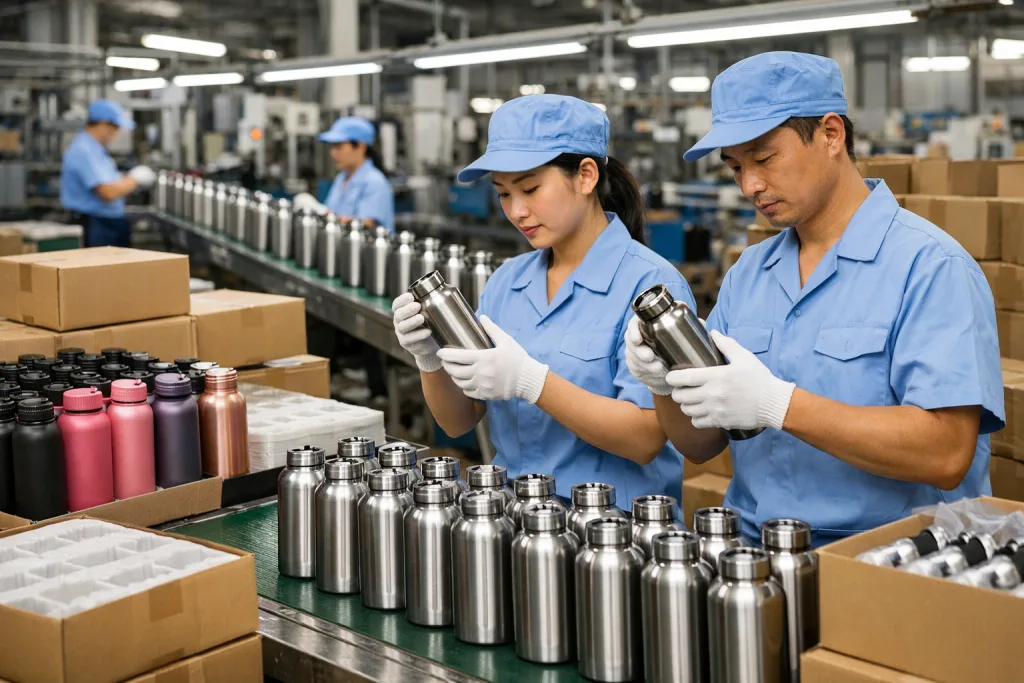
Key Takeaways
- A usable RFQ should define capacity, material grade, coating, logo method, packaging, and target price within 24 to 48 hours
- Most OEM manufacturer thermal bottle projects run 7 to 10 days for samples and 25 to 45 days for bulk production after deposit
- For vacuum bottles, MOQ is commonly 500 to 1,000 pcs per color, while printed promo canteen orders may start at 300 pcs
- AQL 2.5 final inspection, leak testing, and carton drop testing reduce preventable claims by a measurable margin before shipment
You can source a thermal bottle from almost any trading company page in China. That part is simple. The hard part is getting the exact bottle you approved, with the insulation, coating, logo quality, cartons, and compliance papers your market needs, on the ship date your launch depends on.
If you are buying custom drinkware for retail, promotions, or distribution, you need a process that turns a loose inquiry into a controlled purchase order. In Zhejiang, the gap between a smooth project and a painful one is usually decided before tooling starts. We run these jobs in clear steps: RFQ, sampling, approval, bulk production, inspection, and shipment. QC pulled the sample at 24 hours, and the buyer flagged a 2 mm logo shift on the first round. Lock every spec in writing, or your canteen custom or custom growler project will drift fast.
Start with a usable RFQ
Most sourcing problems start with an RFQ that is too vague. Ask five canteen suppliers for “a 500ml insulated bottle with logo,” and you will get five prices for five different builds. One quotes 18/8 stainless steel, another prices an 18/0 outer wall, one includes powder coating, another assumes spray paint, and someone else prices a different lid. That is not a comparison. It is noise.
Your RFQ should read like a purchasing document, not a brand brief. For a manufacturer thermal bottle, state the body style, capacity, fixed dimensions if they matter, target net weight, steel grade, wall construction, mouth diameter, vacuum spec, coating, logo process, unit packing, master carton limit, compliance market, and target Incoterm. If you are a canteen distributor or distributor drinkware buyer serving retail, corporate gifting, or Amazon FBA, say it up front. Packaging and carton rules change cost fast. We’ve seen a buyer flag a PO because the lid color was left open, and the sample on the line came back with the wrong insert.
PO line items to lock at RFQ stage
- Item: 500ml double-wall vacuum bottle, 304 inner / 201 or 304 outer
- Wall: inner 0.4 mm, outer 0.45 mm
- Lid: PP screw lid with silicone seal, BPA-free
- Finish: Pantone-matched powder coat, matte
- Logo: 1-color silk screen, 1 position, 45 x 60 mm
- Packaging: individual kraft box, no plastic tray
- Compliance: REACH for EU, FDA/LFGB if required
- Quantity: 1,000 / 3,000 / 5,000 pcs price breaks
In Zhejiang, China, factories running custom drinkware programs usually answer a complete RFQ within 1 to 2 working days. On our side, MOQ for a stocked vacuum bottle is 500 pcs per color, and monthly output can reach 300,000 units across bottle and tumbler lines. That is the point. A buyer who skips capacity math will get a lead time that looks neat on paper and falls apart on the line. QC pulled the sample, checked the 0.45 mm outer wall, and the quote held because the spec was locked before sampling.
You are not buying a photo. You are buying a controlled specification.
Quote against the real cost drivers
Once suppliers reply, do not start with unit price. Split the quote into the parts that move it. For a manufacturer thermal bottle, the main drivers are steel grade, bottle weight, vacuum yield, coating type, lid construction, logo method, and packaging. Freight matters too, but that comes after you know the build.
A low quote can hide a lighter bottle body, thinner steel, a downgraded lid insert, or a finish that chips early. We have seen that on the line. Changing from full 304 inner and outer to 304 inner with 201 outer can cut a few tenths of a dollar. Moving from powder coat to spray paint may save USD 0.10 to 0.25 depending on size. Replacing a rigid gift box with a standard white or kraft box can remove USD 0.20 to 0.60. Those savings are fine if you asked for them. They are a problem if the supplier made the call for you.
If you are sourcing a custom canteen, customizable canteen, or customized growler line, ask the canteen factory to quote three price levels: ex-stock structure, upgraded retail structure, and fully customized packaging version. That gives you room to value-engineer without restarting the project. QC pulled the sample on one job because the buyer flagged a 12 mm lid change only after the PO was issued. It also helps canteen distributors and canteen promotional buyers separate product cost from presentation cost.
What to compare line by line
- FOB Ningbo or FOB Shanghai price versus EXW
- Mold charge if any, and refund conditions
- Sample charge and whether it is creditable against bulk PO
- Logo setup per color or per location
- Carton details units per carton, gross weight, carton size
- Lead time for pre-production sample and mass production
- Testing cost for third-party lab reports if needed
A practical benchmark: a standard 500ml vacuum bottle in China with powder coating and one simple logo often lands around USD 2.60 to 4.20 FOB at 1,000 to 3,000 pcs, depending on structure and packaging. A customized canteen with unique lid parts, color inserts, or gift box can climb fast. A custom growler or customizable growler with 64 oz capacity, wider body, and handle lid usually costs more because the steel weight goes up and the carton count drops. The math does not work any other way.
Move from drawing to sample
After shortlist and price alignment, sampling is where the job turns from drawings into a part you can hold. Do not place a bulk order on a digital mockup alone, especially for customized drinkware. Powder coat texture, logo registration, color contrast, grip feel, and leak performance all need a physical check on the bench.
There are usually three sample types. First is the stock sample, used to confirm shape and capacity. Second is the pre-production sample with your color and logo. Third is the sealed approval sample kept by both buyer and factory. For most canteen manufacturers in Zhejiang, stock samples can go out in 2 to 5 days, while custom logo samples take around 7 to 10 days. New mold development follows a different clock and can take 20 to 35 days before first sample. We run this schedule every week; the line does not move faster just because the PO is urgent.
Do not approve a sample casually. Check net weight against the quote, verify capacity by fill test, inspect color under daylight, test the lid torque, and confirm the bottle sits flat. We had a buyer flag a 1.8 mm base wobble last month, and that was the right call. If the bottle is sold into North America or Europe, ask for migration-related declarations and material data before you issue the bulk PO. The carton test gets missed here all the time. If your distributor canteen business ships parcel orders, a weak outer carton costs more than a slightly higher unit price.
PO line items to confirm before sample approval
- Approved Pantone: body, lid, strap, bumper if any
- Decoration file: AI/PDF outline, size and position signed off
- Insulation target: for example 12 hours hot / 24 hours cold as internal benchmark
- Packaging artwork: box dieline, barcode, FNSKU if needed
- Master carton marks: PO number, item code, country of origin
If you are buying customizable drinkware with several SKUs, keep one approval sheet per SKU. Mixing versions in email threads is how a factory ends up shipping the wrong lid, finish, or print. We have seen a PO typo change a 500 ml order into 550 ml on paper, and the math does not work after the sample is signed.
Write the bulk PO properly
When buyers say they have a “PO,” half the time they mean a one-line order note. That will not work for a manufacturer thermal bottle job. A real bulk PO needs to act as the working sheet for production, QC, and shipping. If the order is split by color, logo, or pack style, each version needs its own line item or an attached spec sheet. We run into this on the line all the time.
A proper PO protects both sides. The factory in China knows what to build, and you have one document to inspect against. On a 5,000 pcs order, one wrong carton mark can hold the shipment for a day; QC pulled the sample and the buyer flagged the mismatch before loading. For canteen vendors or canteen distributors reselling downstream, the PO also keeps carton count, launch quantity, and compliance files aligned.
Minimum PO fields that should appear
- Buyer item code and factory item code
- Description: 750ml manufacturer thermal bottle, double-wall vacuum, 304/304, powder coated
- Color split: black 2,000 pcs, white 1,500 pcs, green 1,500 pcs
- Unit price and total amount in USD
- Trade term: FOB Ningbo, China
- Payment: 30% deposit, 70% against inspection release or B/L copy
- Lead time: 35 days after deposit and artwork approval
- Quality standard: AQL 2.5 major / 4.0 minor unless otherwise agreed
- Testing requirements: leak test 100%, vacuum performance spot test, drop test on packed cartons
- Document pack: packing list, commercial invoice, test reports, BSCI copy if requested
If your product is a canteen customized for promotional use, spell out print placement tolerance and the cosmetic standard. A screen print off by 2 mm may pass on a giveaway run, but it gets rejected on a retail shelf program. That is the wrong question to ask after approval. Put it in the PO first. We have seen this go sideways when a buyer wrote “print centered” and expected everyone to read it the same way.
Any detail missing from the PO will be filled by assumption, and assumptions are expensive.
Control production before cartons close
After the deposit lands, 7 out of 10 buyers go quiet for 30 days, then come back when the vessel booking cutoff is already close. That is too late. You control a manufacturer thermal bottle order on the line, not after all cartons are taped. If the logo position is off by 3 mm and QC finds it after 10,000 pieces are boxed, the math doesn't work in your favor.
Ask for a production schedule with fixed milestone dates: raw material arrival, coating start, print start, assembly, packing, and inspection readiness. Put dates on each step. We usually run this against the PO and daily output sheet, and once a buyer flagged that the lid color on the schedule did not match the cap code on the artwork file. For larger orders, ask for in-line photos or video from the first production batch. For new projects, book a mid-line inspection at 20% to 30% output. This is where mixed lids, multi-SKU custom drinkware, and fragile finishes start going sideways.
QC should match the risk. For vacuum bottles, a sensible baseline is 100% leak test, visual inspection during packing, and final random inspection to AQL 2.5. We ship plenty of orders where QC pulled the sample from the vacuum tester and found 2 leaking units out of 200 before packing finished. If the product is headed to major retail, add barcode scan verification, carton drop test, and seal integrity checks. If you are importing to the EU, make sure declarations match the final SKU and the materials actually used. If the body, lid, or strap changed after the first quote, update the paperwork. This is the wrong question to ask at shipment stage.
Factories with stable systems usually work under ISO-style documentation, and social compliance requests such as BSCI are common from European buyers. Good, but that does not replace product QC. It only shows the site runs with documented controls. For canteen factory and canteen manufacturer selection, I would rather see an inspection report with defect photos, defect rate, and carton marks than a polished brochure. We have even seen a PO typo on strap color pass through sales and get caught only at final inspection.
- Common bulk defects: weak vacuum, dented base, color mismatch, crooked print, lid leakage, dirty inner wall, scratched coating
- Most preventable issue: mixed components between approved sample and bulk line
Ship with fewer downstream surprises
Shipment is the last step, but this is where we see a lot of claims start. Cartons get packed wrong. Labels are missing. Gross weight goes over the limit. One export file has a typo on the PO number, and the goods sit in a warehouse instead of moving. For a canteen distributor, distributor growler buyer, or distributor canteen program, downstream handling matters almost as much as the bottle itself. We’ve seen this go sideways.
Before shipment, lock the final packed size, gross weight per carton, pallet pattern if used, and loading quantity for 20GP, 40GP, or 40HQ. Check the real numbers, not the first estimate from sampling. On the line, we measure master cartons with a tape and recheck random cartons after drop test packing because a lid shape or a gift box that grows by 8 mm can wreck the container plan. A bottle that looks efficient on paper can waste space fast. If your channel is Amazon FBA, the rules are tighter: FNSKU, suffocation warning if polybags are used, carton label format, and weight limits all need checking before cargo leaves China. This is the wrong question to ask: not “Can you ship FBA?” but “Who checked the carton spec against the final packout?”
Shipping documents should match the PO and actual cargo exactly. No close-enough version. That means item description, HS code if agreed, quantity, carton count, and origin statement. QC pulled the sample; the docs team should pull the same data from the approved packing list, not from an old file. If your market requires testing files, collect them before balance payment where possible. That includes REACH declarations, LFGB/FDA reports when relevant, and packaging material confirmations. For promotional custom canteen and canteen promotional orders, keep artwork approvals and carton photos on file. We usually save the outer carton mark photo, barcode close-up, and final logo file by PO. Reorders often happen six months later, and memory is less reliable than records.
A serious canteen vendor or canteen suppliers group should also settle replenishment terms before the first shipment lands. Ask what changes the MOQ on repeat orders, whether logo screens are archived, and whether color matching can hold across batches. We run into this buyer pushback a lot: “The sample blue was right, why is the repeat slightly darker?” If the factory is matching by eye instead of against a signed panel, the math doesn’t work. In Zhejiang, China, a factory that can repeat within practical tolerances is usually worth more than the lowest first quote. The cheapest first order is often the most expensive supply relationship.
Send your RFQ for a manufacturer thermal bottle
Share capacity, target price, logo file, packaging, and quantity split. We will quote practical options from Zhejiang, China with MOQ, lead time, and QC checkpoints.
Frequently asked questions
What MOQ is realistic for a manufacturer thermal bottle order?
For a standard stocked vacuum bottle, 500 pcs per color is a common starting MOQ in China, and 1,000 pcs total gives you better pricing stability. If you need a custom body mold, MOQ usually moves to 3,000 to 5,000 pcs depending on size and tooling cost. A simple custom canteen with stock shape, stock lid, and one-color logo can sometimes start at 300 pcs for promotional use, but the unit price will be higher. If you are buying for retail, 1,000 to 3,000 pcs per SKU is a more practical range because it supports cleaner color control, carton planning, and better FOB economics.
How long does sampling and bulk production usually take?
Stock reference samples usually take 2 to 5 days. Custom logo samples for customized drinkware are normally 7 to 10 days after artwork approval. If you need a new mold for a customizable growler or customized canteen, first sample lead time is often 20 to 35 days. Bulk production for a manufacturer thermal bottle is commonly 25 to 45 days after deposit, sample signoff, and packaging confirmation. Peak season can add 7 to 15 days, especially before Q4. If your project includes gift boxes, barcode labels, or third-party testing, build that into the schedule early instead of treating it as shipping-week admin.
What tests and documents should I ask for when buying into Europe or North America?
At minimum, ask for material declarations covering food-contact parts, plus relevant lab reports based on your market. For Europe, buyers commonly request REACH-related declarations and, depending on product and channel, LFGB testing on food-contact components. For North America, FDA-related food-contact expectations are common. You should also ask for leak test records, insulation spot-test method, and carton drop-test evidence for packed goods. If your customer requires social compliance, request BSCI or equivalent audit documentation separately. Keep in mind that a factory audit is not a product test. The safest approach is to tie compliance documents to the exact SKU, lid, seal, and decoration used on the bulk PO.
How do I compare canteen suppliers if their prices are far apart?
Break the quote into product weight, steel grade, coating, logo process, lid structure, packaging, and trade term. A difference of USD 0.40 can come from switching 304 outer to 201 outer, lightening the body, using spray paint instead of powder coat, or simplifying the box. Ask each canteen supplier to confirm net weight, wall thickness, unit pack, carton size, and testing scope in writing. Then compare on an FOB basis from Ningbo or Shanghai. If one quote is still much lower, ask for a photo of the same structure on scale and a copy of the sample spec. The goal is not to find the cheapest line. It is to find the quote that actually matches your requirement.
What should be written on the PO so bulk goods match the approved sample?
Your PO should include the full bottle description, buyer and factory item codes, exact quantity split by color, unit price, trade term, lead time, payment term, approved logo file reference, approved Pantone references, packaging standard, carton marks, and inspection standard such as AQL 2.5. Add performance requirements like 100% leak test and any required barcode or FNSKU rules. If the project involves custom growler, custom drinkware gift boxes, or several lid options, attach a signed approval sheet for each variant. The more SKU complexity you have, the less you should rely on email memory. A one-page PO rarely controls a multi-SKU order well.