Key Takeaways
- Most tea bottle projects succeed or fail on 4 decisions: structure, material, decoration, and QC; changing any one after sampling can add 10-20 days
- A practical starting MOQ for custom tea bottles is 1,000-3,000 units per color, with FOB China pricing often around USD 2.80-6.90 depending on steel, filter, and coating
- For insulated stainless models, 304 inner and outer steel with a 0.4-0.5 mm wall and vacuum hold of 8-12 hours is the common commercial baseline
- Use a written QC plan with AQL 2.5/4.0, leak testing at 100%, and REACH/LFGB or FDA migration checks before mass production ships from Zhejiang
If you are sourcing a manufacturer tea bottle for retail, promotions, or distribution, finding factories is easy. In Zhejiang alone, buyers usually pull 20 to 40 options in one search round. The hard part is knowing which details hit margin, returns, and reorder speed. On our line, a tea bottle looks simple until the first sample leaks at the thread, the lid warps at 70°C, or QC pulls a logo sample that fails after 120 dishwasher cycles.
You need a buying standard, not sales talk. For most B2B buyers in Europe and North America, four choices decide the result: bottle structure, material and insulation, decoration method, and supplier control systems. This is where buyers often ask the wrong question. They focus on unit price first, then get stuck later on a 0.3 mm thread mismatch, weak coating adhesion, or a delayed repeat PO. Get these four points right and you buy custom drinkware with fewer surprises, whether you are a canteen distributor, a private-label brand, or a promotional buyer testing a new SKU.
Start with the four buying decisions
Do not judge a manufacturer tea bottle program by the catalog cover or the lowest FOB line on page one. Start with four decisions that set your actual cost, lead time, and complaint rate. We have seen buyers chase a $0.18 saving, then lose it on repack after QC pulled the sample.
- Decision 1: bottle format. Tea infuser bottle, flip-lid sports tea bottle, handled travel flask, or glass tea bottle with sleeve all behave differently on the line. Format changes leakage risk, carton size, and the kind of user complaint you get. A 2.5 mm silicone seal on a flip lid is a different job from a screw cap with basket infuser.
- Decision 2: material system. Single-wall Tritan, borosilicate glass, or double-wall stainless steel each push the project in a different direction. This sets weight, temperature retention, breakage rate, and compliance path. The math does not work if you want low landed cost and vacuum performance from the same bottle body.
- Decision 3: branding method. Silk screen, heat transfer, powder coat plus laser, or digital wrap should be chosen early, not dropped in after the PO is typed. Decoration is not just surface look. It affects yield, scratch resistance, and MOQ. We run cross-hatch adhesion checks on coated samples because the buyer flagged peeling on a past reorder.
- Decision 4: supplier controls. Sampling discipline, AQL, raw material traceability, and carton standards decide whether the first container arrives clean or turns into chargebacks. This is the wrong question to ask: “Can you match the sample photo?” Ask for the control points, the inspection level, and who signs off after drop test.
Buyers mix categories all the time, and that is where projects go sideways. A canteen custom order for a promotional campaign should not be specified like a premium DTC bottle. A custom growler project for outdoor retail also needs different impact and thread requirements than a tea bottle for office gifting. We had one PO with the lid code typed wrong by one letter, and the buyer did not catch it until sample approval. If you are a canteen vendor or distributor drinkware buyer, ask first where the bottle will be sold, what retail price it must hit, and how rough the end user will be with it.
At BottleForge Industrial in Zhejiang, we see the same pattern week after week on the factory floor. Buyers who lock these four decisions before tooling and artwork approval usually ship on time in 35-55 days. Buyers who keep changing lid style, coating, or filter mesh after pre-production sample stage often lose another 2-3 weeks and 3-8% in avoidable cost. In one recent run, changing the mesh from 0.4 mm to 0.2 mm after sample signoff pushed packing back 12 days because the vendor stock was wrong.
Choose the bottle structure first
Tea bottle structure is where buying gets real. If the bottle opening is wrong, the filter setup is awkward, or the base diameter misses the cupholder by 3 mm, the logo will not fix it.
Common structures you will see
- Bottom infuser tea bottle: clean drinking mouth and a better premium look, but you add parts, seals, and more leak points. QC pulled one sample last season with seepage at the lower thread after a drop test.
- Top basket infuser: easier to rinse, works well for loose-leaf tea, and shows up a lot in office-gift programs. Buyers like this setup when the basket depth is enough for full leaf expansion.
- Integrated strainer under lid: lower cost and fewer parts to manage, but the filtration is weaker for fine tea leaves. This is where the buyer flagged leaf bits passing through a 0.8 mm strainer slot.
- Wide-mouth bottle with removable filter: the most flexible SKU in the line. We ship this structure for tea, fruit water, and plain daily use, so it can sit in a custom canteen program without forcing extra molds.
For B2B, wide-mouth removable-filter models are usually the safest first order. They cover more real use cases, and the math works better when one body serves 2 or 3 channels. A 500 ml to 650 ml size range sells best in Europe and North America. Under 450 ml, buyers complain about low capacity. Over 750 ml, the bottle gets bulky for desk use and car cupholders.
Watch the dimensions closely. A 70-75 mm base fits most cupholders better than an 80 mm base, and we have seen this go sideways after sampling because the buyer only checked body shape, not base width. Mouth diameter of 45-55 mm balances cleaning and heat loss. If you are buying for a canteen distributor or canteen distributors network, fewer SKUs with more universal fit usually beat niche shapes.
One rule worth keeping: every extra removable part increases both perceived premium value and after-sales risk.
Ask your canteen factory or canteen manufacturer for exploded drawings and exact component count. A lid assembly with 6-8 parts is not automatically bad; this is the wrong question to ask. Ask whether spare silicone rings are available, whether assembly torque is controlled on the line, and whether the neck finish stays consistent across models. We run torque checks with a digital meter, and if you plan a canteen customizable line, one shared neck finish across several bottle bodies cuts cap tooling cost and makes repeat orders simpler.
Material choices decide margin and returns
You cannot judge a manufacturer tea bottle on 304 stainless alone. Buyers ask about the steel grade first, but returns usually come from the full stack: body, liner, filter fit, lid shell, gasket, coating adhesion, and base pad thickness. We have seen QC pull a sample over a 1.2 mm silicone seal that looked fine on paper but leaked after tilt testing.
For stainless insulated tea bottles, the commercial baseline is usually SS304 inside and outside, 0.4-0.5 mm body wall, copper-coated vacuum layer optional, PP or Tritan lid components, and food-grade silicone seal. This is still the volume sweet spot for customized drinkware orders because the math works on both sell-through and complaint rate. Typical FOB China pricing from Zhejiang for 500 ml vacuum tea bottles is:
- USD 2.80-3.60 for simple powder-coated bottle with basic strainer, 1-color print, MOQ 3,000
- USD 3.80-5.20 for better lid design, fine mesh infuser, gift box, MOQ 2,000
- USD 5.50-6.90 for premium matte coating, laser mark, tea compartment or custom mold elements, MOQ 1,000-2,000
For borosilicate glass tea bottles, the shelf presentation is stronger, but breakage claims and freight cost run higher. On one ecommerce project, the buyer flagged 7 drop failures out of 24 packed samples, and the fix was the insert structure, not thicker glass. If you sell online, this is the wrong question to ask: do not ask only about glass thickness. Ask for the full pack-out test, carton spec, and corner protection.
Tritan or other BPA-free copolyester options work for cold tea and fruit infusions, but for repeated hot-fill use above 90°C, most buyers still expect stainless or glass. Put that in the spec sheet in plain language. We have seen this go sideways when a PO called the item a “hot tea bottle” and the lid vent design was only checked for room-temperature filling.
If you also source custom growler or customizable growler products from the same canteen supplier, note that growlers may need different wall thickness, larger neck construction, and stronger handle weld areas. A 64 oz growler with a wide mouth puts different stress on the line than a 500 ml tea bottle, especially at the handle weld and neck roll. Do not assume a canteen manufacturer is automatically strong in every drinkware category. Ask what percentage of their monthly output is stainless vacuum bottles versus glass bottles or sports styles. A plant shipping 600,000 units per month of insulated drinkware is usually more reliable for repeatable vacuum quality than a workshop doing everything in 8 or 10 small batches.
Branding method changes cost and durability
Buyers often leave decoration until the last quote round. That gets expensive fast. The print method changes MOQ, scrap rate, carton packing, and whether the bottle lands as premium or promo. On our line, QC pulled 6 rubbed samples from one glossy batch after a 1.2 m carton drop test. The buyer flagged all 6.
For tea bottles and custom canteen projects, the common options are:
- Silk screen: lowest setup cost, good for 1-2 spot colors, but not ideal for very fine gradients. We usually run this on stock-color bodies where the artwork stays simple.
- Laser engraving: durable and clean on powder-coated stainless; strong choice for corporate gifts and branded distributor canteen programs. On 304 stainless with powder coat, this holds up well after repeated handling.
- Heat transfer: better for multicolor artwork, but check abrasion resistance. This is where buyers push for photo-style graphics, and this is also where claims start if the surface test is weak.
- Digital print or UV print: flexible for short runs, though unit cost rises quickly. Good for short programs, but the math does not work once volume climbs.
If you need a canteen customized look with low complaint risk, powder coat plus laser is usually safer than glossy paint plus silk screen. We have seen this go sideways in shipment. Powder coat hides minor surface marks better in transit, and the texture masks light carton rub. Gloss surfaces look sharp on a pre-production sample, then show ring marks after 18 days on the water if inner dividers are thin.
MOQ depends on process. A stock-color bottle with 1-color silk screen may run at 1,000 units. A fully customized canteen with special Pantone body color, molded lid insert, and gift box often starts closer to 3,000 units. If you are a canteen suppliers buyer serving multiple small accounts, ask whether the factory can combine colors in one production lot while keeping one master carton spec. We ship mixed-color programs this way, but only when the packing mark and PO details are clean. Last month one PO had a lid color typo, and that kind of mistake costs time on the line.
For Amazon or DTC, include barcode planning early. FNSKU label placement, suffocation warning text on polybags, and retail carton scanability are not factory afterthoughts. This is the wrong question to ask late. We have had buyers send the FNSKU area after the outer box dieline was already approved, which led to relabel work at destination. If your canteen vendor or canteen vendors partner has no experience with this, expect relabeling cost at destination. That can erase any savings from a cheap quote out of China.
One practical point: always ask for a decoration adhesion test method in writing. A simple tape test is not enough. For painted or printed bottles, ask for cross-hatch adhesion, dishwasher cycles if relevant, and rubbing resistance expectations. We usually ask QC to record the test batch and report against the approved sample. If the answer is vague, your claim process later will be vague too.
Audit the factory beyond the sample
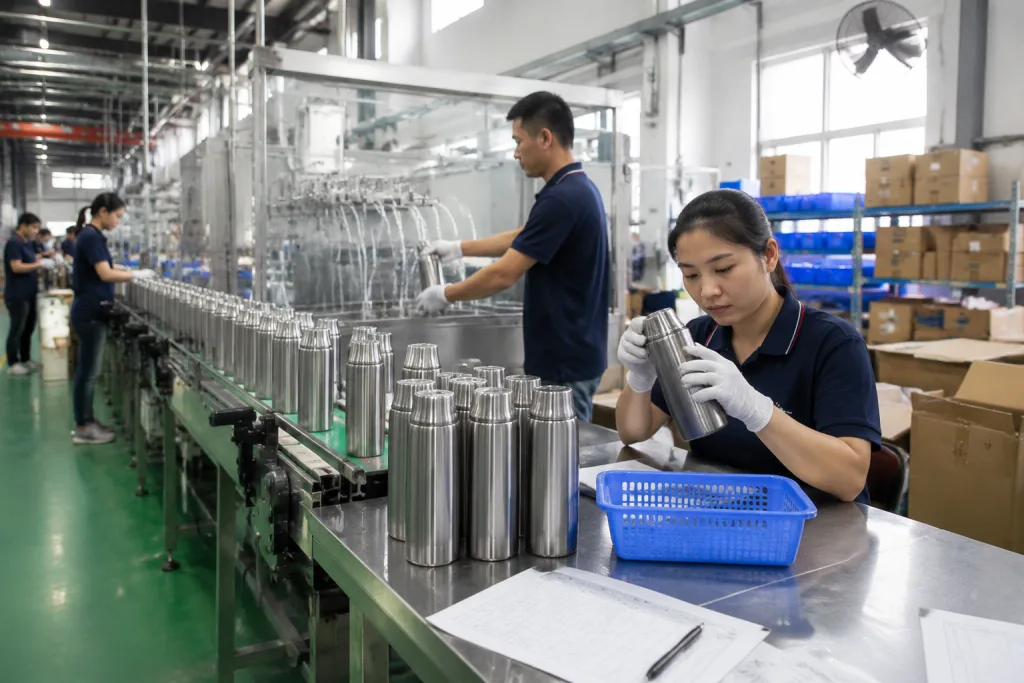
One clean sample proves a factory can make one clean piece. It does not prove they can ship 5,000 matching pieces on the promised date. On our line, that gap shows up fast: color drift after the first 800 pcs, lid torque out by 0.2 N.m, or cartons packed with the wrong inner tray. Sample photos do not tell you that. Factory control does.
For a manufacturer tea bottle source, ask these direct questions:
- What is your normal MOQ by model and finish?
- What is your monthly capacity for stainless vacuum bottles?
- What is your standard lead time in low and peak season?
- Do you run in-house leak test and vacuum retention test?
- What compliance reports can you provide: REACH, LFGB, FDA, BPA-free, CA Prop 65 where applicable?
- Do you have BSCI, ISO 9001, or social audit records?
At a practical level, a capable canteen factory in Zhejiang should answer these in one call or one email, not after 3 follow-ups. This is the wrong question to dodge. If a supplier will not state capacity, there is usually a reason: they are trading, they are splitting orders across subcontractors, or the line is already full for the next 45 days. None of that kills the deal by itself, but you need to know who actually runs production.
Reasonable metrics for a mid-size China factory are 1,000-3,000 unit MOQ, 35-45 days lead time for repeat orders, and 45-60 days for new custom tooling or color development. BottleForge Industrial, for example, plans around 500,000 units per month across stainless categories, with standard sample timing of 7-10 days for stock-body logo samples and 15-20 days for more customized drinkware builds. We have seen buyers push for 20-day delivery on a new painted body with a fresh mold; the math does not work unless stock parts are already on the floor.
If you buy as a canteen distributor, canteen supplier, or distributor growler account manager, ask for defect photos from previous inspections. Serious factories track recurring issues such as pinholes in powder coating, dent rate per lot, and lid torque variation. QC pulled the sample is a phrase you want to hear, followed by the actual finding: 6 dents in a 1,200-pc lot, 2 pinholes near the base, or a PO typo that changed satin black to sand black. You want a partner who talks about process capability and closed-loop correction, not one that just says “no problem.”
Put quality control in writing
The cheapest way to cut claims is to write the QC plan before the deposit goes out. We see the same failure again and again: the buyer expected one standard, the line ran another, and nobody caught the gap until QC pulled the sample.
Your purchase specification for a manufacturer tea bottle should spell out these points:
- Capacity tolerance, for example 500 ml ±3%
- Weight tolerance, for example ±5 g
- Material grades: SS304, borosilicate, Tritan, PP, silicone
- Wall thickness where critical, for example 0.4 mm minimum
- Finish standard: matte powder coat, gloss paint, brushed steel
- Color tolerance by approved Pantone reference
- Leak test requirement: 100% of units
- Vacuum retention target: for example below 45°C after 6 hours from 95°C fill, depending on model
- Inspection level: AQL 2.5 major / 4.0 minor is a common starting point
Do not stop at product QC. Add packaging checks in writing. We ship plenty of orders where the bottle passes, but the carton fails a drop test from 76 cm, the divider board crushes, or the barcode will not scan on the warehouse gun. Master carton gross weight matters too. Keep export carton weight under about 15 kg if your warehouse wants easier handling.
If you are importing into the EU, ask for REACH-related material statements and the food-contact test reports required for that market. For North America, align on FDA-related food-contact expectations and labeling copy before mass production. For children’s products, ASTM and CPSIA issues come into play. For standard adult tea bottles, the core check is still food-contact safety and basic mechanical durability. This is the wrong question to ask if the team is arguing only about unit price.
A lot of canteen manufacturers and canteen suppliers in China will send reports on day one, but old reports for unrelated models do not prove much. We have seen buyers accept a 2021 stock-lid report, then flag a custom painted bottle with metal trim after inspection because the decoration system was never covered. The test report should match the material family and decoration condition closely enough to mean something. A clear-lid stock bottle report does not fully cover a painted, printed, metal-trimmed custom bottle.
Build the order around your channel
The right tea bottle changes by channel. Ignore that, and the spec drifts fast: too much cost for promo, or too little packaging for retail. We see this on the line all the time.
For promotional buying: keep the build plain. Stock molds, 500-600 ml, 1-color branding, MOQ around 1,000-2,000. This is where canteen promotional and customizable canteen projects usually land cleanly, especially when the buyer wants a 30-day ship window. A complex tea compartment sounds good in a meeting, but the math does not work if the target is giveaway pricing.
For retail shelves: packaging and hand feel sell the bottle before the customer tests the filter. Spend on powder coat, laser mark, and a cleaner filter mechanism with tighter thread fit; on one recent run, QC pulled the sample because the lid gap was 0.6 mm and it looked cheap under store lighting. A USD 0.35 upgrade can create a much larger retail price difference if the shelf presentation improves.
For ecommerce: start with the carton, not the bottle. You need drop-tested packaging, barcode controls, and replacement parts ready before launch; the buyer flagged one PO last season because the barcode sticker was printed over the color name and the warehouse rejected 1,200 units. A leaking lid can generate return rates above 5%, which quickly destroys margin. Ask your canteen vendor for torque specs, spare gasket availability, and post-shipment support on parts.
For distributors: cut the assortment down. One body shape in 3 colors and 2 capacities usually beats six bodies with confusing cap systems, and it makes replenishment easier when you ship mixed cartons by SKU count. If you are a canteen distributor, canteen distributors group, or distributor canteen buyer, stable replenishment is worth more than the most original shape in the catalog. We have seen this go sideways when one cap uses a 58 mm neck and the next uses 60 mm with no clear reason.
Think about family strategy early. A manufacturer tea bottle can share design language with a custom canteen, customized canteen, custom growler, or customized growler line, and that keeps the shelf story tight. But the engineering should split where it needs to split. A tea infuser bottle does not need the same handle geometry as a 64 oz growler, and a customizable growler should not be priced using the same packaging assumptions as a desk bottle. This is the wrong question to ask if the team is only looking at artwork and ignoring pack-out weight.
Zhejiang remains one of the strongest sourcing regions in China for this category because supply chains for steel forming, powder coating, printing, silicone parts, and export packing are close together. A gasket vendor, powder coat shop, and carton plant can all sit within 12 km of the factory, which saves days when QC finds a fit issue. That proximity shortens problem-solving time, which is usually worth more to you than saving a few cents on a risky quote.
Get a tea bottle quote with real factory numbers
Send your target price, volume, market, and artwork. We will recommend the right structure, MOQ, tests, and lead time before you commit.
Frequently asked questions
What MOQ should I expect for a custom manufacturer tea bottle order?
For stock-body models with standard lids and simple logo work, 1,000 units per color is a realistic starting point in China. If you need a new body mold, custom lid tooling, special Pantone coating, or retail gift box, MOQ usually moves to 2,000-3,000 units. Stainless vacuum bottles are often easier to run at lower MOQ than glass bottles with fully custom packaging, because breakage and packing complexity are lower. If you are a canteen distributor testing demand, ask for a shared stock mold with custom decoration first. That lets you validate the market before committing to tooling costs that can run from a few hundred dollars for minor inserts to several thousand for new molds.
Which material is best for tea bottles: stainless steel, glass, or Tritan?
It depends on how your customers use the bottle. Double-wall stainless steel is the safest all-around B2B choice because it combines lower breakage, 8-12 hour insulation on many 500 ml models, and strong freight efficiency. Borosilicate glass looks premium and shows the tea clearly, but it needs better packaging and usually creates higher damage risk in ecommerce. Tritan works well for cold tea and lighter weight promotional projects, but many buyers prefer stainless or glass for repeated hot use above 90°C. If your channel is office gifting, distributor drinkware, or retail, stainless usually gives the best balance of complaint rate, perceived value, and reorder consistency.
How do I verify a tea bottle factory is real and not just a trading company?
Ask for factory audit records, business license details, workshop photos with date evidence, and specific capacity numbers. A real canteen factory should tell you monthly output, normal MOQ, sample lead time, and what processes are in-house, such as vacuuming, powder coating, laser marking, or assembly. Then request a video call from the production floor and ask technical questions: wall thickness, leak-test method, vacuum retention standard, and AQL level. If answers are slow or vague, be cautious. Trading companies are not always a bad choice, but you should know whether the party quoting you actually controls production, because lead time and quality responsibility become less clear when problems happen.
What compliance documents do European and North American buyers usually need?
For Europe, buyers commonly ask for REACH-related material statements and food-contact testing relevant to the bottle’s materials and intended use. Depending on market position, LFGB-style testing may also be requested. For North America, FDA food-contact expectations, BPA-free declarations where relevant, and sometimes California Proposition 65 screening are common. If the bottle is marketed to children, requirements expand. The important point is that reports should match the actual construction: steel, lid plastic, gasket, print, and coating. Do not accept a random old report from another model. For a serious custom drinkware order, ask for documents before production and confirm whether third-party testing is built into your timeline and budget.
What lead time is realistic for a first tea bottle order from Zhejiang or other China factories?
For a first order using an existing mold and standard packaging, 35-45 days after sample approval and deposit is common. If you add custom color development, gift boxes, multiple print positions, or new tooling, 45-60 days is more realistic. Peak season can push this longer, especially before major holiday shipping periods. Sampling usually takes 7-10 days for simple logo samples and 15-20 days for more customized drinkware with engineering changes. Build time for testing and approval into your plan. If you need the goods delivered before a campaign date, work backward from the warehouse receipt date, not the ex-factory date, and leave a 7-10 day buffer for inspection and shipment handling.