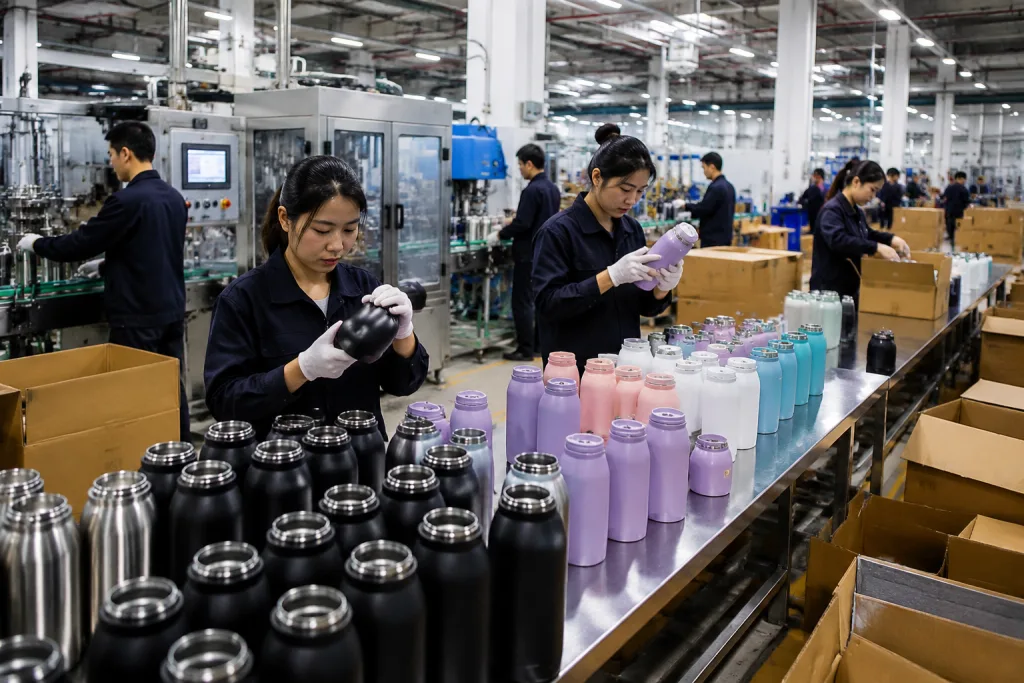
Key Takeaways
- For a 30 oz double-wall 304 tumbler, practical MOQ is usually 1,000-3,000 pcs per color, with tooling-free logo options from about USD 0.08-0.35 per unit
- A normal production cycle in Zhejiang, China is 7-12 days for pre-production samples and 30-45 days for mass production after deposit and artwork approval
- Common B2B QC uses AQL 2.5 major / 4.0 minor, plus 100% vacuum insulation and leak checks before packing
- FOB China pricing for a 30 oz powder-coated tumbler often lands around USD 3.20-5.80 depending on steel grade, lid style, coating, and packaging
You do not usually lose money on a stainless tumbler because of the quoted unit price. You lose it before the first sample is signed off: the lid thread is off by 0.3 mm, logo adhesion fails the tape test, master cartons run 8 mm too wide for the shelf plan, or the steel grade looks fine in a photo and then fails a salt spray or migration test. We have seen this go sideways. If you are buying from a manufacturer stainless steel tumbler supplier in China, the order should be specified like a component, not a souvenir.
A common case looks like this: you need 8,000 branded 30 oz tumblers for a fall retail program in Europe, with a second SKU for North America. The buyer flagged lid compliance on one PO last season because the US straw lid and EU flip lid were mixed under one item code, and that is the wrong question to ask after sampling. We will track the order from first RFQ to final inspection, using the numbers a Zhejiang canteen factory or custom drinkware supplier should be ready to put on the table.
Start with the actual program
Start from the sell-through plan, not the rendering. If you supply chain retail and e-commerce, your target is a manufacturer stainless steel tumbler that looks clean at retail, but the buy is still B2B. Margin, compliance, and repeatability decide the order. A typical brief we see is one core body shape, three powder-coat colors, one clear slider lid, one printed gift box, and split delivery to Hamburg and Los Angeles. That is a real program. We ship these every week.
The first mistake new buyers make is the one-line inquiry: “Need custom tumbler, please quote.” That gets you a rough number and a bad start. A serious canteen manufacturer or canteen supplier in Zhejiang, China needs a working specification package, or the line will price the wrong build. We have seen POs with “matta black” typed instead of “matte black,” and that small typo turned into sample rework. At minimum, send:
- Capacity: 30 oz / about 890 ml usable volume
- Body construction: double-wall vacuum, 18/8 stainless steel, copper-plated inner wall if required
- Steel thickness: outer 0.4 mm, inner 0.4 mm as a common baseline
- Finish: powder coating, Pantone reference, gloss or matte
- Lid: AS or Tritan slider lid, BPA-free silicone gasket
- Logo method: silk screen, laser engraving, or 3D decal
- Packaging: white box, color box, PDQ, or master carton only
- Destination market: EU, US, or both
- Compliance needs: REACH, LFGB, FDA, California Proposition 65 where applicable
- Quantity by SKU and delivery window
If you also buy custom canteen, customized growler, or other customizable drinkware, say it at the start. This is the right question to ask early, because shared sourcing changes the math. A factory planning common materials across a tumbler, custom growler, and canteen custom project can buy lids to one spec, steel coils by the same gauge, cartons in combined runs, and coating powder by batch. In our cost sheets, that often cuts 3% to 8% against quoting each item as a one-off. MOQ pressure usually drops too.
BottleForge Industrial in Hangzhou, Zhejiang typically runs mixed drinkware programs rather than single-SKU jobs, and that is standard for export factories at 300,000 to 500,000 units/month capacity. On the floor, that means shared lid molds, common carton footprints, and faster line changeover between SKUs. You want a canteen factory that prices the full program and watches repeatability, not one that chases the lowest piece price on one tumbler. We have seen that go sideways.
Lock the tumbler specification early
Once the RFQ is real, lock the physical spec before you start fighting over cents. Most tumbler disputes start with loose wording on the PO. “304 stainless” does not tell us wall thickness, and “good lid” tells the line nothing. On our side, if a canteen vendor or canteen suppliers network knows the product, they should answer each point fast, down to mm, steel grade, and test method.
Core body details
- Material: inner and outer 18/8 stainless steel, usually SUS304 for food contact. If cost pressure is high, some canteen manufacturers will offer 201 outer + 304 inner. That setup can work for low-risk indoor use, but for retail in Europe and North America, full 304 is the safer default. We have seen buyers push for mixed steel, then flag rust risk later after salt-spray checks. This is the wrong question to ask if the item is going to supermarket shelves.
- Vacuum structure: double-wall vacuum with sealed base. Ask whether each piece is vacuum-tested at 100% or by sampling only. QC pulled one lot last month where the vacuum loss showed up as a warm body after 20 minutes, and the issue traced back to the sealing station.
- Insulation target: practical benchmark is 6-8 hours hot above 60°C from a near-boiling fill, and 12-24 hours cold depending on ambient conditions and ice ratio. Put the fill temperature and test room condition on the sheet. A 95°C fill in a 23°C room gives different data from a quick bench check on the factory floor.
- Base diameter and height: if it must fit cup holders, specify a base around 72-75 mm and confirm overall height after lid assembly. We normally check this with a digital caliper, because 3 mm off at the base is enough for the buyer to reject the sample.
Lid, coating, and logo
Lids are where returns happen. A slider lid is fine for splash resistance, but it is not leakproof unless it has a screw closure or sealing plug. If your sales team wants “travel safe,” write the leak standard into the PO and stop there. We ship against written standards, not casual wording. Ask for upside-down static leak test results for 30 minutes and a vibration test if the tumbler is sold for car use; one buyer flagged a lid last year because the gasket lifted after road-sim vibration.
For decoration, powder coating usually holds up better than ordinary spray paint. Typical logo options on a tumbler are silk screen at about USD 0.08-0.18, laser engraving at USD 0.12-0.25, or 360-degree transfer printing higher than that. If the same buyer also sources a customizable canteen or customized canteen, align logo methods across items so visual quality stays consistent. We have seen this go sideways when the tumbler used matte powder coat and the canteen used gloss spray, then the shelf set looked mismatched under store lighting.
A cheap quote that hides downgraded lids, thinner steel, or weak coating is not cheaper. It just moves your cost to returns, rework, and lost shelf space.
Experienced canteen distributors and distributor drinkware buyers usually ask for a pre-production sample signed against a spec sheet with weight tolerance, dimensions, logo position, and carton drop standard. Add the unit weight in g, logo position in mm, and carton mark exactly as approved; we once got a claim over a single typo on a PO number. That signed sample should be the reference for QC and claims.
Price the order like a buyer
Price the order like a buyer, not like someone collecting quotes on a spreadsheet. In this case the volume is 8,000 units across 3 colors, about 2,600-2,700 each, and a workable FOB Zhejiang or FOB Ningbo range for a 30 oz powder-coated tumbler with clear slider lid and one-color logo is roughly USD 3.20-5.80. That spread is normal. The line sees cost move fast on four points: material spec, lid build, decoration, and pack-out. On our side, a 0.1 mm wall-thickness change is enough to shift the number.
- Steel grade and thickness
- Lid resin and complexity
- Surface finish and logo process
- Packaging and carton efficiency
One canteen vendor will throw out USD 3.35, and another canteen factory comes back at USD 4.40 for what sounds like the same tumbler. Usually it is not the same tumbler. Ask for the cost split line by line. QC pulled the sample on one project last summer and the cheaper offer had a lighter lid gasket and a thinner white box than the approved spec. A clean breakdown looks like this:
- Body + vacuum process: USD 2.10
- Lid + gasket: USD 0.42
- Powder coat: USD 0.28
- Logo: USD 0.10
- White box: USD 0.18
- Outer carton + inserts: USD 0.12
- QA, overhead, margin: remainder
MOQ matters. Standard open-mold tumbler programs often start at 1,000 pcs/color, but a printed color box can add 1,000-3,000 pcs/design and slow the order if the artwork is late. We have seen buyers miss this and then argue over 2,000 extra boxes sitting in stock. If you want a new lid color, resin matching MOQ usually climbs, and the math does not work for a small run. If you ask for a custom mold, budget can jump by USD 3,000-15,000 depending on body and lid complexity.
If you are a canteen distributor, distributor canteen, or distributor growler buyer, watch carton cube as closely as unit price. This is the wrong question to ask: "What is your cheapest unit price?" Ask how the packed carton lands. We ship plenty of 30 oz tumblers at 40-48 pcs/master carton, but the real answer changes with box style and drop protection, and a buyer flagged one quote because the insert board added 12 mm to carton height and cut container loading. Saving USD 0.12 on the unit means little if carton utilization is poor and sea freight adds USD 0.20 back. Ask for packed dimensions, GW/NW, and units per 40HQ.
Payment terms from China are commonly 30% deposit and 70% against copy B/L or after inspection before shipment. New buyers sometimes push for 100% after arrival. Most established Zhejiang factories will refuse that unless there is trade assurance, credit insurance, or a mature annual agreement. We have seen this go sideways when a PO even had the deposit term typed wrong, so check the paperwork before the line starts.
Sampling before mass production matters
Sampling is where small money saves big money. A reliable canteen manufacturer should split the sample stages clearly, and this is not paperwork for its own sake. On our line, the sample room logs each stage against the PO before we release any logo plate.
- Reference sample: existing mold, close color, 2-5 days
- Pre-production sample: actual finish and logo, usually 7-12 days
- Golden sample: buyer-approved unit held by both sides for QC reference
For our 8,000-piece tumbler program, request at least 3 pre-production samples. One goes to lab or internal compliance review, one stays with marketing for packaging and photo use, and one gets sealed as the golden sample with date and signature on the carton label. If there is also a canteen customizable SKU or customized drinkware family launch, check coating tone and logo placement side by side under the same light box. We have seen buyers approve each item one by one, then flag the full set because the black powder coat reads warmer on one bottle than the tumbler next to it.
What should you inspect on the sample? Use a simple approval sheet. QC pulled the sample, put it on the bench, and worked through the same points we use before mass production:
- Capacity tolerance: for example ±3%
- Weight tolerance: for example ±5%
- Height, rim diameter, base diameter
- Thread fit and lid interchangeability
- Vacuum performance after 4 and 8 hours
- Powder coat adhesion and scratch resistance
- Logo color Delta E tolerance if critical
- Barcode placement and carton marks
For packaging, run the ugly checks, not just the pretty ones. Shake the gift box. If the tumbler rattles, the insert is wrong. Drop the carton from 60 cm and check crushed corners, split tape, and scuff transfer on the coating. Test whether your FNSKU or retailer label sits flat on the panel without bridging a fold. A good canteen supplier knows Amazon FBA and retail compliance can turn a decent tumbler into a claim case fast if the box spec is off by 2 mm.
Lead time discipline starts here. If your factory says 35 days production, ask what that assumes: approved artwork, approved sample, deposit received, and no change to carton print. This is the right question to ask. Last month a buyer changed one Pantone callout after sample approval, and the outer carton file had a typo on the PO number, so the print slot moved and shipment slipped from 12 days to 18 days. That is not a China problem. It is production reality.
QC plan from line to loading
For B2B drinkware, QC is not a last-day check. It is a written plan that starts before the first shell hits the line. On a stainless tumbler order, we usually set 4 control points: incoming materials, in-line checks, pre-shipment inspection, and loading supervision once the shipment value is high enough to justify a container-side check.
Incoming material controls
Ask the factory for material declarations and, where the program requires it, test reports for every food-contact part. That means stainless steel grade confirmation for the body, lid resin data, silicone gasket declaration, and coating compliance paperwork. QC pulled a sample last month because the gasket hardness was off by 3 Shore A from the approved spec, and that is exactly why this step matters. For EU programs, REACH and LFGB often sit on the must-have list. For US programs, FDA-contact expectations and Proposition 65 screening may be required, depending on the material set and where the goods will be sold.
In-line production checks
- Weld seam and body forming appearance
- Vacuum retention test
- Lid fit and torque consistency
- Logo position within agreed tolerance, for example ±1.5 mm
- Color consistency batch to batch
For final inspection, a common buyer standard is AQL 2.5 major / 4.0 minor. Major defects usually mean functional or saleability failures: vacuum loss, a sharp edge at the cup rim, a leaking lid where leak resistance is part of the spec, a missing logo, a wrong barcode, or a crushed carton that retail will reject. Minor defects are smaller issues such as coating pinpoints in a hidden area or print variation still inside the approved tolerance. The wrong question to ask is whether AQL alone will protect you; it will not if the defect definition sheet is weak.
Ask one practical question early: is vacuum testing done at 100%, and is leak testing done at 100% or by sampling? On tumbler programs, 100% vacuum test is standard on the line and should not be priced like an extra. We have seen buyers push back on this, then find out too late the factory only sampled 200 pcs from a 10,000 pc run. You can also require random thermal retention verification during inspection, such as a 6-hour hot-hold check against the approved spec.
Factory social and system audits are not the full picture, but retail buyers still ask for them before they release business. If you supply chain retail, ask for current BSCI or equivalent social audit status and ISO-based process controls where available. We ship to customers who will not onboard the first PO until those files are current, even when the product inspection result is clean. One buyer flagged an expired audit by 12 days, and the booking slipped a full week.
Document the claims window before shipment. If 0.8% of units show lid leakage after arrival, what is the remedy: spare lids, a credit note, or replacement on the next PO? Put the response into the PO terms, because we have seen this go sideways when the carton mark was right, the inspection passed, and the complaint came 45 days after ETA. Serious canteen vendors settle that point before loading, not after the claim email lands.
Shipping, compliance, and repeat orders
After inspection passes, the last expensive misses usually show up in shipping documents and destination compliance. We see this on the line all the time: one PO gets split to the EU and US, but the buyer sends one carton mark and one test file as if both markets read the same. They do not. Your distributor drinkware or retailer account may need different labeling, importer details, warning text, or carton language, and this is where a container gets held for a typo that should have been caught at PO stage.
For sea freight, ask for:
- HS code used by the exporter
- Carton dimensions, gross weight, net weight
- Units per pallet if palletization is required
- Booking-ready cargo date and ex-factory date
- Photo record of loading if cargo value is high
If you also manage a custom growler, customizable growler, or customized growler program, split SKUs by destination and test requirement inside your ERP or PO system. This is not admin fluff. We have seen mixed drinkware orders stall because one infuser bottle or canteen custom item was missing a declaration, so the whole container sat while the forwarder waited. QC pulled the sample, production was done, and the paperwork still blocked shipment.
For repeat orders, the best savings usually do not come from pushing for another 3% off the quoted price. The math does not work if that discount creates extra molds, extra lids, and odd carton sizes. The real gain comes from standardization: keep the same body mold, the same lid family, the same carton footprint, and a tight coating range. A steady program with forecast visibility lets a China factory in Zhejiang buy 304 stainless in larger lots and hold semi-finished stock, which can cut lead time from 45 days to around 25-30 days on repeat SKUs and keep color closer batch to batch.
If you are choosing among canteen suppliers or canteen manufacturers, look hard at how they handle the second and third order, not just the first quote. Anyone can chase your opening PO. We ship plenty of first runs that look smooth on paper. The better partner is the one that keeps steel thickness consistent, hits the cargo date, sends clean documents, and says directly when a spec is unrealistic. That is what makes a manufacturer stainless steel tumbler source usable for real B2B growth.
Get a workable tumbler quote, not just a low quote
Send your target size, quantity, logo file, packaging needs, and market requirements. We will review MOQ, lead time, compliance, and QC points before sampling.
Frequently asked questions
What MOQ should I expect for a custom stainless steel tumbler order?
For an existing tumbler mold, MOQ is commonly 1,000 pcs per color or 3,000 pcs total, depending on the factory and decoration method. A plain white box usually keeps MOQ lower. A custom printed gift box can add 1,000-3,000 pcs per design because of carton printing economics. If you want a new body mold or a special lid color, MOQ and setup cost rise fast. In Zhejiang, China, many export factories will quote mixed-SKU programs if the total order reaches 5,000-10,000 units across tumbler, custom canteen, or other custom drinkware items. Ask whether MOQ applies by color, by logo, by packaging, or by shipment. Those are not always the same.
What is a realistic price for a manufacturer stainless steel tumbler?
A standard 20 oz to 30 oz double-wall vacuum stainless tumbler with powder coating and a clear slider lid often falls between USD 2.70 and USD 5.80 FOB China. For a 30 oz full-304 version with one-color logo and basic color box, USD 3.20-4.60 is a practical planning range. If the quote is far below that, check steel thickness, lid resin, coating type, and whether testing or spare parts are excluded. Laser engraving usually adds around USD 0.12-0.25 per unit; a printed color box may add USD 0.15-0.40. Freight, duties, and destination labeling are separate. Always compare packed carton data, not just unit price, because shipping cube can change total landed cost by 5% or more.
How long does production take for custom tumblers from China?
For an open-mold tumbler, expect 7-12 days for pre-production samples after artwork and Pantone confirmation. Mass production usually takes 30-45 days after sample approval and deposit. Peak season can push that longer, especially from August to November. Repeat orders with unchanged body, lid, and packaging can often run in 25-30 days if the factory has material planning discipline. In Zhejiang, some factories quote shorter lead times, but confirm what is excluded. If artwork, compliance review, carton approval, or barcode setup is still pending, the clock has not really started. For large orders above 20,000 units or for mixed programs including customizable canteen or growler SKUs, build in another 7-10 days.
What tests and compliance documents should I ask for?
At minimum, ask for food-contact declarations for stainless steel, lid plastic, and silicone gasket. For Europe, REACH and often LFGB are common checkpoints. For the US, buyers typically ask for FDA-contact suitability and may request California Proposition 65 screening depending on materials and retail channel. For kids' products, ASTM or CPSIA-related requirements can apply, but for general tumblers the main focus is food contact, labeling, and packaging claims. On the quality side, request insulation verification, leak testing method, coating adhesion results, and carton drop performance if retail packaging is involved. AQL 2.5 major / 4.0 minor is a common final inspection standard. If your customer requires BSCI, ask for the current audit report before placing the PO.
How do I reduce risk on my first order with a canteen or tumbler factory?
Use a staged process. First, send a full RFQ with capacity, steel grade, wall thickness, lid type, logo method, packaging, compliance market, and target quantity. Second, approve a pre-production sample and keep a signed golden sample. Third, put quality points into the PO: 100% vacuum test, agreed leak standard, logo position tolerance, AQL level, and claim process. Fourth, do not skip pre-shipment inspection on the first order, especially above USD 15,000 cargo value. Fifth, standardize what you can: one lid family, one carton size, limited coating colors. Buyers who treat the tumbler as a controlled manufactured item, not a simple giveaway, usually avoid the biggest first-order problems.