Key Takeaways
- For most gym retail programs, 18/8 stainless steel bottles start around USD 2.80-4.90 FOB China at 1,000-3,000 units, while Tritan options often land at USD 1.20-2.40 FOB.
- Decoration choice changes failure risk: laser engraving has near-zero logo rub-off, while silk screen needs abrasion checks and usually adds 3-5 days.
- A realistic custom lead time in Zhejiang, China is 25-35 days after sample approval, with MOQ often 500-1,000 pcs per color per model.
- Use AQL 2.5/4.0, 24-hour leak testing, and REACH or FDA material declarations before final balance payment.
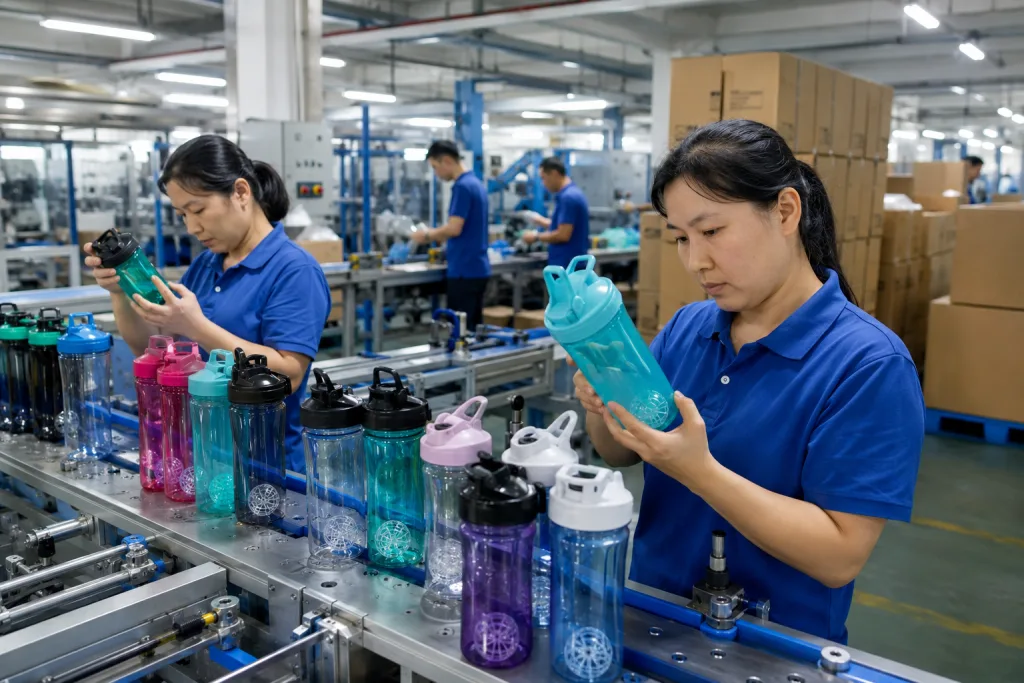
You can buy a sports bottle from almost any trading company in China. Easy part. The harder part is setting up a manufacturer sports water bottle program that still holds when you need 5,000 units in three colors, leak rate below 0.5%, compliant materials for Europe, and repeat delivery to 120 gym locations. On our line, that usually comes down to small details buyers miss early, like a lid thread off by 0.3 mm or a straw seal that passes the first sample and fails after drop test.
Fitness brands and gym chains usually get stuck on four decisions: material, decoration method, order structure, and compliance control. Get those right early and the project moves. Get them wrong and you can lose the next 45 days fixing lid fit, logo wear, or carton dimensions. We run into this every season in Zhejiang with North American distributors and European private-label buyers. One common pushback is, "Why is the carton size changing after approval?" Usually the buyer approved the bottle and missed the divider packout on the PO. This is the wrong question to ask at the start; the better one is whether the full bottle spec, packing spec, and test standard match before mass production.
Start with four sourcing decisions
If you are buying for a fitness brand or gym chain, skip the generic catalog. Start with the program itself. This is the wrong question to ask if your team is still debating color chips and logo width on a 60 mm print area. A distributor sports water bottle order for resale is not built the same way as a customized gym water bottle for member welcome kits. A custom shaker bottle for protein sales brings different lid leak points and odor returns than a bulk gym water bottle sitting at the front desk.
Four sourcing decisions usually set your cost, lead time, and complaint rate before the PO is even clean:
- Body material: single-wall stainless, double-wall vacuum stainless, Tritan, PP, or shaker-grade blends.
- Cap structure: straw lid, screw cap, flip lid, chug lid, or shaker cap with mixer ball or agitator.
- Branding method: silk screen, heat transfer, UV print, laser engraving, or embossed mold detail.
- Order architecture: how many SKUs, colors, and cartons per destination.
The trade-off is straightforward. Add more parts, inserts, and label steps, and your custom made shaker bottle or customizable sports water bottle program starts running like a packaging line. We have seen this go sideways when the buyer flagged a late PO change from 2 SKUs to 5 after carton marks were already confirmed. A single 700 ml Tritan model in two Pantone colors with one-color screen print can move in 25-30 days. A five-SKU stainless line with gift boxes, FNSKU labels, and EU-language inserts can push 40-50 days even in a well-run Zhejiang factory.
At our Hangzhou, Zhejiang production network, a practical MOQ is usually 500 pcs for stocked colors and 1,000 pcs for fully customized sports water bottle production. Monthly output can reach 300,000 units across sports and shaker formats. That sounds strong on paper. The math does not work if the first sample stage is still carrying 3 lid options, 4 print files, and mixed carton packouts, because capacity only helps when the early decisions are locked.
Pick material by use case
Material sets your shelf price and the complaints you will deal with later. For daily gym use, start with where the bottle gets used - treadmill cup holder, weight room floor, locker, dishwasher - not the lowest FOB on the quote sheet.
Single-wall and vacuum stainless
18/8 stainless steel fits premium gym chains, outdoor fitness brands, and higher-ticket member merchandise. Single-wall models are lighter and cheaper, often USD 2.80-3.60 FOB at 1,000 pcs. Double-wall vacuum models run more like USD 4.20-6.80 depending on capacity, coating, and lid. Typical outer wall thickness is 0.4 mm and inner wall 0.35-0.4 mm. Ask for actual gauge confirmation from a micrometer check, not a sales promise. We have seen POs say "0.5/0.5 mm" and the line was running thinner stock.
The upside is clear: better perceived value and better abuse resistance in a gym bag. The tradeoff is freight, dent risk, and dark powder coat showing flaws fast. QC pulled the sample on one black bottle order because a 6 mm scratch near the base looked minor under factory light and obvious under retail light. This is the wrong question to ask: "Is stainless better?" Better for which shelf, which margin, which customer?
Tritan and PP sports bottles
For a bulk fitness water bottle or distributor gym water bottle program, Tritan usually gives the cleanest margin math. It is lightweight, clear, BPA-free, and easy to mold in active shapes. A 600-750 ml Tritan bottle usually lands around USD 1.20-2.40 FOB China. PP is cheaper and common for shaker formats, but odor control and long-term appearance are weaker than Tritan. Buyers push back on this every season, then come back after scuff marks and protein smell complaints.
If you need a bulk shaker bottle or custom logo shaker bottle, PP body plus PP cap is common because it balances impact resistance with price. We ship a lot of these at 3,000 pcs MOQ. For this segment, ask about mixer type:
- Wire whisk ball: low cost and familiar, but it adds one more loose component. The buyer flagged this on a club order after store staff lost samples from open boxes.
- Plastic agitator insert: easier color matching and cleaner carton packing.
- Integrated mixing grid: cleaner assembly with fewer loose parts.
For Europe, ask for REACH declarations and food-contact statements. For North America, FDA or LFGB testing may be relevant depending on your retailer and use claims. If the supplier hesitates on basic compliance paperwork, move on. We have seen this go sideways over one missing migration report that held shipment for 12 days instead of 3.
Choose the lid before the logo
Most bottle complaints start at the lid, not the body. We see this on the line every season. A custom fitness water bottle can carry an average logo and still ship fine, but the wrong cap choice comes back as leaks, cracked hinges, or loose threads. Buyers new to China often approve a clean-looking sample and miss the working checks: 500 open-close cycles, a 24-hour inverted leak test, and whether QC pulled the sample from mass production or hand-built it.
For gym and sports channels, the cap decision should follow usage:
- Chug cap: fewer parts, lower failure rate, and a better fit for high-volume distributor sports water bottle programs. This is usually the safer pick. We run this style on faster assembly lines with less hinge-related rework.
- Flip lid with lock: better shelf appeal, but hinge pin fit and spring consistency need checking. We have seen buyers flag button force above 3.5 kg because one-hand opening felt stiff.
- Straw lid: easy for training use, but cleaning complaints go up fast. In one inspection, residue stayed in a 6 mm straw bend after standard rinse testing.
- Shaker cap: thread fit, seal compression, and snap closure force have to match. If the thread start is off by even 0.3 mm, this style goes sideways fast.
If you are developing a customizable shaker bottle or customized shaker bottle line, ask for three test points in writing: thread engagement tolerance, leak test standard, and drop test height. A practical benchmark is 1.0 meter drop test, 24-hour upside-down leak test, and 500 cycle open-close functional test. For gym chains, that matters more than saving USD 0.08 on the cap. Frankly, price-first cap buying is the wrong question to ask.
A bottle body is easy to copy. A reliable lid system is where factories separate themselves.
Check replacement policy too. If 3% of caps crack in transit, can the factory air-ship spare caps within 7 days? Good Zhejiang manufacturers plan this before booking the shipment. Weak suppliers start arguing over carton drop damage, or point to a typo on the PO and stall the claim. For a custom gym water bottle or customized gym water bottle order shipped to multiple clubs, spare-part planning saves more than the small extra cost.
Balance MOQ against SKU ambition
Plenty of fitness brands overbuild the first PO. We see requests for four sizes, six colors, two logo positions, plus separate packaging for e-commerce and retail, then the buyer flags the MOQ jump as if it came out of nowhere. On the line, each extra version means another setup, another carton mark, another chance for a pack-out miss. Start with one core bottle. Add variants after sell-through data is on the table. This is the wrong question to ask early: "How many options can we launch?" Ask how many units each option can honestly carry.
Here is the math every supplier should put in black and white. If the MOQ is 1,000 pcs per model and 500 pcs per color, a three-color custom sports water bottle launch already needs 1,500 pcs. Add a gift box with custom print and you may trigger a packaging MOQ of 1,000-2,000 pcs per artwork. Add two logo methods and sample approval also slows down. Last month, QC pulled the sample because the silk screen logo sat 3 mm higher than the approved artwork on one colorway. Small change, extra round. That is how lead time slips from 12 days to 18 days.
For distributor fitness water bottle and distributors gym water bottle buyers, the most efficient first order is usually:
- One capacity, such as 650 ml or 750 ml
- Two body colors
- One lid style
- One logo method
- One master carton spec
That setup gives you cleaner forecasting and fewer packing errors. It protects your landed cost too. A bulk sports water bottle order with mixed carton counts, special inserts, and low-quantity color splits can raise unit cost by 8-15% even when the bottle itself does not change. We have seen this go sideways over one small PO typo: outer carton changed from 24 pcs to 20 pcs, and the freight math stopped working.
At BottleForge, we often tell buyers from Europe and North America to spend their first USD 8,000 on depth, not width. We ship smoother that way. A deeper order on one customizable gym water bottle or customized fitness water bottle usually delivers better price breaks, more stable quality, and faster replenishment from Zhejiang, China. On a standard 304 stainless program, that often means one repeatable BOM, one lid mold, and one AQL 2.5 inspection flow instead of three partial runs fighting each other for space.
Printing method changes return rates
Your logo does more than dress up the bottle. It changes the production sequence, the test plan, and the return rate. We see this on the line with custom made shaker bottle, custom gym water bottle, and customizable fitness water bottle programs: pick the wrong decoration, and a solid bottle turns into a warranty claim.
Silk screen printing is the low-cost option for simple 1-2 color logos, at roughly USD 0.05-0.18 per unit depending on print size and color count. It runs well on Tritan and coated stainless, but ask for adhesion and abrasion test records, not just a photo sample. QC pulled one bin-stack test last month where the white logo started scuffing after 80 rub cycles on coated bottles. If gyms throw bottles into wire baskets or you sell through distributors shaker bottle channels, this wear point matters.
Laser engraving is slower, but on stainless steel it is the safer call. Typical cost adder is USD 0.12-0.30. The mark is durable, clean, and close to zero for rub-off risk. We run it often for gym chains that reorder the same custom logo shaker bottle or customized sports water bottle every quarter. One buyer pushed back on the extra USD 0.08, then came back after a screen-printed lot showed wear in 12 days vs 18 days on their test floor. This is the wrong question to ask: unit print cost alone means little if returns eat the margin.
Heat transfer or UV print handles complex graphics, small text, and gradient artwork. It also adds setup work and often adds 3-5 days. On one PO, the buyer flagged a missing Pantone note before we burned the first fixture, and that alone cost half a day. Good fit for lifestyle retail. Weak fit for urgent replenishment. We have seen this go sideways when a customer wants photo-quality art and still expects screen-print lead time.
Do not treat logo placement tolerance as a soft target. Ask for a measurable standard, such as plus or minus 2 mm from approved artwork centerline. If your order is headed to Amazon or 3PL channels, require barcode and FNSKU placement diagrams before mass production. We ship plenty of these, but the files, carton marks, and print position need to be locked before printing starts. One common inspection finding is a barcode drifting 3 mm into the bottle curve, which is enough to create scan trouble at inbound.
Control quality before shipment
If you are buying bulk gym water bottle, bulk shaker bottle, or distributor shaker bottle quantities, quality control needs to be written down before deposit payment. After defects show up, the math does not work. We usually lock the QC points on the PI and sample approval sheet first, with clear numbers, photos, and who signs off.
Use an inspection standard with defined defect categories. AQL 2.5 for major defects and 4.0 for minor defects is common for drinkware, and QC pulled the sample size from the lot quantity before the line closed. For sports bottles, major defects usually include leaking lids, cracked handles, wrong logo, contamination inside the vessel, and failed insulation where relevant. Minor defects include small coating dots under 1 mm, slight seam lines, or packaging scuffs outside the approval standard.
Your pre-shipment checklist should cover:
- 24-hour leak test on sampled units
- Drop test at 1.0 meter with defined acceptance
- Logo adhesion or abrasion test
- Capacity verification within agreed tolerance
- Carton drop and barcode scan check
- Material and compliance paperwork review
For stainless insulated models, ask for heat retention benchmarks, for example from 95 degrees C filled water to above 45 degrees C after 6 hours. We run this with a calibrated probe and record ambient room temperature because buyers have flagged temperature claims that were tested in the wrong conditions. For plastic shakers, ask for odor evaluation after hot water rinse. Sounds basic. It catches resin or sealing issues early, especially on first orders or after a mold repair.
A serious Zhejiang supplier should also be comfortable discussing BSCI, ISO-style process control, and corrective action reports. This is the wrong question to ask: “Do you have all certificates?” Ask what happened on the last defect case. We have seen issues traced back to a loose lid core on the injection mold and even a PO typo that swapped a barcode version, and a capable factory will explain the root cause, the correction, and how they kept it from shipping again.
Plan the landed cost, not FOB only
FOB price matters, but it is not your margin. We have seen fitness brands shave USD 0.30 off the bottle, then give it back on freight, relabeling, oversized gift boxes, or retailer compliance fees. For a manufacturer sports water bottle project, landed cost control beats hard haggling on the unit price alone. This is the wrong question to ask if the quote stops at FOB.
Break the cost down into five buckets: unit FOB, packaging, testing, freight, and destination handling. On the line, packaging is where the math often goes sideways. A stainless bottle that is USD 0.45 cheaper than another option may still land higher if its gift box adds 120 grams and increases carton cube by 18%. We have had buyers flag a box that looked better on screen, then pull back after the carton drop test and freight calc came in. For a bulk fitness water bottle order by sea to Europe or North America, cubic volume can wipe out factory savings fast.
If you are a distributor fitness water bottle buyer or one of the larger distributors fitness water bottle groups serving chain gyms, ask the supplier these practical questions:
- Can master cartons stay below 15 kg for warehouse handling?
- Can inner packs be standardized for club-level allocation?
- Can labels, inserts, and carton marks be varied by country without changing bottle production?
- Can spare parts be packed at 1-2% of order quantity?
Lead time matters here too. A standard custom sports water bottle order from China is commonly 25-35 days after sample sign-off and deposit. Add third-party testing and it may become 35-45 days. QC pulled the sample on one recent order because the carton mark had the wrong PO suffix, and that alone cost 3 days before inspection booking. If your launch date is fixed, leave a 7-10 day buffer for inspection corrections. That is normal export planning, not pessimism.
The best buyers are not the ones who grind every quote lower. They define the right bottle, the right cap, and the right channel economics, then make the numbers work from Zhejiang factory gate to gym shelf. That is how we ship programs that hold margin after the container lands.
Get a bottle plan that survives real gym use
Send your target price, quantity, and sales channel. We will recommend the right bottle, cap, MOQ, and branding method within one working day.
Frequently asked questions
What MOQ should I expect for a custom sports water bottle order?
For a standard custom sports water bottle, MOQ is usually 500-1,000 pcs per model, and often 500 pcs per color if the factory already has the mold. For a custom shaker bottle with new lid colors, printed box, and custom insert, practical MOQ often rises to 1,000-3,000 pcs because packaging and color matching add setup cost. If you want laser engraving on stainless, some Zhejiang suppliers can start at 500 pcs. If you want a fully customized gym water bottle with custom mold parts, budget for 3,000-10,000 pcs depending on the tooling. Always ask whether MOQ applies per SKU, per color, or per shipment, because that changes the order economics.
How do I choose between stainless steel and Tritan for gyms?
Use stainless when you want a premium retail price, stronger brand perception, and better long-term durability. Single-wall stainless usually starts around USD 2.80-3.60 FOB, while vacuum insulated models often run USD 4.20-6.80. Use Tritan when you want lower freight cost, lighter weight, and better value for a bulk gym water bottle or distributor sports water bottle program. Tritan bottles often land around USD 1.20-2.40 FOB at 1,000 pcs. For member giveaways, entry retail, and large chain rollouts, Tritan is often more practical. For higher-margin merchandise and executive club kits, stainless usually performs better.
What tests should a custom shaker bottle pass before shipment?
At minimum, your custom shaker bottle should pass a 24-hour upside-down leak test, a 1.0 meter drop test, and an open-close durability test of at least 500 cycles on the flip cap or snap feature. For the body, check volume tolerance and visual quality. For the lid, check sealing ring fit, thread smoothness, and closure force. If the shaker includes a wire whisk or agitator, confirm material safety and packing count accuracy. For plastic models, ask for odor evaluation after hot water rinse. Use AQL 2.5 for major defects and 4.0 for minor defects, and have a third-party inspection booked before the final 70% balance payment.
How long does custom production take from China?
For a repeat model with straightforward logo printing, 25-35 days after sample approval and deposit is realistic. If you are ordering a customized sports water bottle with custom color matching, printed gift boxes, barcode labels, and export testing, lead time often becomes 35-45 days. New mold development can add 20-35 days before production even begins. During peak periods, especially before summer promotions and holiday retail windows, add another 7-10 days of buffer. In Zhejiang, China, the fastest projects are the simplest ones: one bottle, two colors, one logo method, standard carton packing, and clear artwork files.
What certifications and compliance documents should I ask for?
For Europe, start with REACH-related material declarations and food-contact compliance documents relevant to the bottle material. For North America, FDA food-contact declarations are commonly requested. If you sell to larger retailers or corporate programs, you may also want third-party lab testing on migration, BPA-free claims, or dishwasher-related performance depending on your product claims. On the factory side, BSCI audit reports are often relevant for social compliance, and process quality systems should be explainable even if you do not require a full certification package. The key is not collecting papers for their own sake. It is making sure the supplier can match the documents to the exact model, material batch, and production run.